

Nonlinear guided-wave response to prescribed subsurface slit cracks in cement mortar: A three-dimensional numerical study

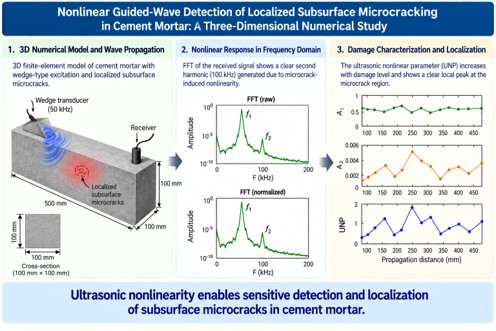
Subsurface microcracking in cementitious materials can compromise structural integrity while remaining difficult to detect using conventional linear ultrasonic methods. Nonlinear guided-wave techniques offer a promising alternative by exploiting higher-harmonic generation associated with contact-induced acoustic nonlinearity at crack interfaces. This study investigates the sensitivity of nonlinear guided-wave indicators to prescribed subsurface slit cracks in a homogeneous cement–mortar specimen using three-dimensional finite-element simulations. A 500 mm × 100 mm × 100 mm specimen and a polytetrafluoroethylene wedge excitation system were modeled in finite-element software. The bulk materials were described using effective elastic properties, while unilateral frictionless contact between opposing slit faces represented crack opening and closure. Five configurations containing one to five prescribed slit interfaces were examined under 50 kHz excitation. Fundamental and second-harmonic amplitudes were extracted from simulated receiver signals, and the amplitude ratio β = A2/A12 was evaluated along the propagation path. At the reported receiver position of 250 mm, the tabulated amplitude ratio increased from 0.0299 for the one-slit configuration to 0.0596 for the five-slit configuration. The spatially normalized peak increased separately, indicating a change in the concentration of the response along the receiver path. A spatial maximum near the prescribed slit cluster was observed for the tested configuration. These results constitute a forward numerical sensitivity assessment; they do not establish inverse reconstruction of unknown defects, identify individual cracks, or assess crack-specific diagnostic performance. The model excludes explicit aggregate heterogeneity and experimental measurement variability, and its practical applicability requires independent validation.
- Shah AA, Ribakov Y. Non-linear ultrasonic evaluation of damaged concrete based on higher order harmonic generation. Mater Des. 2009;30(10):4095-4102. https://doi.org/10.1016/j.matdes.2009.05.009
- Yan X, Wang H, Fan X. Research progress in nonlinear ultrasonic testing for early damage in metal materials. Materials. 2023;16(6):2161. https://doi.org/10.3390/ma16062161
- Shokouhi P, Zoëga A, Wiggenhauser H. Nondestructive investigation of stress-induced damage in concrete. Adv Civ Eng. 2010;2010:740189. https://doi.org/10.1155/2010/740189
- Yim HJ, Kwak HG, Kim JH. Wave attenuation measurement technique for nondestructive evaluation of concrete. Nondestruct Test Eval. 2012;27(1):81-94. https://doi.org/10.1080/10589759.2011.606319
- Bompan KF, Haach VG. Ultrasonic tests in the evaluation of the stress level in concrete prisms based on the acoustoelasticity. Constr Build Mater. 2018;162:740-750. https://doi.org/10.1016/j.conbuildmat.2017.11.153
- Toumi S, Mechri C, Bentahar M, Boubenider F, Guerjouma RE. Detection and imaging of microcracking in complex media using coda wave interferometry (CWI) under linear resonance conditions. Preprint. arXiv. 2016;arXiv:1602.02510. https://doi.org/10.48550/arXiv.1602.02510
- Hilloulin B, Zhang Y, Abraham O, et al. Small crack detection in cementitious materials using nonlinear coda wave modulation. NDT E Int. 2014;68:98-104. https://doi.org/10.1016/j.ndteint.2014.08.010
- Quiviger A, Payan C, Chaix JF, Garnier V, Salin J. Effect of the presence and size of a real macro-crack on diffuse ultrasound in concrete. NDT E Int. 2012;45(1):128-132. https://doi.org/10.1016/j.ndteint.2011.09.010
- Li W, Shi T, Qin X, Deng M. Detection and location of surface damage using third-order combined harmonic waves generated by non-collinear ultrasonic waves mixing. Sensors. 2021;21(18):6027. https://doi.org/10.3390/s21186027
- Hilloulin B, Zhang Y, Abraham O, et al. Closed crack detection in concrete with coda wave non-linear modulation. In: EWSHM - 7th European Workshop on Structural Health Monitoring. IFFSTTAR, Inria, Université de Nantes; 2014:1434-1440. Accessed September 4, 2026. https://inria.hal.science/hal-01021037
- Climent-Llorca MÁ, Miró-Oca M, Poveda-Martínez P, Ramis-Soriano J. Use of higher-harmonic and intermodulation generation of ultrasonic waves to detecting cracks due to steel corrosion in reinforced cement mortar. Int J Concr Struct Mater. 2020;14(1):52. https://doi.org/10.1186/s40069-020-00432-x
- Sun D, Cao M, Li H, Du P, Xu D. Damage detection of concrete under static loading based on ultrasonic sensor. In: International Conference on Durability of Concrete Structures. Purdue University; 2022:9. Accessed September 4, 2026. https://docs.lib.purdue.edu/icdcs/2022/partiii/9
- Nie Z, Yu L, Zhu P, Wu N, Zuo D, Gan X. Experimental study on nonlinear ultrasonic characterization of concrete during crack propagation. J Eng Res. 2023;11(4):314-321. https://doi.org/10.1016/j.jer.2023.100140
- Basu S, Thirumalaiselvi A, Sasmal S, Kundu T. Nonlinear ultrasonics-based technique for monitoring damage progression in reinforced concrete structures. Ultrasonics. 2021;115:106472. https://doi.org/10.1016/j.ultras.2021.106472
- Kuchipudi ST, Pudovikov S, Wiggenhauser H, Ghosh D, Rabe U. Imaging of vertical surface-breaking cracks in concrete members using ultrasonic shear wave tomography. Sci Rep. 2023;13:21744. https://doi.org/10.1038/s41598-023-48699-w
- Galaz Donoso BA, Avudaiappan S, Saavedra Flores EI. Feasibility of using shear wave ultrasonic probes as pump-wave sources in concrete microcrack detection and monitoring by nonlinear ultrasonic coda wave interferometry. Sensors. 2022;22(6):2105. https://doi.org/10.3390/s22062105
- Sampath S, Jang J, Sohn H. Ultrasonic Lamb wave mixing based fatigue crack detection using a deep learning model and higher-order spectral analysis. Int J Fatigue. 2022;163:107028. https://doi.org/10.1016/j.ijfatigue.2022.107028
- Thirumalaiselvi A, Sasmal S. Early detection and monitoring of corrosion in reinforced concrete structures using coupled time-frequency analysis. J Mater Civ Eng. 2024;36(8):04024207. https://doi.org/10.1061/JMCEE7.MTENG-17393
- Miró M, Climent MÁ, Poveda P, Ramis J. Nonlinear ultrasonic test applied to discern factors controlling cracking of cement mortar affected by reinforcement corrosion. Constr Build Mater. 2026;518:145845. https://doi.org/10.1016/j.conbuildmat.2026.145845
- Li H, Di B, Zheng Y, et al. Concrete damage identification and localization for structural health monitoring based on piezoelectric sensors. Sensors. 2025;25(8):2532. https://doi.org/10.3390/s25082532
- Wang J, Chen M, Zhu N, Liu H. A damage zone detection method in concrete hydraulic structures based on multi-frequency ultrasonic characteristics. Sci Rep. 2025;15:11173. https://doi.org/10.1038/s41598-025-91198-3
- Qu S, Hilloulin B, Saliba J, Sbartai M, Abraham O, Tournat V. Imaging concrete cracks using nonlinear Coda Wave Interferometry (INCWI). Constr Build Mater. 2023;391:131772. https://doi.org/10.1016/j.conbuildmat.2023.131772
- Wojtczak E, Rucka M, Skarżyński Ł. Monitoring the fracture process of concrete during splitting using integrated ultrasonic coda wave interferometry, digital image correlation and X-ray micro-computed tomography. NDT E Int. 2022;126:102591. https://doi.org/10.1016/j.ndteint.2021.102591
- Caires DM, Pinto RC. Diffuse ultrasound on the evaluation of surface crack repair in concrete structures. E-J Nondestruct Test. 2025;30(10). https://doi.org/10.58286/31713
- Climent MÁ, Miró M, Eiras JN, et al. Early detection of corrosion-induced concrete micro-cracking by using nonlinear ultrasonic techniques: possible influence of mass transport processes. Corros Mater Degrad. 2022;3(2):235-257. https://doi.org/10.3390/cmd3020014
- Broda D, Mendrok K, Silberschmidt VV, Pieczonka L, Staszewski WJ. The study of localized crack-induced effects of nonlinear vibro-acoustic modulation. Materials. 2023;16(4):1653. https://doi.org/10.3390/ma16041653
- Liu C, Hao H, Liu J. Mesoscopic numerical investigation on wave attenuation in meta-concrete with cubic engineered aggregates. Eng Struct. 2025;344:121360. https://doi.org/10.1016/j.engstruct.2025.121360
- Zhang L, Jiang Z, Jia S, Xie L, Liu Q, Li H. Frequency-dependent reliability of ultrasonic testing based on numerical model with consideration of coarse aggregates in concrete. Case Stud Constr Mater. 2023;19:e02462. https://doi.org/10.1016/j.cscm.2023.e02462
- Wojtczak E, Rucka M. A procedure for simulation-assisted identification of ultrasonic wave attenuation in heterogeneous materials and its application to the detection of fracture in concrete beams. Ultrasonics. 2025;153:107658. https://doi.org/10.1016/j.ultras.2025.107658
- Nanthakumar SS, Lahmer T, Zhuang X, Zi G, Rabczuk T. Detection of material interfaces using a regularized level set method in piezoelectric structures. Inverse Probl Sci Eng. 2016;24(1):153-176. https://doi.org/10.1080/17415977.2015.1017485
- Samaniego E, Anitescu C, Goswami S, et al. An energy approach to the solution of partial differential equations in computational mechanics via machine learning: concepts, implementation and applications. Comput Methods Appl Mech Eng. 2020;362:112790. https://doi.org/10.1016/j.cma.2019.112790
- Huber A. ArminHuber/Dispersion-Calculator: Dispersion Calculator v3.2. Zenodo; 2026. https://doi.org/10.5281/zenodo.19626939
- Masurkar F, Peter WT, Yelve N. Investigating the critical aspects of evaluating the material nonlinearity in metal plates using Lamb waves: theoretical and numerical approach. Appl Acoust. 2018;140:301-314. https://doi.org/10.1016/j.apacoust.2018.06.015
- Masurkar F. Detecting the structural integrity of autonomous underwater vehicles made of hybrid metal-composite plates using ultrasonic guided waves–simulations and experiments. Compos Struct. 2025;373:119703. https://doi.org/10.1016/j.compstruct.2025.119703