
Calibrated refresh systems for clinical artificial intelligence: A sociotechnical framework for expert escalation

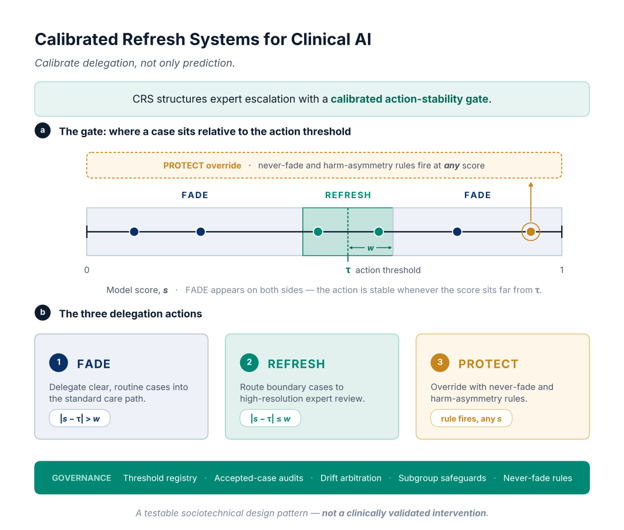
Expert attention is scarce, yet clinical artificial intelligence often escalates by fixed thresholds. Hereby present Calibrated Refresh Systems (CRS), a systems-level design pattern for calibrated expert review rather than a new estimator or validated intervention. CRS accepts a low-resolution action only when calibrated residual bounds cannot cross an action threshold; otherwise, the case receives high-resolution review. It couples selective prediction, learning to defer, conformal calibration, reference-label governance, accepted-case audit, drift arbitration, subgroup safeguards, and never-fade rules. A synthetic capacity-matched mechanism check illustrates how harm-aware budgets can reduce a prespecified weighted disagreement proxy without implying improved patient outcomes. CRS yields testable operational artifacts and a staged validation roadmap, generating artifacts suitable for safety governance and regulatory documentation while preserving attention for rare, high-harm cases. Its claims depend on exchangeability, adequate calibration samples, credible reference processes, workflow capacity, and prospective clinical evaluation.
- Wong A, Otles E, Donnelly JP, et al. External validation of a widely implemented proprietary sepsis prediction model in hospitalized patients. JAMA Intern Med. 2021;181(8):1065-1070. doi: 10.1001/jamainternmed.2021.2626
- Ostermayer DG, Braunheim B, Mehta AM, et al. External validation of the Epic sepsis predictive model in 2 county emergency departments. JAMIA Open. 2024;7(4):ooae133. doi: 10.1093/jamiaopen/ooae133
- Ancker JS, Edwards A, Nosal S, et al. Effects of workload, work complexity, and repeated alerts on alert fatigue in a clinical decision support system. BMC Med Inform Decis Mak. 2017;17(1):36. doi: 10.1186/s12911-017-0430-8
- Geifman Y, El-Yaniv R. SelectiveNet: A deep neural network with an integrated reject option. Proceedings of the International Conference on Machine Learning. PMLR. 2019;97:2151-2159. Accessed June 27, 2026. https://proceedings.mlr.press/v97/geifman19a.html
- Madras D, Pitassi T, Zemel R. Predict responsibly: Improving fairness and accuracy by learning to defer. Adv Neural Inf Process Syst. 2018;31:6147-6157. https://proceedings.neurips.cc/paper/2018/hash/09d37c08f7b129e96277388757530c72-Abstract.html
- Mozannar H, Sontag D. Consistent estimators for learning to defer to an expert. Proceedings of the International Conference on Machine Learning. PMLR. 2020;119:7076-7087. Accessed June 27, 2026. https://proceedings.mlr.press/v119/mozannar20b.html
- Verma R, Nalisnick E. Calibrated learning to defer with one-vs-all classifiers. Proceedings of the International Conference on Machine Learning. PMLR. 2022;162:22184-22202. Accessed June 27, 2026. https://proceedings.mlr.press/v162/verma22c.html
- Vovk V, Gammerman A, Shafer G. Algorithmic Learning in a Random World. Springer; 2005. doi: 10.1007/b106715
- Angelopoulos AN, Bates S. Conformal prediction: A gentle introduction. Found Trends Mach Learn. 2023;16(4):494-591. doi: 10.1561/2200000101
- Angelopoulos AN, Bates S, Fisch A, Lei L, Schuster T. Conformal risk control. International Conference on Learning Representations. In: The Twelfth International Conference on Learning Representations (ICLR 2024). Vienna, Austria; 2024. Accessed June 27, 2026. https://proceedings.iclr.cc/paper_files/paper/2024/hash/f3549ef9b5ff520a7e41ff3cc306ab2b-Abstract-Conference.html
- Straitouri E, Wang L, Okati N, Gomez Rodriguez M. Improving expert predictions with conformal prediction. Proceedings of the International Conference on Machine Learning. PMLR. 2023;202:32633-32653. Accessed June 27, 2026. https://proceedings.mlr.press/v202/straitouri23a.html
- Verma R, Barrejón D, Nalisnick E. Learning to defer to multiple experts: Consistent surrogate losses, confidence calibration, and conformal ensembles. Proceedings of the International Conference on Artificial Intelligence and Statistics. PMLR. 2023;206:11415-11434. Accessed June 27, 2026. https://proceedings.mlr.press/v206/verma23a.html
- Sittig DF, Singh H. A new sociotechnical model for studying health information technology in complex adaptive healthcare systems. Qual Saf Health Care. 2010;19(Suppl 3):i68-i74. doi: 10.1136/qshc.2010.042085
- Sendak MP, Gao M, Brajer N, Balu S. Presenting machine learning model information to clinical end users with model facts labels. npj Digit Med. 2020;3:41. doi: 10.1038/s41746-020-0253-3
- Caroprese L, Vocaturo E, Zumpano E. Argumentation approaches for explanaible AI in medical informatics. Intell Syst Appl. 2022;16:200109. doi: 10.1016/j.iswa.2022.200109
- Guzzo A, Rullo A, Vocaturo E. Process mining applications in the healthcare domain: A comprehensive review. WIREs Data Min Knowl Discov. 2022;12(2):e1442. doi: 10.1002/widm.1442
- Tschandl P, Rinner C, Apalla Z, et al. Human-computer collaboration for skin cancer recognition. Nat Med. 2020;26(8):1229-1234. doi: 10.1038/s41591-020-0942-0
- Reverberi C, Rigon T, Solari A, et al. Experimental evidence of effective human-AI collaboration in medical decision-making. Sci Rep. 2022;12:14952. doi: 10.1038/s41598-022-18751-2
- Obermeyer Z, Powers B, Vogeli C, Mullainathan S. Dissecting racial bias in an algorithm used to manage the health of populations. Science. 2019;366(6464):447-453. doi: 10.1126/science.aax2342
- Teeple S, Smith A, Toerper M, et al. Exploring the impact of missingness on racial disparities in predictive performance of a machine learning model for emergency department triage. JAMIA Open. 2023;6(4):ooad107. doi: 10.1093/jamiaopen/ooad107
- Anderson JW, Visweswaran S. Algorithmic individual fairness and healthcare: A scoping review. JAMIA Open. 2024;8(1):ooae149. doi: 10.1093/jamiaopen/ooae149
- Tabassi E. Artificial Intelligence Risk Management Framework (AI RMF 1.0). National Institute of Standards and Technology; 2023. NIST AI 100-1. doi: 10.6028/NIST.AI.100-1
- US Food and Drug Administration. Marketing Submission Recommendations for a Predetermined Change Control Plan for Artificial Intelligence-Enabled Device Software Functions: Guidance for Industry and Food and Drug Administration Staff. 2025. Accessed June 27, 2026. https://www.fda.gov/regulatory-information/search-fda-guidance-documents/marketing-submission-recommendations-predetermined-change-control-plan-artificial-intelligence
- European Parliament and Council of the European Union. Regulation (EU) 2024/1689 of 13 June 2024 laying down harmonised rules on artificial intelligence (Artificial Intelligence Act). Off J Eur Union 2024;L:2024/1689. 2024. Accessed June 27, 2026. https://eur-lex.europa.eu/eli/reg/2024/1689/oj/eng
- Lekadir K, Frangi AF, Porras AR, et al. FUTURE-AI Consortium. FUTURE-AI: International consensus guideline for trustworthy and deployable artificial intelligence in healthcare. BMJ. 2025;388:e081554. doi: 10.1136/bmj-2024-081554
- Adams R, Henry KE, Sridharan A, et al. Prospective, multi-site study of patient outcomes after implementation of the TREWS machine learning-based early warning system for sepsis. Nat Med. 2022;28(7):1455-1460. doi: 10.1038/s41591-022-01894-0
- Henry KE, Adams R, Parent C, et al. Factors driving provider adoption of the TREWS machine learning-based early warning system and its effects on sepsis treatment timing. Nat Med. 2022;28(7):1447-1454. doi: 10.1038/s41591-022-01895-z
- Levin S, Toerper M, Hamrock E, et al. Machine-learning-based electronic triage more accurately differentiates patients with respect to clinical outcomes compared with the Emergency Severity Index. Ann Emerg Med. 2018;71(5):565-574.e2. doi: 10.1016/j.annemergmed.2017.08.005
- Vasey B, Nagendran M, Campbell B, et al. DECIDE-AI expert group. Reporting guideline for the early-stage clinical evaluation of decision support systems driven by artificial intelligence: DECIDE-AI. Nat Med. 2022;28(5):924-933. doi: 10.1038/s41591-022-01772-9
- van de Sande D, Chung EFF, Oosterhoff J, van Bommel J, Gommers D, van Genderen ME. To warrant clinical adoption AI models require a multi-faceted implementation evaluation. npj Digit Med. 2024;7:58. doi: 10.1038/s41746-024-01064-1