
On Efficient Optimal Multiple-Root Solver: Convergence, Efficiency and Fractal Dynamics

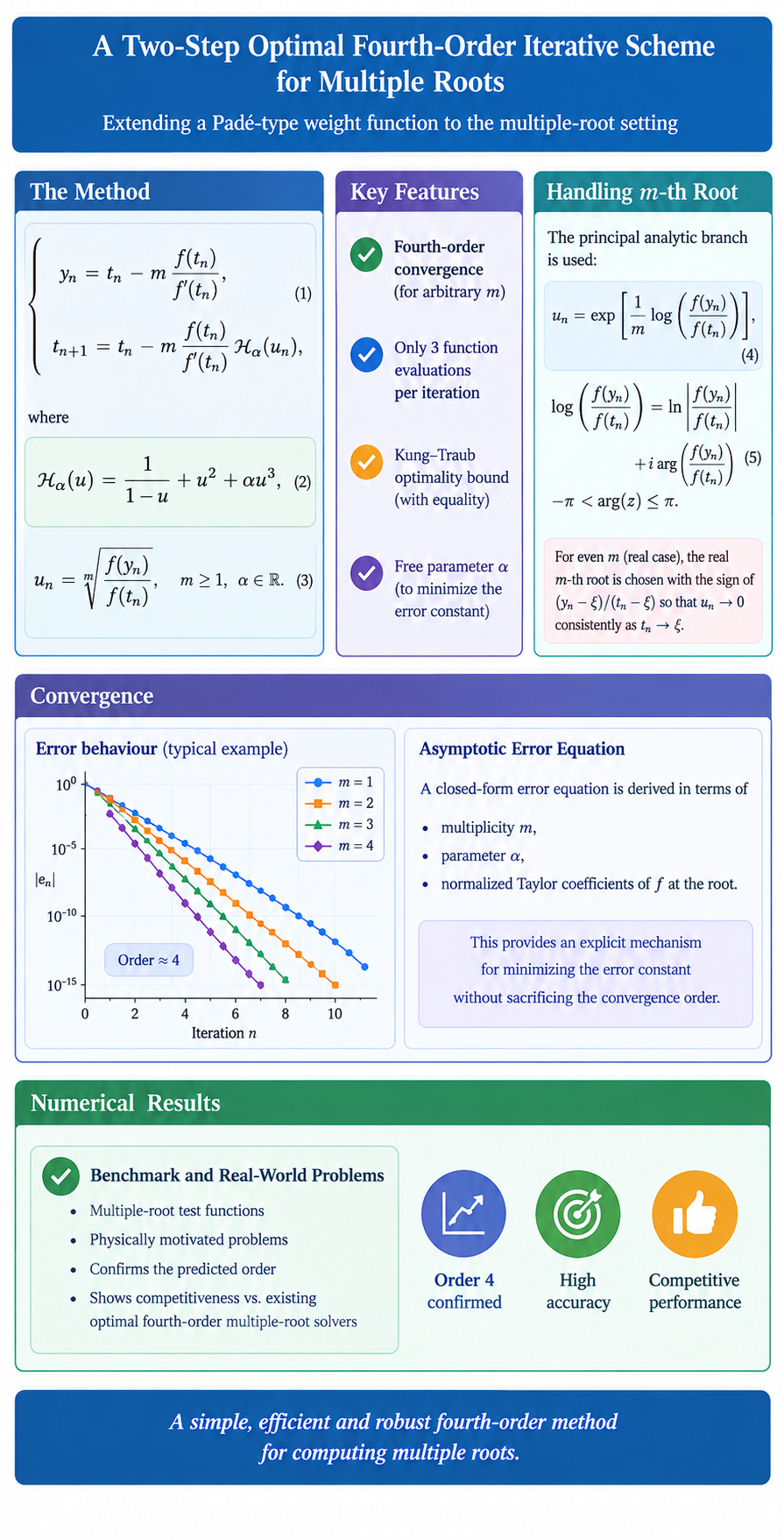
This paper presents a new two-step optimal fourth-order iterative scheme for computing roots of known multiplicity m ≥ 1 of a nonlinear equation. The method extends a Padé-type rational weight function, originally devised for simple roots, to the multiple-root setting through a single m-th-root substitution that scales naturally with the multiplicity and reduces exactly to its simple-root parent when m = 1. Using symbolically verified Taylor-series analysis, the scheme is shown to have fourth-order convergence for arbitrary m while requiring only three functional evaluations per iteration, thereby attaining equality in the Kung–Traub optimality bound. A closed-form asymptotic error equation is derived in terms of the multiplicity m, a single tunable real parameter α, and the normalized Taylor coefficients of f at the root, offering an explicit mechanism for minimizing the error constant without sacrificing convergence order. Numerical experiments on benchmark problems and physically motivated multiple-root problems confirm the predicted order and demonstrate the competitiveness of the proposed scheme against existing optimal fourth-order multiple-root solvers.
- Traub JF. Iterative Methods for the Solution of Equations. Englewood Cliffs, NJ: Prentice-Hall; 1964.
- Kung HT, Traub JF. Optimal order of one-point and multipoint iteration. J Assoc Comput Mach. 1974;21(4):643-651. https://doi.org/10.1145/321850.321860
- Neta B, Johnson AN. High-order nonlinear solver for multiple roots. Comput Math Appl. 2008;55(9):2012-2017. https://doi.org/10.1016/j.camwa.2007.09.001
- Li S, Liao X, Cheng L. A new fourth-order iterative method for finding multiple roots of nonlinear equations. Appl Math Comput. 2009;215(3):1288-1292. https://doi.org/10.1016/j.amc.2009.06.065
- Zafar F, Cordero A, Torregrosa JR. A family of optimal fourth-order methods for multiple roots of nonlinear equations. Math Methods Appl Sci. 2020. https://doi.org/10.1002/mma.5384
- Abdullah S, Choubey N, Dara S, Kansal M, Junjua MUD. On memory-based higher-order iterative schemes for nonlinear equations: complex dynamics and applications. Eng Comput. 2026;43:785-822. https://doi.org/10.1108/EC-04-2025-0357
- Sharma JR, Kumar S, Jäntschi L. On a class of optimal fourth order multiple root solvers without using derivatives. Symmetry. 2019;11:1452. https://doi.org/10.3390/sym11121452
- Kumar S, Kumar D, Sharma JR, Cesarano C, Agarwal P, Chu YM. An optimal fourth order derivative-free numerical algorithm for multiple roots. Symmetry. 2020;12:1038. https://doi.org/10.3390/sym12061038
- Kumar S, Sharma JR, Jäntschi L. Optimal fourth-order methods for multiple zeros: Design, convergence analysis and applications. Axioms. 2024;13(3):143. https://doi.org/10.3390/axioms13030143
- Koupaeia JA, Ebadib MJ. Enhancing Efficiency of Newton-Raphson Method with Chaotic Mappings for Nonlinear Equation Solving. J Model Eng. 2025;23:59-73. https://doi.org/10.22075/jme.2024.32533.2574
- Behl R, Bhalla S, Mallawi F, Alsulami MA. An optimal iterative technique for multiple root finder of nonlinear problems. Math Comput Appl. 2022;27(5):74. https://doi.org/10.3390/mca27050074
- Rafiq N, Akram S, Mir NA, Shams M. Study of dynamical behavior and stability of iterative methods for nonlinear equation with applications in engineering. Math Probl Eng. 2020;2020:3524324. https://doi.org/10.1155/2020/3524324
- Petković MS, Petković LD. Construction and efficiency of multipoint root-ratio methods for finding multiple zeros. J Comput Appl Math. 2019;351:54-65. https://doi.org/10.1016/j.cam.2018.10.042
- Ahlfors LV. Complex Analysis: An Introduction to the Theory of Analytic Functions of One Complex Variable. International Series in Pure and Applied Mathematics. McGraw-Hill; 1979.
- Soleymani F, Babajee DKR, Lotfi T. On a numerical technique for finding multiple zeros and its dynamics. J Egypt Math Soc. 2013;21:346-353. https://doi.org/10.1016/j.joems.2013.05.003
- Kansal M, Kanwar V, Bhatia S. On some optimal multiple root-finding methods and their dynamics. Appl Appl Math. 2015;10:22. Accessed September 10, 2026. https://digitalcommons.pvamu.edu/aam/vol10/iss1/22
- Li SG, Cheng LZ, Neta B. Some fourth-order nonlinear solvers with closed formulae for multiple roots. Comput Math Appl. 2010;59:126-135. https://doi.org/10.1016/j.camwa.2009.08.026
- Sharma JR, Sharma R. Modified Jarratt method for computing multiple roots. Appl Math Comput. 2010;217:878-881. https://doi.org/10.1016/j.amc.2010.06.041
- Zhou X, Chen X, Song Y. Constructing higher-order methods for obtaining the multiple roots of nonlinear equations. J Comput Appl Math. 2011;235:4199-4206. https://doi.org/10.1016/j.cam.2011.03.006
- Akram S, Junjua MUD, Amir F, Akram F, Khalid L, Nosirovich NM. Eighth-order iterative algorithm for multiple roots of unknown multiplicity with models in civil, control, and biomedical engineering. Int J Math Math Sci. 2026;2026:4446431. https://doi.org/10.1155/ijmm/4446431