
Chrysin attenuates pentadecafluorooctanoic acid-induced hepatotoxicity in male Wistar rats via modulation of oxidative stress, inflammation, and metabolic dysfunction

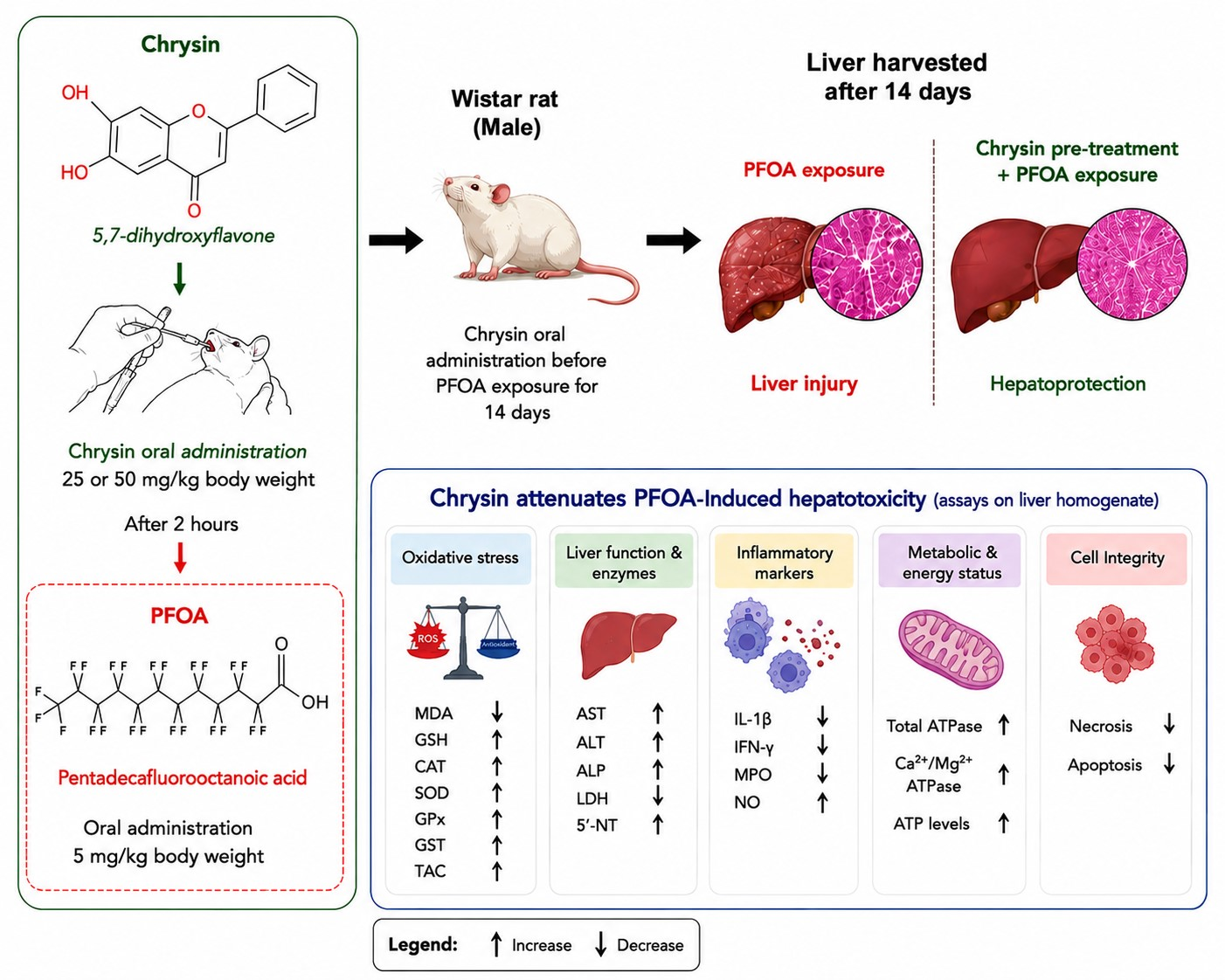
Pentadecafluorooctanoic acid (PFOA), a persistent environmental pollutant, has been implicated in hepatotoxicity through mechanisms involving oxidative stress, inflammation, and metabolic dysfunction. This study investigated the hepatoprotective effects of chrysin against PFOA-induced liver injury in male Wistar rats. Twenty-five male Wistar rats were randomly divided into five groups (n = 5): control (20% dimethyl sulfoxide), PFOA (5 mg/kg), PFOA + chrysin (25 mg/kg), PFOA + chrysin (50 mg/kg), and chrysin only (50 mg/kg). Treatments were orally administered for 14 days. Serum and hepatic biomarkers of liver function, oxidative stress, inflammation, membrane integrity, and energy metabolism were evaluated using standard biochemical assays and enzyme-linked immunosorbent assay methods. PFOA exposure significantly (p < 0.05) increased serum liver enzymes (alanine aminotransferase, aspartate aminotransferase, alkaline phosphatase, and lactate dehydrogenase), lipid peroxidation marker (malondialdehyde), and pro-inflammatory cytokines (interleukin 1 beta and interferon gamma), while significantly reducing antioxidant parameters (glutathione, catalase, superoxide dismutase, glutathione peroxidase, and glutathione-S-transferase, nitric oxide (NO), and membrane-bound enzyme activities, including adenosine triphosphatase (ATPase), Ca2+/Mg2+ ATPase, and 5’-nucleotidase. Chrysin treatment at both 25 and 50 mg/kg significantly (p < 0.05) ameliorated these alterations in a dose-dependent manner, with the 50 mg/kg dose showing greater protective efficacy. The findings indicate that PFOA-induced hepatotoxicity is associated with oxidative stress, inflammation, and metabolic dysfunction, whereas chrysin pre-treatment restores antioxidant defenses, attenuates inflammatory responses, and normalizes membrane-associated enzyme activities. Overall, chrysin demonstrates potent protective potential against PFOA-induced liver injury and may serve as a promising therapeutic candidate for environmental toxin-associated hepatotoxicity.
- Alamri ZZ. The role of liver in metabolism: an updated review with physiological emphasis. Int J Basic Clin Pharmacol. 2018;7(11):2271-2276. doi: 10.18203/2319-2003.ijbcp20184211
- Casotti V, D’Antiga L. Basic Principles of Liver Physiology. In: D’Antiga L, ed. Pediatric Hepatology and Liver Transplantation. Cham, Switzerland: Springer International Publishing; 2019:21-39. doi: 10.1007/978-3-319-96400-3_2
- Gu X, Manautou JE. Molecular mechanisms underlying chemical liver injury. Expert Rev Mol Med. 2012;14:e4. doi: 10.1017/S1462399411002110
- Liu J, Avendaño MS. Microbial degradation of polyfluoroalkyl chemicals in the environment: A review. Environ Int. 2013;61:98-114. doi: 10.1016/j.envint.2013.08.022
- Savoca D, Pace A. Bioaccumulation, Biodistribution, Toxicology and Biomonitoring of Organofluorine Compounds in Aquatic Organisms. Int J Mol Sci. 2021;22(12):6276. doi: 10.3390/ijms22126276
- Rusyn I, Arzuaga X, Cattley RC, et al. Key Characteristics of Human Hepatotoxicants as a Basis for Identification and Characterization of the Causes of Liver Toxicity. Hepatology. 2021;74(6):3486-3496. doi: 10.1002/hep.31999
- Darrow LA, Groth AC, Winquist A, Shin HM, Bartell SM, Steenland K. Modeled Perfluorooctanoic Acid (PFOA) Exposure and Liver Function in a Mid-Ohio Valley Community. Environ Health Perspect. 2016;124(8):1227-1233. doi: 10.1289/ehp.1510391
- Gebreab KY, Eeza MNH, Bai T, et al. Comparative toxicometabolomics of perfluorooctanoic acid (PFOA) and next-generation perfluoroalkyl substances. Environ Pollut. 2020;265:114928. doi: 10.1016/j.envpol.2020.114928
- Li K, Gao P, Xiang P, Zhang X, Cui X, Ma LQ. Molecular mechanisms of PFOA-induced toxicity in animals and humans: Implications for health risks. Environ Int. 2017;99:43-54. doi: 10.1016/j.envint.2016.11.014
- Zhang R, Lu W, Tu L, et al. Perfluorooctanoic acid-induced metabolic disorder via enhancing metabolism of glutamine and fatty acids in human intestinal cells. Environ Pollution. 2023;338:122684. doi: 10.1016/j.envpol.2023.122684
- Leung SCE, Shukla P, Chen D, et al. Emerging technologies for PFOS/PFOA degradation and removal: A review. Sci Total Environ. 2022;827:153669. doi: 10.1016/j.scitotenv.2022.153669
- Newland A, Khyum M, Halamek J, Ramkumar S. Perfluoroalkyl and polyfluoroalkyl substances (PFAS) — Fibrous substrates. TAPPI J. 2023;22(9):559-572. doi: 10.32964/TJ22.9.559
- Zhang X, Ren X, Sun W, Griffin N, Wang L, Liu H. PFOA exposure induces aberrant glucose and lipid metabolism in the rat liver through the AMPK/mTOR pathway. Toxicology. 2023;493:153551. doi: 10.1016/j.tox.2023.153551
- Zheng X, Zhang H, Xu Z, et al. Tolerance and recovery of aerobic granular sludge: Impact of perfluorooctanoic acid. Chemosphere. 2023;313:137430. doi: 10.1016/j.chemosphere.2022.137430
- Hongal L, David M. Impact of Redox Imbalance and Mitochondrial Dysfunction on Neurotoxicity Induced by Perfluorooctanoic Acid in Male Wistar Albino Rats (Rattus norvegicus). J Appl Toxicol. 2025. doi: 10.1002/jat.70009
- Liu C, Yu K, Shi X, et al. Induction of oxidative stress and apoptosis by PFOS and PFOA in primary cultured hepatocytes of freshwater tilapia (Oreochromis niloticus). Aquat Toxicol. 2007;82(2):135-143. doi: 10.1016/j.aquatox.2007.02.006
- Obiako PC, Ayisire SO, Sayes CM. Impact of perfluorooctanoic acid (PFOA) and perfluorobutanoic acid (PFBA) on oxidative stress and metabolic biomarkers in human neuronal cells (SH-SY5Y). Environ Int. 2024;190:108864. doi: 10.1016/j.envint.2024.108864
- Batta DA. Comparative Study of Serum 5’ Nucleotidase, Alkaline Phosphatase, Aminotransferases and Bilirubin in Hepatpbilrary Diseases. Int J Cur Biomed Phar Res. 2011;1(3):93-97.
- Pieters A, Gijbels E, Cogliati B, Annaert P, Devisscher L, Vinken M. Biomarkers of Cholestasis. Biomark Med. 2021;15(6):437-454. doi: 10.2217/bmm-2020-0691
- Hyder MA, Hasan M, Mohieldein A. Comparative Study of 5’-Nucleotidase Test in Various Liver Diseases. J Clin Diagn Res. 2016;10(2):BC01-BC03. doi: 10.7860/JCDR/2016/12754.7163
- Yokomori H, Oda M, Kamegaya Y, Ogi M, Tsukada N, Ishii H. Bile canalicular contraction and dilatation in primary culture of rat hepatocytes - possible involvement of two different types of plasma membrane Ca 2+ -Mg 2+ -ATPase and Ca 2+ -pump-ATPase. Med Electron Microsc. 2001;34(2):115-122. doi: 10.1007/s007950170005
- Chen T, Zamora R, Zuckerbraun B, Billiar TR. Role of Nitric Oxide in Liver Injury. Curr Mol Med. 2003;3(6):519-526. doi: 10.2174/1566524033479582
- Liu Z, Lin H, Zheng Y, et al. Perfluorooctanoic acid and perfluorooctanesulfonic acid induce immunotoxicity through the NF-κB pathway in black-spotted frog (Rana nigromaculata). Chemosphere. 2023;313:137622. doi: 10.1016/j.chemosphere.2022.137622
- Klebanoff SJ. Myeloperoxidase: friend and foe. J Leukoc Biol. 2005;77(5):598-625. doi: 10.1189/jlb.1204697
- Moghadam ER, Ang HL, Asnaf SE, et al. Broad-Spectrum Preclinical Antitumor Activity of Chrysin: Current Trends and Future Perspectives. Biomolecules. 2020;10(10):1374. doi: 10.3390/biom10101374
- Pushpavalli G, Kalaiarasi P, Veeramani C, Pugalendi KV. Effect of chrysin on hepatoprotective and antioxidant status in d-galactosamine-induced hepatitis in rats. Eur J Pharmacol. 2010;631(1-3):36-41. doi: 10.1016/j.ejphar.2009.12.031
- Hermenean A, Mariasiu T, Navarro‑González I, et al. Hepatoprotective activity of chrysin is mediated through TNF-α in chemically-induced acute liver damage: An in vivo study and molecular modeling. Exp Ther Med. 2017;13(5):1671-1680. doi: 10.3892/etm.2017.4181
- Pingili RB, Pawar AK, Challa SR, Kodali T, Koppula S, Toleti V. A comprehensive review on hepatoprotective and nephroprotective activities of chrysin against various drugs and toxic agents. Chem-Biol Interact. 2019;308:51-60. doi: 10.1016/j.cbi.2019.05.010
- Adwas AA, Elsayed IAS, Azab . Azab Elsayed, Quwaydir FA. Oxidative stress and antioxidant mechanisms in human body. JABB. 2019;6(1):43-47. doi: 10.15406/jabb.2019.06.00173
- Chatterjee S. Oxidative stress, inflammation, and disease. In: Oxidative Stress and Biomaterials. Amsterdam, Netherlands: Elsevier; 2016:35-58. doi: 10.1016/B978-0-12-803269-5.00002-4
- Ozougwu J. The Role of Reactive Oxygen Species and Antioxidants in Oxidative Stress. Int J Pharm Biosci. 2016;3(6):1-8.
- Soliman MM, Aldhahrani A, Gaber A, et al. Ameliorative impacts of chrysin against gibberellic acid-induced liver and kidney damage through the regulation of antioxidants, oxidative stress, inflammatory cytokines, and apoptosis biomarkers. Toxicol Res. 2022;11(1):235-244. doi: 10.1093/toxres/tfac003
- Allameh A, Niayesh-Mehr R, Aliarab A, Sebastiani G, Pantopoulos K. Oxidative Stress in Liver Pathophysiology and Disease. Antioxidants. 2023;12(9):1653. doi: 10.3390/antiox12091653
- Noeman SA, Hamooda HE, Baalash AA. Biochemical Study of Oxidative Stress Markers in the Liver, Kidney and Heart of High Fat Diet Induced Obesity in Rats. Diabetol Metab Syndr. 2011;3(1):17. doi: 10.1186/1758-5996-3-17
- Sathiavelu J, Senapathy GJ, Devaraj R, Namasivayam N. Hepatoprotective effect of chrysin on prooxidant-antioxidant status during ethanol-induced toxicity in female albino rats. J Pharm Pharmacol. 2009;61(6):809-817. doi: 10.1211/jpp.61.06.0015
- Tekeli MY, Eraslan G, Bayram LÇ, Aslan C, Çalımlı S. The protective effects of baicalin and chrysin against emamectin benzoate-induced toxicity in Wistar albino rats. Environ Sci Pollut Res. 2023;30(18):53997-54021. doi: 10.1007/s11356-023-26110-5
- Becker JB, Prendergast BJ, Liang JW. Female rats are not more variable than male rats: a meta-analysis of neuroscience studies. Biol Sex Differ. 2016;7(1):34. doi: 10.1186/s13293-016-0087-5
- Miller CK, Halbing AA, Patisaul HB, Meitzen J. Interactions of the estrous cycle, novelty, and light on female and male rat open field locomotor and anxiety-related behaviors. Physiol Behav. 2021;228:113203. doi: doi: 10.1016/j.physbeh.2020.113203
- Awolesi AB, Koledoye TM, Adesina RM, Omoniyi KC, Praise StephenA. Evaluation of the nephroprotective potential of chrysin against pentadecafluorooctanoic acid-induced kidney dysfunction in male Wistar rats. Innov Med Omics. 2026;0(0):026250043. doi: 10.36922/IMO026250043
- Albus U. Guide for the Care and Use of Laboratory Animals (8th edn). Lab Anim. 2012;46(3):267-268. doi: 10.1258/la.2012.150312
- Javaid N, Patra MC, Seo H, Yasmeen F, Choi S. A Rational Insight into the Effect of Dimethyl Sulfoxide on TNF-α Activity. Int J Mol Sci. 2020;21(24):9450. doi: 10.3390/ijms21249450
- Kay AG, Rooney P, Kearney J, Pegg DE. Evaluation of dmso transport in human articular cartilage: Vehicle solutions and effects on cell function. CryoLetters. 2015;36(3):187-194.
- Luptakova L, Dvorcakova S, Demcisakova Z, Belbahri L, Holovska K, Petrovova E. Dimethyl Sulfoxide: Morphological, Histological, and Molecular View on Developing Chicken Liver. Toxics. 2021;9(3):55. doi: 10.3390/toxics9030055
- Modrzyński JJ, Christensen JH, Brandt KK. Evaluation of dimethyl sulfoxide (DMSO) as a co-solvent for toxicity testing of hydrophobic organic compounds. Ecotoxicology. 2019;28(9):1136-1141. doi: 10.1007/s10646-019-02107-0
- Santos NC, Figueira-Coelho J, Martins-Silva J, Saldanha C. Multidisciplinary utilization of dimethyl sulfoxide: pharmacological, cellular, and molecular aspects. Biochem Pharmacol. 2003;65(7):1035-1041. doi: 10.1016/s0006-2952(03)00002-9
- James AS, Onunkwor BO, Akinseye VO, et al. Cashew nut-supplemented diet on testicular injury in rats exposed to sub-acute alcohol. Pharmacol Res-Rep. 2023;1:100001. doi: 10.1016/j.prerep.2024.100001
- Sharma P, Singh R. Efficacy of Trans-2-Hydroxycinnamic Acid Against Trichlorfon-Induced Oxidative Stress in Wistar Rats. Toxicol Int. 2012;19(3):295. doi: 10.4103/0971-6580.103671
- Včelařová L, Skalický V, Chamrád I, et al. Auxin Metabolome Profiling in the Arabidopsis Endoplasmic Reticulum Using an Optimised Organelle Isolation Protocol. Int J Mol Sci. 2021;22(17):9370. doi: 10.3390/ijms22179370
- Lowry OliverH, Rosebrough NiraJ, Farr AL, Randall RoseJ. PROTEIN MEASUREMENT WITH THE FOLIN PHENOL REAGENT. J Biol Chem. 1951;193(1):265-275. doi: 10.1016/S0021-9258(19)52451-6
- Reitman S, Frankel S. A Colorimetric Method for the Determination of Serum Glutamic Oxalacetic and Glutamic Pyruvic Transaminases. Am J Clin Pathol. 1957;28(1):56-63. doi: 10.1093/ajcp/28.1.56
- Akuyam S, Abubakar A, Lawal N, et al. Assessment of biochemical liver function tests in relation to age among steady state sickle cell anemia patients. Niger J Clin Pract. 2017;20(11):1428. doi: 10.4103/njcp.njcp_14_17
- Holmes RS, Scopes RK. Immunochemical Homologies among Vertebrate Lactate‐Dehydrogenase Isozymes. Eur J Biochem. 1974;43(1):167-177. doi: 10.1111/j.1432-1033.1974.tb03397.x
- Al-Jassabi S. Purification and Kinetic Properties of Skeletal Muscle Lactate Dehydrogenase from the Lizard Agama stellio stellio. Biochemistry. 2002;67(7):786-789. doi: 10.1023/A:1016300808378
- Kamil Jabbar D. Biochemical Evaluation of Antioxidant Enzyme Activities and Lipid Peroxidation Level Associated with Liver Enzymes in Patients with Fascioliasis. Arch Razi Inst. 2022;77(3):1067-1073. doi: 10.22092/ARI.2022.357466.2043
- Green LC, Wagner DA, Glogowski J, Skipper PL, Wishnok JS, Tannenbaum SR. Analysis of nitrate, nitrite, and [15N] nitrate in biological fluids. Anal Biochem. 1982;126(1):131-138. doi: 10.1016/0003-2697(82)90118-X
- Hodges DM, DeLong JM, Forney CF, Prange RK. Improving the thiobarbituric acid-reactive-substances assay for estimating lipid peroxidation in plant tissues containing anthocyanin and other interfering compounds. Planta. 1999;207(4):604-611. doi: 10.1007/s004250050524
- Rotruck JT, Pope AL, Ganther HE, Swanson AB, Hafeman DG, Hoekstra WG. Selenium: Biochemical Role as a Component of Glutathione Peroxidase. Science. 1973;179(4073):588-590. doi: 10.1126/science.179.4073.588
- Akamo AJ, Rotimi SO, Akinloye DI, et al. Naringin prevents cyclophosphamide-induced hepatotoxicity in rats by attenuating oxidative stress, fibrosis, and inflammation. Food Chem Toxicol. 2021;153:112266. doi: 10.1016/j.fct.2021.112266
- Hadwan MH, Abed HN. Data supporting the spectrophotometric method for the estimation of catalase activity. Data Brief. 2016;6:194-199. doi: 10.1016/j.dib.2015.12.012
- Sun Y, Oberley LW, Li Y. A simple method for clinical assay of superoxide dismutase. Clin Chem. 1988;34(3):497-500. doi: 10.1093/clinchem/34.3.497
- Tew KD, Ronai Z. GST function in drug and stress response. Drug Resist Updates 1999;2(3):143-147. doi: 10.1054/drup.1999.0086
- Ellman GL. Tissue sulfhydryl groups. Arch Biochem Biophys. 1959;82(1):70-77. doi: 10.1016/0003-9861(59)90090-6
- Prieto P, Pineda M, Aguilar M. Spectrophotometric quantitation of antioxidant capacity through the formation of a phosphomolybdenum complex: specific application to the determination of vitamin E. Anal Biochem. 1999;269(2):337-341. doi: 10.1006/abio.1999.4019
- Tsakiris S, Deliconstantinos G. Influence of phosphatidylserine on (Na++ K+)-stimulated ATPase and acetylcholinesterase activities of dog brain synaptosomal plasma membranes. Biochem J. 1984;220(1):301-307. doi: 10.1042/bj2200301
- Hanahan DJ, Ekholm JE. The expression of optimum ATPase activities in human erythrocytes: A comparison of different lytic procedures. Arch Biochem Biophys. 1978;187(1):170-179. doi: 10.1016/0003-9861(78)90020-6
- Heinz F, Pilz R, Reckel S, Kalden JR, Haeckel R. A new spectrophotometric method for the determination of 5′-nucleotidase. Clin Chem Lab Med. 1980;18(11):781-788. doi: 10.1515/cclm.1980.18.11.781
- Hasmann A, Wehrschuetz-Sigl E, Marold A, et al. Analysis of myeloperoxidase activity in wound fluids as a marker of infection. Ann Clin Biochem. 2013;50(3):245-254. doi: 10.1258/acb.2011.010249
- Zhang QY, Xu LL, Zhong MT, et al. Gestational GenX and PFOA exposures induce hepatotoxicity, metabolic pathway, and microbiome shifts in weanling mice. Sci Total Environ. 2024;907:168059. doi: 10.1016/j.scitotenv.2023.168059
- Siddiqui A, Badruddeen, Akhtar J, Khan MI, Khalid M, Ahmad M. A Naturally Occurring Flavone (Chrysin): Chemistry, Occurrence, Pharmacokinetic, Toxicity, Molecular Targets and Medicinal Properties. J Biol Act Prod Nat. 2018;8(4):208-227. doi: 10.1080/22311866.2018.1498750
- Kurkiewicz M, Moździerz A, Rzepecka-Stojko A, Stojko J. Chrysin: A Comprehensive Review of Its Pharmacological Properties and Therapeutic Potential. Pharmaceuticals. 2025;18(8):1162. doi: 10.3390/ph18081162
- Nabavi SF, Braidy N, Habtemariam S, et al. Neuroprotective effects of chrysin: From chemistry to medicine. Neurochem Int. 2015;90:224-231. doi: 10.1016/j.neuint.2015.09.006
- Walle T, Otake Y, Brubaker JA, Walle UK, Halushka PV. Disposition and metabolism of the flavonoid chrysin in normal volunteers. Brit J Clinical Pharma. 2001;51(2):143-146. doi: 10.1111/j.1365-2125.2001.01317.x
- Gallo V, Leonardi G, Genser B, et al. Serum Perfluorooctanoate (PFOA) and Perfluorooctane Sulfonate (PFOS) Concentrations and Liver Function Biomarkers in a Population with Elevated PFOA Exposure. Environ Health Perspect. 2012;120(5):655-660. doi: 10.1289/ehp.1104436
- Kalas MA, Chavez L, Leon M, Taweesedt PT, Surani S. Abnormal liver enzymes: A review for clinicians. World J Hepatol. 2021;13(11):1688-1698. doi: 10.4254/wjh.v13.i11.1688
- Naderi M, Seyedabadi M, Talebpour Amiri F, Akbari S, Shaki F. Rutin mitigates perfluorooctanoic acid-induced liver injury via modulation of oxidative stress, apoptosis, and inflammation. Iran J Basic Med Sci. 2023;26(11):1291-1297. doi: 10.22038/IJBMS.2023.69747.15187
- Zou W, Liu W, Yang B, et al. Quercetin protects against perfluorooctanoic acid-induced liver injury by attenuating oxidative stress and inflammatory response in mice. Int Immunopharmacol. 2015;28(1):129-135. doi: 10.1016/j.intimp.2015.05.043
- Fenton SE, Ducatman A, Boobis A, et al. Per‐ and Polyfluoroalkyl Substance Toxicity and Human Health Review: Current State of Knowledge and Strategies for Informing Future Research. Environ Toxicol Chem. 2020;40(3):606-630. doi: 10.1002/etc.4890
- Khezri S, Sabzalipour T, Jahedsani A, Azizian S, Atashbar S, Salimi A. Chrysin ameliorates aluminum phosphide-induced oxidative stress and mitochondrial damages in rat cardiomyocytes and isolated mitochondria. Environ Toxicol. 2020;35(10):1114-1124. doi: 10.1002/tox.22947
- Lankin VZ, Tikhaze AK, Melkumyants AM. Malondialdehyde as an Important Key Factor of Molecular Mechanisms of Vascular Wall Damage under Heart Diseases Development. Int J Mol Sci. 2023;24(1):128. doi: 10.3390/ijms24010128
- Tang J, Lu X, Chen F, et al. Effects of Perfluorooctanoic Acid on the Associated Genes Expression of Autophagy Signaling Pathway of Carassius auratus Lymphocytes in vitro. Front Physiol. 2018;9:1748. doi: 10.3389/fphys.2018.01748
- Wielsøe M, Long M, Ghisari M, Bonefeld-Jørgensen EC. Perfluoroalkylated substances (PFAS) affect oxidative stress biomarkers in vitro. Chemosphere. 2015;129:239-245. doi: 10.1016/j.chemosphere.2014.10.014
- Vairetti M, Pasqua LGD, Cagna M, Richelmi P, Ferrigno A, Berardo C. Changes in Glutathione Content in Liver Diseases: An Update. Antioxidants. 2021;10(3):364. doi: 10.3390/antiox10030364
- Angelopoulou E, Pyrgelis ES, Piperi C. Neuroprotective potential of chrysin in Parkinson’s disease: Molecular mechanisms and clinical implications. Neurochem Int. 2020;132:104612. doi: 10.1016/j.neuint.2019.104612
- Rani N, Arya DS. Chrysin rescues rat myocardium from ischemia-reperfusion injury via PPAR-γ/Nrf2 activation. Eur J Pharmacol. 2020;883:173389. doi: 10.1016/j.ejphar.2020.173389
- Hagenaars A, Vergauwen L, Benoot D, Laukens K, Knapen D. Mechanistic toxicity study of perfluorooctanoic acid in zebrafish suggests mitochondrial dysfunction to play a key role in PFOA toxicity. Chemosphere. 2013;91(6):844-856. doi: 10.1016/j.chemosphere.2013.01.056
- Chakraborti S, Rahaman SM, Alam MN, et al. Na+/K+-ATPase: A Perspective. In: Chakraborti S, Dhalla NS, eds. Regulation of Membrane Na+-K+ ATPase. Cham, Switzerland: Springer International Publishing; 2016:3-30. doi: 10.1007/978-3-319-24750-2_1
- Suhail M. Na+, K+-ATPase: Ubiquitous Multifunctional Transmembrane Protein and its Relevance to Various Pathophysiological Conditions. J Clin Med Res. 2010;2(1):1-17. doi: 10.4021/jocmr2010.02.263w
- Behr AC, Kwiatkowski A, Ståhlman M, et al. Impairment of bile acid metabolism by perfluorooctanoic acid (PFOA) and perfluorooctanesulfonic acid (PFOS) in human HepaRG hepatoma cells. Arch Toxicol. 2020;94(5):1673-1686. doi: 10.1007/s00204-020-02732-3
- Marin J JG, Briz O, Perez MJ, Romero MR, Monte MJ. Hepatobiliary transporters in the pharmacology and toxicology of anticancer drugs. Front Biosci. 2009;14(14):4257-4280. doi: 10.2741/3527
- Ragab EM, El Gamal DM, Mohamed TM, Khamis AA. Therapeutic potential of chrysin nanoparticle-mediation inhibition of succinate dehydrogenase and ubiquinone oxidoreductase in pancreatic and lung adenocarcinoma. Eur J Med Res. 2022;27(1):172. doi: 10.1186/s40001-022-00803-y
- Mou Y, Liao W, Liang Y, et al. Environmental pollutants induce NLRP3 inflammasome activation and pyroptosis: Roles and mechanisms in various diseases. Sci Total Environ. 2023;900:165851. doi: 10.1016/j.scitotenv.2023.165851
- Yu L, Hong W, Lu S, et al. The NLRP3 Inflammasome in Non-Alcoholic Fatty Liver Disease and Steatohepatitis: Therapeutic Targets and Treatment. Front Pharmacol. 2022;13:780496. doi: 10.3389/fphar.2022.780496
- Zhang H, Fang W, Wang D, Gao N, Ding Y, Chen C. The role of interleukin family in perfluorooctanoic acid (PFOA)-induced immunotoxicity. J Hazard Mater. 2014;280:552-560. doi: 10.1016/j.jhazmat.2014.08.043
- Yang M, Li LY, Qin XD, et al. Perfluorooctanesulfonate and perfluorooctanoate exacerbate airway inflammation in asthmatic mice and in vitro. Sci Total Environ. 2021;766:142365. doi: 10.1016/j.scitotenv.2020.142365
- Clerbaux LA, Albertini MC, Amigó N, et al. Factors Modulating COVID-19: A Mechanistic Understanding Based on the Adverse Outcome Pathway Framework. J Clin Med. 2022;11(15):4464. doi: 10.3390/jcm11154464
- Shabsoug B, Khalil R, Abuharfeil N. Enhancement of Natural Killer Cell Activity In Vitro Against Human Tumor Cells by Some Plants From Jordan. J Immunotoxicol. 2008;5(3):279-285. doi: 10.1080/15376510802312027
- Tursi AR, Lindeman B, Kristoffersen AB, et al. Immune cell profiles associated with human exposure to perfluorinated compounds (PFAS) suggest changes in natural killer, T helper, and T cytotoxic cell subpopulations. Environ Res. 2024;256:119221. doi: 10.1016/j.envres.2024.119221
- Wang D, Tan Z, Yang J, et al. Perfluorooctane sulfonate promotes atherosclerosis by modulating M1 polarization of macrophages through the NF-κB pathway. Ecotoxicol Environ Saf. 2023;249:114384. doi: 10.1016/j.ecoenv.2022.114384
- Barbier L, Ferhat M, Salamé E, et al. Interleukin-1 Family Cytokines: Keystones in Liver Inflammatory Diseases. Front Immunol. 2019;10. doi: 10.3389/fimmu.2019.02014
- Kaulmann A, Bohn T. Bioactivity of Polyphenols: Preventive and Adjuvant Strategies toward Reducing Inflammatory Bowel Diseases—Promises, Perspectives, and Pitfalls. Oxidative Med Cell Longev. 2016;2016(1):9346470. doi: 10.1155/2016/9346470
- Siheri W, Alenezi S, Tusiimire J, Watson DG. The Chemical and Biological Properties of Propolis. In: Alvarez-Suarez JM, ed. Bee Products – Chemical and Biological Properties. Cham, Switzerland: Springer Nature Switzerland; 2025:209-269. doi: 10.1007/978-3-031-89049-9_7
- da Cunha LR, Muniz-Junqueira MI, dos Santos Borges TK. Impact of polyphenols in phagocyte functions. J Inflamm Res. 2019;12:205-217. doi: 10.2147/JIR.S193749
- Li HJ, Wu NL, Pu CM, Hsiao CY, Chang DC, Hung CF. Chrysin alleviates imiquimod-induced psoriasis-like skin inflammation and reduces the release of CCL20 and antimicrobial peptides. Sci Rep. 2020;10(1):2932. doi: 10.1038/s41598-020-60050-1
- Feng X, Qin H, Shi Q, et al. Chrysin attenuates inflammation by regulating M1/M2 status via activating PPARγ. Biochem Pharmacol. 2014;89(4):503-514. doi: 10.1016/j.bcp.2014.03.016
- Firouzi-Amandi A, Dadashpour M, Nouri M, et al. Chrysin-nanoencapsulated PLGA-PEG for macrophage repolarization: Possible application in tissue regeneration. Biomed Pharmacother. 2018;105:773-780. doi: 10.1016/j.biopha.2018.06.037
- Park EJ, Li K, Kang MS, et al. Perfluorooctanoic acid inhibits cell proliferation through mitochondrial damage. Toxicol Vitro. 2024;97:105810. doi: 10.1016/j.tiv.2024.105810
- Yang B, Zou W, Hu Z, et al. Involvement of Oxidative Stress and Inflammation in Liver Injury Caused by Perfluorooctanoic Acid Exposure in Mice. BioMed Res Int. 2014;2014(1):1-7. doi: 10.1155/2014/409837
- Morgan RE, Trauner M, van Staden CJ, et al. Interference with Bile Salt Export Pump Function Is a Susceptibility Factor for Human Liver Injury in Drug Development. Toxicol Sci. 2010;118(2):485-500. doi: 10.1093/toxsci/kfq269
- Tastet V, Le Vée M, Bruyère A, Fardel O. Interactions of human drug transporters with chemical additives present in plastics: Potential consequences for toxicokinetics and health. Environ Pollut. 2023;331:121882. doi: 10.1016/j.envpol.2023.121882
- Vujic E, Ferguson SS, Brouwer KLR. Effects of PFAS on human liver transporters: implications for health outcomes. Toxicol Sci. 2024;200(2):213-227. doi: 10.1093/toxsci/kfae061
- Anand KV, Jaabir MSM, Thomas PA, Geraldine P. Protective role of chrysin against oxidative stress in d‐galactose‐induced aging in an experimental rat model. Geriatr Gerontol Int. 2012;12(4):741-750. doi: 10.1111/j.1447-0594.2012.00843.x
- Naseri A, Taymouri S, Hosseini Sharifabadi A, Varshosaz J. Chrysin loaded bilosomes improve the hepatoprotective effects of chrysin against CCl4 induced hepatotoxicity in mice. J Biomater Appl. 2023;38(4):509-526. doi: 10.1177/08853282231198948
- Cooper CE, Giulivi C. Nitric oxide regulation of mitochondrial oxygen consumption II: molecular mechanism and tissue physiology. Am J Physiol-Cell Physiol. 2007;292(6):C1993-C2003. doi: 10.1152/ajpcell.00310.2006
- Okina Y, Sato-Matsubara M, Kido Y, et al. Nitric Oxide Derived from Cytoglobin-Deficient Hepatic Stellate Cells Causes Suppression of Cytochrome c Oxidase Activity in Hepatocytes. Antioxid Redox Signal. 2023;38(7-9):463-479. doi: 10.1089/ars.2021.0279
- Umbrello M, Dyson A, Feelisch M, Singer M. The Key Role of Nitric Oxide in Hypoxia: Hypoxic Vasodilation and Energy Supply–Demand Matching. Antioxid Redox Signal. 2013;19(14):1690-1710. doi: 10.1089/ars.2012.4979
- Pacher P, Beckman JS, Liaudet L. Nitric Oxide and Peroxynitrite in Health and Disease. Physiol Rev. 2007;87(1):315-424. doi: 10.1152/physrev.00029.2006
- Bogdan C. Nitric oxide synthase in innate and adaptive immunity: an update. Trends Immunol. 2015;36(3):161-178. doi: 10.1016/j.it.2015.01.003
- Adangale SC, Wairkar S. Potential therapeutic activities and novel delivery systems of chrysin-a nature’s boon. Food Biosci. 2022;45:101316. doi: 10.1016/j.fbio.2021.101316
- Giannini EG, Testa R, Savarino V. Liver enzyme alteration: a guide for clinicians. Cmaj. 2005;172(3):367-379. doi: 10.1503/cmaj.1040752
- Choi J, Jo C, Kim S, et al. Updated Reference Intervals for Alanine Aminotransferase in a Metabolically and Histologically Normal Population. Clin Gastroenterol Hepatol. 2024;22(11):2240-2249.e6. doi: 10.1016/j.cgh.2024.04.031
- eClinPath. ALT. Cornell University College of Veterinary Medicine. eClinpath. 2026. Accessed July 12, 2026. https://eclinpath.com/chemistry/liver/liver-injury/alanine-aminotransferase/
- Ennulat D, Magid-Slav M, Rehm S, Tatsuoka KS. Diagnostic Performance of Traditional Hepatobiliary Biomarkers of Drug-Induced Liver Injury in the Rat. Toxicol Sci. 2010;116(2):397-412. doi: 10.1093/toxsci/kfq144
- Liu Z, Que S, Xu J, Peng T. Alanine aminotransferase-old biomarker and new concept: a review. Int J Med Sci. 2014;11(9):925. doi: 10.7150/ijms.8951
- McGill MR. The past and present of serum aminotransferases and the future of liver injury biomarkers. EXCLI J. 2016;15:817-828. doi: 10.17179/excli2016-800
- Reagan WJ, Yang RZ, Park S, Goldstein R, Brees D, Gong DW. Metabolic Adaptive ALT Isoenzyme Response in Livers of C57/BL6 Mice Treated with Dexamethasone. Toxicol Pathol. 2012;40(8):1117-1127. doi: 10.1177/0192623312447550
- Zhang TT, Dai XW, Xu C, et al. Current research status on the role of natural product polyphenols in anti-liver injury. Tradit Med Res. 2026;11(10):70. doi: 10.53388/TMR20251103005
- Galijatovic A, Otake Y, Walle UK, Walle T. Extensive metabolism of the flavonoid chrysin by human Caco-2 and Hep G2 cells. Xenobiotica. 1999;29(12):1241-1256. doi: 10.1080/004982599237912
- Rehman MU, Ali N, Rashid S, et al. Alleviation of hepatic injury by chrysin in cisplatin administered rats: Probable role of oxidative and inflammatory markers. Pharmacol Rep. 2014;66(6):1050-1059. doi: 10.1016/j.pharep.2014.06.004
- Zeinali M, Shafaei A, Rafatpanah H, et al. Potential protective effects of chrysin against immunotoxicity induced by diazinon. Sci Rep. 2022;12(1):15578. doi: 10.1038/s41598-022-20010-3
- Yao Y, Chen L, Xiao J, et al. Chrysin Protects against Focal Cerebral Ischemia/Reperfusion Injury in Mice through Attenuation of Oxidative Stress and Inflammation. Int J Mol Sci. 2014;15(11):20913-20926. doi: 10.3390/ijms151120913
- Pai SA, Martis EA, Munshi RP, Gursahani MS, Mestry SN, Juvekar AR. Chrysin mitigated obesity by regulating energy intake and expenditure in rats. J Tradit Complementary Med. 2020;10(6):577-585. doi: 10.1016/j.jtcme.2019.09.002
- Renuka M, Vijayakumar N, Ramakrishnan A. Chrysin, a flavonoid attenuates histological changes of hyperammonemic rats: A dose dependent study. Biomed Pharmacother. 2016;82:345-354. doi: 10.1016/j.biopha.2016.05.013
- Zeybek E, Kart A, Özmen Ö. Redox-sensitive and inflammatory pathway modulation by Chrysin confers protection against aflatoxin B1–induced hepato-renal damage. Mycotoxin Res. 2026;42(3):45. doi: 10.1007/s12550-026-00655-z
- Hitchings AW. Monitoring drug therapy. Medicine. 2024;52(1):23-30. doi: 10.1016/j.mpmed.2023.10.005
- Karlgren M, Bergström CAS. How Physicochemical Properties of Drugs Affect Their Metabolism and Clearance.In: New Horizons in Predictive Drug Metabolism and Pharmacokinetics. Cambridge, UK: The Royal Society of Chemistry; 2015:1-26. doi: 10.1039/9781782622376-00001
- Noh K, Oh DG, Nepal MR, et al. Pharmacokinetic Interaction of Chrysin with Caffeine in Rats. Biomol Ther. 2016;24(4):446-452. doi: 10.4062/biomolther.2015.197
- Dabiri S, Jafari S, Molavi O. Advances in nanocarrier-mediated delivery of chrysin: Enhancing solubility, bioavailability, and anticancer efficacy. Bioimpacts. 2024;15:30269. doi: 10.34172/bi.30269
- Kudo N, Kawashima Y. Toxicity and toxicokinetics of perfluorooctanoic acid in humans and animals. J Toxicol Sci. 2003;28(2):49-57. doi: 10.2131/jts.28.49
- Rosen MB, Das KP, Rooney J, Abbott B, Lau C, Corton JC. PPARα-independent transcriptional targets of perfluoroalkyl acids revealed by transcript profiling. Toxicology. 2017;387:95-107. doi: 10.1016/j.tox.2017.05.013