
Delay-driven stability switching in a predator–prey model with fear effect and Holling type II functional response

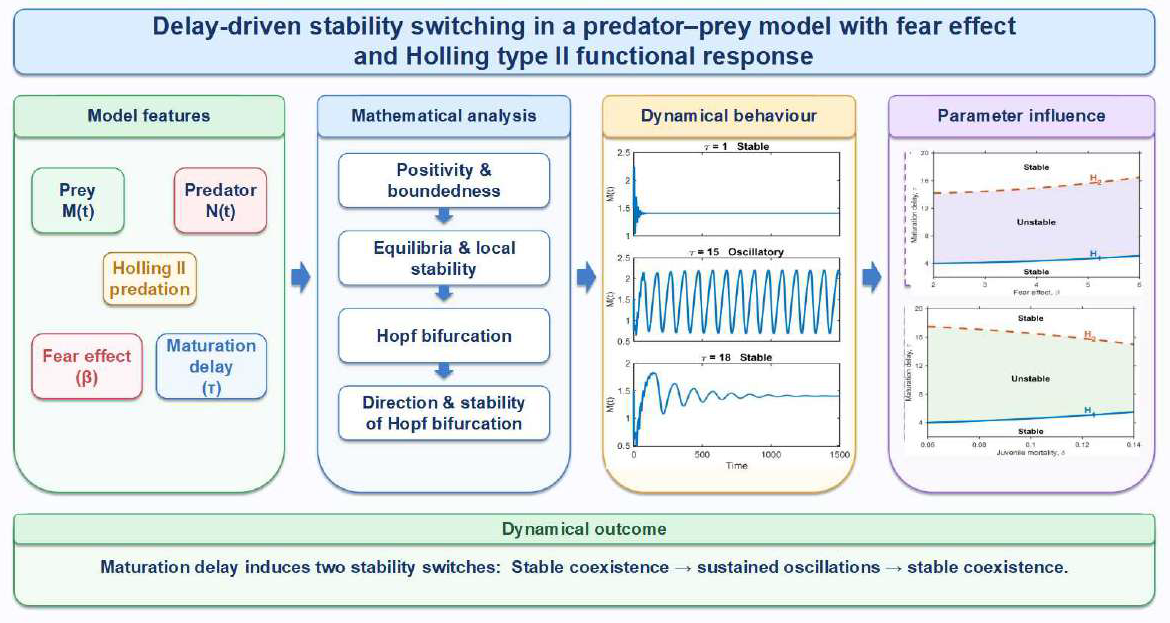
This paper studies a delayed predator–prey model incorporating predation-induced fear, prey maturation delay, and a Holling type II functional response. The well-posedness of the system and the existence and stability of its equilibrium points are examined. Taking the maturation delay as a bifurcation parameter, two critical values are determined, which lead to stability switches via Hopf bifurcation. The direction and stability of the resulting periodic solutions are analyzed by applying normal form theory and the center manifold theorem. Two-parameter analyses are also carried out to examine the influence of fear strength and juvenile mortality on the Hopf bifurcation thresholds and on the existence of the positive equilibrium. Numerical simulations confirm the analytical results and reveal both stable and oscillatory population dynamics.
- Li C. Existence of positive solution for a cross-diffusion predator-prey system with Holling type-II functional response. Chaos Solitons Fractals. 2017;99:226-232. https://doi.org/10.1016/j.chaos.2017.04.001
- Mehdi R, Wu R, Hammouch Z. Chaotic bifurcation dynamics in predator-prey interactions with logistic growth and Holling type-II response. Alex Eng J. 2025;115:119-130. https://doi.org/10.1016/j.aej.2024.11.077
- Arancibia-Ibarra C, Flores J. Dynamics of a Leslie-Gower predator-prey model with Holling type II functional response, Allee effect and a generalist predator. Math Comput Simul. 2021;188:1-22. https://doi.org/10.1016/j.matcom.2021.03.035
- Zhou Y, Sun W, Song Y, Zheng Z, Lu J, Chen S. Hopf bifurcation analysis of a predator-prey model with Holling-II type functional response and a prey refuge. Nonlinear Dyn. 2019;97(2):1439-1450. https://doi.org/10.1007/s11071-019-05063-w
- Jin C, Gu K, Niculescu SI, Boussaada I. Stability analysis of systems with delay-dependent coefficients: An overview. IEEE Access. 2018;6:27392-27407. https://doi.org/10.1109/ACCESS.2018.2828871
- Wang X, Zanette L, Zou X. Modelling the fear effect in predator-prey interactions. J Math Biol. 2016;73(5):1179-1204. https://doi.org/10.1007/s00285-016-0989-1
- Magudeeswaran S, Vinoth S, Sathiyanathan K, Sivabalan M. Impact of fear on delayed three species food-web model with Holling type-II functional response. Int J Biomath. 2022;15(4):2250014. https://doi.org/10.1142/S1793524522500140
- Sarkar K, Khajanchi S. Impact of fear effect on the growth of prey in a predator-prey interaction model. Ecol Complex. 2020;42:100826. https://doi.org/10.1016/j.ecocom.2020.100826
- Das A, Samanta GP. Modelling the fear effect in a two-species predator-prey system under the influence of toxic substances. Rend Circ Mat Palermo (2). 2021;70(3):1501-1526. https://doi.org/10.1007/s12215-020-00570-x
- Dubey B, Sajan, Kumar A. Stability switching and chaos in a multiple delayed prey-predator model with fear effect and anti-predator behavior. Math Comput Simul. 2021;188:164-192. https://doi.org/10.1016/j.matcom.2021.03.037
- Liang Z, Meng X. Stability and Hopf bifurcation of a multiple delayed predator-prey system with fear effect, prey refuge and Crowley-Martin function. Chaos Solitons Fractals. 2023;175:113955. https://doi.org/10.1016/j.chaos.2023.113955
- Panday P, Samanta S, Pal N, Chattopadhyay J. Delay induced multiple stability switch and chaos in a predator-prey model with fear effect. Math Comput Simul. 2020;172:134-158. https://doi.org/10.1016/j.matcom.2019.12.015
- Guo Z, Liu J, Li B, Zhang T. Stability analysis of a delayed predator-prey model with generalist predator and fear effect. Chaos Solitons Fractals. 2026;202:117448. https://doi.org/10.1016/j.chaos.2025.117448
- Mo H, Shao Y. Stability and bifurcation analysis of a delayed stage-structured predator-prey model with fear, additional food, and cooperative behavior in both species. Adv Contin Discrete Models. 2025;2025(1):27. https://doi.org/10.1186/s13662-025-03879-y
- Zhao J, Shao Y. Stability of a delayed prey-predator model with fear, stochastic effects and Beddington-DeAngelis functional response. Adv Contin Discrete Models. 2025;2025(1):13. https://doi.org/10.1186/s13662-025-03875-2
- Banerjee M, Takeuchi Y. Maturation delay for the predators can enhance stable coexistence for a class of prey-predator models. J Theor Biol. 2017;412:154-171. https://doi.org/10.1016/j.jtbi.2016.10.016
- Dubey B, Kumar A. Dynamics of prey-predator model with stage structure in prey including maturation and gestation delays. Nonlinear Dyn. 2019;96(4):2653-2679. https://doi.org/10.1007/s11071-019-04951-5
- Li S, Yuan S, Jin Z, Wang H. Bifurcation analysis in a diffusive predator-prey model with spatial memory of prey, Allee effect and maturation delay of predator. J Differ Equ. 2023;357:32-63. https://doi.org/10.1016/j.jde.2023.02.009
- Kundu S, Maitra S. Dynamics of a delayed predator-prey system with stage structure and cooperation for preys. Chaos Solitons Fractals. 2018;114:453-460. https://doi.org/10.1016/j.chaos.2018.07.013
- Liang Z, Meng X. Stability and Hopf bifurcation of a delayed predator-prey model with a stage structure for generalist predators and a Holling type-II functional response. Symmetry. 2024;16(5):597. https://doi.org/10.3390/sym16050597
- Roy J, Dey S, Banerjee M. Maturation delay induced stability enhancement and shift of bifurcation thresholds in a predator-prey model with generalist predator. Math Comput Simul. 2023;211:368-393. https://doi.org/10.1016/j.matcom.2023.04.019
- Teslya A, Wolkowicz GSK. Dynamics of a predator-prey model with distributed delay to represent the conversion process or maturation. Differ Equ Dyn Syst. 2023;31(3):613-649. https://doi.org/10.1007/s12591-020-00546-4
- Ma X, Su Y, Zou X. Joint impact of maturation delay and fear effect on the population dynamics of a predator-prey system. SIAM J Appl Math. 2024;84(4):1557-1579. https://doi.org/10.1137/23M1596569
- Mahendra, Pandey DN. Bifurcation analysis of a generalist predator-prey system with fear-induced prey competition, prey refuge and maturation delay. Math Comput Simul. 2026;247:453-482. https://doi.org/10.1016/j.matcom.2026.03.016
- Vishwakarma K. Dynamics of a predator-prey model with maturation delay and hunting cooperation in predator. Int J Appl Comput Math. 2025;11(2):69. https://doi.org/10.1007/s40819-025-01879-w
- Yang R, Ma J. Analysis of a diffusive predator-prey system with anti-predator behaviour and maturation delay. Chaos Solitons Fractals. 2018;109:128-139. https://doi.org/10.1016/j.chaos.2018.02.006
- Traoré A, Sangaré B, Savadogo A. Mathematical analysis of the direction and stability of Hopf-bifurcation in a prey-predator model including a maturation and hunting delay. Res Math. 2026;13(1):2605846. https://doi.org/10.1080/27684830.2025.2605846
- Celik C. Stability and Hopf bifurcation in a delayed ratio dependent Holling-Tanner type model. Appl Math Comput. 2015;255:228-237. https://doi.org/10.1016/j.amc.2014.11.086
- Jana D, Agrawal R, Upadhyay RK. Top-predator interference and gestation delay as determinants of the dynamics of a realistic model food chain. Chaos Solitons Fractals. 2014;69:50-63. https://doi.org/10.1016/j.chaos.2014.09.001
- Li D, Liu H, Zhang H, Wei Y. Influence of multiple delays mechanisms on predator-prey model with Allee effect. Chaos Solitons Fractals. 2023;175:113942. https://doi.org/10.1016/j.chaos.2023.113942
- Beretta E, Kuang Y. Geometric stability switch criteria in delay differential systems with delay dependent parameters. SIAM J Math Anal. 2002;33(5):1144-1165. https://doi.org/10.1137/S0036141000376086
- Singh Y, Ghosh B, Mondal S. Delay-induced multiple stability scenarios, species coexistence, and predator extinction in an ecological system. Math Comput Simul. 2026;243:171-195. https://doi.org/10.1016/j.matcom.2025.09.025
- Sivakumar M, Balachandran K. Bifurcation and stability analysis of a diffusive predator-prey model with ratio-dependent type III functional response. Discontinuity Nonlinearity Complex. 2017;6(3):393-407. https://doi.org/10.5890/DNC.2017.09.008
- Sk N, Mondal B, Ch-Chaoui M, Upadhyay RK, Mandal S, Tiwari PK. Influence of Allee effect and cooperative hunting on the dynamics of a modified Hastings-Powell model in deterministic, discrete, and stochastic environments. Eur Phys J Plus. 2025;140(12):1178. https://doi.org/10.1140/epjp/s13360-025-07123-0
- Mouhsine H, Mokni K, Ch-Chaoui M. Exploring multi-parameter bifurcations and immigration-driven dynamics in a discrete-time Bazykin-Berezovskaya prey-predator model. Nonlinear Dyn. 2025;113(24):34101-34131. https://doi.org/10.1007/s11071-025-11818-5
- Shao Y. Global stability of a delayed predator-prey system with fear and Holling-type II functional response in deterministic and stochastic environments. Math Comput Simul. 2022;200:65-77. https://doi.org/10.1016/j.matcom.2022.04.013
- Tang G, Tang S, Cheke RA. Global analysis of a Holling type II predator-prey model with a constant prey refuge. Nonlinear Dyn. 2014;76(1):635-647. https://doi.org/10.1007/s11071-013-1157-4
- Umasankar C, Sivakumar M, Dharani S, Ma YK. Bifurcation analysis of continuous and discrete time predator-prey models with habitat complexity. Sci Rep. 2026. https://doi.org/10.1038/s41598-026-69370-0
- Sivasamy R, Sivakumar M, Sathiyanathan K, Balachandran K. Dynamics of modified Leslie-Gower harvested predator-prey model with Beddington-DeAngelis functional response. Discontinuity Nonlinearity Complex. 2019;8(2):111-125. https://doi.org/10.5890/DNC.2019.06.001
- Sivakumar M, Dharani S, Balachandran K. Spatiotemporal patterns and bifurcation analysis of a diffusive predator-prey model with hyperbolic mortality. J Appl Nonlinear Dyn. 2026;15(3):683-694. https://doi.org/10.5890/JAND.2026.09.011
- Sivakumar M, Balachandran K. Phase portraits, Hopf bifurcations and limit cycles of the ratio dependent Holling-Tanner models for predator-prey interactions. J Appl Nonlinear Dyn. 2016;5(3):283-304. https://doi.org/10.5890/JAND.2016.09.003
- Mahalakshmi R, Sivakumar M. Study of memory-dependent dynamics of a predator-prey model with hyperbolic mortality. Sci Rep. 2026;16:24039. https://doi.org/10.1038/s41598-026-52712-3
- Liu S, Liu Z, Tang J. A delayed marine bacteriophage infection model. Appl Math Lett. 2007;20(6):702-706. https://doi.org/10.1016/j.aml.2006.06.017
- Smith HL. Monotone Dynamical Systems: An Introduction to the Theory of Competitive and Cooperative Systems. Providence, RI: American Mathematical Society; 1995. https://doi.org/10.1090/surv/041
- Wang LL, Li WT. Existence and global stability of positive periodic solutions of a predator-prey system with delays. Appl Math Comput. 2003;146(1):167-185. https://doi.org/10.1016/S0096-3003(02)00534-9
- Kuang Y. Delay Differential Equations with Applications in Population Dynamics. Boston: Academic Press; 1993. https://shop.elsevier.com/books/delay-differential-equations/kuang/978-0-12-427610-9
- Hassard BD, Kazarinoff ND, Wan YH. Theory and Applications of Hopf Bifurcation. Cambridge: Cambridge University Press; 1981. https://books.google.com/books?id=rgyOjgEACAAJ