

Electroluminescence image-based photovoltaic defect severity classification using convolutional neural network architectures and ensemble learning

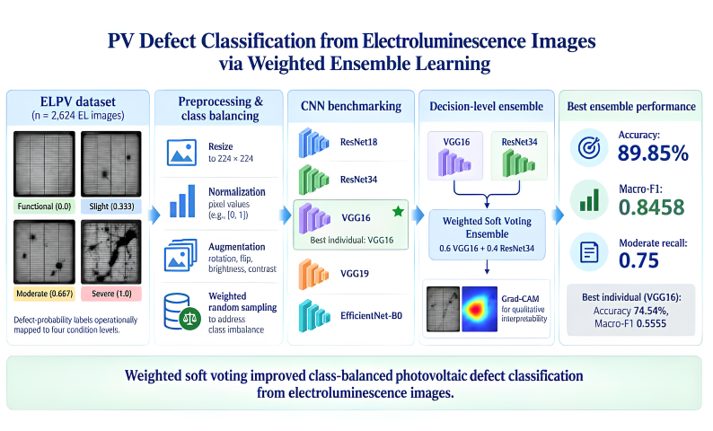
Accurate fault detection and defect severity classification in photovoltaic (PV) modules are essential for predictive maintenance and reliable energy production. Electroluminescence (EL) imaging provides a fast, non-contact, and effective approach for identifying internal defects in PV cells, including cracks, inactive regions, and structural abnormalities. However, automatic severity classification remains challenging due to class imbalance and subtle visual differences between intermediate defect levels. This study investigated transfer learning using several convolutional neural network (CNN) architectures, including ResNet18, ResNet34, VGG16, VGG19, and EfficientNet-B0, for multi-class PV defect severity classification using publicly available EL images within a unified experimental framework. Among the individual models, VGG16 achieved the best test performance with an accuracy of 74.54% and a macro-F1 score of 0.56, indicating that single CNN models remain insufficiently robust for reliable multi-class severity classification, particularly under class imbalance and overlapping severity levels. To address these limitations, ensemble learning was employed to combine complementary CNN models, significantly improving classification performance to approximately 90% accuracy and 0.84 macro-F1. In addition, gradient-weighted class activation mapping analysis was used to provide qualitative insight into the regions of the EL images that influenced model predictions. The ensemble models produced visually consolidated and interpretable attention patterns across the representative samples compared with the individual models. Overall, the proposed ensemble-based framework provides a practical and computationally efficient approach for improving PV defect severity classification using EL imaging.
- Guo Q, Ingram A. Powering the Future: Advancements and Applications of Photovoltaic Systems with Political, Economic, and Environmental Considerations. Engineering Science & Technology. 2024;5(1):109-120. https://doi.org/10.37256/est.5120243972
- El-Banby GM, Moawad NM, Abouzalm BA, Abouzaid WF, Ramadan EA. Photovoltaic system fault detection techniques: a review. Neural Comput & Applic. 2023;35(35):24829-24842. https://doi.org/10.1007/s00521-023-09041-7
- Liu Y, Wu Y. Fault diagnosis of photovoltaic modules: A review. Solar Energy. 2025;293:113489. https://doi.org/10.1016/j.solener.2025.113489
- Taghezouit B, Harrou F, Sun Y, Merrouche W. Model-based fault detection in photovoltaic systems: A comprehensive review and avenues for enhancement. Results in Engineering. 2024;21:101835. https://doi.org/10.1016/j.rineng.2024.101835
- Mohamed KA, Zakzouk NE, Abdelgeliel M, Youssef KH. Faults and Faults¡¯ Diagnosis Techniques in Photovoltaics: An Overview. In: 2025 IEEE PES/IAS PowerAfrica. IEEE; 2025:1-6. https://doi.org/10.1109/PowerAfrica65840.2025.11289065
- Yao S, Kang Q, Zhou M, Abusorrah A, Al-Turki Y. Intelligent and Data-Driven Fault Detection of Photovoltaic Plants. Processes. 2021;9(10):1711. https://doi.org/10.3390/pr9101711
- Mohamed KA, Zakzouk NE, Abdelgeliel M, Youssef KH. Online Fault Detection, Classification and Localization in PV Arrays Using Feedforward Neural Networks and Residual-Based Modeling. Technologies. 2026;14(2):130. https://doi.org/10.3390/technologies14020130
- Ali MU, Zafar A, Kim KS. Imaging based fault diagnosis of photovoltaic modules: a systematic review. Solar Energy. 2026;314:114679. https://doi.org/10.1016/j.solener.2026.114679
- Sadeghi R, Memme S, Morchio S, Fossa M, Parenti M. Infrared Thermography in Photovoltaic Systems: A Review for Maximizing Energy Yield and Long-Term Reliability. Energies. 2026;19(6):1570. https://doi.org/10.3390/en19061570
- Del Prado Santamar¨ªa R, Dhimish M, Dos Reis Benatto GA, Kari T, Poulsen PB, Spataru SV. From Indoor to Daylight Electroluminescence Imaging for PV Module Diagnostics: A Comprehensive Review of Techniques, Challenges, and AI-Driven Advancements. Micromachines. 2025;16(4):437. https://doi.org/10.3390/mi16040437
- Deitsch S, Christlein V, Berger S, et al. Automatic classification of defective photovoltaic module cells in electroluminescence images. Solar Energy. 2019;185:455-468. https://doi.org/10.1016/j.solener.2019.02.067
- Hussain T, Hussain M, Al-Aqrabi H, Alsboui T, Hill R. A Review on Defect Detection of Electroluminescence-Based Photovoltaic Cell Surface Images Using Computer Vision. Energies. 2023;16(10):4012. https://doi.org/10.3390/en16104012
- Almashhadani RAI, Hock GC, Bt Nordin FH, Abdulrazzak HN. Electroluminescence Images for Solar Cell Fault Detection Using Deep Learning for Binary and Multiclass Classification. SSRG-IJEEE. 2024;11(5):150-160. https://doi.org/10.14445/23488379/IJEEE-V11I5P114
- Matusz-Kal¨¢sz D, Bodn¨¢r I, Jobb¨¢gy M. An Overview of CNN-Based Image Analysis in Solar Cells, Photovoltaic Modules, and Power Plants. Applied Sciences. 2025;15(10):5511. https://doi.org/10.3390/app15105511
- Sonawane PR, Bhandari S, Patil RB, Al-Dahidi S. Comparative analysis of methods used to solve class imbalance problem in dataset for CNN-based fault diagnosis of solar photovoltaic panels. International Journal of Thermofluids. 2025;28:101303. https://doi.org/10.1016/j.ijft.2025.101303
- Kumar R, Kim YW, Byun YC. Mitigating dataset imbalance using image-based stable diffusion and feature-level SMOTE for solar panel classification with CNNs. Energy Reports. 2026;15:109055. https://doi.org/10.1016/j.egyr.2026.109055
- Simonyan K, Zisserman A. Very Deep Convolutional Networks for Large-Scale Image Recognition. arXiv. Preprint posted online 2014. https://doi.org/10.48550/ARXIV.1409.1556
- Buerhop-Lutz C, Deitsch S, Maier A, et al. A benchmark for visual identification of defective solar cells in electroluminescence imagery. In: Proceedings of the 35th European Photovoltaic Solar Energy Conference and Exhibition (EU PVSEC); 2018:1287-1289. https://doi.org/10.4229/35THEUPVSEC20182018-5CV.3.15.
- Krizhevsky A, Sutskever I, Hinton GE. ImageNet classification with deep convolutional neural networks. Commun ACM. 2017;60(6):84-90. https://doi.org/10.1145/3065386
- Sokolova M, Lapalme G. A systematic analysis of performance measures for classification tasks. Information Processing & Management. 2009;45(4):427-437. https://doi.org/10.1016/j.ipm.2009.03.002
- Selvaraju RR, Cogswell M, Das A, Vedantam R, Parikh D, Batra D. Grad-CAM: Visual Explanations from Deep Networks via Gradient-Based Localization. In: 2017 IEEE International Conference on Computer Vision (ICCV). IEEE; 2017:618-626. https://doi.org/10.1109/ICCV.2017.74
- He H, Garcia EA. Learning from Imbalanced Data. IEEE Trans Knowl Data Eng. 2009;21(9):1263-1284. https://doi.org/10.1109/TKDE.2008.239
- Demirci MY, Beşli N, G¨¹m¨¹şç¨¹ A. Efficient deep feature extraction and classification for identifying defective photovoltaic module cells in Electroluminescence images. Expert Systems with Applications. 2021;175:114810. https://doi.org/10.1016/j.eswa.2021.114810
- Wang J, Bi L, Sun P, et al. Deep-Learning-Based Automatic Detection of Photovoltaic Cell Defects in Electroluminescence Images. Sensors. 2023;23(1):297. https://doi.org/10.3390/s23010297
- Al-Otum HA. Automatic Defect Detection and Classification in Electroluminescence Images of Pv Cells Using Convolutional Neural Networks. SSRN. Preprint posted online 2023. https://doi.org/10.2139/ssrn.4422413
- Tella H, Hussein A, Rehman S, Liu B, Balghonaim A, Mohandes M. Solar photovoltaic panel cells defects classification using deep learning ensemble methods. Case Studies in Thermal Engineering. 2025;66:105749. https://doi.org/10.1016/j.csite.2025.105749
- Ebied MA, Munshi A, Alhuzali SA, El-sotouhy MM, Shehta AI, Elborlsy MS. Advanced deep learning modeling to enhance detection of defective photovoltaic cells in electroluminescence images. Sci Rep. 2025;15(1):31640. https://doi.org/10.1038/s41598-025-14478-y
- Japkowicz N, Stephen S. The class imbalance problem: A systematic study. IDA. 2002;6(5):429-449. https://doi.org/10.3233/IDA-2002-6504
- Deitsch S, Buerhop-Lutz C, Sovetkin E, et al. Segmentation of photovoltaic module cells in uncalibrated electroluminescence images. Machine Vision and Applications. 2021;32(4):84. https://doi.org/10.1007/s00138-021-01191-9
- Liu Q, Liu M, Wang C, Wu QMJ. An efficient CNN-based detector for photovoltaic module cells defect detection in electroluminescence images. Solar Energy. 2024;267:112245. https://doi.org/10.1016/j.solener.2023.112245
- He K, Zhang X, Ren S, Sun J. Deep Residual Learning for Image Recognition. In: 2016 IEEE Conference on Computer Vision and Pattern Recognition (CVPR). IEEE; 2016:770-778. https://doi.org/10.1109/CVPR.2016.90
- Tan M, Le QV. EfficientNet: Rethinking Model Scaling for Convolutional Neural Networks. In: Proceedings of the 36th International Conference on Machine Learning. Vol 97. Proceedings of Machine Learning Research; 2019:6105¨C6114. https://proceedings.mlr.press/v97/tan19a.html
- Paszke A, Gross S, Massa F, et al. PyTorch: An Imperative Style, High-Performance Deep Learning Library. arXiv. In: Advances in Neural Information Processing Systems 32. Curran Associates, Inc; 2019:8024-8035. https://proceedings.neurips.cc/paper/2019/hash/bdbca288fee7f92f2bfa9f7012727740-Abstract.html
- Loshchilov I, Hutter F. Decoupled Weight Decay Regularization. arXiv. Preprint posted online 2017. https://doi.org/10.48550/ARXIV.1711.05101
- Kingma DP, Ba J. Adam: A Method for Stochastic Optimization. arXiv. Preprint posted online 2014. https://doi.org/10.48550/ARXIV.1412.6980
- Sleibi F. PV EL Defect Severity Ensemble [software]. Hugging Face Space. Accessed September 12, 2026. https://huggingface.co/spaces/fouadsl/PV-EL-Defect-Severity-Ensemble