
A kernel-adaptive Mittag-Leffler polynomial framework for ψ-Caputo fractional optimal control of robotic systems

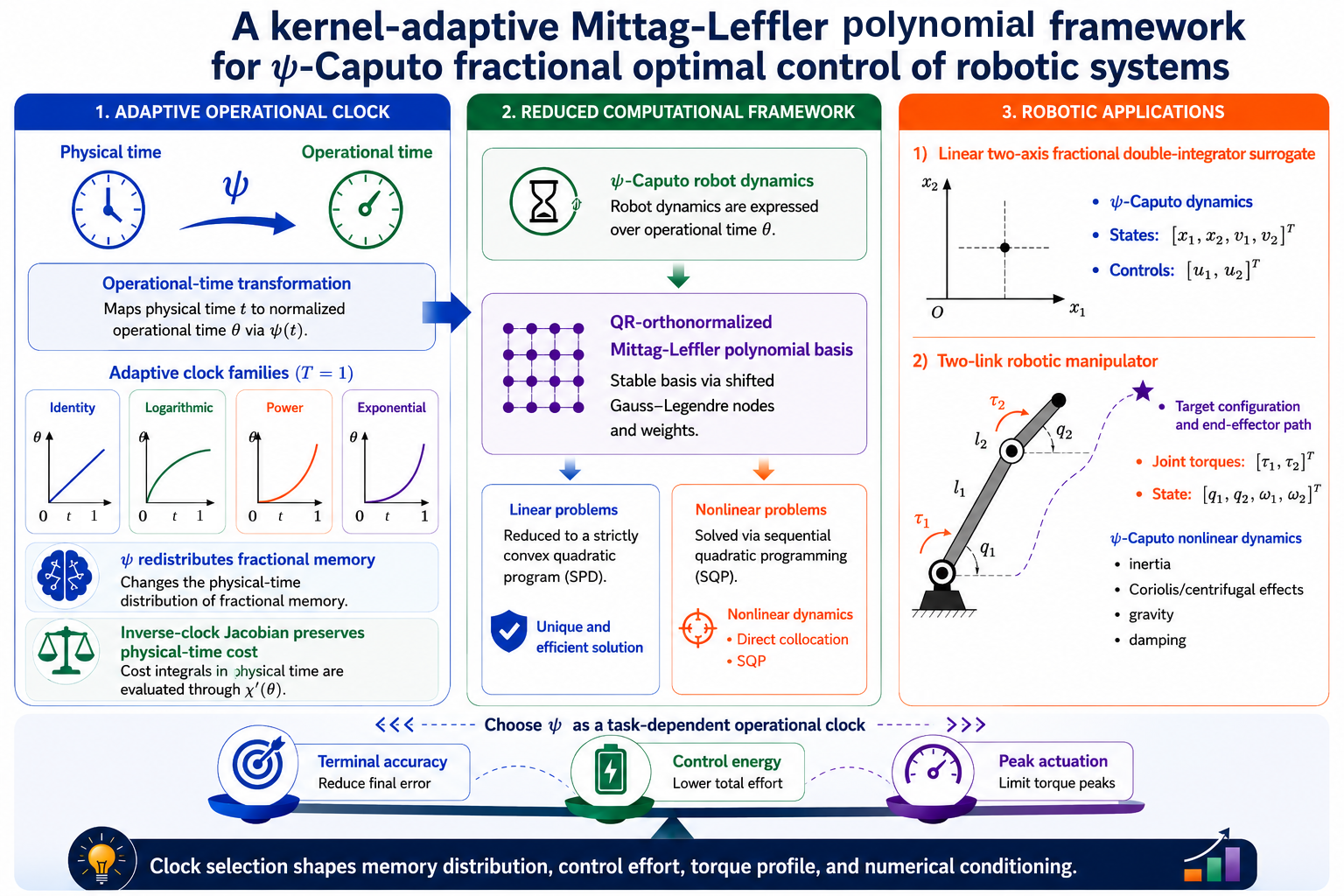
This paper develops a kernel-adaptive Mittag-Leffler polynomial framework for solving ψ-Caputo fractional optimal-control problems arising in robotic systems. In the proposed formulation, the function ψ is interpreted as a nonlinear operational clock that reshapes the memory structure of the fractional dynamics and influences the distribution of the control effort over physical time. A normalized operational-time transformation is introduced to convert the original ψ-Caputo system into an equivalent Caputo-type representation; at the same time, the physical-time performance index is preserved through the inverse-clock Jacobian. This formulation allows different kernel choices to be incorporated systematically without altering the underlying optimal control structure. For numerical implementation, QR-orthonormalized Mittag-Leffler polynomial bases are constructed to improve stability and conditioning. The fractional integral terms are evaluated analytically by expanding the basis functions in terms of monomials, yielding an efficient finite-dimensional approximation. For the linear planar robotic regulator, the state variables are analytically eliminated, yielding a symmetric positive-definite quadratic programming problem. For the nonlinear two-link manipulator, the same transformation and approximation strategy produce a nonlinear programming formulation. The method is first validated using a manufactured ψ-Caputo benchmark problem, confirming its accuracy and consistency. It is then applied to robotic control examples to examine the effects of kernel selection on terminal accuracy, control energy, physical-time cost, peak actuation, torque profiles, and numerical conditioning. The results demonstrate that the operational clock significantly influences both computational performance and control behavior.
- Tassaddiq A, Qureshi S, Soomro A, Abu Arqub O, Senol M. Comparative analysis of classical and Caputo models for COVID-19 spread: vaccination and stability assessment. Fixed Point Theory Algorithms Sci Eng. 2024;2024:2. https://doi.org/10.1186/s13663-024-00760-7
- Qureshi S. Fox H-functions as exact solutions for Caputo type mass spring damper system under Sumudu transform. J Appl Math Comput Mech. 2021;20(1):83-89. https://doi.org/10.17512/jamcm.2021.1.08
- Samko SG, Kilbas AA, Marichev OI. Fractional Integrals and Derivatives: Theory and Applications. Yverdon, Switzerland: Gordon and Breach Science Publishers; 1993.
- Baleanu D, Diethelm K, Scalas E, Trujillo JJ. Fractional Calculus: Models and Numerical Methods. Vol 3. Singapore: World Scientific; 2012. https://doi.org/10.1142/8180
- Agrawal OP. A general formulation and solution scheme for fractional optimal control problems. Nonlinear Dyn. 2004;38(1-4):323-337. https://doi.org/10.1007/s11071-004-3764-6
- Baleanu D, Tajani A, Zguaid K, Jajarmi A. Fractional optimal control problems in the sense of ψ-Caputo fractional derivative. Optim Control Appl Methods. 2025;46(6):2867-2881. https://doi.org/10.1002/oca.70034
- Alqhtani M, Sadek L, Saad KM. The Mittag-Leffler-Caputo-Fabrizio fractional derivative and its numerical approach. 2025;17(5):800. https://doi.org/10.3390/sym17050800
- Sadek L, Aldawish I. An efficient numerical approach for solving the Mittag-Leffler fractional differential equations. Math Sci. 2026;20(3):263-280. https://doi.org/10.57647/mathsci.2026.2003.14
- Zaky MA, Doha EH. A new adaptive spectral collocation method for tempered fractional differential equations with initial singularities. Comput Appl Math. 2026;45(7):302. https://doi.org/10.1007/s40314-026-03699-0
- Ahmed AI. Collocation method for solving delay fractional optimal control problems by fractional-order Chelyshkov functions. Adv Cont Discr Mod. 2026;2026:24. https://doi.org/10.1186/s13662-026-04065-4
- Qureshi S, Argyros IK, Ramos H, et al. A stable optimal solver for nonlinear equations with semilocal convergence using majorizing sequences in Banach spaces. SeMA J. 2026;83:515-549. https://doi.org/10.1007/s40324-025-00402-x
- Jmal A, Ahmed H. Generalized Mittag-Leffler stability for k-Caputo fractional-order systems---An observer application. Asian J Control. 2026;28(1):424-430. https://doi.org/10.1002/asjc.3754
- Ma L, Zhang W. Finite-time stability for Caputo-Hadamard type fractional differential systems without and with proportional delays. 2026;36(1):013131. https://doi.org/10.1063/5.0311074
- Ghosh I, Cheong HT, Teo KL. A novel gradient-based discrete time-delayed optimization algorithm for optimal control problems with Caputo-Fabrizio fractional derivative. J Comput Appl Math. 2025;464:116526. https://doi.org/10.1016/j.cam.2025.116526
- Hidayatullah AA, Subchan S, Safarina S, et al. A hybrid fractional Chebyshev-Legendre spectral collocation method for Hamilton-Jacobi-Bellman equations. IEEE Access. 2026;14:34564-34584. https://doi.org/10.1109/ACCESS.2026.3668899
- Sadek L, Samei ME, Hashemi MS. The Galerkin Mittag-Leffler method for solving fractional optimal control problems with inequality constraints. Math Comput Simul. 2026;240:191-207. https://doi.org/10.1016/j.matcom.2025.07.018
- Sadek L, Aldawish I, Hammouch Z, Shafee A, Popa IL. A robust Galerkin fractional Taylor technique to solve multi-dimensional fractional optimal control problems with inequality constraints. Math Sci. 2026;20(4):359-375. https://doi.org/10.57647/mathsci.89bj.w891
- Mao X, Wang X, Lu Y, Qin H. Synchronizations control of fractional-order multidimension-valued memristive neural networks with delays. 2024;563:126942. https://doi.org/10.1016/j.neucom.2023.126942
- Chávez-Vázquez S, Gómez-Aguilar JF, Lavín-Delgado JE, Escobar-Jiménez RF, Olivares-Peregrino VH. Applications of fractional operators in robotics: A review. J Intell Robot Syst. 2022;104(4):63. https://doi.org/10.1007/s10846-022-01597-1
- Singh AP, Bingi K. Applications of fractional-order calculus in robotics. Fractal Fract. 2024;8(7):403. https://doi.org/10.3390/fractalfract8070403
- Ghasempour A, Ordokhani Y, Razzaghi M. An efficient optimal control framework for robotic systems using Mittag-Leffler polynomial techniques. Optim Control Appl Methods. 2026;47(4):1004-1014. https://doi.org/10.1002/oca.70110
- Odibat Z, Qureshi S, Cattani C, Gómez-Aguilar JF, Yang XJ, Baleanu D. Analytical solutions of fractional Burgers' equation with exponential extension kernel derivatives. J Comput Appl Math. 2026;486:117620. https://doi.org/10.1016/j.cam.2026.117620
- Saad KM, Abdo MS, Hamanah WM. Existence and controllability analysis of multi-term fractional coupled systems with generalized [ψ,w]-Caputo-Fabrizio operators. Sci Rep. 2025;15:34434. https://doi.org/10.1038/s41598-025-17523-y
- Almeida R. A Caputo fractional derivative of a function with respect to another function. Commun Nonlinear Sci Numer Simul. 2017;44:460-481. https://doi.org/10.1016/j.cnsns.2016.09.006
- Sousa JVC, Oliveira EC de. On the ψ-Hilfer fractional derivative. Commun Nonlinear Sci Numer Simul. 2018;60:72-91. https://doi.org/10.1016/j.cnsns.2018.01.005
- Almeida R. What is the best fractional derivative to fit data? Appl Anal Discrete Math. 2017;11(2):358-368. https://doi.org/10.2298/AADM170428002A
- Baghani O. Solving state feedback control of fractional linear quadratic regulator systems using triangular functions. Commun Nonlinear Sci Numer Simul. 2019;73:319-337. https://doi.org/10.1016/j.cnsns.2019.01.023
- Gomoyunov MI. Value functional and optimal feedback control in linear-quadratic optimal control problem for fractional-order system. Math Control Relat Fields. 2024;14(1):215-254. https://doi.org/10.3934/mcrf.2023002
- Zhou B, Speyer JL. Fractional linear quadratic regulators using Wiener-Hopf spectral factorization. SIAM J Control Optim. 2019;57(6):4011-4032. https://doi.org/10.1137/19M1239520
- Kilbas AA, Srivastava HM, Trujillo JJ. Theory and Applications of Fractional Differential Equations. North-Holland Mathematics Studies. Vol 204. Amsterdam: Elsevier; 2006. https://doi.org/10.1016/S0304-0208(06)80001-0
- Qureshi S, Yusuf A, Aziz S. On the use of Mohand integral transform for solving fractional-order classical Caputo differential equations. J Appl Math Comput Mech. 2020;19(3):99-109. https://doi.org/10.17512/jamcm.2020.3.08
- Mohiuddin M, Karim ME, Amin MR, et al. Detecting dynamical behaviors of solitary waves in the M-fractional Konopelchenko-Dubrovsky system with stability and sensitivity analysis. Phys Open. 2026;28:100454. https://doi.org/10.1016/j.physo.2026.100454
- Alam N, Ullah MS, Manafian J, et al. Bifurcation analysis, chaotic behaviors, and explicit solutions for a fractional two-mode Nizhnik-Novikov-Veselov equation in mathematical physics. AIMS Math. 2025;10(3):4558-4578. https://doi.org/10.3934/math.2025211
- Amin MR, Hakim MA, Ullah MS. Analysis of soliton behavior and overlap phenomena in the integrable beta-fractional Akbota equation with stability evaluation of equilibrium points. AIP Adv. 2025;15(12):125205. https://doi.org/10.1063/5.0308937
- Gambo YY, Jarad F, Baleanu D, Abdeljawad T. On Caputo modification of the Hadamard fractional derivatives. Adv Differ Equ. 2014;2014:10. https://doi.org/10.1186/1687-1847-2014-10
- Roman S. The Umbral Calculus. Orlando: Academic Press; 1984. https://books.google.com/books/about/The_Umbral_Calculus.html?id=JpHjkhFLfpgC
- Spong MW, Hutchinson S, Vidyasagar M. Robot Modeling and Control. Hoboken: John Wiley & Sons; 2006. https://www.wiley.com/en-us/shop/general-introductory-electrical-electronics-engineering/robot-modeling-and-control-2nd-edition-p-9781119524045