

Energy-storing analysis and fishtail stiffness optimization for a wire-driven elastic robotic fish

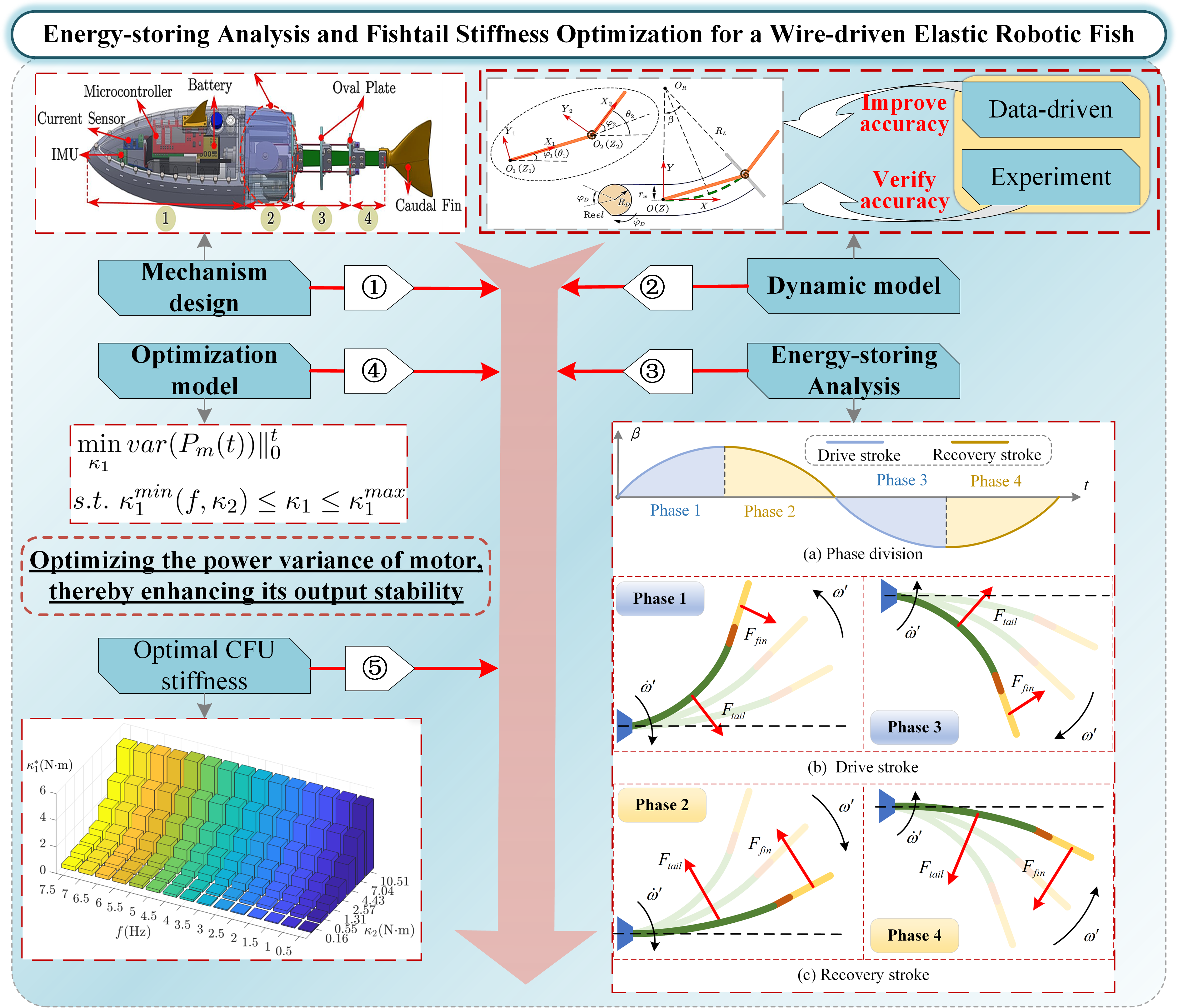
The robotic fish with high propulsion efficiency and good maneuverability achieves underwater fishlike propulsion by commonly adopting a motor to drive the fishtail, causing significant fluctuations within motor power due to the uneven swing speed of the fishtail in one swing cycle. Hence, we propose a wire-driven robotic fish with a controlled flexible unit that is a spring-steel-based fishlike tail. This unit can produce elastic deformation to store energy under the action of the wire driving and motor to respond to fluctuations in motor power. Further{more}, we analyze the effects of the energy-storing of the controlled flexible unit on the smoothness of motor power. Based on the developed Lagrangian dynamic model and the cantilever beam model, the power-variance-based nonlinear optimization model for the stiffness of the controlled flexible unit is established to respond to sharp fluctuations in motor power during each fishtail swing cycle. The results validate that the energy-storing of the controlled flexible unit plays a vital role in improving the power fluctuations and maximum frequency of the motor by adjusting its stiffness reasonably, which is beneficial for achieving high propulsion and high speed for robotic fish. Compared with the rigid counterpart that is incapable of storing energy, the energy-storing of the controlled flexible unit is beneficial to increase the maximum frequency of the motor and the average thrust of the fishtail by 0.41 Hz and 0.06 N, respectively.
- Chen Y, Ren T, Li Y, et al. AI-empowered intelligence in industrial robotics: technologies, challenges, and emerging trends. Intell Robot. 2026;6(1):1-18. https://doi.org/10.20517/ir.2026.01
- Li K, Yang L, Cheng Q, Wang B, Xu L. Magnetic soft robots in biomedicine: From remote actuation to diagnostic-therapeutic integrated systems. Adv Bionics. 2026;2(1):14-32. https://doi.org/10.1016/j.abs.2026.01.001
- Wang J, Wang C, Chen W, Dou Q, Chi W. Embracing the future: the rise of humanoid robots and embodied AI. Intell Robot. 2024;4(2):196. https://doi.org/10.20517/ir.2024.12
- Sun Y, Yan C, Xiang X, Zhou H, Tang D, Zhu Y. Towards end-to-end formation control for robotic fish via deep reinforcement learning with non-expert imitation. Ocean Eng. 2023;271:113811. https://doi.org/10.1016/j.oceaneng.2023.113811
- Dai W, Rai U, Chiun J, Cao Y, Sartoretti G. Heterogeneous multi-robot task allocation and scheduling via reinforcement learning. IEEE Robot Autom Lett. 2025;10(3):2654-2661. https://doi.org/10.1109/LRA.2025.3534682
- He H, Liao R, Li Y. MSAFNet: a novel approach to facial expression recognition in embodied AI systems. Intell Robot. 2025;5(2):313-332. https://doi.org/10.20517/ir.2025.16
- Zheng X, Wang W, Xiong M, Xie G. Online state estimation of a fin-actuated underwater robot using artificial lateral line system. IEEE Trans Robot. 2020;36(2):472-487. https://doi.org/10.1109/TRO.2019.2956343
- Zhang Y, Zhu D, Chen M, Yang SX. Model predictive tracking control based on adaptive sliding mode constraints for unmanned underwater vehicles. Intell Robot. 2026;6(1):101-119. https://doi.org/10.20517/ir.2026.06
- Hua M, Zhou W, Cheng H, Chen Z. Improved DDPG algorithm-based path planning for unmanned surface vehicles. Intell Robot. 2024;4(4):363-384. https://doi.org/10.20517/ir.2024.22
- Scaradozzi D, Palmieri G, Costa D, Pinelli A. BCF swimming locomotion for autonomous underwater robots: A review and a novel solution to improve control and efficiency. Ocean Eng. 2017;130:437-453. https://doi.org/10.1016/j.oceaneng.2016.11.055
- Zhang P, Wu Z, Meng Y, Tan M, Yu J. Nonlinear model predictive position control for a tail-actuated robotic fish. Nonlinear Dyn. 2020;101(4):2235-2247. https://doi.org/10.1007/s11071-020-05963-2
- Omari M, Ghommem M, Romdhane L, Hajj MR. Performance analysis of bio-inspired transformable robotic fish tail. Ocean Eng. 2022;244:110406. https://doi.org/10.1016/j.oceaneng.2021.110406
- Clapham RJ, Hu H. iSplash: Realizing fast carangiform swimming to outperform a real fish. In: Robot Fish: Bio-inspired Fishlike Underwater Robots. Springer; 2015:193-218. https://doi.org/10.1007/978-3-662-46870-8_7
- Liu S, Wang Y, Li Z, Jin M, Ren L, Liu C. A fluid-driven soft robotic fish inspired by fish muscle architecture. Bioinspir Biomim. 2022;17(2):026009. https://doi.org/10.1088/1748-3190/ac4afb
- Aubin CA, Choudhury S, Jerch R, Archer LA, Pikul JH, Shepherd RF. Electrolytic vascular systems for energy-dense robots. 2019;571(7763):51-57. https://doi.org/10.1038/s41586-019-1313-1
- Marchese AD, Onal CD, Rus D. Autonomous soft robotic fish capable of escape maneuvers using fluidic elastomer actuators. Soft Robot. 2014;1(1):75-87. https://doi.org/10.1089/soro.2013.0009
- Katzschmann RK, DelPreto J, MacCurdy R, Rus D. Exploration of underwater life with an acoustically controlled soft robotic fish. Sci Robot. 2018;3(16):eaar3449. https://doi.org/10.1126/scirobotics.aar3449
- Wang Z, Hang G, Wang Y, Li J, Du W. Embedded SMA wire actuated biomimetic fin: A module for biomimetic underwater propulsion. Smart Mater Struct. 2008;17(2):025039. https://doi.org/10.1088/0964-1726/17/2/025039
- Li L, Guo X, Liu Y, Zhang D, Liao WH. Dynamic modeling of a fish tail actuated by IPMC actuator based on the absolute nodal coordinate formulation. Smart Mater Struct. 2022;31(11):115005. https://doi.org/10.1088/1361-665X/ac8c0a
- Li G, Chen X, Zhou F, et al. Self-powered soft robot in the Mariana Trench. 2021;591(7848):66-71. https://doi.org/10.1038/s41586-020-03153-z
- Ning K, Hartono P, Sawada H. Using inverse learning for controlling bionic robotic fish with SMA actuators. MRS Adv. 2022;7(30):649-655. https://doi.org/10.1557/s43580-022-00328-w
- Chen X, Yu J, Wu Z, Meng Y, Kong S. Toward a maneuverable miniature robotic fish equipped with a novel magnetic actuator system. IEEE Trans Syst Man Cybern Syst. 2018;50(7):2327-2337. https://doi.org/10.1109/TSMC.2018.2812903
- Huang C, Lai Z, Zhang L, Wu X, Xu T. A magnetically controlled soft miniature robotic fish with a flexible skeleton inspired by zebrafish. Bioinspir Biomim. 2021;16(6):065004. https://doi.org/10.1088/1748-3190/ac23a9
- Chen B, Jiang H. Swimming performance of a tensegrity robotic fish. Soft Robot. 2019;6(4):520-531. https://doi.org/10.1089/soro.2018.0079
- Chen B, Jiang H. Body stiffness variation of a tensegrity robotic fish using antagonistic stiffness in a kinematically singular configuration. IEEE Trans Robot. 2021;37(5):1712-1727. https://doi.org/10.1109/TRO.2021.3049430
- Li Z, Zhong Y, Du R. A novel underactuated wire-driven robot fish with vector propulsion. In: 2013 IEEE/RSJ International Conference on Intelligent Robots and Systems. 2013:941-946. https://doi.org/10.1109/IROS.2013.6696463
- Zhong Y, Li Z, Du R. A novel robot fish with wire-driven active body and compliant tail. IEEE/ASME Trans Mechatron. 2017;22(4):1633-1643. https://doi.org/10.1109/TMECH.2017.2712820
- Liu J, Zhang C, Liu Z, et al. Design and analysis of a novel tendon-driven continuum robotic dolphin. Bioinspir Biomim. 2021;16(6):065002. https://doi.org/10.1088/1748-3190/ac2126
- Shintake J, Zappetti D, Peter T, Ikemoto Y, Floreano D. Bio-inspired tensegrity fish robot. In: 2020 IEEE International Conference on Robotics and Automation (ICRA). 2020:2887-2892. https://doi.org/10.1109/ICRA40945.2020.9196675
- Estarki M, Varnousfaderani RH, Ghafarirad H, Zareinejad M. Design and implementation of a soft robotic fish based on carangiform fish swimming. In: 2021 9th RSI International Conference on Robotics and Mechatronics (ICRoM). 2021:322-328. https://doi.org/10.1109/ICRoM54204.2021.9663484
- Park YJ, Jeong U, Lee J, Kim HY, Cho KJ. The effect of compliant joint and caudal fin in thrust generation for robotic fish. In: 2010 3rd IEEE RAS & EMBS International Conference on Biomedical Robotics and Biomechatronics. 2010:528-533. https://doi.org/10.1109/BIOROB.2010.5626007
- Reddy S, Sen S, Har C. Effect of flexural stiffness distribution of a fin on propulsion performance. Mech Mach Theory. 2018;129:218-231. https://doi.org/10.1016/j.mechmachtheory.2018.07.012
- Chen D, Wu Z, Meng Y, Tan M, Yu J. Development of a high-speed swimming robot with the capability of fish-like leaping. IEEE/ASME Trans Mechatron. 2022;27(5):3579-3589. https://doi.org/10.1109/TMECH.2021.3136342
- Behbahani SB, Tan X. Design and modeling of flexible passive rowing joint for robotic fish pectoral fins. IEEE Trans Robot. 2016;32(5):1119-1132. https://doi.org/10.1109/TRO.2016.2593452
- Li Z, Du R, Zhang Y, Li H. Robot fish with novel wire-driven continuum flapping propulsor. Appl Mech Mater. 2013;300:510-514. https://doi.org/10.4028/www.scientific.net/AMM.300-301.510
- Lau WP, Zhong Y, Du R, Li Z. Bladderless swaying wire-driven robot shark. In: 2015 IEEE 7th International Conference on Cybernetics and Intelligent Systems (CIS) and IEEE Conference on Robotics, Automation and Mechatronics (RAM). 2015:155-160. https://doi.org/10.1109/ICCIS.2015.7274613
- Fujiwara S, Yamaguchi S. Development of fishlike robot that imitates carangiform and subcarangiform swimming motions. J Aero Aqua Bio-mech. 2017;6(1):1-8. https://doi.org/10.5226/jabmech.6.1
- El Daou H, Salumäe T, Toming G, Kruusmaa M. A bio-inspired compliant robotic fish: Design and experiments. In: 2012 IEEE International Conference on Robotics and Automation. 2012:5340-5345. https://doi.org/10.1109/ICRA.2012.6225321
- Valdivia y Alvarado P, Youcef-Toumi K. Design of machines with compliant bodies for biomimetic locomotion in liquid environments. J Dyn Syst Meas Control. 2006;128:3-13. https://doi.org/10.1115/1.2168476
- Jiang Y, Liu X, Chen H, Gong W, Lu Y, Zhang W. Design and modeling of a biomimetic wire-driven soft robotic fish. In: 2019 Chinese Automation Congress (CAC). 2019:1778-1782. https://doi.org/10.1109/CAC48633.2019.8996663
- Liao X, Zhou C, Wang J, Tan M. A wire-driven dual elastic fishtail with energy storing and passive flexibility. IEEE/ASME Trans Mechatron. 2023;29(3):1914-1925. https://doi.org/10.1109/TMECH.2023.3318219