

A hybrid fuzzy logic-driven behavioral intrusion detection architecture integrating fuzzy clustering and adaptive machine learning for Zero-Trust networks

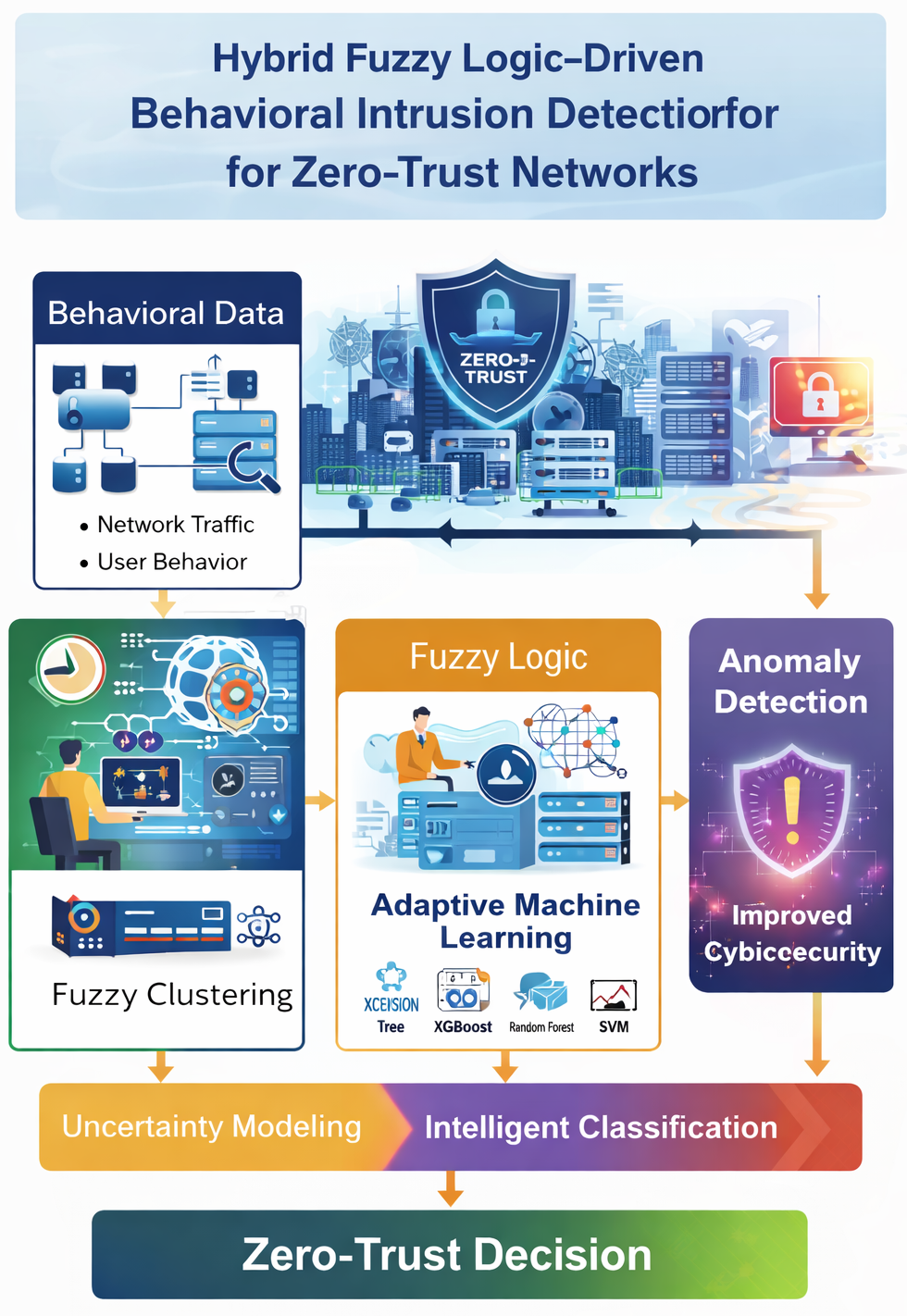
In current Zero-Trust architectures, detecting behavioral intrusions has become critical because traditional rule-based access control systems struggle to combat polymorphic, low-and-slow, and identity-spoofing attacks. Although machine learning technologies have advanced intrusion detection through behavioral pattern modeling, the inherent ambiguity in behavioral patterns and overlapping feature distributions still degrade classification accuracy and increase false positives, especially with traditional supervised models that rely on deterministic boundary conditions. Recent approaches have focused primarily on feature extraction, pre-trained deep learning models, or rule-based validation and have not addressed uncertainty quantification, highlighting a gap between real-time inference and trust-based access enforcement. To address these issues, this paper introduces a hybrid fuzzy logic-driven behavioral intrusion detection architecture that combines fuzzy clustering with adaptive machine learning models: decision tree, logistic regression, random forest, support vector machine (SVM), and extreme gradient boosting, to improve Zero-Trust decision-making. Experimental results show that combining fuzzy membership scores with divergence scores significantly improves the SVM's predictive performance on overlapping behavioral segments in the test data, outperforming other models and achieving 98.00% accuracy, 96.50% F1-score, 97.20% recall, and 97.00% area under the curve. This research integrates uncertainty-aware fuzzy computing with continuous Zero-Trust authorization, enabling dynamic trust recalibration rather than validation against a fixed threshold. The proposed solution will better categorize high-risk events, reducing operational disruptions for legitimate users. This research also contributes to the United Nations Sustainable Development Goals (SDGs), particularly SDG 9 (Industry, Innovation, and Infrastructure) and SDG 16 (Peace, Justice, and Strong Institutions), by enhancing digital infrastructure security through intelligent, adaptive cybersecurity mechanisms.
- Karakaya A. A Hybrid Approach for IoT Security: Combining Ensemble Learning with Fuzzy Logic. Sensors. 2025;25(18):5668. doi: 10.3390/s25185668
- Lilhore UK, Simaiya S, Alroobaea R, et al. SmartTrust: a hybrid deep learning framework for real-time threat detection in cloud environments using Zero-Trust Architecture. J Cloud Comp. 2025;14(1). doi: 10.1186/s13677-025-00764-7
- Ogendi EG. Leveraging Advanced Cybersecurity Analytics to Reinforce Zero-Trust Architectures within Adaptive Security Frameworks. Int J Res Publ Rev. 2025;6(2):691-704. doi: 10.55248/gengpi.6.0225.0729
- Tiwari S, Sarma W, Srivastava A. Integrating artificial intelligence with Zero-Trust architecture: Enhancing adaptive security in modern cyber threat landscape. Int J Res Anal Rev. 2022:9(2):712¨C728
- Stodt, F. Building a secure and scalable distributed network using blockchain and Zero-Trust for IIoT. Doctoral thesis. Université de Strasbourg; 2025.
- Alshieck Ali B. Efficient Trust-Aware Authentication and Task Offloading in Multi-Access Edge Computing Using a Dual Fuzzy Method Based Zero Trust Security Framework. Doctoral thesis. RMIT University; 2023. doi: 10.25439/RMT.27602841
- Cicek NE, Shafae N. Zero-Trust micro-segmentation in cloud environments: A systematic literature review of strategies, challenges, and future trends. Cloud Security Review. 2025.
- Akter L, Mollah MM, Sany NJ, Ahamed S. Zero-Trust access control systems by artificial intelligence in hybrid cloud environments. Best J Innov Sci Res Dev. 2022;1(3):45-69.
- Camila MG. A Multi-Tenant Cloud Security Framework Using Zero-Trust Architecture and AI-Based Anomaly Detection. AIJCST. 2024;6. doi: 10.63282/3117-5481/aijcst-v6i4p101
- Fojude, M. Insider threat agent: Behavioral-based Zero-Trust access control using machine learning agents. Master's thesis. Georgia Southern University; 2024.
- Saeedi Taleghani E, Maldonado Valencia RI, Sandoval Orozco AL, García Villalba LJ. Trust Evaluation Techniques for 6G Networks: A Comprehensive Survey with Fuzzy Algorithm Approach. Electronics. 2024;13(15):3013. doi: 10.3390/electronics13153013
- Liu Z, Li X, Mu D. Data-Driven Zero Trust Key Algorithm. Ning X, ed. Wirel Commun Mob Comput. 2022;2022(1). doi: 10.1155/2022/8659428
- Siddiqui EF, Haleem M, Ahmad SF, Salhi A, Zamani AT, Varish N. A Multi-Layered AI-Driven Cybersecurity Architecture: Integrating Entropy Analytics, Fuzzy Reasoning, Game Theory, and Multi-Agent Reinforcement Learning for Adaptive Threat Defense. IEEE Access. 2025;13:170235-170257. doi: 10.1109/access.2025.3610526
- Itodo CA. A novel framework for the adoption of Zero-Trust security for organizations. Doctoral thesis. University of Cincinnati; 2024.
- Arisdakessian S, Wahab OA, Mourad A, Otrok H, Guizani M. A Survey on IoT Intrusion Detection: Federated Learning, Game Theory, Social Psychology, and Explainable AI as Future Directions. IEEE Internet Things J. 2023;10(5):4059-4092. doi: 10.1109/jiot.2022.3203249
- Karthick, R. Securing digital ecosystems through a hybrid AI-cloud framework against zero-day attacks. ResearchGate. 2025.
- Mao Y, Fu W, Zhao Y, Yuan Z, Sun Z, Zhao Y. A Zero-Trust Access Control Model Based on Attribute and Dynamic Trust Evaluation for Cloud Environments. Symmetry. 2025;17(12):2059. doi: 10.3390/sym17122059
- Wang R, Li C, Zhang K, Tu B. Zero-trust based dynamic access control for cloud computing. Cybersecurity. 2025;8(1). doi: 10.1186/s42400-024-00320-x
- Hamad NA, Bakar KAA, Qamar F, Jubair AM, Mohamed RR, Mohamed MA. Systematic Analysis of Federated Learning Approaches for Intrusion Detection in the Internet of Things Environment. IEEE Access. 2025;13:95410-95444. doi: 10.1109/access.2025.3574672
- Meda F. Secure communications in the era of digital trust: Global frameworks and Zero-Trust architectures. Secur Commun Digit Trust. 2025.
- Xu D, Gondal I, Yi X, Susnjak T, Watters P, McIntosh TR. The Erosion of Cybersecurity Zero-Trust Principles Through Generative AI: A Survey on the Challenges and Future Directions. JCP. 2025;5(4):87. doi: 10.3390/jcp5040087
- Li K, Li C, Yuan X, Li S, Zou S, Sohail Ahmed S, et al. Zero-Trust Foundation Models: A New Paradigm for Secure and Collaborative Artificial Intelligence for Internet of Things. IEEE Internet Things J. 2025;12(22):46269-46293. doi: 10.1109/jiot.2025.3603957
- Ang S, Huy S, Janarthanan M. Utilizing IDS and IPS to Improve Cybersecurity Monitoring Process. JCSRA. 2025;2025(3):77-88. doi: 10.63180/jcsra.thestap.2025.3.10
- Bankó MB, Dyszewski S, Králová M, et al. Advancements in Machine Learning-Based Intrusion Detection in IoT: Research Trends and Challenges. Algorithms. 2025;18(4):209. doi: 10.3390/a18040209
- Erskine SK. Real-Time Large-Scale Intrusion Detection and Prevention System (IDPS) CICIoT Dataset Traffic Assessment Based on Deep Learning. ASI. 2025;8(2):52. doi: 10.3390/asi8020052
- Demir G. The Synergy of Fuzzy Logic and Multi-Criteria Decision-Making: Application Areas and Global Trends. JIDMIS. 2025;2:429-455. doi: 10.59543/jidmis.v2i.14157
- Nwokoro CO, Ejegwa PA. A Decade of Picture Fuzzy Sets in Multi-Criteria Decision-Making: A Comprehensive Review of Trends, Gaps, and Future Directions. KADSA. 2025;1:145-164. doi: 10.59543/kadsa.v1i.14051
- Sarkar A, Paul RK, Yeasin M, Singh AK, Paul AK. FuzzyML: fuzzy based machine learning models for predicting agricultural prices. ProcIndian Natl Sci Acad. 2025. doi: 10.1007/s43538-025-00482-3
- Arul K. Advancing Diabetes Risk Prediction Using Anfis: a Fuzzy-Logic Approach for Improved Healthcare Decision Support. In: 2025 3rd International Conference on Artificial Intelligence and Machine Learning Applications Theme: Healthcare and Internet of Things (AIMLA). IEEE; 2025:1-6. doi: 10.1109/aimla63829.2025.11040564
- Rahman A, Kundu D, Debnath T, et al. From AI to the era of explainable AI: Current state and future outlook. Expert Syst. 2025;42(6). doi: 10.1111/exsy.70060
- Alkhanbouli R, Matar Abdulla Almadhaani H, Alhosani F, Simsekler MCE. The role of explainable artificial intelligence in disease prediction: a systematic literature review and future research directions. BMC Med Inform Decis Mak. 2025;25(1). doi: 10.1186/s12911-025-02944-6
- Topuz K, Bajaj A, Coussement K, Urban TL. Interpretable machine learning and explainable artificial intelligence. Ann Oper Res. 2025;347(2):775-782. doi: 10.1007/s10479-025-06577-w
- Oladimeji OO, Taiwo GA, Adenusi DA. Unveiling the footprints of explainable AI in Industry 4.0/5.0: a systematic review and bibliometric exploration. Data Sci Manag. 2026;9(1):100160. doi: 10.1016/j.dsm.2025.07.002
- Mohammad SI, Yogeesh N, Raja N, Jabeen FTZ, Ahamed BA, Vasudevan A. Integrating fuzzy logic into economic viability studies for sustainable farming. Appl Math Inf Sci. 2025;19(2):387-401. doi: 10.18576/amis/190214
- Kalmykov VL, Kalmykov LV. Towards eXplicitly eXplainable Artificial Intelligence. Inf Fusion. 2025;123:103352. doi: 10.1016/j.inffus.2025.103352
- Maußner C, Oberascher M, Autengruber A, Kahl A, Sitzenfrei R. Explainable artificial intelligence for reliable water demand forecasting to increase trust in predictions. Water Res. 2025;268:122779. doi: 10.1016/j.watres.2024.122779
- Alkubaisi H, Danandeh Mehr A, S A, Khan MMH. Drought modelling and forecasting using shallow and deep machine learning techniques. Model Earth Syst Environ. 2024;11(1). doi: 10.1007/s40808-024-02268-w