
Discrete stochastic optimal control for multi-stakeholder
governance of crop rotation and fallow insurance

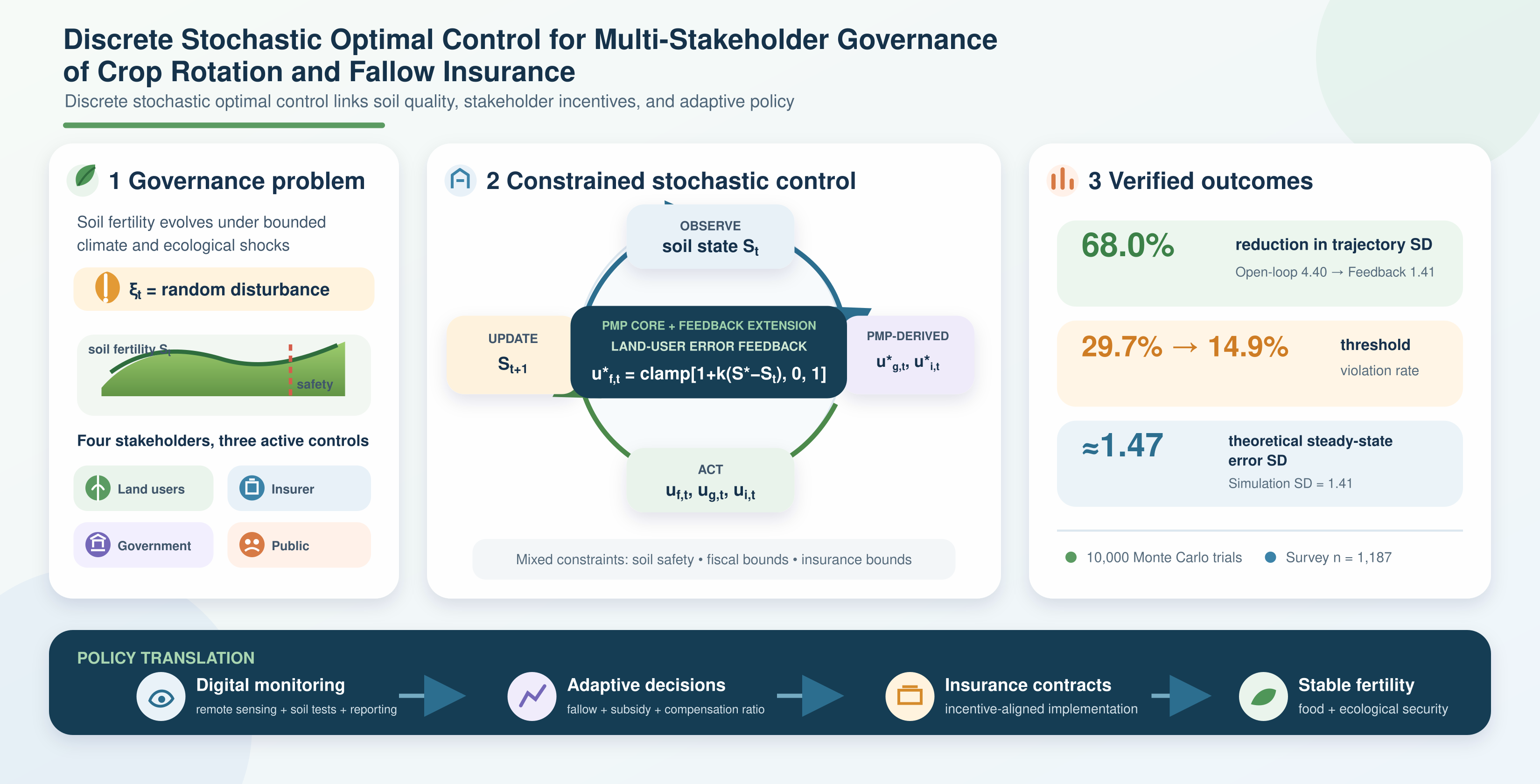
Multi-stakeholder ecological governance requires coordinated decisions under environmental uncertainty, yet existing agricultural governance models rarely integrate stochastic disturbances, dynamic stakeholder controls, and policy constraints within a unified analytical framework. This paper develops a discrete-time stochastic optimal control framework with mixed constraints for multi-agent decision systems subject to bounded random disturbances. The framework is motivated by and applied to multi-stakeholder governance of crop rotation and fallow insurance, where soil fertility serves as the system state and stakeholder decisions form the control vector. The discrete-time Pontryagin Maximum Principle yields necessary optimality conditions and analytical control laws for all agent types, including a closed-form insurance compensation ratio. Stochastic Lyapunov analysis establishes finite-horizon practical bounded mean-square behavior under the constant control law. We further propose an error feedback control law u*f,t = clamp [1 + k ( S* − St ), 0, 1] that introduces a contraction term, transforming the error dynamics from an unbounded random walk to a stable first-order autoregressive process with bounded steady-state variance 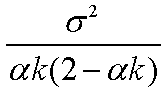 ; the optimal gain k = 1 / α yields a minimum bound of σ2. Monte Carlo simulation (10,000 trials) confirms a 68.0% reduction in trajectory standard deviation and a threshold violation rate decrease from 29.7% to 14.9%. Parameter calibration based on field survey data from 1,187 valid questionnaires across three provinces validates the theoretical model. The framework generalizes to similar multi-stakeholder ecological governance systems with stochastic disturbances.
- Bertsekas DP, Shreve SE. Stochastic Optimal Control: The Discrete-Time Case. New York, NY: Academic Press; 1978. Accessed August 24, 2026. https://books.google.com/books/about/Stochastic_Optimal_Control_The_Discrete.html?id=sRHEAAAACAAJ
- Kushner HJ. Stochastic Stability and Control. Mathematics in Science and Engineering. Vol 33. New York, NY: Academic Press; 1967. Accessed August 24, 2026. https://www.sciencedirect.com/bookseries/mathematics-in-science-and-engineering/vol/33/suppl/C
- Liu QP. Huai he liu yu hua fei shi yong kong jian te zheng ji huan jing feng xian fen xi. [Spatial characteristics and environmental risk analysis of chemical fertilizer application in Huaihe River Basin.] Ecol Environ Sci. 2015;24(9):1512-1518. [In Chinese] https://doi.org/10.16258/j.cnki.1674-5906.2015.09.014
- Song HM, Li TL, Liu Y, Huang L, Yang LF. Wo guo jin 20 nian zhu yao liang shi zuo wu chan liang jin chu kou ji hua fei tou ru bian hua te zheng. [Temporal variation of main grain crops yield, import and export and fertilizer consumption of China in the past 20 years.] J Soil Water Conserv. 2023;37(1):332-339. [In Chinese] https://doi.org/10.13870/j.cnki.stbcxb.2023.01.042
- Xie XX, Zhao MJ, Cai Y, Deng Y. Nong di xiu geng ru he ying xiang nong hu shou ru—ji yu xi bei xiu geng shi dian qu 1240 ge nong hu mian ban shu ju de shi zheng. [How does farmland fallow affect farmers’ income? Based on panel data of 1240 farmers in Northwest Fallow Pilot Areas.] Chin Rural Econ. 2020;(11):62-78. [In Chinese] https://doi.org/10.20077/j.cnki.11-1262/f.2020.11.005
- Liu D, Hu ZT, Liu JH. The impact of fallow ecological compensation on farmers’ income: taking groundwater over-exploitation areas as an example. Resour Sci. 2022;44(2):350-364. https://doi.org/10.18402/resci.2022.02.11
- Zheng T, Zhao GQ. The impact of policy-oriented agricultural insurance on China’s grain production resilience. Front Sustain Food Syst. 2025;8:1510953. https://doi.org/10.3389/fsufs.2024.1510953
- Ainiwaerjiang A, Jin X, Xie Z, Tian T, Dang Y. Research on the multi-agent motivation coupling evolution and synergy improvement for farmland ecological protection in China. Environ Sustain Indic. 2025;25:100583. https://doi.org/10.1016/j.indic.2025.100583
- Ma XP, Liu XP, Zeng QM, Wu NBT. Analysis on influencing factors of farmers’ response to cultivated land fallow policy: taking Urumqi County as an example. Chin J Agric Resour Reg Plan. 2021;42(5):237-244. https://doi.org/10.7621/cjarrp.1005-9121.20210527
- Wu HH, He LB. You dao — zi fa er fen xia nong hu xiu geng xing wei ying xiang yin su fen xi. [The analysis of factors influencing farmers’ fallowing behaviors under the ‘induced-spontaneous’ dichotomy.] Res Agric Mod. 2023;44(6):1014-1023. [In Chinese] https://doi.org/10.13872/j.1000-0275.2023.0105
- Song W, Song W. Cropland fallow reduces agricultural water consumption by 303 million tons annually in Gansu Province, China. Sci Total Environ. 2023;879:163013. https://doi.org/10.1016/j.scitotenv.2023.163013
- Liu T, Yao R. Has China’s farmland rotation and fallow system contributed to an increase in grain production? Land Use Policy. 2026;162:107907. https://doi.org/10.1016/j.landusepol.2025.107907
- Sun YP, Cai YY, Xie J. Ji yu PMC zhi shu mo xing de geng di bao hu bu chang zheng ce liang hua ping jia. [Quantitative evaluation of cultivated land protection compensation policy based on PMC index model.] J Arid Land Resour Environ. 2024;38(12):1-12. [In Chinese] https://doi.org/10.13448/j.cnki.jalre.2024.239
- Song CM, Cai YY. New old‑age insurance system for rural residents and the Conversion of Cropland to Forest and Grassland Program: theoretical analysis and empirical test. China Popul Resour Environ. 2023;33(5):193-200. https://doi.org/10.12062/cpre.20230107
- Sethi SP, Thompson GL. Optimal Control Theory: Applications to Management Science and Economics. 2nd ed. New York, NY: Springer; 2000. https://doi.org/10.1007/0-387-29903-3
- Chen F, Zeng SY, Ma J, Liu JN, Yu HC, Sun Y. Multi-scenario simulation of fallow’s impact on China’s food security. China Land Sci. 2023;37(1):90-101. https://doi.org/10.11994/zgtdkx.20221014.092941
- Bettiol P, Bourdin L. Pontryagin maximum principle for state-constrained optimal sampled-data control problems on time scales. ESAIM Control Optim Calc Var. 2021;27:51. https://doi.org/10.1051/cocv/2021046
- Ansori MF. Dynamic modeling and optimal control of bank balance sheets under capital adequacy constraints. Int J Optim Control Theor Appl. 2025;16(1):40-53. https://doi.org/10.36922/IJOCTA025250113
- Darıcı S, Şahin Z, Darıcı A. The evolution of intelligent digital profiling: a multi-sectoral synthesis of explainable artificial intelligence and federated learning frameworks. Intell Syst Res Appl J. 2026;2(2):199-229. https://doi.org/10.59543/68svs968
- Musbah J, Badi I. LLM-assisted virtual expert weight elicitation in pharmaceutical supply chains: a Z-number multi-agent framework. Intell Syst Res Appl J. 2026;2:27-39. https://doi.org/10.59543/mmhqdg22
- Wang ML. Mei guo tu di xiu geng bao hu ji hua de zhi du she ji ji ruo gan qi shi [Institutional design of the US Conservation Reserve Program and its enlightenments.] Issues Agric Econ. 2020;(5):119-122. [In Chinese] https://doi.org/10.13246/j.cnki.iae.2020.05.010
- Tilahun W, Ayenew B, Atinafu S, Enyew S. A computational and geometric analysis of economic dynamics using Pontryagin’s maximum principle: advanced numerical simulations perspective. Discov Appl Sci. 2026;8(4):418. https://doi.org/10.1007/s42452-026-08475-7
- Chen J, Yang S, Du H, Liang W, Liu Y. Horizontal ecological compensation zoning and standard in China’s major grain-producing areas based on virtual cultivated land flow. Front Environ Sci. 2025;13:1578780. https://doi.org/10.3389/fenvs.2025.1578780
- Wijesena S, Pradhan B. Advancements in weather index insurance: a review of data-driven approaches to design, pricing and risk management. Earth Syst Environ. 2025;9(3):2355-2379. https://doi.org/10.1007/s41748-025-00712-0
- Shah R, Lassoued D, Fayyaz A, Zulfiqar A, Saleem J, Ali T. Study of stability of discrete-time stochastic systems with time variations through Lyapunov’s method. Filomat. 2025;39(24):8623-8634. https://doi.org/10.2298/FIL2524623S
- Fang J. Geng di bao hu shi jiao xia lun zuo xiu geng de fa lv biao da. [Legal expression of crop rotation and fallow from the perspective of cultivated land protection.] J Nanjing Agric Univ Soc Sci Ed. 2020;20(3):111-122. [In Chinese] https://doi.org/10.19714/j.cnki.1671-7465.2020.0044
- Li L, Zhang AL. Lun zuo xiu geng ji qi bu chang de fa lv yi yun, fa li zheng cheng ji ru fa jin lu. [Legal implication, legal justification and legislative approach of crop rotation and fallow and its compensation.] China Land Sci. 2021;35(11):27-35. [In Chinese] https://doi.org/10.11994/zgtdkx.20211026.093948
- Zhu GF, Li XC, Shi YR, Zhang Y, Li ZY. Practice comparison and policy enlightenment of cultivated land crop rotation and fallow at home and abroad. Chin J Agric Resour Reg Plan. 2018;39(6):35-41,92. https://doi.org/10.7621/cjarrp.1005-9121.20180606
- Yang QY, Xin GX, Jiang JL, Chen ZT. Ou mei ji dong ya di qu geng di lun zuo xiu geng zhi du shi jian. [Practice of cultivated land crop rotation and fallow system in Europe, America and East Asia: comparison and enlightenment.] China Land Sci. 2017;31(4):71-79. [In Chinese] https://doi.org/10.11994/zgtdkx.20170421.143345
- Nie Y, Han XZ, Wang ZMH, Du YF, Li YB. Geng di xiu geng—guo wai jing yan yu zhong guo shi jian. [Cultivated land fallow: foreign experience and China’s practice. World Agric. 2022;(12):34-44. [In Chinese] https://doi.org/10.13856/j.cn11-1097/s.2022.12.003
- Kushwaha D, Biron Z. A review on safe reinforcement learning using Lyapunov and barrier functions. Artif Intell Rev. 2026. https://doi.org/10.1007/s10462-026-11611-9
- van Laatum B, Msaad S, van Henten EJ, McAllister RD, Boersma S. Stochastic model predictive control with reinforcement learning for greenhouse production systems under parametric uncertainty. Control Eng Pract. 2026;169:106787. https://doi.org/10.1016/j.conengprac.2026.106787
- Svensen JL, Cheng X, Boersma S, Sun C. Chance-constrained stochastic MPC of greenhouse production systems with parametric uncertainty. Comput Electron Agric. 2024;217:108578. https://doi.org/10.1016/j.compag.2023.108578
- Ahsen R, Di Bitonto P, Novielli P, et al. Harnessing digital twins for sustainable agricultural water management: a systematic review. Appl Sci. 2025;15(8):4228. https://doi.org/10.3390/app15084228
- Awais M, Wang X, Hussain S, Aziz F, Mahmood MQ. Advancing precision agriculture through digital twins and smart farming technologies: a review. AgriEngineering. 2025;7(5):137. https://doi.org/10.3390/agriengineering7050137
- Zhao T, Song C, Yu J, et al. Leveraging immersive digital twins and AI-driven decision support systems for sustainable water reserves management: a conceptual framework. Sustainability. 2025;17(8):3754. https://doi.org/10.3390/su17083754
- Xiong WY, Meng F, Chen H, Tan Y. Geng di “san wei yi ti” bao hu shi jiao xia zhong guo sheng yu xiu geng gui mo yu kong jian bu ju. [Provincial fallow scale and fallow spatial layout of cultivated land in China from the “Trinity” protection perspective.] Trans Chin Soc Agric Eng. 2024;40(18):240-250. [In Chinese] https://doi.org/10.11975/j.issn.1002-6819.202405110
- Zeng S, Chen F, Ma J, Liu GJ, Wanger TC. Multiscenario simulation of fallow schemes in China and their impact on food security. Land Degrad Dev. 2024;35(16):4972-4984. https://doi.org/10.1002/ldr.5271
- Yin JF, Song CQ, Gao PC, Wang GL, Ye SJ. Guo ji geng di xiu geng shi jian jing yan fen xi yu zhong guo cha yi hua xiu geng kuang jia jian gou. [Analysis of international cropland fallow practice experience and construction of differentiated fallow framework in China.] Trans Chin Soc Agric Eng. 2025;41(13):22-34. [In Chinese] https://doi.org/10.11975/j.issn.1002-6819.202504164
- Sun Y, Jiang H, Zhu X. Drivers, constraints, and policy regulation strategies for the abandonment of farmland: insights from China. Land. 2024;13(12):2096. https://doi.org/10.3390/land13122096