
Optimal reconfiguration of photovoltaic/wind-based distributed generation systems: A techno-economic analysis using AHP–GA

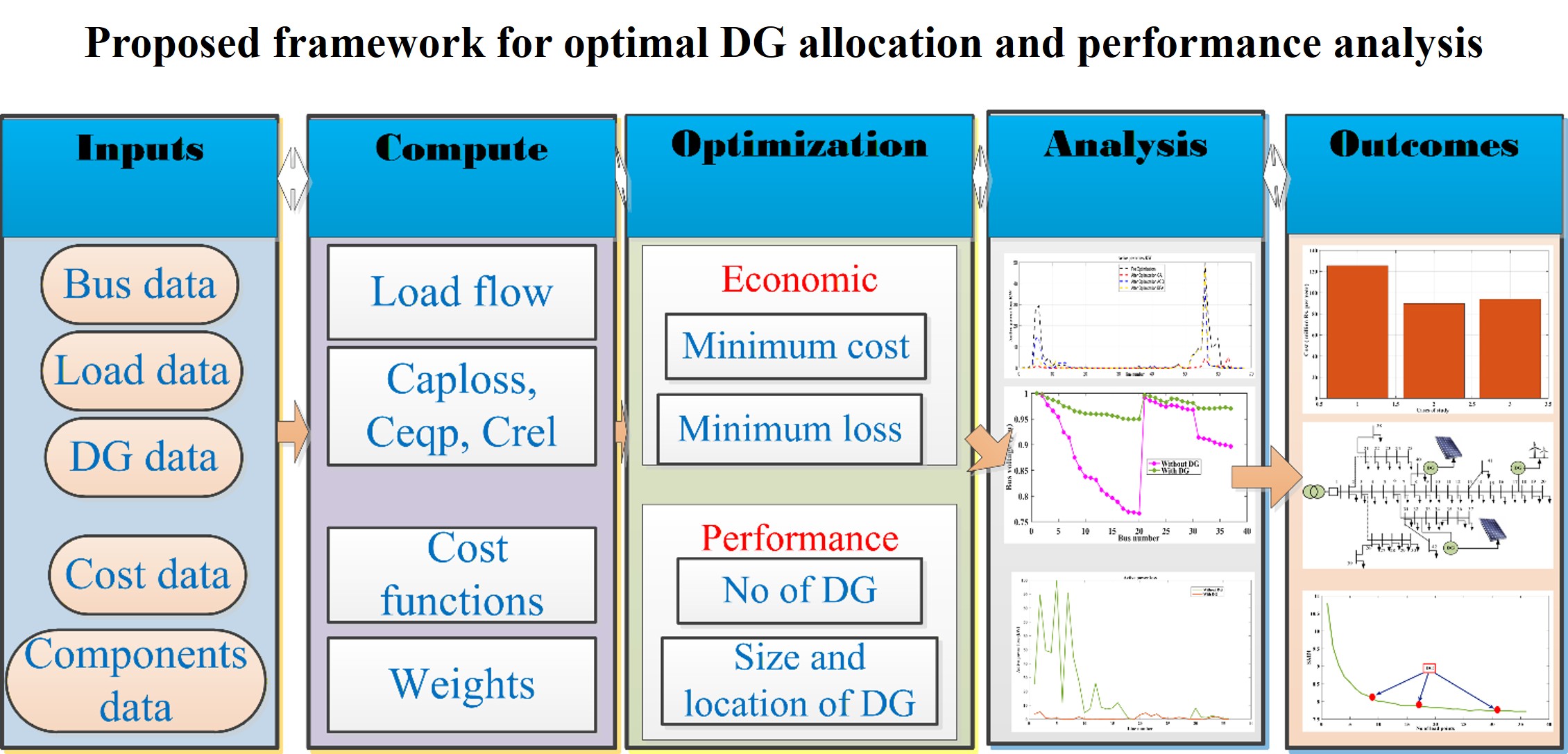
Renewable distributed generation (RDG), notably solar and wind energy, is increasingly integrated into distribution networks (DNs) to enhance sustainability, meet rising demand, and improve grid reliability. This study proposes a coordinated planning framework that jointly optimizes RDG siting/sizing and DN expansion using a hybrid Analytic Hierarchy Process–genetic algorithm (AHP–GA). Multi-objective goals—minimizing active power losses, reliability-related costs, and annual equipment investment—are scalarized using AHP-derived weights and solved through a chromosome-segmentation GA that reduces the search space and accelerates convergence. The method was validated on a modified IEEE 37-node radial distribution system, demonstrating substantial techno-economic benefits: total cost reductions exceeding 25%, approximately 75% reduction in active power losses, and about 40% improvement in reliability indices. A comparative assessment of the IEEE 69-bus system further underscored the approach’s efficiency, achieving an active power loss of 16.88 kW (a 92.50% reduction) and 112.67 s of CPU time, outperforming alternative metaheuristics. After the integration of DGs, both reliability indices improved significantly, resulting in reductions of 40.27% in System Average Interruption Duration Index (SAIDI) and 58.84% in Energy Not Served (ENS) annually. The results indicate that coordinated RDG–DN planning yields DNs that are more economical, reliable, and operationally robust than those from sequential or uncoordinated strategies.
- Zhu D, Broadwater RP, Tam KS, Seguin R, Asgeirsson H. Impact of DG placement on reliability and efficiency with time-varying loads. IEEE Trans Power Syst. 2006;21(1):419-427. https://doi.org/10.1109/TPWRS.2005.860943
- Fergany AE. Optimal allocation of multi-type distributed generators using backtracking search optimization algorithm. Int J Electr Power Energy Syst. 2015;64:1197-1205. https://doi.org/10.1016/j.ijepes.2014.09.020
- Ismael SM, Abdel Aleem SHE, Abdelaziz AY, Zobaa AF. State-of-the-art of hosting capacity in modern power systems with distributed generation. Renew Energy. 2019;130:1002-1020. https://doi.org/10.1016/j.renene.2018.07.008
- Lee SH, Park JW. Optimal placement and sizing of multiple DGs in a practical distribution system by considering power loss. IEEE Trans Ind Appl. 2013;49(5):2262-2270. https://doi.org/10.1109/TIA.2013.2260117
- Georgilakis PS, Hatziargyriou ND. Optimal distributed generation placement in power distribution networks: models, methods, and future research. IEEE Trans Power Syst. 2013;28(3):3420-3428. https://doi.org/10.1109/TPWRS.2012.2237043
- Nekooei K, Farsangi MM, Nezamabadi H, Lee KY. An improved multi-objective harmony search for optimal placement of DGs in distribution systems. IEEE Trans Smart Grid. 2013;4(1):557-567. https://doi.org/10.1109/TSG.2012.2237420
- Hung DQ, Mithulananthan N. Multiple distributed generator placement in primary distribution networks for loss reduction. IEEE Trans Ind Electron. 2013;60(4):1700-1708. https://doi.org/10.1109/TIE.2011.2112316
- Kansal S, Kumar V, Tyagi B. Optimal placement of different type of DG sources in distribution networks. Int J Electr Power Energy Syst. 2013;53:752-760. https://doi.org/10.1016/j.ijepes.2013.05.040
- Kaur S, Kumbhar G, Sharma JD. A MINLP technique for optimal placement of multiple DG units in distribution systems. Int J Electr Power Energy Syst. 2014;63:609-617. https://doi.org/10.1016/j.ijepes.2014.06.023
- Sheng W, Liu KY, Meng X, Li Y. Optimal placement and sizing of distributed generation via an improved nondominated sorting genetic algorithm II. IEEE Trans Power Deliv. 2015;30(2):569-578. https://doi.org/10.1109/TPWRD.2014.2325938
- Heidari A, Agelidis VG, Kia M. Considerations of sectionalizing switches in distribution networks with distributed generation. IEEE Trans Power Deliv. 2015;30(3):1401-1409. https://doi.org/10.1109/TPWRD.2014.2385654
- Ganguly S, Yokota H. Distributed generation allocation on radial distribution networks under uncertainties of load and generation using genetic algorithm. IEEE Trans Sustain Energy. 2015;6(3):688-697. https://doi.org/10.1109/TSTE.2015.2406915
- Abdelsalam A, Zidan A, El-Saadany A. Optimal DG allocation in radial distribution systems with high penetration of non-linear loads. Electr Power Compon Syst. 2015;43(13):1487-1497. https://doi.org/10.1080/15325008.2015.1043601
- Narayanan K, Siddiqui SA, Fozdar M. Optimal placement of distributed generators in radial distribution system for reducing the effect of islanding. J Electr Eng Technol. 2016;11(3):551-559. https://doi.org/10.5370/JEET.2016.11.3.551
- Poornazaryan B, Karimyan P, Gharehpetian G, Abedi M. Optimal allocation and sizing of DG units considering voltage stability, losses and load variations. Int J Electr Power Energy Syst. 2016;79:42-52. https://doi.org/10.1016/j.ijepes.2015.12.034
- Pereira B, Martin G, da Costa R, Contreras J, Mantovani JRS. Optimal distributed generation and reactive power allocation in electrical distribution systems. IEEE Trans Sustain Energy. 2016;7(3):975-984. https://doi.org/10.1109/TSTE.2015.2512819
- Amohadi M, Firuzabad MF. Optimal placement of switching and protection devices in radial distribution networks to enhance system reliability using the AHP-PSO method. Turk J Electr Eng Comput Sci. 2019;27(1):181-196. https://doi.org/10.3906/elk-1806-130
- Kaur N, Jain SK. Multi-objective optimization approach for placement of multiple DGs for voltage sensitive loads. Energies. 2017;10(11):1733. https://doi.org/10.3390/en10111733
- Meena NK, Parashar S, Swarnkar A, Gupta N, Niazi KR. Improved elephant herding optimization for multiobjective DER accommodation in distribution systems. IEEE Trans Ind Inform. 2018;14(3):1029-1039. https://doi.org/10.1109/TII.2017.2748220
- Eltamaly AM, Al-Saud MS. Nested multi-objective PSO for optimal allocation and sizing of renewable energy distributed generation. J Renew Sustain Energy. 2018;10(3):035302. https://doi.org/10.1063/1.5028484
- Grisales-Noreña LF, Montoya DG, Ramos-Paja CA. Optimal sizing and location of distributed generators based on PBIL and PSO techniques. Energies. 2018;11(4):1018. https://doi.org/10.3390/en11041018
- HassanzadehFard H, Jalilian A. Optimal sizing and location of renewable energy-based DG units in distribution systems considering load growth. Int J Electr Power Energy Syst. 2018;101:356-370. https://doi.org/10.1016/j.ijepes.2018.03.038
- Bhullar S, Ghosh S. Optimal integration of multi distributed generation sources in radial distribution networks using a hybrid algorithm. Energies. 2018;11(3):628. https://doi.org/10.3390/en11030628
- El-Ela AAA, El-Sehiemy RA, Abbas AS. Optimal placement and sizing of distributed generation and capacitor banks in distribution systems using water cycle algorithm. IEEE Syst J. 2018;12(4):3629-3636. https://doi.org/10.1109/JSYST.2018.2796847
- Khoubseresht O, Shayanfar H. The role of demand response in optimal sizing and siting of distribution energy resources in distribution network with time-varying load: an analytical approach. Electr Power Syst Res. 2020;180:106100. https://doi.org/10.1016/j.epsr.2019.106100
- Manna DK, Goswami SK. Optimum placement of distributed generation considering economics as well as operational issues. Int Trans Electr Energy Syst. 2020;30(3):e12246. https://doi.org/10.1002/2050-7038.12246
- Madhav MK, Yadav KB. Economic analysis of isolator placement in the radial network for enhancement of reliability indicators. Electr Eng. 2024;106(1):891-904. https://doi.org/10.1007/s00202-023-02013-z
- Pesaran HM, Nazari-Heris M, Mohammadi-Ivatloo B, Seyedi H. A hybrid genetic particle swarm optimization for distributed generation allocation in power distribution networks. Energy. 2020;209:118218. https://doi.org/10.1016/j.energy.2020.118218
- Wang HJ, Pan JS, Nguyen TT, Weng S. Distribution network reconfiguration with distributed generation based on parallel slime mould algorithm. Energy. 2022;244:123011. https://doi.org/10.1016/j.energy.2021.123011
- Kawambwa S, Hamisi N, Mafole P, Kundaeli H. A cloud model based symbiotic organism search algorithm for DG allocation in radial distribution network. Evol Intell. 2022;15:545-562. https://doi.org/10.1007/s12065-020-00529-y
- Shaheen AM, Elsayed AM, Ragab A, El-Sehiemy AY. Equilibrium optimization algorithm for network reconfiguration and distributed generation allocation in power systems. Appl Soft Comput. 2021;98:106867. https://doi.org/10.1016/j.asoc.2020.106867
- Rafi V, Dhal PK, Rajesh M, Srinivasan DR, Chandrashekhar M, Reddy NM. Optimal placement of time-varying distributed generators by using crow search and black widow-hybrid optimization. Meas Sens. 2023;30:100900. https://doi.org/10.1016/j.measen.2023.100900
- Subbaramaiah K, Sujatha P. Optimal DG unit placement in distribution networks by multi-objective whale optimization algorithm and its techno-economic analysis. Electr Power Syst Res. 2023;214:108869. https://doi.org/10.1016/j.epsr.2022.108869
- Aishvarya N, Srivastava SK, Singh SN. Congestion management approaches in restructured power system: key issues and challenges. Electr J. 2020;33(3):106715. https://doi.org/10.1016/j.tej.2020.106715
- Madhav MK, Yadav KB. Optimum location of isolator in radial distribution system using genetic algorithm to improve the system reliability. In: Kumar J, Tripathy M, Jena P, eds. Control Applications in Modern Power Systems. Lecture Notes in Electrical Engineering. Vol 870. Singapore: Springer; 2022:177-188. https://doi.org/10.1007/978-981-19-0193-5_15
- Selim A, Akher MA, Aly MM, Kamel S, Seniyu T. Fast quasi-static time-series analysis and reactive power control of unbalanced distribution systems. Int Trans Electr Energy Syst. 2019;29(1):e2673. https://doi.org/10.1002/etep.2673
- Saaty TL. A scaling method for priorities in hierarchical structures. J Math Psychol. 1977;15(3):234-281. https://doi.org/10.1016/0022-2496(77)90033-5
- Shaik MA, Mareddy PL, Visali N. Enhancement of voltage profile in distribution system by reconfiguring with DG placement using equilibrium optimizer. Alex Eng J. 2022;61(5):4081-4093. https://doi.org/10.1016/j.aej.2021.09.063
- Dashtdar M, Najafi M, Esmaeilbeig M, Bajaj M. Placement and optimal size of DG in the distribution network based on nodal pricing reduction with nonlinear load model using the IABC algorithm. Sadhana. 2022;47(2):73. https://doi.org/10.1007/s12046-022-01850-1
- Veeramsetty V, Venkaiah C, Kumar DMV. Hybrid genetic dragonfly algorithm based optimal power flow for computing LMP at DG buses for reliability improvement. Energy Syst. 2018;9(3):709-757. https://doi.org/10.1007/s12667-017-0268-2
- Rezvanfara R, Hagha MT, Zarea K. Power-based distribution locational marginal pricing under high penetration of distributed energy resources. Int J Electr Power Energy Syst. 2020;123:106303. https://doi.org/10.1016/j.ijepes.2020.106303