

Entropy-optimized radiative Maxwell ternary nanofluid flow with magnetohydrodynamics and heat generation effects

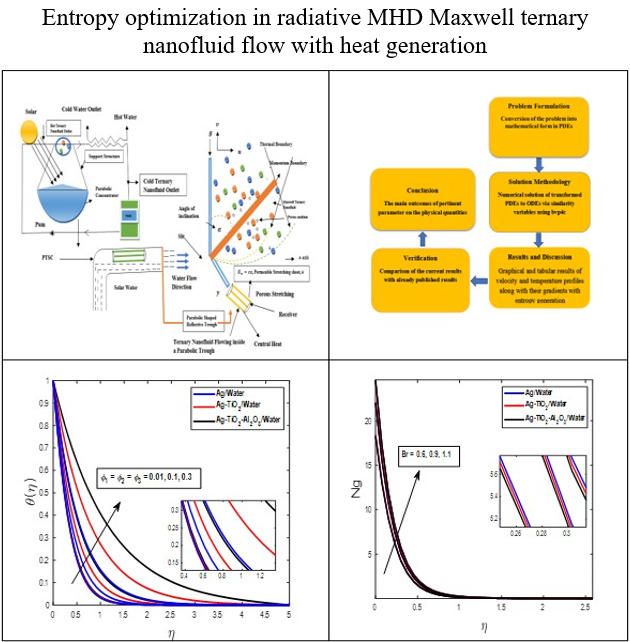
The present study investigates the mechanism of solar energy utilization as non-renewable energy in a ternary nanofluid flow and heat transfer system, incorporating a Maxwell non-Newtonian fluid over a linearly inclined stretching sheet at an inclination angle of π/4, with the effects of heat generation. The influence of a perpendicular magnetic field, which induces Lorentz forces, in a porous medium is also considered. In addition, suction at the plate and entropy generation analysis are incorporated to evaluate thermodynamic irreversibility in the system. The governing partial differential equations are transformed into a system of ordinary differential equations using appropriate similarity transformations. The transformed model is then solved using the bvp4c solver to obtain the final solution, and the results are presented in graphical and tabular form. The results indicate that increasing solar thermal radiation and magnetic field strength significantly improve temperature distribution within the system. Similarly, an increase in the heat generation parameter further enhances the temperature distribution. The presence of solar radiation enhances the fluid’s thermal efficiency. The proposed approach presents a novel framework for improving thermal management in next-generation solar energy technologies. The magnetic force, while influencing fluid motion, also affects the system’s thermal behavior. The results are compared at the end to assess the validity of the current solutions. The study further demonstrates that an increase in the Brinkman number results in a decrease in the Bejan number. Since the Bejan number represents the heat transfer irreversibility within the fluid, the increasing resistance, driven by the Brinkman number, directly affects it, thereby reducing the system’s overall thermodynamic efficiency. The comparison with previously published results shows strong agreement, validating the accuracy and reliability of the present model. A sensitivity analysis is also performed to evaluate the relative influence and ranking of key governing parameters on the system response.
1. Manjunatha S, Puneeth V, Gireesha BJ, Chamkha A. Theoretical study of convective heat transfer in ternary nanofluid flowing past a stretching sheet. J Appl Comput Mech. 2022;8(4):1279-1286. https://doi.org/10.22055/jacm.2021.37698.3067
2. Alshahrani S, Ahammad NA, Bilal M, et al. Numerical simulation of ternary nanofluid flow with multiple slip and thermal jump conditions. Front Energy Res. 2022;10:967307. https://doi.org/10.3389/fenrg.2022.967307
3. Adun H, Adedeji M, Dagbasi M, Bamisile O, Senol M, Kumar R. A numerical and exergy analysis of the effect of ternary nanofluid on performance of photovoltaic thermal collector. J Therm Anal Calorim. 2021;145(3):1413-1429. https://doi.org/10.1007/s10973-021-10575-y
4. Nasir S, Sirisubtawee S, Juntharee P, Berrouk AS, Mukhtar S, Gul T. Heat transport study of ternary hybrid nanofluid flow under magnetic dipole together with nonlinear thermal radiation. Appl Nanosci. 2022;12(9):2777-2788. https://doi.org/10.1007/s13204-022-02583-7
5. Arif M, Kumam P, Kumam W, Mostafa Z. Heat transfer analysis of radiator using different shaped nanoparticles water-based ternary hybrid nanofluid with applications: a fractional model. Case Stud Therm Eng. 2022;31:101837. https://doi.org/10.1016/j.csite.2022.101837
6. Algehyne EA, Alrihieli HF, Bilal M, Saeed A, Weera W. Numerical approach toward ternary hybrid nanofluid flow using variable diffusion and non-Fourier’s concept. ACS Omega. 2022;7(33):29380-29390. https://doi.org/10.1021/acsomega.2c03634
7. Alharbi KAM, Ahmed AES, Ould Sidi M, et al. Computational valuation of Darcy ternary-hybrid nanofluid flow across an extending cylinder with induction effects. Micromachines. 2022;13(4):588. https://doi.org/10.3390/mi13040588
8. Zayan JM, Rasheed AK, John A, et al. Synthesis and characterization of novel ternary-hybrid nanoparticles as thermal additives. Materials. 2022;16(1):173. https://doi.org/10.3390/ma16010173
9. Priyadharshini P, Archana MV, Shah NA, Alshehri MH. Ternary hybrid nanofluid flow emerging on a symmetrically stretching sheet optimization with machine learning prediction scheme. Symmetry. 2023;15(6):1225. https://doi.org/10.3390/sym15061225
10. Jan SU, Khan U, Abd El-Rahman M, Islam S, Hassan AM, Ullah A. Effect of variable thermal conductivity of ternary hybrid nanofluids over a stretching sheet with convective boundary conditions and magnetic field. Results Eng. 2023;20:101531. https://doi.org/10.1016/j.rineng.2023.101531
11. Sajjan K, Shah NA, Ahammad NA, Raju CSK, Kumar MD, Weera W. Nonlinear Boussinesq and Rosseland approximations on 3D flow in an interruption of ternary nanoparticles with various shapes of densities and conductivity properties. AIMS Math. 2022;7(10):18416-18449. https://doi.org/10.3934/math.20221014
12. Sohail M, El-Zahar ER, Mousa AAA, Althobaiti S, Shah NA, Chung JD. Finite element analysis for ternary hybrid nanoparticles on thermal enhancement in pseudo-plastic liquid through porous stretching sheet. Sci Rep. 2022;12(1):9219. https://doi.org/10.1038/s41598-022-20206-7
13. Ramesh GK, Madhukesh JK, Das R, Shah NA, Yook SJ. Thermodynamic activity of a ternary nanofluid flow passing through a permeable slipped surface with heat source and sink. Waves Random Complex Media. 2025;35(2):3499-3519. https://doi.org/10.1080/17455030.2022.2053237
14. Faizan M, Ajithkumar M, Reddy MV, et al. A theoretical analysis of the ternary hybrid nano-fluid with Williamson fluid model. Ain Shams Eng J. 2024;15(8):102839. https://doi.org/10.1016/j.asej.2024.102839
15. Abbas M, Khan N, Hashmi MS, et al. Numerical simulation of Darcy–Forchheimer flow of Casson ternary hybrid nanofluid with melting phenomena and local thermal non-equilibrium effects. Case Stud Therm Eng. 2024;60:104694. https://doi.org/10.1016/j.csite.2024.104694
16. Farouk B, Shayer H. Natural convection around a heated cylinder in a saturated porous medium. J Heat Transfer. 1988;110(3):642-648. https://doi.org/10.1115/1.3250540
17. Hossain MA, Vafai K, Khanafer KM. Non-Darcy natural convection heat and mass transfer along a vertical permeable cylinder embedded in a porous medium. Int J Therm Sci. 1999;38(10):854-862. https://doi.org/10.1016/S1290-0729(99)80040-4
18. Pop I, Na TY. Conjugate free convection over a vertical slender hollow cylinder embedded in a porous medium. Heat Mass Transf. 2000;36(5):375-379. https://doi.org/10.1007/s002310000124
19. Ullah Z, Alam MM, Khan AA, Alkarni S, Merga FE. Radiative heat and mass transfer of second-grade nanofluid slip flow with variable thermal properties. AIP Adv. 2025;15(3). https://doi.org/10.1063/5.0254208
20. Salih AA, Ullah Z, Alam MM, et al. Turbulent heat and mass transfer in Williamson nanofluid flow over gasketed-plate heat exchanger: Influence of exothermic catalytic-reaction and radiative-heat source. Eng Sci Technol Int J. 2026;76:102305. https://doi.org/10.1016/j.jestch.2026.102305
21. Riaz MB, Naseer F, Abbas M, Abd El-Rahman M, Nazir T, Chan CK. Solitary wave solutions of Sawada–Kotera equation using two efficient analytical methods. AIMS Math. 2023;8(12):31268-31292. https://doi.org/10.3934/math.20231601
22. Syed NH, Khan NA, Ahmad N, et al. CFD analysis to investigate the effect of inserts on the overall heat transfer coefficient in a concentric tube heat exchanger. Eng Technol Appl Sci Res. 2024;14(6):18077-18085. https://doi.org/10.48084/etasr.8891
23. Maatki C, Bilal M, Ahmad N, et al. Numerical study of three-dimensional unsteady viscous fluid flow across parallel rotating discs with an upward fluctuation and thermal radiation. J Radiat Res Appl Sci. 2025;18(2):101577. https://doi.org/10.1016/j.jrras.2025.101577
24. Chamkha AJ. Solar radiation assisted natural convection in uniform porous medium supported by a vertical flat plate. J Heat Transfer. 1997;119(1):89-96. https://doi.org/10.1115/1.2824104
25. Mahendran MS, Wong LS, Dhanapal ACTA, Djearamane S. The effect of titanium dioxide nanoparticles on Haematococcus pluvialis biomass concentration. J Exp Biol Agric Sci. 2023;11(2):416-422. https://doi.org/10.18006/2023.11(2).416.422
26. Ghasemi SE, Hatami M, Jing D, Ganji DD. Nanoparticles effects on MHD fluid flow over a stretching sheet with solar radiation: a numerical study. J Mol Liq. 2016;219:890-896. https://doi.org/10.1016/j.molliq.2016.03.065
27. Chen X, Xia XL, Liu H, Li Y, Liu B. Heat transfer analysis of a volumetric solar receiver by coupling the solar radiation transport and internal heat transfer. Energy Convers Manag. 2016;114:20-27. https://doi.org/10.1016/j.enconman.2016.01.074
28. Pustovalov VK. Modeling and analysis of optical properties of nanoparticles and nanofluids for effective absorption of solar radiation and their heating. SN Appl Sci. 2019;1:356. https://doi.org/10.1007/s42452-019-0370-2
29. Obalalu AM, Ajala AO, Akindele AO, Oladapo OA, Adepoju O, Jimoh MO. Unsteady squeezed flow and heat transfer of dissipative Casson fluid using optimal homotopy analysis method: an application of solar radiation. Partial Differ Equ Appl Math. 2021;4:100146. https://doi.org/10.1016/j.padiff.2021.100146
30. Aziz S, Javed R, Nowak A, et al. Effects of TiO2, Ag-TiO2, and Cu-TiO2 nanoparticles on mechanical and anticariogenic properties of conventional pit and fissure sealants. Open Nano. 2023;14:100185. https://doi.org/10.1016/j.onano.2023.100185
31. Khan WA, Pop I. Boundary-layer flow of a nanofluid past a stretching sheet. Int J Heat Mass Transf. 2010;53(11-12):2477-2483. https://doi.org/10.1016/j.ijheatmasstransfer.2010.01.032
32. Rauf A, Hussain F, Mushtaq A, Shah NA, Ali MR. MHD mixed convection flow for Maxwell hybrid nanofluid with Soret, Dufour and morphology effects. Arab J Chem. 2023;16(8):104965. https://doi.org/10.1016/j.arabjc.2023.104965
33. Varatharaj K, Tamizharasi R, Vajravelu K. Ternary hybrid nanofluid flow and heat transfer at a permeable stretching sheet with slip boundary conditions. Eur Phys J Spec Top. 2025;234:2293-2316. https://doi.org/10.1140/epjs/s11734-024-01295-z
34. Devi SA, Devi SSU. Numerical investigation of hydromagnetic hybrid Cu–Al₂O₃/water nanofluid flow over a permeable stretching sheet with suction. Int J Nonlinear Sci Numer Simul. 2016;17(5):249-257. https://doi.org/10.1515/ijnsns-2016-0037
35. Mukherjee S, Poloju V, Mishra PC. Heat transfer, exergoeconomic performance and sustainability impact of a novel CuO + MgO + GO/water ternary nanofluid. Appl Therm Eng. 2023;235:121391. https://doi.org/10.1016/j.applthermaleng.2023.121391
36. Aich W, Hussanan A, Abbas A, et al. Inclined magnetic field and chemical reaction effects on Maxwell hybrid nanofluid flow in a non-Darcy porous medium. Z Angew Math Mech. 2025;105(8):e70172. https://doi.org/10.1002/zamm.70172
37. Jameel M, Shah Z, Rooman M, Alshehri MH, Vrinceanu N. Entropy generation analysis on Darcy–Forchheimer Maxwell nanofluid flow past a porous stretching sheet with threshold non-Fourier heat flux model and Joule heating. Case Stud Therm Eng. 2023;52:103738. https://doi.org/10.1016/j.csite.2023.103738
38. Amudhini M, De P. Irreversibility analysis on tetra-hybrid non-Newtonian fluids with thermal radiation and Soret–Dufour effects over porous inclined stretching sheet. Results Eng. 2025;26:104786. https://doi.org/10.1016/j.rineng.2025.104786
39. Razzaq A, Hayat T, Khan SA, Razaq A. New concepts of magnetohydrodynamics and entropy rate for radiative nanofluid flow invoking artificial neural network approach. Results Eng. 2025;27:106343. https://doi.org/10.1016/j.rineng.2025.106343