
Complex variable neural network controller for port-Hamiltonian systems with non-holonomic constraints

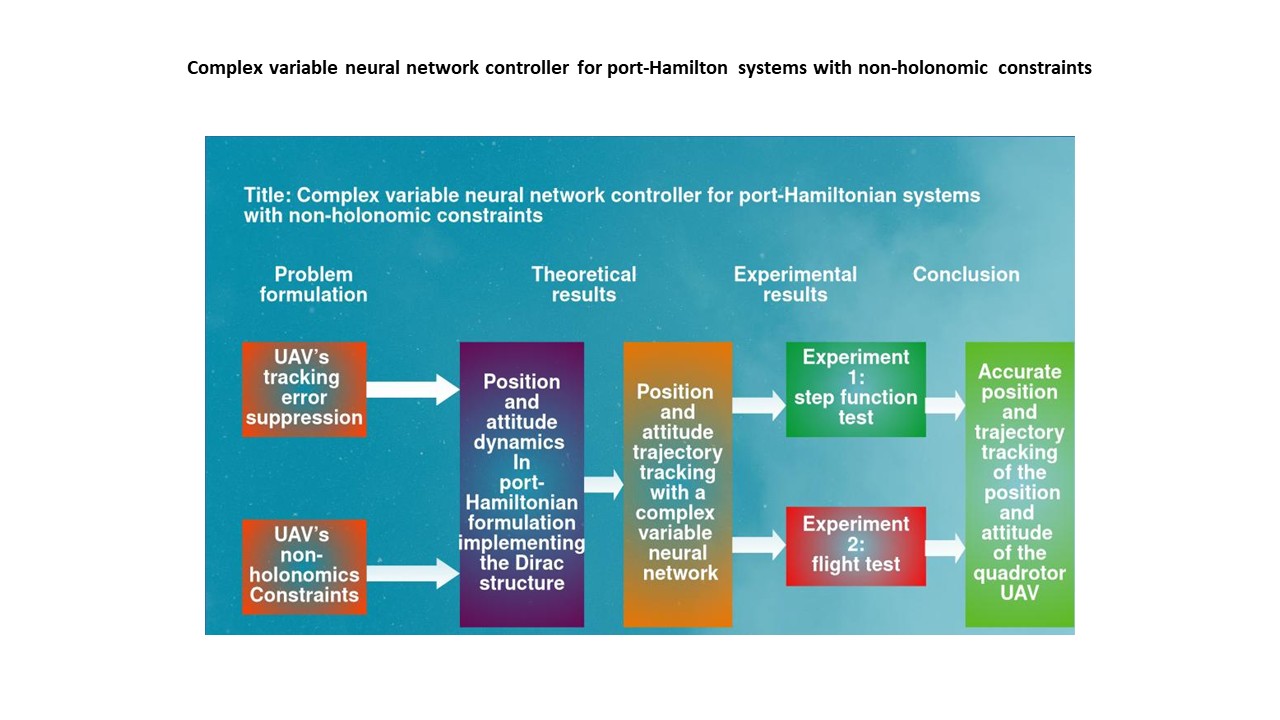
This study presents a complex variable neural network (CVNN) controller designed for unmanned aerial vehicles (UAVs) using the port-Hamiltonian formulation with non-holonomic constraints. The approach begins by deriving the dynamic model of a quadrotor UAV in port-Hamiltonian form, where the Hamiltonian is constructed from the system’s total kinetic and potential energies. Dirac structures are implemented to preserve the system’s structural properties while incorporating non-holonomic constraints specifically in the attitude loop. The proposed control architecture decouples the attitude and position control loops, with each utilizing a CVNN controller designed through Lyapunov stability analysis. Theoretical proofs establish the stability of both control loops, while numerical simulations demonstrate the effectiveness of the proposed approach for trajectory tracking tasks. Comparative analysis against existing controllers shows superior performance in reducing root mean square errors while maintaining reasonable control effort. The results confirm that the CVNN controller effectively manages the UAV’s dynamic behavior even with non-holonomic constraints limiting the vehicle’s orientation range.
- Pu J, Zhang Q, Zhao W, Zhang W, Qin Z, Zhang Y. Research on refined UAV inspection method of wind/solar power stations based on YOLOv8. J Eng Appl Sci. 2025;72(1). https://www.doi.org/10.1186/s44147-025-00576-1
- Li X, Wang A. Forest pest monitoring and early warning using UAV remote sensing and computer vision techniques. Sci Rep. 2025;15(1). https://www.doi.org/10.1038/s41598-024-84464-3
- Tarpenning MS, Bramante JT, Coombe KD, et al. Comparison of unmanned aerial vehicle imaging to ground truth walkthroughs for identifying and classifying trash sites serving as potential Aedes aegypti breeding grounds. Parasit Vectors. 2025;18(1). https://www.doi.org/10.1186/s13071-025-06706-1
- Xu P, Sulaiman NAA, Ding Y, Zhao J. Innovative segmentation technique for aerial power lines via amplitude stretching transform. Sci Rep. 2025;15(1). https://www.doi.org/10.1038/s41598-025-86753-x
- Van Haeften S, Smith D, Robinson H, et al. Unmanned aerial vehicle phenotyping of agro-nomic and physiological traits in mungbean. Plant Phenome J. 2025;8(1). https://www.doi.org/10.1002/ppj2.70016
- Li J, Ling M, Fu B, et al. UAV based smart grazing: a prototype of space-air-ground integrated grazing IoT networks in Qinghai-Tibet plateau. Discov IoT. 2025;5(1). https://www.doi.org/10.1007/s43926-025-00114-8
- Liller J, Goel R, Aziz A, Hester J, Nguyen P. Development of a battery free, solar powered, and energy aware fixed wing unmanned aerial vehicle. Sci Rep. 2025;15(1). https://www.doi.org/10.1038/s41598-025-90729-2
- Han G. Bio-inspired swarm intelligence for en-hanced real-time aerial tracking: integrating whale optimization and grey wolf optimizer algo-rithms. Discov Artif Intell. 2025;5(1). https://www.doi.org/10.1007/s44163-025-00237-5
- Liu Y, Zhang H, Zheng H, Li Q, Tian Q. A spherical vector-based adaptive evolutionary particle swarm optimization for UAV path planning under threat conditions. Sci Rep. 2025;15(1). https://www.doi.org/10.1038/s41598-025-85912-4
- Bouzid Y, Siguerdidjane H, Bestaoui Y, Zareb M. Energy Based 3D Autopilot for VTOL UAV Un-der Guidance and Navigation Constraints. J Intell Robot Syst Theory Appl. 2017;87(2):341–362. https://www.doi.org/10.1007/s10846-016-0441-1
- Rashad R, Engelen JBC, Stramigioli S. Energy Tank-Based Wrench/Impedance Control of a Fully-Actuated Hexarotor: A Geometric Port-Hamiltonian In: 2019 International Conference on Robotics and Automation (ICRA). IEEE ; 2019:6418-6424. https://www.doi.org/10.1109/icra.2019.8793939
- Souza C, Raffo GV, Castelan EB. Passivity Based Control of a Quadrotor IFAC-PapersOnLine. 2014;47(3):3196-3201. https://www.doi.org/10.3182/20140824-6-za-1003.02335
- Rashad R, Califano F, Stramigioli Port-Hamiltonian Passivity-Based Control on SE(3) of a Fully Actuated UAV for Aerial Physical Interaction Near-Hovering. IEEE Robotics and Automation Letters. 2019;4(4):4378–4385. https://www.doi.org/10.1109/LRA.2019.2932864
- Avazzadeh Z, Hassani H, Eshkaftaki AB, Ebadi M, Agarwal P. Optimal solution of nonlinear 2D variable-order fractional optimal control problems using generalized Bessel polynomials. J Vib Control. 2025;31(7-8):1457-1471. https://doi.org/10.1177/10775463241227475
- Zhou W, Xu Z, Wu Y, Xiang J, Li Y. Energy-based trajectory tracking control of under-actuated unmanned surface vessels. Ocean Eng. 2023;288. https://www.doi.org/10.1016/j.oceaneng.2023. 116166
- Ma L, Pang S, He Y, Wu Y, Li Y, Zhou W. Passivity-Based Sliding Mode Control for the Ro-bust Trajectory Tracking of Unmanned Surface Vessels Under External Disturbances and Model Uncertainty. J Mar Sci Eng. 2025;13(2). https://doi.org/10.3390/jmse13020364
- Lv C, Chen J, Yu H, Chi J, Yang Z. Adaptive NN state error PCH trajectory tracking control for unmanned surface vessel with uncertain-ties and input saturation. Asian J Control. 2023;25(5):3903–3919. https://www.doi.org/10.1002/asjc.3076
- Jin L, Yu S, Zhao Q, Shi G, Wu X. Fixed-time H-infinity tracking control of unmanned underwater vehicles with disturbance rejection via Port-Hamiltonian framework. Ocean Eng. 2024;293. https://www.doi.org/10.1016/j.oceaneng.2023.116533
- Wang Z, Zhang Y, Gao Q, Chen J, Lv C. Fourier-Based Formation Control of Multiple Unmanned Surface Vessels Using a State Error Port Control Hamiltonian Framework. In: 2024 China Automation Congress (CAC). IEEE ; 2024:2490-2495. https://www.doi.org/10.1109/cac63892.2024.10865534
- Lv C, Wang Z, Zhang Y, Chen J, Yu H. Cooperative formation control of multiple unmanned surface vessels based on state error port control Hamiltonian framework. Ocean Eng. 2024;313. https://www.doi.org/10.1016/j.oceaneng.2024.11941
- Feng L, Yu J, Hu C, Yang C, Jiang H. Nonseparation Method-Based Finite/Fixed-Time Synchronization of Fully Complex-Valued Discontinuous Neural Networks. EEE Trans Cybern. 2021;51(6):3212–3223. https://www.doi.org/10.1109/TCYB.2020.2980684
- Jayanthi N, Santhakumari R. Passivity analysis of multiple time-varying time delayed complex vari-able neural networks in finite-time. Math Model Comput. 2021;8(4):842–854. https://www.doi.org/10.23939/mmc2021.04.842
- Liu B, Mei X, Jiang H, Wu L. A Nonpenalty Neurodynamic Model for Complex-Variable Optimization. Discrete Dyn Nat Soc. 2021;2021. https://www.doi.org/10.1155/2021/6632257
- Sriraman R, Manoj N, Agarwal P, Vigo-Aguiar J, Jain Event-triggered control for exponential synchronization of reaction–diffusion fractional-order Clifford-valued delayed neural networks and its application to image encryption. Neurocomputing. 2025;648:130604. https://doi.org/10.1016/j.neucom.2025.130604
- Chen W, Ding Y, Weng F, Liang C, Li J. Global Fast Terminal Fuzzy Sliding Mode Control of Quadrotor UAV Based on RBF Neural Network. Sensors. 2025;25(4). https://www.doi.org/10.3390/s25041060
- Xiong JJ, Li C. Neuroadaptive Sliding Mode Tracking Control for an Uncertain TQUAV With Unknown Controllers. Int J Robust Nonlin. 2025;35(2):579–590. https://www.doi.org/10.1002/rnc.7664
- Li J, Wu L. A multiple connected recurrent neural network based super-twisting terminal sliding mode control for quad-rotor UAV. Eur J Control. 2025;83. https://www.doi.org/10.1016/j.ejcon.2025.101220
- Chai Y, Yang Z, Yu H, Liang X, Han J. Adaptive Trajectory Tracking Control for Double-Pendulum Aerial Transportation System. IEEE Trans Ind Electron. 2025. https://www.doi.org/10.1109/TIE.2025.3536563
- Mahmood A, Rehman uF, Okasha M, Saeed A. Neural Adaptive Sliding Mode Control for Camera Positioner Quadrotor UAV. Int J Aeronaut Space Sci. 2025;26(2):733–747. https://www.doi.org/10.1007/s42405-024-00781-x
- Li B, Chen M, Qi S, Peng K. Finite-time fault-tolerant control of attitude control system of quadrotor UAV based on neural network disturbance observer. Neural Comput Appl. 2025;37(7):5597–5606. https://www.doi.org/10.1007/s00521-024-10927-3
- Wu LF, Wang Z, Rastgaar M, Mahmoudian N. Adaptive velocity control for UAV boat landing: A neural network and particle swarm optimization approach. J Intell Robot Syst. 2025;111(1). https://www.doi.org/10.1007/s10846-024-02201-4
- Peng C, Qiao G, Ge B. Dynamic Cascade Spiking Neural Network Supervisory Controller for a Non-planar Twelve-Rotor UAV. Sensors. 2025;25(4). https://www.doi.org/10.3390/s25041177
- Zhang Y, Sha H, Peng R, et al. Adaptive Observer-Based Neural Network Control for Multi-UAV Systems with Predefined-Time Stability. Drones. 2025;9(3). https://www.doi.org/10.3390/drones9030222
- Bekhiti A, Souanef T, Toubakh H, Horri N, Kafi MR, Bouzid Z. Adaptive UAV Control with Sensor and Actuator Faults Recovery. Aerospace. 2025;12(3). https://www.doi.org/10.3390/aerospace12030261
- van der Schaft A, Maschke B. Differential operator Dirac structures. IFAC-PapersOnLine. 2021;54(19):198-203. https://doi.org/10.1016/j.ifacol.2021.11.078
- Ye Y, Li Z, Li C, Shen S, Ma WX. A generalized Dirac soliton hierarchy and its bi-Hamiltonian structure. Appl Math Lett. 2016;60:67-72. https://doi.org/10.1016/j.aml.2016.04.010
- Yoshimura H, Gay-Balmaz Dirac structures in nonequilibrium thermodynamics. IFAC-PapersOnline. 2018;51(3):31-37. https://www.doi.org/10.1016/j.ifacol.2018.06.009
- Kumar N, Zwart H, van der Vegt J. Dirac structure for linear dynamical systems on Sobolev spaces. J Math Anal Appl. 2025;549(2):129493. https://doi.org/10.1016/j.jmaa.2025.129493
- Gay-Balmaz F, Yoshimura H. Variational and Dirac structures for interconnected distributed-discrete IFAC-PapersOnline. 2024;58(6):286-291. https://doi.org/10.1016/j.ifacol.2024.08.295
- Tortorella AG. The deformation L-infinity algebra of a Dirac–Jacobi structure. Differential Geometry and its Applications. 2022;80:101846. https://doi.org/10.1016/j.difgeo.2021.101846
- Seslija M, van der Schaft A, Scherpen JMA. Reduction of Stokes-Dirac structures and gauge symmetry in port-Hamiltonian systems. IFAC-PapersOnLine. 2012;45(19):114-119. https://www.doi.org/10.3182/20120829-3-it-4022.00030
- Lamoline F, Hastir A. On Dirac structure of infinite-dimensional stochastic port-Hamiltonian systems. Eur J Control. 2024; 75:100924. https://doi.org/10.1016/j.ejcon.2023.100924
- Cervera J, van der Schaft A, Ban˜os A. Interconnection of port-Hamiltonian sys-tems and composition of Dirac structures. Automatica 2007;43(2):212-225. https://doi.org/10.1016/j.automatica.2006.08.014
- Azar AT, Serrano FE, Koubaa A, Taha MA, Kamal NA. Fast terminal sliding mode controller for high speed and complex maneuvering of unmanned aerial vehicles. In: Unmanned Aerial Systems. Elsevier; 2021:203-230. https://www.doi.org/10.1016/b978-0-12-820276-0.00016-9
- Fujimoto K, Sakai S, Sugie Passivity Hamiltonian based control of a class of systems with non-holonomic Automatica. 2012;48(12):constraints. 3054-3063. https://doi.org/10.1016/j.automatica.2012.08.032
- Hui M, Zhang J, Iu HHC, Yao R, Bai L. A novel intermittent sliding mode con-trol approach to finite-time synchroniza-tion of complex-valued neural networks. Neurocomputing. 2022;513: 181-193. https://doi.org/10.1016/j.neucom.2022.09.111
- Singha A, Thakur S, Ray AK. Lyapunov based trajectory tracking controller for a quadro-tor UAV with nonholonomic constraints. e-Prime - Advances in Electrical Engineering, Electronics and Energy. 2024;8:100617. https://doi.org/10.1016/j.prime.2024.100617
- Shukla A, Arora U, Sukavanam N. Approximate controllability of retarded semilinear stochastic system with non local conditions. Appl Math Comput. 2015;49:513–527. https://doi.org/10.1007/s12190-140851-9
- Shukla A, Sukavanam N. Interior approximate controllability of second-order semi-linear control systems. Int J Control. 2024;97(3):615–624. https://www.doi.org/10.1080/00207179.2022. 2161013
- Rezapour S, Henr´ıquez HR, Vijayakumar V, Nisar KS, Shukla A. A Note on Existence of Mild Solutions for Second-Order Neutral Integro-Differential Evolution Equations with State-Dependent Delay. Fractal Fract. 2021;5(3). https://www.doi.org/10.3390/fractalfract5030126