

Enhanced audio classification with quantum-inspired neural layers and exponentially weighted attention fusion

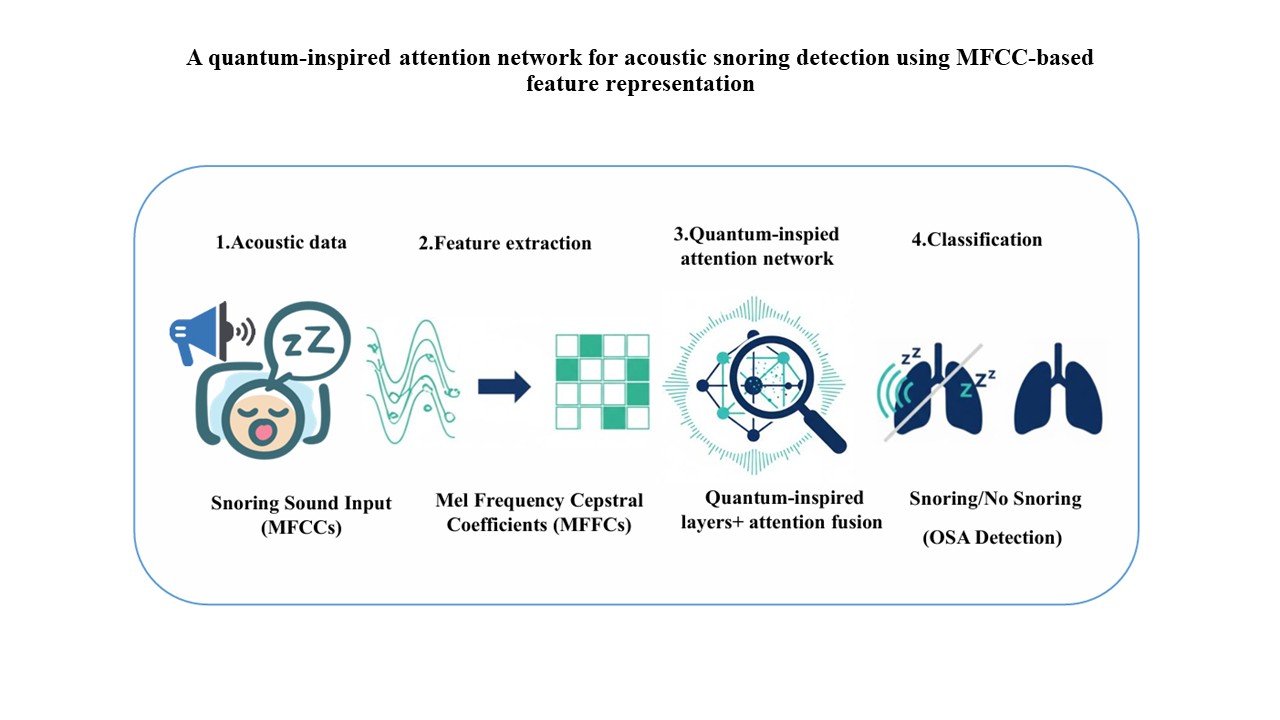
Snoring is a common sleep problem and may indicate underlying health conditions, such as obstructive sleep apnea. Accurate detection and classification of snoring sounds are critical for early diagnosis and effective treatment. Traditional snoring detection methods rely on manual analysis or rule-based systems, which are often time-consuming and error-prone. With advances in deep learning and quantum-inspired computing, an opportunity has emerged to develop more powerful and intelligent solutions to automate snoring classification. In this paper, we propose a quantum-inspired attention fusion network for snoring detection, using Mel-Frequency Cepstral Coefficients as the primary representation of acoustic features. The network combines quantum-inspired layers with an attention mechanism to enhance feature learning and improve classification accuracy, offering a novel approach to audio analysis in the healthcare domain. The quantum-inspired layer simulates quantum gates using dense neural layers, enabling the model to detect complex patterns in audio data, while an attention mechanism dynamically weights the most important features to improve classification. The model achieved outstanding performance with an accuracy of 0.997, a prediction precision of 0.997, a recall of 0.997, and an average F1-score of 0.997, demonstrating its ability to generalize well and classify snoring sounds with near-perfect accuracy.
- Hong J, et al. Real-time snoring detection using deep learning: a home-based smartphone approach for sleep monitoring. Nat Sci Sleep. 2025;17:519-530. https://www.doi.org/10.2147/NSS.S514631
- Meenal T, Asokan R. Quantum-inspired adaptive feature fusion for highly accurate brain tumor classification in MRI using deep learning. Biomed Signal Process Control. 2026;112:108694. https://www.doi.org/10.1016/j.bspc.2025.108694
- Xu X, Gan Y, Yuan X, Cheng Y, Zhou L. Non- contact screening of OSAHS using multi-feature snore segmentation and deep learning. 2025;25(17):5483. https://www.doi.org/10.3390/s25175483
- Hassan E, Ghazalah SA, Al-Shehri F, et al. Optimizing deepfake audio detection: fragment feature overlaid quantization model for high accuracy and efficiency. Int J Mach Learn Cybern. 2025;16:8933- 8952. https://www.doi.org/10.1007/s13042-025-02777- 9
- Li H, et al. CTAL: pre-training cross-modal trans- former for audio-and-language representations. In: Proceedings of the 2021 Conference on Empirical Methods in Natural Language Processing. 2021:3966-3977. https://www.doi.org/10.18653/v1/2021.emnlp-main.323
- Khan F, Sareen A, Kumar AS, Bhuvaneswari M. A quantum-hybrid framework for enhanced deepfake detection: integrating QAOA-based feature selection with quantum-inspired attention mechanisms. IEEE Access. 2026;14:17853-17873. https://www.doi.org/10.1109/ACCESS.2026. 3659021
- Pandeya YR, et al. A monophonic cow sound annotation tool using a semi-automatic method on audio/video data. Livest Sci. 2022;256:104811. https://www.doi.org/10.1016/j.livsci.2021.104811
- Atenco JC, Moreno JC, Ramirez JM. Audiovisual biometric network with deep feature fusion for identification and text prompted verification. 2023;16(2):66. https://www.doi.org/10.3390/a16020066
- Shi J, Li Z, Lai W, et al. Two end-to-end quantum-inspired deep neural networks for text classification. IEEE Trans Knowl Data Eng. 2021;35(4):4335-4345. https://www.doi.org/10.1109/TKDE.2021.3130598
- Xu Z, Shen K, Cai P, et al. Parallel proportional fusion of a spiking quantum neural network for optimizing image classification. Appl Intell. 2024;54(22):11876-11891. https://www.doi.org/10.1007/s10489-024-05786-3
- Dai W, Wang W, Lu Y, Du P, Shi J. Quantum audio neural networks with time-series encoding for audio classification. Quantum Inf Process. 2026;25(1). https://www.doi.org/10.1007/s11128-025-05027-7
- Wang F, Liang X, Du X. Exploring quantum- inspired encoding strategies in neuromorphic systems for affective state recognition. 2026;26(2):568. https://www.doi.org/10.3390/s26020568
- Prabha R, Manikandan L, Srinivasan R, Valarmathi R, Miriam AJ, Rajashree S. Quantum- assisted neuro-fusion network for cross-modal intelligence in biomedical imaging. Int J Adv Signal Image Sci. 2026;12(1):274-285. https://www.doi.org/10.29284/10knqj25
- Hassan E, Shams MY, Abd El-Hafeez T, et al. A novel model for expanding horizons in sign language recognition. Sci Rep. 2025;15(1): 24358. https://www.doi.org/10.1038/s41598-025-09643- 2
- Saber A, Emara T, Elbedwehy S, et al. A novel approach for breast cancer detection using a Nesterov accelerated Adam optimizer with an attention mechanism. Sci Rep. 2025;15:27065. https://www.doi.org/10.1038/s41598-025-12070-y
- Akyol S, Yildirim M, Alatas B. Multi-feature fusion and improved BO and IGWO metaheuristics- based models for automatically diagnosing sleep disorders from sleep sounds. Comput Biol Med. 2023;157:106768. https://www.doi.org/10.1016/j.compbiomed.2023.106768
- Cheng S, Wang C, Yue K, Li R, Shen F, Shuai W, et al. Automated sleep apnea detection in snoring signals using long short-term memory neural networks. Biomed Signal Process Control. 2022;71:103238. https://www.doi.org/10.1016/j.bspc.2021.103238
- Yang CH, Kuo YM, Chen IC, Lin FM, Chung PC. A machine learning-based detection method for snoring and coughing. J Internet Technol. 2022;23(6):1233-1244
- Gonz´alez-Mart´ınez FD, Carabias-Orti JJ, Can˜adas-Quesada FJ, Ruiz-Reyes N, Mart´ınez- Mun˜oz D, Garc´ıa-Gal´an S. Improving snore detection under limited dataset through harmonic/percussive source separation and convolutional neural networks. Appl Acoust. 2024;216:109811. https://www.doi.org/10.1016/j.apacoust.2023.109811
- Li R, Li W, Yue K, Zhang R, Li Y. Automatic snoring detection using a hybrid 1D–2D convolutional neural network. Sci Rep. 2023;13(1):14009. https://www.doi.org/10.1038/s41598-023-41267-7
- Yıldırım M. Automatic diagnosis of snoring sounds with the developed artificial intelligence- based hybrid model. Turk J Sci Technol. 2022;17(2):405-416.
- Tuncer T, Akbal E, Dogan S. An automated snoring sound classification method based on local dual octal pattern and iterative hybrid feature selector. Biomed Signal Process Control. 2021;63:102173. https://www.doi.org/10.1016/j.bspc.2020.102173
- Ding L, Peng J. Automatic classification of snoring sounds from excitation locations based on prototypical network. Appl Acoust. 2022;195:108799. https://www.doi.org/10.1016/j.apacoust.2022.108799
- Liu Y, Feng Y, Li Y, Xu W, Wang X, Han D. Automatic classification of the obstruction site in obstructive sleep apnea based on snoring sounds. Am J Otolaryngol. 2022;43(6):103584. https://www.doi.org/10.1016/j.amjoto.2022.103584
- Dong H, Wu H, Yang G, Zhang J, Wan K. A multi-branch convolutional neural network for snoring detection based on audio. Comput Methods Biomech Biomed Engin. 2025;28(8):1243-1254.
- Hassan E, Hossain MS, Saber A, et al. A quantum convolutional network and ResNet(50)-based classification architecture for the MNIST medical dataset. Biomed Signal Process Control. 2024;87:105560. https://www.doi.org/10.1016/j.bspc.2023.105560
- Lamichhane P, Rawat DB. Quantum machine learning: recent advances, challenges and perspectives. IEEE Access. https://www.doi.org/10.1109/ACCESS.2025.3573244
- Hassan E, Talaat AS, Elsabagh MA. Intelligent text similarity assessment using RoBERTa with integrated chaotic perturbation optimization techniques. J Big Data. 2025;12:164. https://www.doi.org/10.1186/s40537-025-01233-3
- Saber A, et al. Guardians of the voice: defending speech interfaces against deepfakes and adversarial attacks. In: Advancements in Speech Processing for Human-Computer Interaction. IGI Global Scientific Publishing; 2026:267-298. https://www.doi.org/10.4018/979-8-3373-3048-8.ch009