
New horizons in analytic function classes induced by the Erdélyi–Kober fractional integral operators

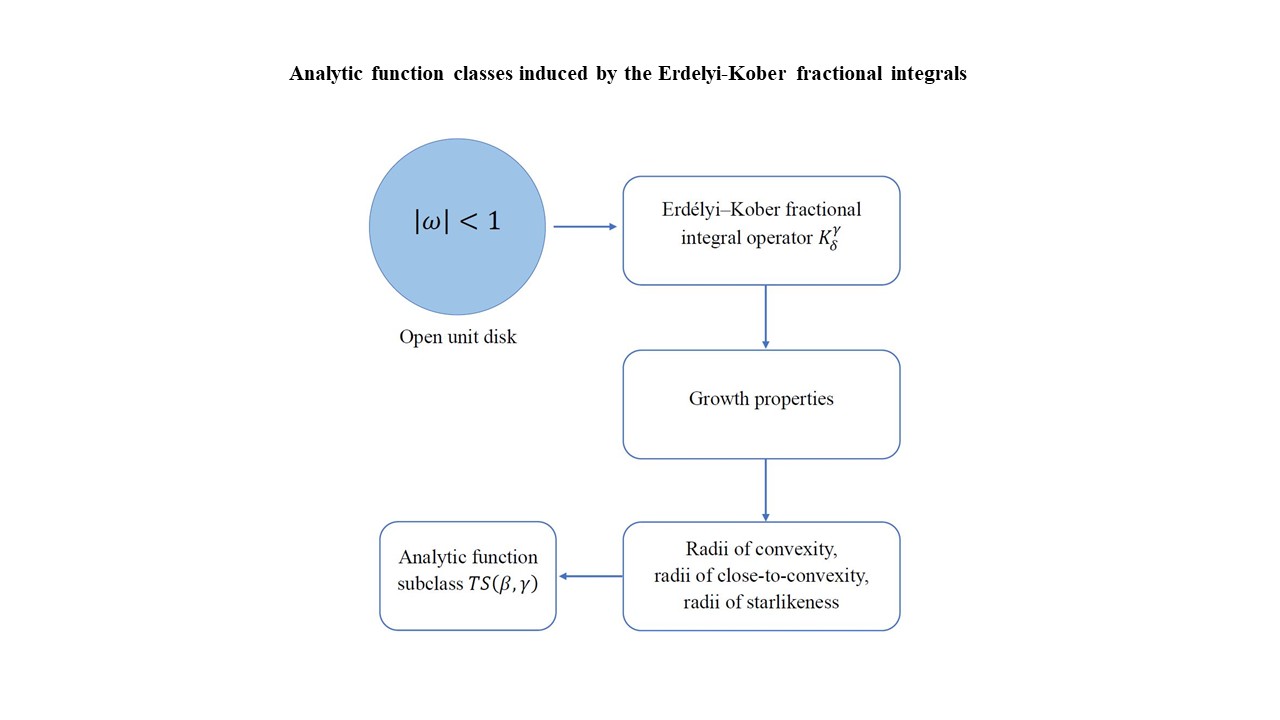
This study investigates a new subclass of analytic and univalent functions in the open unit disk, through the convolution of normalized analytic functions with a generalized Erdélyi–Kober fractional integral operator. The main objective is to define a new subclass TS(β, γ) related with the normalized form of the Erdélyi–Kober fractional integral operator Kϑδ and explore its geometrical properties. This study obtains sharp coefficient bounds and geometric characteristics such as growth, and distortion properties. Furthermore, convexity, close-to-convexity, radii of and starlikeness, extremal functions, and inclusion relations are determined. These results contribute to the broader understanding of defined subclass within geometric function theory and provide a mathematical foundation for modelling phenomena in fractional calculus, conformal mapping, and applied engineering contexts. The study also highlights limitations associated with the operator parameters and suggests extensions to numerical and control-based models for future investigation.
- Raina RK, Srivastava HM. A certain subclass of analytic functions associated with operators of fractional calculus. Comput Math Appl. 1996;32(7):13-19. https://doi.org/10.1016/0898-1221(96)00151-4
- Kilbas AA, Srivastava HM, Trujillo JJ. The- ory and Applications of Fractional Differential Equations. Amsterdam: Elsevier; 2006. https://doi.org/10.1016/S0304-0208(06)80001-0
- Srivastava HM, Tomovski Zˇ. Fractional calculus with an integral operator containing a generalized Mittag–Leffler function in the kernel. Appl Math Comput. 2009;211(1):198-210. https://www.doi.org/10.1016/j.amc.2009.01.055
- Propst Univalent functions, fractional calculus, and their applications. Mathematics. 2016. Available from: https://api.semanticscholar.org/CorpusID: 123753268
- Duren PL. Univalent Functions. New York: Springer-Verlag; 1983.
- Pommerenke C. Univalent Functions. G¨ottingen: Vandenhoeck & Ruprecht; 1975.
- Goodman AW. Univalent Functions. Vols I–II. Tampa, FL: Mariner Publishing; 1983.
- Thangamani S, Mohammed PO, Devadoss JF, Yousif MA, Arab M, Baleanu D. Representation of Bi-Univalent Functions to Lucas Balancing Polynomials with Geometric Properties and Coefficient Bounds. Eur J Pure Appl Math. 2025;18(3):6294.
- Mehmood S, Baleanu D, Yousif MA, Mohammed PO, Abbas A, Chorfi N. Some new inequalities involving generalized convex functions in the katugampola fractional setting. Contemp Math. 2025;6(4):4483.
- Mehmood S, Mohammed PO, Kashuri A, Chorfi N, Mahmood SA, Yousif MA. Some new fractional inequalities defined using cr-Log-h- Convex functions and applications. Symmetry. 2024;16(4):407.
- Ruscheweyh D. New criteria for univalent functions. Proc Am Math Soc. 1975;49(1):109-115.
- Sal˘agean GS. Subclasses of univalent functions. Seminar on complex analysis. University of Bucharest; 1983:55-62.
- Terwase AP, Salihu AS, Joseph TA. On certain subclass of analytic functions based on convolution of Ruscheweyh and generalized Salagean differential operator.
- Tremblay R. Using the well-poised fractional calculus operator g(z)Oα to obtain transformations of the Gauss hypergeometric function with higher-level arguments. Montes Taurus J Pure Appl Math. 2021;3(3):260-283.
- Saravanan G, Baskaran S, Vanithakumari B, et al. Bernoulli polynomials for a new subclass of Te-univalent functions. Heliyon. 2024;10(14).
- Khan B, Gong J, Khan MG, Tchier F. Sharp co- efficient bounds for a class of symmetric starlike functions involving the balloon shape domain. Heliyon. 2024;10(19).
- Allu V, Shaji A. Moduli difference of inverse logarithmic coefficients of univalent functions. J Math Anal Appl. 2025;546(2):129217.
- Kober H. On fractional integrals and derivatives. Q J Math. 1940;11(1):193-211.
- Giri MK, Raghavendar K. Inclusion results on hypergeometric functions in a class of analytic functions associated with linear operators. Contemp Math. 2024;5(2):2315–2334. https://doi.org/10.37256/cm.5220244039
- Mitra S, Parmar RK, Ponnusamy S, Sugawa T, eds. Geometric Function Theory and Related Topics. Providence, RI: AMS Contemporary Mathematics Series; 2025.
- Ibrahim RW. On a combination of fractional differential and integral operators. AIMS Math. 2021;6(9):9782–9798.
- Indushree M. An application of the Prabhakar fractional operator. J Math. 2023;2023:Article ID
- Khan S, Darus M. Partial sums for normalized Mittag-Leffler–Prabhakar functions. Eur J Pure Appl Math. 2025;18(1):101–117.
- Murugusundaramoorthy G, et al. Fractional bi- univalent functions. J Math. 2024;2024:6006272.
- Alotaibi A, Darus M. Fractional derivative operators of Srivastava–Owa type. Mathematics. 2023;11(19):4032.
- Zainab M, Lashin A. Caputo-type fractional subordinations. Results Nonlinear Anal. 2024;8(1):113–128.
- Srivastava HM, Mohammed PO, Baleanu D, Yousif MA, Ibrahim IS, Abdelwahed M. Positivity and uniqueness of solutions for Riemann–Liouville fractional problem of delta types. Alex Eng J. 2025:114:173-178.
- Mohammed PO, Agarwal RP, Yousif MA, Al-Sarairah E, Lupas AA, Abdelwahed M. Theoretical results on positive solutions in delta Riemann–Liouville setting. Mathematics. 2024;12(18):2864.
- Bulut S, Kumar R. Mittag-Leffler Poisson distribution series. arXiv preprint arXiv:2402.06587.
- Kanwal B, Raza N, Mubeen A. Fuzzy differential J Appl Anal. 2024;30(3):415–431.
- Abubaker AA, Kumar R, Bulut S. Four- parameter Mittag-Leffler functions. Adv Math Phys. 2025;2025:3157249.
- Hussen A. Mittag-Leffler-type Borel distribution. Results Nonlinear Anal. 2024;7(2):245–259.
- Raza N, Kanwal B. Fractional Hadamard opera AIMS Math. 2024;9(10):22134–22148.
- Parmar RK, Goyal P. Poisson–Mittag-Leffler kernels and analytic functions. AIMS Math. 2025;10(2):1650–1668.
- Saber S, Solouma E, Althubyani M, Messaoudi M. Statistical Insights into Zoonotic Dis- ease Dynamics: simulation and control strategy evaluation. Symmetry. 2025; 17(5):733. https://doi.org/10.3390/sym17050733
- Hyers-Ulam Stability and control of fractional Glucose-Insulin Eur Int J Pure Appl Math. 2025;18(2):6152. https://doi.org/10.29020/nybg.ejpam.v18i2.6152
- Reddy KA, Murugusundaramoorthy G. A unified class of analytic functions associated with Erd´elyi–Kober integral operator. Int J Nonlinear Anal Appl. 2023;14(2):385–397.
- Hanna LA-M, Al-Kandari M, Luchko Y. Operational method for solving fractional differential equations with the left- and right- hand sided Erd´elyi–Kober fractional derivatives. Fract Calc Appl Anal. 2020;23(1):103–125. https://doi.org/10.1515/fca-2020-0004
- Prathiba S, Rosy T. On certain subclass of starlike functions with negative coefficients associated with Erd´elyi–Kober integral operator. Gen Math. 2021;29(2):69–82. https://doi.org/10.2478/gm-2021-0015
- Odibat Z, Baleanu D. On a new modification of the Erd´elyi–Kober fractional derivative. Fractal Fract. 2021;5(3):121. https://doi.org/10.3390/fractalfract5030121
- Mathai AM, Haubold HJ. Erd´elyi–Kober fractional integral operators from a statistical perspective (I). Tbilisi Math J. 2017;10(1):99–120. https://doi.org/10.1515/tmj-2017-0009
- Plociniczak L , Sobieszek S. Numerical schemes for integro-differential equations with Erd´elyi–Kober fractional operator. Numer Algorithms. 2017;76(1):125–150. https://doi.org/10.1007/s11075-016-0247-z
- Hari N, Nataraj C, Reddy PT, Kumar SS. Some properties of analytic functions as-sociated with Erd´elyi–Kober integral operator. Contemp Math. 2025;6(2):2339–2354. https://doi.org/10.37256/cm.6220256033
- Tassaddiq A, Srivastava R, Alharbi R, Kasmani RM, Qureshi S. An application of multiple Erd´elyi–Kober fractional integral operators to establish new inequalities involving a general class of functions. Fractal Fract. 2024;8(8):438. https://doi.org/10.3390/fractalfract8080438
- Tassaddiq A, Srivastava R, Alharbi R, Kasmani RM, Qureshi S. New inequalities using multiple Erd´elyi–Kober fractional integral operators. Fractal Fract. 2024;8(4):180. 10.3390/frac- talfract8040180
- Lagad A, Ingle RN, Reddy PT. Some families of analytic functions related to the Erd´elyi–Kober integral operator. J Fract Calc Appl. 2025;16(1):Article 6.
- Malathi V, Vijaya K. Subclass of analytic functions involving Erd´ely–Kober type integral operator in conic regions and applications to neutrosophic Poisson distribution. Physica A. 2022;600:127595.
- Porwal S. An application of a poisson distribution series on certain analytic functions. J Complex Anal. 2014;(1):984135.