
Perceived effects of stress ratio and microstructural heterogeneity on fatigue life through damage accumulation and crack nucleation: A PLS-SEM study of practising engineers in Saudi Arabia

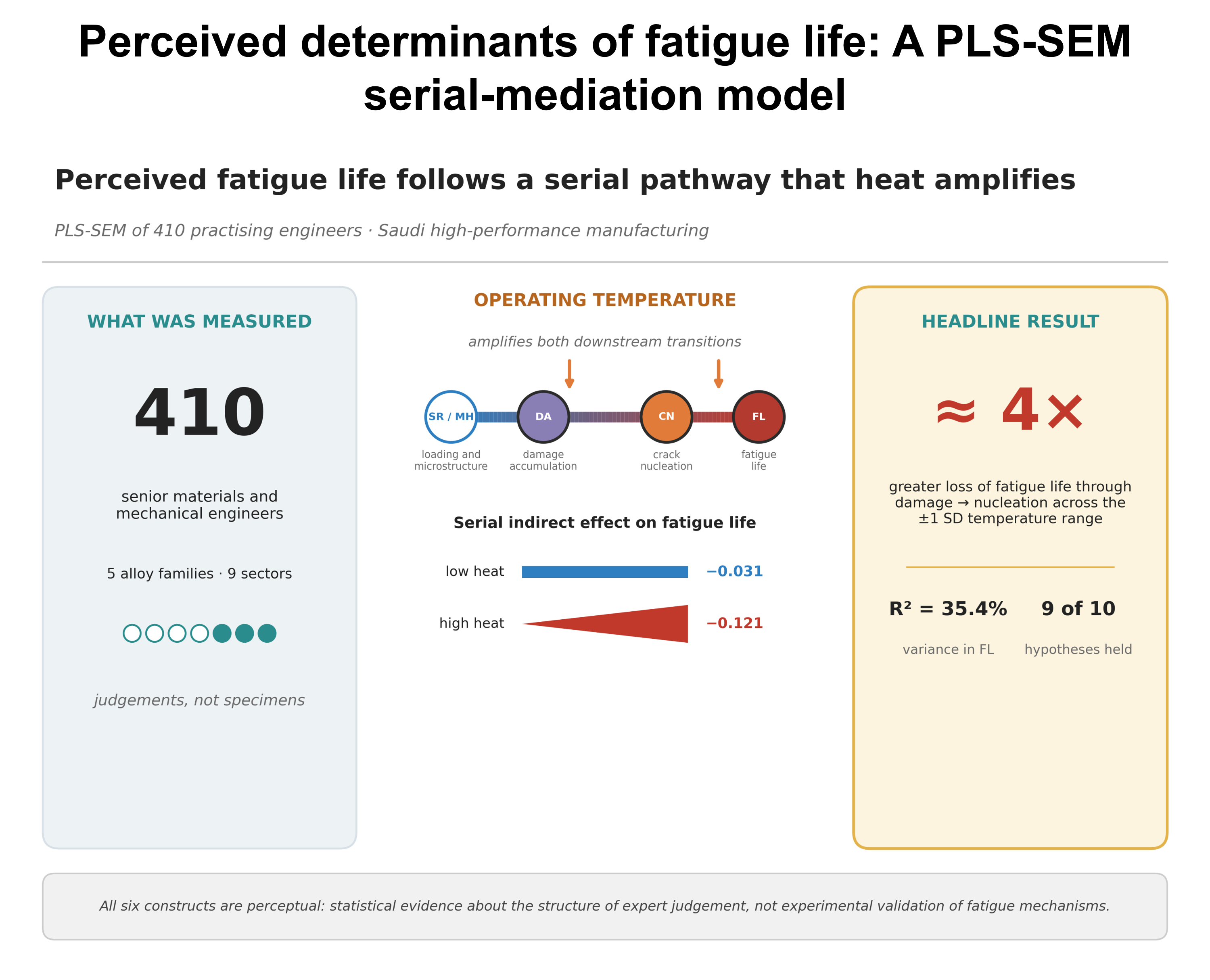
Fatigue-related failures are an important limitation on the service life of metallic components subjected to cyclic loading in aerospace, defence, petroleum, and power-generation applications in Saudi Arabia. Guided by continuum damage mechanics, this research examined a mediated moderation model to determine how practising engineers perceive the effects of stress ratio (SR) and microstructural heterogeneity (MH) on fatigue life (FL). The study also examines how damage accumulation (DA) and crack nucleation (CN) mediate these relationships. In addition, the study tests for the moderating effect of operating temperature (TEMP) on each of the two sequential paths: DA → CN and CN → FL; TEMP is modelled as a moderator of these transitions, not as a stage within the serial pathway. A survey was conducted among 410 senior materials and mechanical engineers working for Saudi Arabian companies in the aerospace, defence, petroleum, power-generation, and heavy-industry sectors within the context of the Vision 2030 localisation strategy. Partial least squares structural equation modelling was used to analyse the data and to test for conditional indirect effects and the index of moderated mediation. All but one tested hypothesis was supported; the effects of SR and MH on FL via DA/CN were nearly four times larger across the temperature range examined. Additionally, the proposed model accounts for 35.4% of the variance in perceived FL. All six constructs are latent variables measured by seven-point Likert items capturing the judgements of experienced engineers; none is a physical quantity obtained from fatigue testing or material characterisation. The findings therefore describe perceived relationships among these constructs and constitute statistical evidence from expert judgement rather than experimental validation of the underlying fatigue mechanisms.
- Schijve J. Fatigue of Structures and Materials. 2nd ed. Springer; 2009. https://doi.org/10.1007/978-1-4020-6808-9
- Suresh, S. Fatigue of Materials. 2nd ed. Cambridge University Press; 1998. https://doi.org/10.1017/CBO9780511806575
- Lemaitre J, Chaboche JL. Mechanics of Solid Materials. Cambridge University Press; 1990. https://doi.org/10.1017/CBO9781139167970
- McDowell DL, Dunne FPE. Microstructure-sensitive computational modeling of fatigue crack formation. Int J Fatigue. 2010;32(9):1521-1542. https://doi.org/10.1016/j.ijfatigue.2010.01.003
- Dowling NE. Mechanical Behavior of Materials: Engineering Methods for Deformation, Fracture, and Fatigue. 4th ed. Pearson; 2012.
- Li Z, Dai W, Yue H, et al. Fatigue life prediction of 2024-T3 clad Al alloy based on an improved SWT equation and machine learning. Materials. 2025;18(2):332. https://doi.org/10.3390/ma18020332
- Prithivirajan V, Sangid MD. The role of defects and critical pore size analysis in the fatigue response of additively manufactured IN718 via crystal plasticity. Mater Des. 2018;150:139-153. https://doi.org/10.1016/j.matdes.2018.04.022
- Nadot Y. Fatigue from defect: Influence of size, type, position, morphology and loading. Int J Fatigue. 2022;154:106531. https://doi.org/10.1016/j.ijfatigue.2021.106531
- Shiraiwa T, Briffod F, Enoki M. Prediction of fatigue crack initiation of 7075 aluminum alloy by crystal plasticity simulation. Materials. 2023;16(4):1595. https://doi.org/10.3390/ma16041595
- Yang Y, Chen C, Zhuang Y, Suo Z. Reviewing the progress of corrosion fatigue research on marine structures. Front Mater. 2024;11:1399292. https://doi.org/10.3389/fmats.2024.1399292
- Sangid MD. The physics of fatigue crack initiation. Int J Fatigue. 2013;57:58-72. https://doi.org/10.1016/j.ijfatigue.2012.10.009
- Dodaran MS, Muhammad M, Shamsaei N, Shao S. Synergistic effect of microstructure and defects on the initiation of fatigue cracks in additively manufactured Inconel 718. Int J Fatigue. 2022;162:107002. https://doi.org/10.1016/j.ijfatigue.2022.107002
- Chaboche JL. A review of some plasticity and viscoplasticity constitutive theories. Int J Plast. 2008;24(10):1642-1693. https://doi.org/10.1016/j.ijplas.2008.03.009
- Pineau A, McDowell D L, Busso EP, Antolovich SD. Failure of metals II: Fatigue. Acta Mater. 2016;107:484-507. https://doi.org/10.1016/j.actamat.2015.05.050
- Moverare J, Lancaster RJ, Jones J, Stekovic S, Whittaker MT. A review of recent advances in the understanding of thermomechanical fatigue durability and failure mechanisms in nickel-based superalloys. Metall Mater Trans A. 2025;56(4):1115-1134. https://doi.org/10.1007/s11661-025-07698-4
- Hayes AF. An index and test of linear moderated mediation. Multivariate Behav Res. 2015;50(1):1-22. https://doi.org/10.1080/00273171.2014.962683
- Kachanov LM. Time of the rupture process under creep conditions. Izv Akad Nauk SSSR Otd Tekh Nauk. 1958;8:26-31.
- Xiao YC, Li S, Gao Z. A continuum damage mechanics model for high cycle fatigue. Int J Fatigue. 1998;20(7):503-508. https://doi.org/10.1016/S0142-1123(98)00005-X
- Feng S, Sun X, Chen G, Wu H, Chen X. LBE corrosion fatigue life prediction of T91 steel and 316 SS using machine learning method assisted by symbol regression. Int J Fatigue. 2023;177:107962. https://doi.org/10.1016/j.ijfatigue.2023.107962
- Hair JF, Risher JJ, Sarstedt M, Ringle CM. When to use and how to report the results of PLS-SEM. Eur Bus Rev. 2019;31(1):2-24. https://doi.org/10.1108/EBR-11-2018-0203
- Sarstedt M, Ringle CM, Hair JF. Partial least squares structural equation modeling. In: Homburg C, Klarmann M, Vomberg AE, eds. Handbook of Market Research. Springer International Publishing; 2022:587-632. https://doi.org/10.1007/978-3-319-57413-4_15
- Brislin RW. Back-translation for cross-cultural research. J Cross Cult Psychol. 1970;1(3):185-216. https://doi.org/10.1177/135910457000100301
- Beaton DE, Bombardier C, Guillemin F, Ferraz MB. Guidelines for the process of cross-cultural adaptation of self-report measures. Spine. 2000;25(24):3186-3191. https://doi.org/10.1097/00007632-200012150-00014
- Podsakoff PM, MacKenzie SB, Podsakoff NP. Sources of method bias in social science research and recommendations on how to control it. Annu Rev Psychol. 2012;63:539-569. https://doi.org/10.1146/annurev-psych-120710-100452
- Hair JF, Hult GTM, Ringle CM, Sarstedt M. A Primer on Partial Least Squares Structural Equation Modeling (PLS-SEM). 3rd ed. Sage Publications; 2022.
- Ringle CM, Wende S, Becker JM. SmartPLS 4. SmartPLS GmbH; 2024. https://www.smartpls.com. Accessed August 15, 2026.
- Henseler J, Chin WW. A comparison of approaches for the analysis of interaction effects between latent variables using partial least squares path modeling. Struct Equ Modeling. 2010;17(1):82-109. https://doi.org/10.1080/10705510903439003
- Hayes AF. Introduction to Mediation, Moderation, and Conditional Process Analysis: A Regression-Based Approach. 3rd ed. Guilford Press; 2022.
- Henseler J, Ringle CM, Sarstedt M. A new criterion for assessing discriminant validity in variance-based structural equation modeling. J Acad Mark Sci. 2015;43(1):115-135. https://doi.org/10.1007/s11747-014-0403-8
- Kock N. Common method bias in PLS-SEM: A full collinearity assessment approach. Int J e-Collab. 2015;11(4):1-10. https://doi.org/10.4018/ijec.2015100101
- Wang H, Gao SL, Wang BT, et al. Recent advances in machine learning-assisted fatigue life prediction of additive manufactured metallic materials: A review. J Mater Sci Technol. 2024;198:111-136. https://doi.org/10.1016/j.jmst.2024.01.086
- He L, Wang Z, Akebono H, Sugeta A. Machine learning-based predictions of fatigue life and fatigue limit for steels. J Mater Sci Technol. 2021;90:9-19. https://doi.org/10.1016/j.jmst.2021.02.021
- Yang J, Kang G, Liu Y, Kan Q. A novel method of multiaxial fatigue life prediction based on deep learning. Int J Fatigue. 2021;151:106356. https://doi.org/10.1016/j.ijfatigue.2021.106356
- Pałczy¨½ski K, Skibicki D, Pejkowski Ł, Andrysiak T. Application of machine learning methods in multiaxial fatigue life prediction. Fatigue Fract Eng Mater Struct. 2023;46(2):416-432. https://doi.org/10.1111/ffe.13874
- Bao H, Wu S, Wu Z, Kang G, Peng X, Withers PJ. A machine-learning fatigue life prediction approach of additively manufactured metals. Eng Fract Mech. 2021;242:107508. https://doi.org/10.1016/j.engfracmech.2020.107508
- Zhang X, Liu F, Shen M, Han D, Wang Z, Yan N. Ultra-high-cycle fatigue life prediction of metallic materials based on machine learning. Appl Sci. 2023;13(4):2524. https://doi.org/10.3390/app13042524
- Aydın S, Altun K. Early prediction of fabric quality using machine learning to reduce rework in manufacturing processes. Int J Optim Control Theor Appl. 2024;14(4):308-321. https://doi.org/10.11121/ijocta.1462
- Abazari S, Shamsipur A, Bakhsheshi-Rad HR, et al. Magnesium-based nanocomposites: A review from mechanical, creep and fatigue properties. J Magnes Alloys. 2023;11(8):2655-2687. https://doi.org/10.1016/j.jma.2023.08.005