

Retail reverse supply chain optimization under profit–loss budgetary limitation

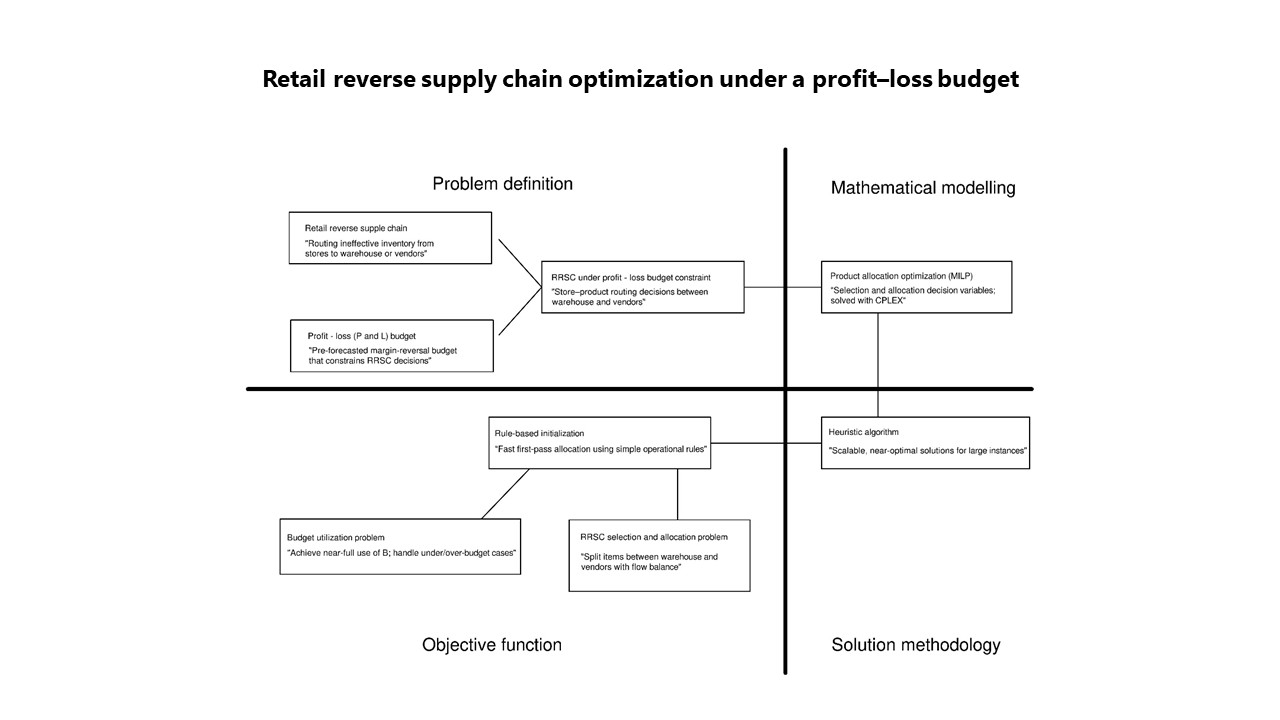
Retailers increasingly need decision-support tools to manage unsold inventory under operational and fiscal constraints. In this paper, we develop a reverse supply chain (RSC) model for retailers under profit–loss budgetary limitation. The retail RSC consists of multiple stores, a warehouse, and multiple vendors. Each store carries inventory that is not selling as hoped, and they want to get rid of these unwanted products to replace the space with more productive items. Our model considers two options for how a store can get rid of these products: the retailer can send the products to its warehouse if there is demand at other stores, or send them back to their vendor if there are available vendor funds. However, the retailer operates under a predetermined profit–loss budget that should be utilized as closely as possible within the fiscal cycle. The budgetary limitation is the result of profit–loss that will be incurred due to relocating products within and out of its supply chain system. This budgetary limitation, also known as the “P&L effect” in industry, is decided a year prior to an RSC activity for financial, planning, and/or taxation reasons. We model this problem as a mixed integer linear program and solve test problems using CPLEX. We then develop a heuristic solution algorithm and compare the CPLEX solution results and times with our heuristic. We summarize useful insights into our heuristic and how it can be further developed for similar optimization problems with budgetary constraints. Eventually, we outline future research topics and suggestions for RSC models for retailers.
- Rogers DS, Tibben-Lembke RS. Going Back- wards: Reverse Logistics Trends and Practices. Reverse Logistics Executive Council; 1998. https://www.icesi.edu.co/blogs/gestionresiduossolidos/files/2008/11/libro-lr.pdf. Accessed February 18, 2026.
- Kazemi N, Modak NM, Govindan K. A review of reverse logistics and closed loop supply chain management studies published in IJPR: a bibliometric and content analysis. Int J Prod Res. 2019;57(15-16):4937-4960. https://www.doi.org/10.1080/00207543.2018.1471244
- Van Engeland J, Beli¨en J, De Boeck L, De Jaeger S. Literature strategic network optimization models in waste reverse supply chains. Omega. 2020;91(C):102012. https://www.doi.org/10.1016/j.omega.2018.12.001
- Ambilkar P, Dohale V, Gunasekaran A, Bilolikar V. Product returns management: a comprehensive review and future research agenda. Int J Prod Res. 2022;60(12):3920-3944. https://www.doi.org/10.1080/00207543.2021.1933645
- Yuliawati E, Pratikto P, Sugiono S, Novareza O. Development of cores acquisition model with two switching mechanisms in a retailer-oriented closed- loop supply chain system. East Eur J Enterp Technol. 2021;2(3):110. https://www.doi.org/10.15587/1729-4061.2021.225147
- Kaboudani Y, Ghodsypour SH, Kia H, Shahmardan A. Vehicle routing and scheduling in cross docks with forward and reverse logistics. Oper Res. 2020;20(3):1589-1622. https://www.doi.org/10.1007/s12351-018-0396-z
- Das K. Integrating reverse logistics into the strategic planning of a supply chain. Int J Prod Res. 2012;50(5):1438-1456. https://www.doi.org/10.1080/00207543.2011.571944
- Dias KTS, Braga SS, Silva D, Satolo EG. Re- verse logistics for return management in retail: a systematic literature review from 2007 to 2016. In: Mula J, Barbastefano R, D´ıaz-Madron˜ero M, Poler R, eds. New Global Perspectives on Industrial Engineering and Management. Springer In- ternational Publishing; 2019:145-153. https://www.doi.org/10.1007/978-3-319-93488-417
- Gustafsson E, Jonsson P, Holmstro¨m J. Reducing retail supply chain costs of product returns using digital product fitting. Int J Phys Distrib Logist Manag. 2021;51(8):877-896. https://www.doi.org/10.1108/ijpdlm-10-2020-0334
- De Borba JLG, de Magalh˜aes MR, Filgueiras RS, Bouzon M. Barriers in omnichannel retailing returns: a conceptual framework. Int J Retail Distrib Manag. 2020;49(1):121-143. https://www.doi.org/10.1108/ijrdm-04-2020-0140
- Junior B, Junqueira KTS, da Silva D, Oliveira SC. Analise sobre a disposicao para implementacao da logistica reversa no varejo supermercadista. Int J Innov. 2020;8(2):204-222. https://www.doi.org/10.5585/iji.v8i2.17699
- Frei R, Jack L, Krzyzaniak S-A. Sustainable re- verse supply chains and circular economy in multichannel retail returns. Bus Strategy Environ. 2020;29(5):1925-1940. https://www.doi.org/10.1002/bse.2479
- Xu D. Research on strategic mode and development of reverse logistics in retail industry. Malays E Commerce J (MECJ). 2019;3(1):30-33. https://www.doi.org/10.26480/mecj.01.2019.30.33
- Demajorovic J, Campos LDSO, Campos JBS de. Reverse logistics in retail: barriers and motivation to products and packaging return. Rev Adm UFSM. 2019;12(5):911-930. https://www.doi.org/10.5902/1983465928557
- Bernon M, Upperton J, Bastl M, Cullen J. An exploration of supply chain integration in the retail product returns process. Int J Phys Distrib Logist Manag. 2013;43(7):586-608. https://www.doi.org/10.1108/ijpdlm-03-2012-0060
- Beitelspacher LS, Baker TL, Rapp A, Grewal D. Understanding the long-term implications of re- tailer returns in business-to-business relationships. J Acad Mark Sci. 2018;46(2):252-272. https://www.doi.org/10.1007/s11747-017-0553-6
- Mostert W, Niemann W, Kotze T. Supply chain integration in the product return process: a study of consumer electronics retailers. Acta Commer. 2017;17(1):1-16. https://www.doi.org/10.4102/ac.v17i1.487
- Beh LS, Ghobadian A, He Q, Gallear D, O’Regan N. Second-life retailing: a reverse supply chain perspective. Supply Chain Manag. 2016;21(2):259- 272, https://www.doi.org/10.1108/scm-07-2015-0296
- Dias KTS, Braga Junior SS. The use of reverse logistics for waste management in a Brazilian grocery retailer. Waste Manag Res. 2016;34(1):22- 29. https://www.doi.org/10.1177/0734242x15615696
- Bernon M, Cullen J, Gorst J. Online retail returns management: integration within an omni-channel distribution context. Int J Phys Distrib Logist Manag. 2016;46(6/7):584-605. https://www.doi.org/10.1108/ijpdlm-01-2015-0010
- Bajor I, Babic D. Reverse logistics retail level return. Int J Traffic Transp Eng. 2014;4(2):161- 170. https://www.doi.org/10.7708/ijtte.2014.4(2)03
- Bernon M, Rossi S, Cullen J. Retail reverse logistics: a call and grounding framework for research. Int J Phys Distrib Logist Manag. 2011;41(5):484- 510. https://www.doi.org/10.1108/0960003111 1138835.
- Jack EP, Powers TL, Skinner L. Reverse logistics capabilities: antecedents and cost savings. Int J Phys Distrib Logist Manag. 2010;40(3):228-246. https://www.doi.org/10.1108/0960003101 1035100
- Hsu HS, Alexander CA, Zhu Z. Understanding the reverse logistics operations of a retailer: a pilot study. Ind Manag Data Syst. 2009;109(4):515-531. https://www.doi.org/10.1108/02635570910948641
- Moise M. The importance of reverse logistics for retail activity. Amfiteatru Econ. 2008;10(24):192- 209. https://www.amfiteatrueconomic.ro/ArticolEN.aspx?CodArticol=36. Accessed February 18, 2026.
- Wojanowski R, Verter V, Boyaci T. Retail- collection network design under deposit-refund. Comput Oper Res. 2007;34(2):324-345. https://www.doi.org/10.1016/j.cor.2005.03.003
- Bernon M, Cullen J. An integrated approach to managing reverse logistics. Int J Logist Res Appl. 2007;10(1):41-56. https://www.doi.org/10.1080/13675560600717763
- Chaves GDLDD, Alcantara RLC. Reverse logistics and the relation between industry and retail in the after-sale reverse flow management. In: Proceedings of the Third International Conference on Production Research–Americas’ Region (ICPR- AM06); July 30-August 2, 2006; Curitiba, Brazil. 1-14.
- Horvath PA, Autry CW, Wilcox WE. Liquidity implications of reverse logistics for retailers: a Markov chain approach. J Retail. 2005;81(3):191- 203. https://www.doi.org/10.1016/j.jretai.2005.07.003.
- Tibben-Lembke RS, Rogers DS. Differences between forward and reverse logistics in a retail environment. Supply Chain Manag. 2002;7(5):271- 282. https://www.doi.org/10.1108/13598540210447719
- Frei R, Jack L, Krzyzaniak SA. Mapping product returns processes in multichannel retailing: challenges and opportunities. Sustainability. 2022;14(3):1382. https://www.doi.org/10.3390/su14031382
- Karlsson S, Oghazi P, Hellstr¨om D, Patel PC, Papadopoulou C, Hjort K. Retail returns management strategy: an alignment perspective. J Innov Knowl. 2023;8(4):100420. https://www.doi.org/10.1016/j.jik.2023.100420
- Yang L, Li X, Xia Y, Aneja YP. Returns oper- ations in omnichannel retailing with buy-online- and-return-to-store. Omega. 2023;119:102874. https://www.doi.org/10.1016/j.omega.2023.102874
- Zhang D, Frei R, Wills G, Gerding E, Bayer S, Senyo PK. Strategies and practices to reduce the ecological impact of product returns: an environ- mental sustainability framework for multichannel retail. Bus Strategy Environ. 2023;32(7):4636- 4661. https://www.doi.org/10.1002/bse.3385.
- Zhang D, Frei R, Senyo PK, et al. Understanding fraudulent returns and mitigation strategies in multichannel retailing. J Retail Consum Serv. 2023;70:103145. https://www.doi.org/10.1016/j.jretconser.2 022.103145
- Sarkar B, Guchhait R. A sustainable random paradigm of centralized multi-customized facility with fourth-party logistics (4PL) and cleaner production with remanufacturing. J Clean Prod. 2025;525:146530. https://www.doi.org/10.1016/j.jclepro.2025.146530
- Garai A, Sarkar B. Economically independent reverse logistics of customer-centric closed-loop supply chain for herbal medicines and biofuel. J Clean Prod. 2022;334:129977. https://www.doi.org/10.1016/j.jclepro.2021.129977