

Advanced three-dimensional bioprinting for in vitro tumor model engineering: From biomimetic model construction to personalized precision medicine

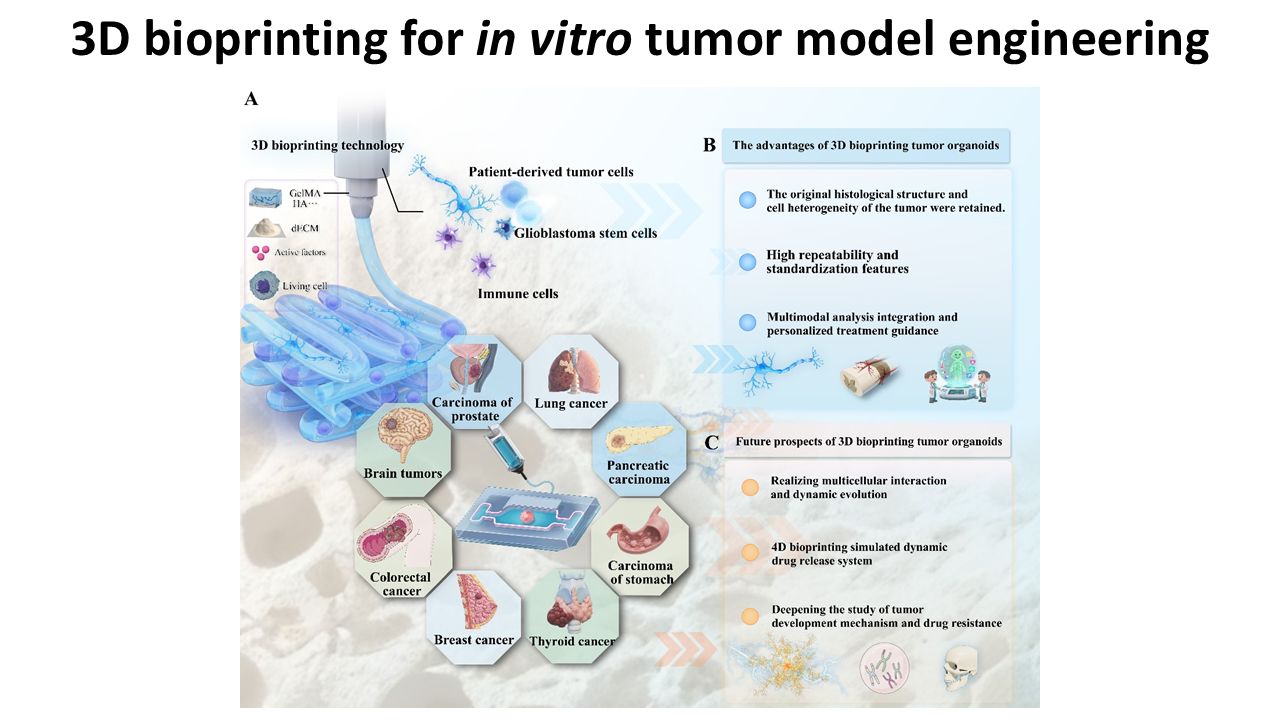
Three-dimensional (3D) bioprinting technology offers a transformative approach for constructing biomimetic tumor organoid models that overcome the limitations of traditional two-dimensional cell cultures and animal models. This review systematically summarizes recent advances in 3D bioprinted tumor organoids, emphasizing extrusion-based, inkjet-based, and lithography-based bioprinting methods. These technologies enable precise spatial control of cell distribution and tissue architecture, achieving high reproducibility while maintaining complex tumor microenvironmental characteristics. Applications across multiple cancer types—including colorectal, gastric, pancreatic, breast, glioma, renal, bladder, lung, and thyroid cancers—demonstrate significant potential for drug screening, tumor heterogeneity research, and preclinical evaluation of individualized treatment responses. Despite substantial progress, challenges remain regarding multicellular complexity simulation, technical resolution, and biomaterial optimization. Future directions include integrating four-dimensional bioprinting, multiomics analysis, and immune microenvironment reconstruction to enhance physiological fidelity and clinical applicability, ultimately advancing precision oncology and personalized cancer treatment strategies.
- Filho AM, Laversanne M, Ferlay J, et al. The GLOBOCAN 2022 cancer estimates: data sources, methods, and a snapshot of the cancer burden worldwide. Int J Cancer. 2025;156(7):1336-1346. doi: 10.1002/ijc.35278
- Zhang L, Zheng H, Jiang ST, et al. Worldwide research trends on tumor burden and immunotherapy: a bibliometric analysis. Int J Surg. 2024;110(3):1699-1710. doi: 10.1097/JS9.0000000000001022
- Zhou BL, Zang RC, Zhang MY, et al. Worldwide burden and epidemiological trends of tracheal, bronchus, and lung cancer: a population-based study. EBioMedicine. 2022;78:103951. doi: 10.1016/j.ebiom.2022.103951
- Xiang DH, Hu SW, Mai TX, et al. Worldwide cancer statistics of adults over 75 years old in 2019: a systematic analysis of the global burden of disease study 2019. BMC Public Health. 2022;22(1):1979. doi: 10.1186/s12889-022-14412-1
- Yu Q, Zhang YF, Qiao L, et al. The evolving global burden of kidney cancer: a comparative analysis of trends in China and worldwide with projections to 2041. Urol Oncol. 2026;44(7):280-296. doi: 10.1016/j.urolonc.2026.03.005
- Crucitta S, Cucchiara F, Mathijssen R, et al. Treatment-driven tumour heterogeneity and drug resistance: lessons from solid tumours. Cancer Treat Rev. 2022;104:102340. doi: 10.1016/j.ctrv.2022.102340
- Kou ZX, Liu C, Zhang WF, Sun CG, Liu LJ, Zhang QM. Heterogeneity of primary and metastatic CAFs: from differential treatment outcomes to treatment opportunities (review). Int J Oncol. 2024;64(5):54. doi: 10.3892/ijo.2024.5642
- Zhang XY, Xie JJ, Yang ZX, Yu CKW, Hu YH, Qin J. Tumour heterogeneity and personalized treatment screening based on single-cell transcriptomics. Comput Struct Biotechnol J. 2025;27:307-320. doi: 10.1016/j.csbj.2024.12.020
- Huang JB, Wang HY, Jiang DH, et al. Development of novel PROTAC RAD51 degraders as enhancers of DNA damage response for hepatocellular carcinoma treatment. J Med Chem. 2026;69(4):3957-3983. doi: 10.1021/acs.jmedchem.5c02624
- Jose A, Kulkarni P, Thilakan J, et al. Integration of pan-omics technologies and three-dimensional in vitro tumor models: an approach toward drug discovery and precision medicine. Mol Cancer. 2024;23(1):50. doi: 10.1186/s12943-023-01916-6
- Song SL, Li B, Carvalho MR, et al. Complex in vitro 3D models of digestive system tumors to advance precision medicine and drug testing: progress, challenges, and trends. Pharmacol Ther. 2022;239:108276. doi: 10.1016/j.pharmthera.2022.108276
- Wang LM, Hu DP, Xu JM, Hu J, Wang YF. Complex in vitro model: a transformative model in drug development and precision medicine. Clin Transl Sci. 2024;17(2):e13695. doi: 10.1111/cts.13695
- Wan LFY, Zhao YJ, Huang C, et al. Carbazole/triphenylamine-based red-emitting probes for mitochondrial viscosity imaging and tumor visualization. J Photochem Photobiol A Chem. 2026;478:117253. doi: 10.1016/j.jphotochem.2026.117253
- Deng Y, Zhao XY, Su Q, et al. Application of a near-infrared fluorescent probe with dual-targeting capability toward lipid droplets and mitochondria in imaging of liver cirrhosis and tumors. Spectrochim Acta A Mol Biomol Spectrosc. 2026;353:127593. doi: 10.1016/j.saa.2026.127593
- Chawla U, Dahiya D, Kumar Y, et al. A review on ZnO-based targeted drug delivery system. Lett Drug Des Discov. 2024;21(3):397-420. doi: 10.2174/1570180820666230222092950
- Bini F, D'Alessandro S, Agarwal T, et al. Biomimetic 3D bioprinting approaches to engineer the tumor microenvironment. Int J Bioprint. 2023;9(6):1022. doi: 10.36922/ijb.1022
- Datta P, Dey M, Ataie Z, Unutmaz D, Ozbolat IT. 3D bioprinting for reconstituting the cancer microenvironment. NPJ Precis Oncol. 2020;4(1):18. doi: 10.1038/s41698-020-0121-2
- Shukla P, Yeleswarapu S, Heinrich MA, Prakash J, Pati F. Mimicking tumor microenvironment by 3D bioprinting: 3D cancer modeling. Biofabrication. 2022;14(3):032002. doi: 10.1088/1758-5090/ac6d11
- Chen H, Wu ZH, Gong ZY, et al. Acoustic bioprinting of patient-derived organoids for predicting cancer therapy responses. Adv Healthc Mater. 2022;11(13):2102784. doi: 10.1002/adhm.202102784
- Samadian H, Jafari S, Sepand MR, et al. 3D bioprinting technology to mimic the tumor microenvironment: tumor-on-a-chip concept. Mater Today Adv. 2021;12:100160. doi: 10.1016/j.mtadv.2021.100160
- Xu KL, Huang YY, Wu MB, Yin J, Wei P. 3D bioprinting of multi-cellular tumor microenvironment for prostate cancer metastasis. Biofabrication. 2023;15(3):035020. doi: 10.1088/1758-5090/acd960
- D'Alessandro S, Mohammadi S, Iafrate L, et al. Hybrid 3D microfluidic bioprinting for the engineering of cancer models and tissue substitutes. Virtual Phys Prototyp. 2024;19(1):e2419411. doi: 10.1080/17452759.2024.2419411
- Lee G, Kim SJ, Park JK. Fabrication of a self-assembled and vascularized tumor array via bioprinting on a microfluidic chip. Lab Chip. 2023;23(18):4079-4091. doi: 10.1039/d3lc00275f
- Radhakrishnan J, Varadaraj S, Dash SK, Sharma A, Verma RS. Organotypic cancer tissue models for drug screening: 3D constructs, bioprinting and microfluidic chips. Drug Discov Today. 2020;25(5):879-890. doi: 10.1016/j.drudis.2020.03.002
- Sibbitts J, Di Pietro L, Privitera A, et al. 3D bioprinting and microfluidic-based devices for cancer detection and drug treatment: focus on prostate cancer. Curr Med Chem. 2026;33(8):1503-1522. doi: 10.2174/0109298673298382240307040239
- Pellegrino P, Greco S, Gonzàlez AD, et al. Establishment of 3D cultures of myometrium, leiomyoma, and leiomyosarcoma cells: advantages and disadvantages of two different models. Reprod Sci. 2024;31(12):3729-3742. doi: 10.1007/s43032-024-01724-3
- Thibieroz N, Picart C, Migliorini E. Advanced biomaterial strategies for 3D in vitro biomimetic neuroblastoma cell culture. Biomater Sci. 2026;14(17):4418-4434. doi: 10.1039/d6bm00438e
- Cui XR, Jiao JH, Yang LL, et al. Advanced tumor organoid bioprinting strategy for oncology research. Mater Today Bio. 2024;28:101198. doi: 10.1016/j.mtbio.2024.101198
- Dai R, Chen W, Chen Y, et al. 3D bioprinting platform development for high-throughput cancer organoid models construction and drug evaluation. Biofabrication. 2024;16(3):035026. doi: 10.1088/1758-5090/ad51a6
- Han J, Jeong HJ, Choi J, et al. Bioprinted patient-derived organoid arrays capture intrinsic and extrinsic tumor features for advanced personalized medicine. Adv Sci (Weinh). 2025;12(20):2407871. doi: 10.1002/advs.202407871
- Dong QQ, Su X, Li X, et al. In vitro construction of lung cancer organoids by 3D bioprinting for drug evaluation. Colloids Surf A Physicochem Eng Asp. 2023;666:131288. doi: 10.1016/j.colsurfa.2023.131288
- Pérez-Pedroza R, Al-Jalih F, Xu JY, Moretti M, Briola GR, Hauser CAE. Fabrication of lumen-forming colorectal cancer organoids using a newly designed laminin-derived bioink. Int J Bioprint. 2022;9(1):633. doi: 10.18063/ijb.v9i1.633
- Wang Q, Yuan FW, Zuo XL, Li M. Breakthroughs and challenges of organoid models for assessing cancer immunotherapy: a cutting-edge tool for advancing personalised treatments. Cell Death Discov. 2025;11(1):222. doi: 10.1038/s41420-025-02505-w
- Ju MG, Jin ZZ, Yu X, et al. Gastric cancer models developed via GelMA 3D bioprinting accurately mimic cancer hallmarks, tumor microenvironment features, and drug responses. Small. 2025;21(8):2409321. doi: 10.1002/smll.202409321
- Tebon PJ, Wang B, Markowitz AL, et al. Drug screening at single-organoid resolution via bioprinting and interferometry. Nat Commun. 2023;14(1):3168. doi: 10.1038/s41467-023-38832-8
- Tong F, Nie RJ, Wu ZY, et al. Construction of 3D bioprinted colorectal cancer models and evaluation of their efficacy and drug sensitivity. APL Bioeng. 2026;10(3):036106. doi: 10.1063/5.0320497
- Du LW, Zheng ZC, Zhang K, et al. Exploring personalized prediction of clinical chemotherapy efficacy and revealing tumor heterogeneity using patient-derived 3D bioprinting gastric cancer models. Mol Cancer. 2025;24(1):259. doi: 10.1186/s12943-025-02466-9
- Mao SS, Xie RY, Shou JZ, Pang Y, Sun W. Bioprinting of patient-derived heterogeneous renal cell carcinoma organoids for personalized therapy. Biofabrication. 2025;17(4):045008. doi: 10.1088/1758-5090/adecc5
- Mu PY, Zhou SJ, Lv T, et al. Newly developed 3D in vitro models to study tumor-immune interaction. J Exp Clin Cancer Res. 2023;42(1):81. doi: 10.1186/s13046-023-02653-w
- Li H, Jin CR. Retinoblastoma: unveiling molecular pathogenesis and pioneering organoid-driven therapeutic innovations. Stem Cell Res Ther. 2026;17(1):96. doi: 10.1186/s13287-026-04951-4
- Maloney E, Clark C, Sivakumar H, et al. Immersion bioprinting of tumor organoids in multi-well plates for increasing chemotherapy screening throughput. Micromachines (Basel). 2020;11(2):208. doi: 10.3390/mi11020208
- Wen J, Liu FK, Cheng Q, et al. Applications of organoid technology to brain tumors. CNS Neurosci Ther. 2023;29(10):2725-2743. doi: 10.1111/cns.14272
- Feng SJ, Zhang Y, Wang YY, Gao YF, Song YJ. Harnessing gene editing technology for tumor microenvironment modulation: an emerging anticancer strategy. Chemistry. 2024;30(62):e202402485. doi: 10.1002/chem.202402485
- Wang ZH, Guo LY, Li Z, et al. Three-dimensional fluorescence spectroscopy recognition and component analysis based on machine learning. Spectrochim Acta A Mol Biomol Spectrosc. 2026;354:127633. doi: 10.1016/j.saa.2026.127633
- Fan YP, Zhang YT, Zhang GY, et al. Proteomic profiling of urinary large extracellular vesicles for the diagnosis of prostate cancer. Anal Chem. 2025;97(32):17368-17379. doi: 10.1021/acs.analchem.5c01320
- Molander D, Sbirkov Y, Bodurov I, Dikov D, Sarafian V. Comparative analysis of bioinks in 3D bioprinted organoids of colorectal cancer. Acta Morphol Anthropol. 2022;29(3-4). doi: 10.7546/ama.29.3-4.2022.03
- Chen H, Du L, Li J, et al. Modeling cancer metastasis using acoustically bio-printed patient-derived 3D tumor microtissues. J Mater Chem B. 2022;10(11):1843-1852. doi: 10.1039/d1tb02789a
- Wang PP, Sun LJ, Li CC, et al. Study on drug screening multicellular model for colorectal cancer constructed by three-dimensional bioprinting technology. Int J Bioprint. 2023;9(3):379-398. doi: 10.18063/ijb.694
- McGuckin C, Forraz N, Milet C, et al. Stable biotherapeutic penetration screening in critically small colorectal metastatic cancer biopsies allows for oncolytic virus-delivered chemotherapeutic response assessment through 3D bioprinted organoid expansion. Adv Ther (Weinh). 2025;8(1):2400221. doi: 10.1002/adtp.202400221
- Hou S, Tiriac H, Sridharan BP, et al. Advanced development of primary pancreatic organoid tumor models for high-throughput phenotypic drug screening. SLAS Discov. 2018;23(6):574-584. doi: 10.1177/2472555218766842
- Fernandez-Vega V, Hou S, Plenker D, et al. Lead identification using 3D models of pancreatic cancer. SLAS Discov. 2022;27(3):159-166. doi: 10.1016/j.slasd.2022.03.002
- Reid JA, Palmer XL, Mollica PA, Northam N, Sachs PC, Bruno RD. A 3D bioprinter platform for mechanistic analysis of tumoroids and chimeric mammary organoids. Sci Rep. 2019;9(1):97466. doi: 10.1038/s41598-019-43922-z
- Mollica PA, Booth-Creech EN, Reid JA, et al. 3D bioprinted mammary organoids and tumoroids in human mammary derived ECM hydrogels. Acta Biomater. 2019;95:201-213. doi: 10.1016/j.actbio.2019.06.017
- Shi W, Mirza S, Kuss M, et al. Embedded bioprinting of breast tumor cells and organoids using low-concentration collagen-based bioinks. Adv Healthc Mater. 2023;12(26). doi: 10.1002/adhm.202300905
- Bjerring JS, Khodour Y, Peterson EA, Sachs PC, Bruno RD. Intercellular mitochondrial transfer contributes to microenvironmental redirection of cancer cell fate. FEBS J. 2025;292(9):2306-2322. doi: 10.1111/febs.70002
- van Pel DM, Harada K, Song D, Naus CC, Sin WC. Modelling glioma invasion using 3D bioprinting and scaffold-free 3D culture. J Cell Commun Signal. 2018;12(4):723-730. doi: 10.1007/s12079-018-0469-z
- Clark CC, Yoo KM, Sivakumar H, et al. Immersion bioprinting of hyaluronan and collagen bioink-supported 3D patient-derived brain tumor organoids. Biomed Mater. 2023;18(1):015014. doi: 10.1088/1748-605X/aca05d
- Tang M, Xie Q, Gimple RC, et al. Three-dimensional bioprinted glioblastoma microenvironments model cellular dependencies and immune interactions. Cell Res. 2020;30(10):833-853. doi: 10.1038/s41422-020-0338-1
- Roth JG, Brunel LG, Huang MS, et al. Spatially controlled construction of assembloids using bioprinting. Nat Commun. 2023;14(1):4300. doi: 10.1038/s41467-023-40006-5
- Yoon WH, Lee HR, Kim S, et al. Use of inkjet-printed single cells to quantify intratumoral heterogeneity. Biofabrication. 2020;12(3):035030. doi: 10.1088/1758-5090/ab9491
- Fredrikson JP, Roth DM, Cosgrove JA, et al. Engineering neuronal networks in granular microgels to innervate bioprinted cancer organoids on-a-chip. Lab Chip. 2025;25(14):3467-3481. doi: 10.1039/d5lc00134j
- Choi YM, Lee H, Ann M, Song M, Rheey J, Jang J. 3D bioprinted vascularized lung cancer organoid models with underlying disease capable of more precise drug evaluation. Biofabrication. 2023;15(3):034104. doi: 10.1088/1758-5090/acd95f
- Gao H, Lin J, Chen X, et al. Microfluidic-based patient-derived organoids recapitulate thyroid cancer heterogeneity and reveal NF-κB-driven maturation for precision therapy. J Transl Med. 2026;24(1):467. doi: 10.1186/s12967-026-07882-z
- Zelaia Amilibia M, Aizarna-Lopetegui U, Sánchez LP, et al. Novel printing strategy for high fidelity extrusion-based bioprinted multi-material nested models. Biomed Mater. 2026;21(3):035019. doi: 10.1088/1748-605X/ae6aea
- Ding J, Li YY, Wu Y, Xu JB, Huang ZW, Huang B. Optimized design of a multichannel integrated nozzle for extrusion-based 3D bioprinting: balancing cell viability and printing precision. Rapid Prototyp J. 2026:1-19. doi: 10.1108/RPJ-01-2026-0020
- Li JF, Fischer P. Advances in extrusion-based bioprinting enabled by advanced printhead and nozzle designs. Mater Today Bio. 2026;37:102941. doi: 10.1016/j.mtbio.2026.102941
- Zhang T, Zhao W, Zijie XH, Wang XW, Zhang KX, Yin JB. Bioink design for extrusion-based bioprinting. Appl Mater Today. 2021;25:101227. doi: 10.1016/j.apmt.2021.101227
- Cui RW, Li SM, Li TY, et al. Natural polymer derived hydrogel bioink with enhanced thixotropy improves printability and cellular preservation in 3D bioprinting. J Mater Chem B. 2023;11(17):3907-3918. doi: 10.1039/d2tb02786k
- Leucht A, Volz AC, Rogal J, Borchers K, Kluger PJ. Advanced gelatin-based vascularization bioinks for extrusion-based bioprinting of vascularized bone equivalents. Sci Rep. 2020;10(1):5330. doi: 10.1038/s41598-020-62166-w
- Wei LC, Li Z, Li JJ, et al. An approach for mechanical property optimization of cell-laden alginate-gelatin composite bioink with bioactive glass nanoparticles. J Mater Sci Mater Med. 2020;31(11):103. doi: 10.1007/s10856-020-06440-3
- Le H, Tran ATT, Waheed A, Tung TT, Losic D. Extrusion bioprinting for wound healing: innovations in functionalized bioinks and bioprinting technology. Adv Mater Technol. 2026;11(18). doi: 10.1002/admt.71143
- Naolou T, Schadzek N, Nolte J, et al. Additive-free hyaluronic acid-based bioink for 3D bioprinting of bone marrow microenvironments. Mater Today Bio. 2025;35:102512. doi: 10.1016/j.mtbio.2025.102512
- Al Qassab M, Merheb M, Sayadi S, et al. Organ-specific strategies in bioprinting: addressing translational challenges in the heart, liver, kidney, and pancreas. J Funct Biomater. 2025;16(10):356. doi: 10.3390/jfb16100356
- Borgia C, Gagliardi F, Gabriele D, Ambrogio G, Filice L. Bioinks for extrusion-based bioprinting: a systematic review of rheology, applications and future directions. J Mech Sci Technol. 2026;40(3):2379-2401. doi: 10.1007/s12206-026-0267-0
- Gao ZQ, Liu X, Zhao H, et al. Synthesis of easily-processable collagen bio-inks using ionic liquid for 3D bioprinted liver tissue models with branched vascular networks. Sci China Chem. 2023;66(5):1489-1499. doi: 10.1007/s11426-022-1472-6
- Horder H, Lasheras MG, Grummel N, et al. Bioprinting and differentiation of adipose-derived stromal cell spheroids for a 3D breast cancer-adipose tissue model. Cells. 2021;10(4):803. doi: 10.3390/cells10040803
- Wu T, Gao YY, Su J, et al. Three-dimensional bioprinting of artificial ovaries by an extrusion-based method using gelatin-methacryloyl bioink. Climacteric. 2022;25(2):170-178. doi: 10.1080/13697137.2021.1921726
- Yuan TY, Fu XH, Hu RC, et al. Bioprinted, spatially defined breast tumor microenvironment models of intratumoral heterogeneity and drug resistance. Trends Biotechnol. 2024;42(11):1523-1550. doi: 10.1016/j.tibtech.2024.06.007
- Bai LG, Hao ZY, Wang S, et al. Biomimetic three-dimensional glioma model printed in vitro for the studies of glioma cells and neurons interactions. Int J Bioprint. 2024;9(4):715. doi: 10.18063/ijb.715
- Jaiswal C, Dey S, Prasad J, Gupta R, Agarwala M, Mandal BB. 3D bioprinted microfluidic based osteosarcoma-on-a-chip model as a physiomimetic pre-clinical drug testing platform for anti-cancer drugs. Biomaterials. 2025;320:123267. doi: 10.1016/j.biomaterials.2025.123267
- Vítková L, Kazantseva N, Musilová L, et al. Magneto-responsive hyaluronan hydrogel for hyperthermia and bioprinting: magnetic, rheological properties and biocompatibility. APL Bioeng. 2023;7(3):036113. doi: 10.1063/5.0147181
- Dukov N, Bliznakova K, Okkalidis N, Teneva T, Encheva E, Bliznakov Z. Thermoplastic 3D printing technology using a single filament for producing realistic patient-derived breast models. Phys Med Biol. 2022;67(4):045008. doi: 10.1088/1361-6560/ac4c30
- Liu J, Zhao Y, Ren BH, et al. Multiscale vascularized tumor-on-a-chip via bioprinting for drug research. Int J Bioprint. 2025;11(4):378-391. doi: 10.36922/ijb025180180
- Wang WZ, Liu P, Zhang BQ, et al. Fused deposition modeling printed PLA/nano β-TCP composite bone tissue engineering scaffolds for promoting osteogenic induction function. Int J Nanomedicine. 2023;18:5815-5830. doi: 10.2147/IJN.S416098
- Gao QL, Guo ZW, Zhang SQ, et al. Coaxial bioprinting of microsphere bioink to engineer heterogeneous vascularized lung cancer model. Biomater Adv. 2026;183:214741. doi: 10.1016/j.bioadv.2026.214741
- Gato-Diaz U, de Castro-Alves L, Concheiro A, et al. Biomimetic core-shell breast cancer models using alginate, gelatin, and collagen I: simulating the tumor matrix for drug evaluation. Int J Biol Macromol. 2026;335:149205. doi: 10.1016/j.ijbiomac.2025.149205
- Jin ZZ, Li XD, Liu BX, et al. Coaxial bioprinted microfibers with mesenchymal stem cells for glioma microenvironment simulation. Bio-Des Manuf. 2022;5(2):348-357. doi: 10.1007/s42242-021-00155-2
- Andolfi A, Cai L, Martinez MVG, et al. Hyaluronic acid-based bioink for anisotropic neural tissue cryobioprinting. Int J Extreme Manuf. 2026;8(1):015003. doi: 10.1088/2631-7990/adfeee
- Chen Z, Huang CZ, Liu HL, et al. 3D bioprinting of complex biological structures with tunable elastic modulus and porosity using freeform reversible embedding of suspended hydrogels. Bio-Des Manuf. 2023;6(5):550-562. doi: 10.1007/s42242-023-00251-5
- Zhou KR, Rao W. Cryogenic biomanufacturing: principle, technology, and applications. Adv Funct Mater. 2026;36(53). doi: 10.1002/adfm.202531265
- Budharaju H, Kumar SKP, Rajendran M, Sivasubramanian M, Sethuraman S, Sundaramurthi D. Advances in 3D bioprinting of functional skeletal muscle constructs: focus on preclinical models and evaluation strategies. ACS Biomater Sci Eng. 2026;12(4):1913-1946. doi: 10.1021/acsbiomaterials.5c01868
- Li B, Huang C, Wang Z, et al. Rheology-directed design of multifunctional human-like skin materials for extrusion-based 3D bioprinting combining bioadhesion, bacteriostatic, and wound repair. Med Eng Phys. 2026;147(8):085003. doi: 10.1088/1873-4030/ae8858
- Ng WL, Shkolnikov V. Jetting-based bioprinting: process, dispense physics, and applications. Bio-Des Manuf. 2024;7(5):771-799. doi: 10.1007/s42242-024-00285-3
- Ng WL, Shkolnikov V. Optimizing cell deposition for inkjet-based bioprinting. Int J Bioprint. 2024;10(2):182-206. doi: 10.36922/ijb.2135
- Xu HQ, Liu JC, Shahriar M, Xu CX. Investigation of cell aggregation on the printing performance in inkjet-based bioprinting of cell-laden bioink. Langmuir. 2023;39(1):545-555. doi: 10.1021/acs.langmuir.2c02817
- Dell AC, Wagner G, Own J, Geibel JP. 3D bioprinting using hydrogels: cell inks and tissue engineering applications. Pharmaceutics. 2022;14(12):2596. doi: 10.3390/pharmaceutics14122596
- Wan WM, Wang X, Zhang RT, et al. Construction of artificial lung tissue structure with 3D-inkjet bioprinting core for pulmonary disease evaluation. J Tissue Eng. 2025;16. doi: 10.1177/20417314251328128
- Byrne R, Carrico A, Lettieri M, Rajan AK, Forster RJ, Cumba LR. Bioinks and biofabrication techniques for biosensors development: a review. Mater Today Bio. 2024;28:101185. doi: 10.1016/j.mtbio.2024.101185
- Chiticaru EA, Ionita M. Commercially available bioinks and state-of-the-art lab-made formulations for bone tissue engineering: a comprehensive review. Mater Today Bio. 2024;29:101341. doi: 10.1016/j.mtbio.2024.101341
- Xu HQ, Salazar DMM, Xu CX. Investigation of cell concentration change and cell aggregation due to cell sedimentation during inkjet-based bioprinting of cell-laden bioink. Machines. 2022;10(5):315. doi: 10.3390/machines10050315
- Lee YJ, Park JA, Tuladhar T, Jung SJE. Sonochemical degradation of gelatin methacryloyl to control viscoelasticity for inkjet bioprinting. Macromol Biosci. 2023;23(5). doi: 10.1002/mabi.202200509
- Liu JC, Shahriar M, Xu HQ, Xu CX. Cell-laden bioink circulation-assisted inkjet-based bioprinting to mitigate cell sedimentation and aggregation. Biofabrication. 2022;14(4):045020. doi: 10.1088/1758-5090/ac8fb7
- Bozek J, Kurchakova O, Michel J, et al. Pneumatic conveying inkjet bioprinting for the processing of living cells. Biofabrication. 2025;17(2):025003. doi: 10.1088/1758-5090/ada8e2
- Zhang JH, Wehrle E, Rubert M, Müller R. 3D bioprinting of human tissues: biofabrication, bioinks, and bioreactors. Int J Mol Sci. 2021;22(8):3971. doi: 10.3390/ijms22083971
- Choi T, Park J, Lee S, et al. 3D bioprinted neural tissues: emerging strategies for regeneration and disease modeling. Pharmaceutics. 2025;17(9):1176. doi: 10.3390/pharmaceutics17091176
- Rahman TT, Arman MS, Perez V, Xu B, Li JZ. Analysis of the operating conditions of pulse electric field-assisted EHD for sodium alginate printing using design of experiment approach. Int J Adv Manuf Technol. 2021;115(7-8):2037-2047. doi: 10.1007/s00170-021-07042-1
- Unagolla JM, Jayasuriya AC. Hydrogel-based 3D bioprinting: a comprehensive review on cell-laden hydrogels, bioink formulations, and future perspectives. Appl Mater Today. 2020;18:100479. doi: 10.1016/j.apmt.2019.100479
- Shulunov VR. Rapid inkjet resorbable plate scaffold 3D bioprinting technology. Int J Artif Organs. Published online 2026. doi: 10.1177/03913988261471402
- Shulunov VR, Stelmakh SA, Grigor'eva MN. Formatted water-soluble ribbon for roll porous scaffold 3D bioprinting. Int J Artif Organs. 2026;49(3):218-224. doi: 10.1177/03913988261422332
- Yadav PK, Alsaidan OA, Altemani FH, et al. Advancing regenerative medicine with 3D bioprinting: techniques, biomaterials, and clinical applications. Curr Med Chem. Published online 2026. doi: 10.2174/01092986734450242604121251222
- Campbell A, Gutierrez DA, Knight C, et al. Novel combinatorial strategy using thermal inkjet bioprinting, chemotherapy, and radiation on human breast cancer cells: an in-vitro cell viability assessment. Materials (Basel). 2021;14(24):7864. doi: 10.3390/ma14247864
- Cheng C, Deneke N, Moon HR, et al. Inkjet-printed morphogenesis of tumor-stroma interface using bi-cellular bioinks of collagen-poly(N-isopropyl acrylamide-co-methyl methacrylate) mixture. Mater Today Adv. 2023;19:100408. doi: 10.1016/j.mtadv.2023.100408
- Krajewska U, Chechlinska M, Kurzyk A. Vascularisation in 3D bioprinted models: emerging solutions engineering functional tissues and tumour models. Biofabrication. 2026;18(2):022001. doi: 10.1088/1758-5090/ae2f02
- Liu X, Xu M, Wang H, Zhu L. Bioprinting strategies for skeletal muscle regeneration: advances in bioinks, technologies, and functional reconstruction. Int J Bioprint. 2025;11(5):46. doi: 10.36922/ijb025300306
- Narayanan KB. Advances in 3D bioprinting for scaffold-based and scaffold-free tissue engineering and regenerative medicine. Gels. 2026;12(8):691. doi: 10.3390/gels12080691
- Narayanan KB, Han SS. 3D bioprinting modalities for tissue engineering and regenerative medicine. Adv Colloid Interface Sci. 2026;358:104026. doi: 10.1016/j.cis.2026.104026
- Le NN, Phan HCT, Dang DMT, Dang CM. Fabrication of miniaturized microfluidic paper-based analytical devices for sandwich enzyme-linked immunosorbent assays using inkjet printing. Appl Biochem Microbiol. 2021;57(2):257-261. doi: 10.1134/S0003683821020071
- Mea H, Wan J. Microfluidics-enabled functional 3D printing. Biomicrofluidics. 2022;16(2):021501. doi: 10.1063/5.0083673
- Cheah E, Gao XC, Jaw WQ, et al. Customizable fabrication of 2D and conformal multielectrode arrays for 3D printed organotypic bioelectronic interfaces. Adv Healthc Mater. 2026;15(8):e02757. doi: 10.1002/adhm.202502757
- Gibney R, Ferraris E. Bioprinting of collagen type I and II via aerosol jet printing for the replication of dense collagenous tissues. Front Bioeng Biotechnol. 2021;9:786945. doi: 10.3389/fbioe.2021.786945
- Williams NX, Watson N, Joh DY, Chilkoti A, Franklin AD. Aerosol jet printing of biological inks by ultrasonic delivery. Biofabrication. 2020;12(2):025004. doi: 10.1088/1758-5090/ab5cf5
- Han Z, Huang J, Qiu X. Advances and challenges in 3D bioprinting of cartilage organoids: from material innovation to functional regeneration. Int J Nanomedicine. 2026;21(2):1-24. doi: 10.2147/IJN.S518179
- Varma PY, Diksha S, Sonar VA, et al. Polymer materials for additive manufacturing: a comprehensive review of selection, processing, and emerging applications. Polym Plast Technol Mater. 2026;65(15):1609-1646. doi: 10.1080/25740881.2026.2714219
- Gonzalez G, Roppolo I, Pirri CF, Chiappone A. Current and emerging trends in polymeric 3D printed microfluidic devices. Addit Manuf. 2022;55:102867. doi: 10.1016/j.addma.2022.102867
- Mehta V, Rath SN. 3D printed microfluidic devices: a review focused on four fundamental manufacturing approaches and implications on the field of healthcare. Bio-Des Manuf. 2021;4(2):311-343. doi: 10.1007/s42242-020-00112-5
- Ghazali HS, Askari E, Ghazali ZS, Naghib SM, Braschler T. Lithography-based 3D printed hydrogels: from bioresin designing to biomedical application. Colloid Interface Sci Commun. 2022;50:100667. doi: 10.1016/j.colcom.2022.100667
- Liang RJ, Gu YQ, Wu YC, Bunpetch V, Zhang SF. Lithography-based 3D bioprinting and bioinks for bone repair and regeneration. ACS Biomater Sci Eng. 2021;7(3):806-816. doi: 10.1021/acsbiomaterials.9b01818
- Lim KS, Galarraga JH, Cui XL, Lindberg GCJ, Burdick JA, Woodfield TBF. Fundamentals and applications of photo-cross-linking in bioprinting. Chem Rev. 2020;120(19):10637-10669. doi: 10.1021/acs.chemrev.9b00812
- Prados-Martin L, Tran HA, Mota C, et al. Advances in light-based 3D bioprinting. Biofabrication. 2026;18(3):033001. doi: 10.1088/1758-5090/ae7208
- Schwab A, Levato R, D'Este M, Piluso S, Eglin D, Malda J. Printability and shape fidelity of bioinks in 3D bioprinting. Chem Rev. 2020;120(19):10850-10877. doi: 10.1021/acs.chemrev.0c00084
- Azzariti LL, Muir VG. Dynamic covalent hydrogels for bioprinting and soft material additive manufacturing. ACS Appl Polym Mater. 2026;8(15):12141-12163. doi: 10.1021/acsapm.6c01725
- Rani S, Das RK, Suryawanshi T, et al. Directed cell growth of C2C12 cells on ECM free bioprinted nano/micro scaffolds. Small. 2025;21(4):2405928. doi: 10.1002/smll.202405928
- Choi Y, Kim SJ, Park JK. Configurable 3D-printed microstructured stamp as a user-friendly tool for versatile patterning of low-viscosity bioinks. Adv Mater Technol. 2025;10(22):e00442. doi: 10.1002/admt.202500442
- Chen S, Cao J, Ye X, et al. Limbal organoids and bioengineering sheets based on niche microphysiological systems and bioprinting for corneal injury repair in rabbits. Acta Biomater. 2026;216:137-155. doi: 10.1016/j.actbio.2026.04.042
- Fournié V, Venzac B, Trevisiol E, et al. A microfluidics-assisted photopolymerization method for high-resolution multimaterial 3D printing. Addit Manuf. 2023;72:103629. doi: 10.1016/j.addma.2023.103629
- Lee S, Kim JH, Kang SJ, Chang IH, Park JY. Customized multilayered tissue-on-a-chip (MToC) to simulate Bacillus Calmette-Guerin (BCG) immunotherapy for bladder cancer treatment. Biochip J. 2022;16(1):67-81. doi: 10.1007/s13206-022-00047-2
- Soliman BG, Major GS, Atienza-Roca P, et al. Development and characterization of gelatin-norbornene bioink to understand the interplay between physical architecture and micro-capillary formation in biofabricated vascularized constructs. Adv Healthc Mater. 2022;11(2):2101873. doi: 10.1002/adhm.202101873
- Dong YX, Qian SY, Wang XC, et al. In situ tailored confining microenvironment for lung cancer spheroids. Mater Today Bio. 2025;31:101602. doi: 10.1016/j.mtbio.2025.101602
- Gan Q, Ge ZX, Wang XD, et al. Stiffness-tunable substrate fabrication by DMD-based optical projection lithography for cancer cell invasion studies. IEEE Trans Biomed Eng. 2024;71(7):2201-2210. doi: 10.1109/TBME.2024.3364971
- Dzikonski D, Bekker E, Zamboni R, et al. Hybrid microfluidic chip design with two-photon polymerized protein-based hydrogel microstructures for single cell experiments. Adv Mater Technol. 2025;10(9):2401571. doi: 10.1002/admt.202401571
- He ZY, Cheng PP, Ying GQ, Ou ZM. Research progress in the construction and application of in vitro vascular models. Appl Sci (Basel). 2024;14(15):6780. doi: 10.3390/app14156780
- Salerno A, Netti PA. Review on computer-aided design and manufacturing of drug delivery scaffolds for cell guidance and tissue regeneration. Front Bioeng Biotechnol. 2021;9:682133. doi: 10.3389/fbioe.2021.682133
- Breideband L, Wächtershäuser KN, Hafa L, et al. Upgrading a consumer stereolithographic 3D printer to produce a physiologically relevant model with human liver cancer organoids. Adv Mater Technol. 2022;7(10):2200029. doi: 10.1002/admt.202200029
- Li YE, Xing HY, Lai L, et al. Additive manufacturing of graphene oxide-doped SiOC/Si3N4 photothermal functional bioceramic scaffolds through stereolithography technology. J Adv Ceram. 2025;14(7):9221098. doi: 10.26599/JAC.2025.9221098
- Gretser S, Kinzler MN, Theilen TM, Wild PJ, Vogler M, Gradhand E. Fluorescence confocal microscopy for evaluation of fresh surgical specimens and consecutive tumor cell isolation in rare pediatric tumors. Virchows Arch. 2025;486(3):585-593. doi: 10.1007/s00428-024-03861-1
- Han C, Zhang RC, He XW, et al. A digital manufactured microfluidic platform for flexible construction of 3D co-culture tumor model with spatiotemporal resolution. Biofabrication. 2025;17(1):015029. doi: 10.1088/1758-5090/ad9636
- Barin N, Chowdhury SZ, de Wit M, et al. Two-photon polymerized microvascular environments for multicellular modeling of the blood-brain tumor barrier. Adv Mater Technol. 2026. doi: 10.1002/admt.202502614
- Genchi GG, Conci C, Sen Ö, et al. Two-photon polymerization of miniaturized 3D scaffolds optimized for studies on glioblastoma multiforme in spaceflight-like microgravity conditions. Biofabrication. 2025;17(2):025024. doi: 10.1088/1758-5090/adbb21
- Xiao XY, Cai H, Huang QR, et al. Polymeric dual-modal imaging nanoprobe with two-photon aggregation-induced emission for fluorescence imaging and gadolinium-chelation for magnetic resonance imaging. Bioact Mater. 2023;19:538-549. doi: 10.1016/j.bioactmat.2022.04.026
- Guzzi EA, Bischof R, Dranseikiene D, et al. Hierarchical biomaterials via photopatterning-enhanced direct ink writing. Biofabrication. 2021;13(4):044105. doi: 10.1088/1758-5090/ac212f
- Sailer A, Meiring JCM, Heise C, et al. Pyrrole hemithioindigo antimitotics with near-quantitative bidirectional photoswitching that photocontrol cellular microtubule dynamics with single-cell precision. Angew Chem Int Ed Engl. 2021;60(44):23695-23704. doi: 10.1002/anie.202104794
- Yu C, Miller KL, Schimelman J, et al. A sequential 3D bioprinting and orthogonal bioconjugation approach for precision tissue engineering. Biomaterials. 2020;258:120294. doi: 10.1016/j.biomaterials.2020.120294
- Huang YH, Ono A, Sudo R. Advances in in vitro vascularization of engineered tissues: from microvessel formation to hepatic tissue integration. Regen Ther. 2026;32:101086. doi: 10.1016/j.reth.2026.101086
- Vidler C, Halwes M, Collins DJ. In situ characterisation of hydrogels via dynamic interface printing. Adv Sci (Weinh). 2026. doi: 10.1002/advs.202515106
- Shashikumar U, Saraswat A, Deshmukh K, et al. Innovative technologies for the fabrication of 3D/4D smart hydrogels and its biomedical applications—a comprehensive review. Adv Colloid Interface Sci. 2024;328:103163. doi: 10.1016/j.cis.2024.103163
- Cui XR, Liu DD, Lu X, et al. Advanced dECM-based bioprinting strategy for tissue regeneration. Mater Today Adv. 2026;29:100733. doi: 10.1016/j.mtadv.2026.100733
- Liu Q, Ran B, Li M, Xu Q, Cui X, Xu W. Advanced 3D bioprinting of cell-laden bioinks for cartilage and osteochondral repair. Mater Today Adv. 2026;31:100930. doi: 10.1016/j.mtadv.2026.100930