
Nanozyme‑functionalized hydrogel bioinks for 3D bioprinting: Tumor microenvironment remodeling and spatiotemporally regulated cancer immunotherapy

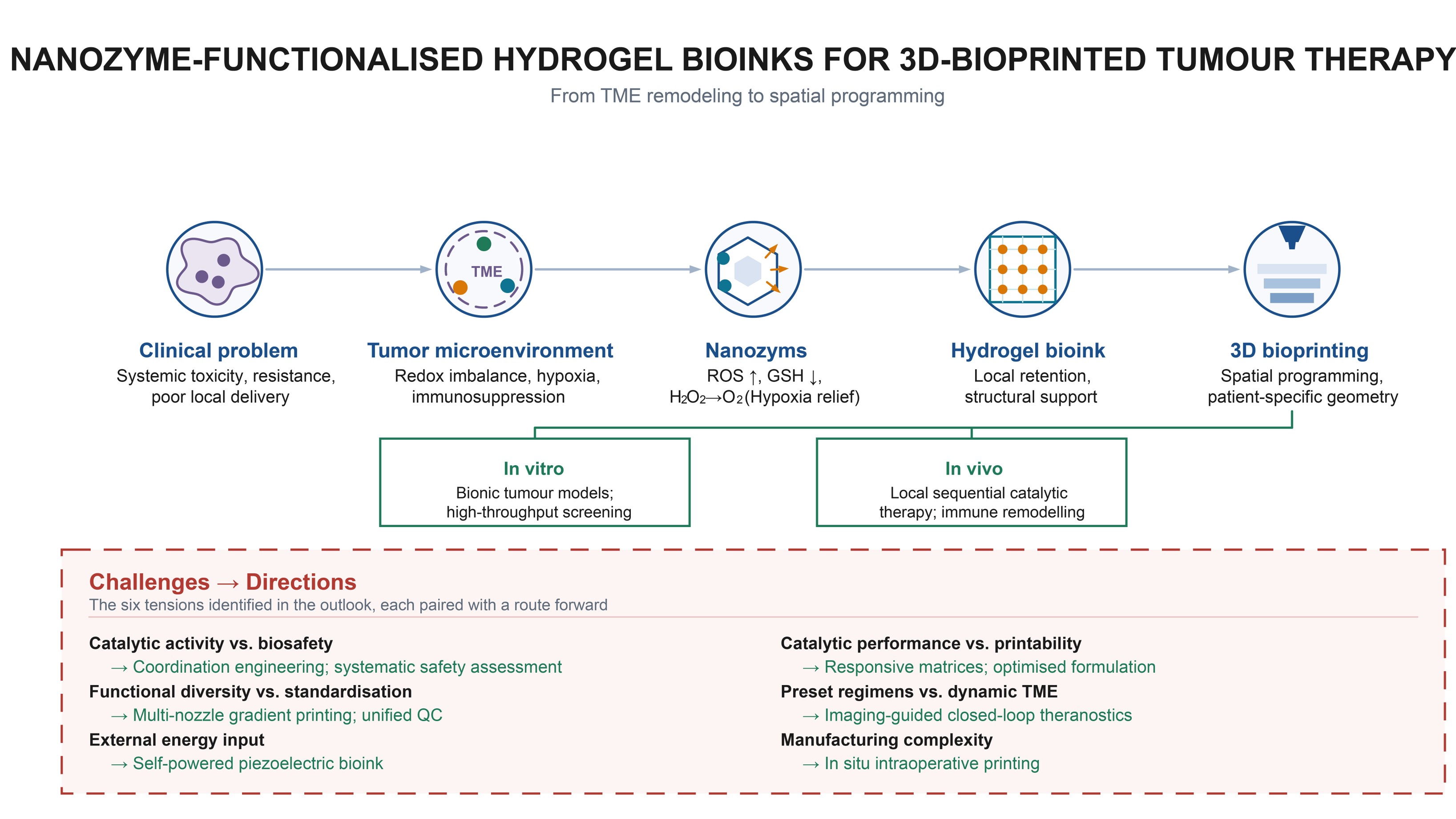
Three-dimensional (3D)-bioprinted nanozyme-hydrogel composites bridge nanocatalytic therapeutics and biomimetic tumor engineering for advancing tumor modeling and localized cancer treatment. Nanozymes are catalytic nanomaterials that emulate enzyme-mimicking activities while overcoming the instability and high cost of natural enzymes. Since the discovery of Fe3O4 peroxidase (POD)-mimicking catalysis, nanozyme research has advanced from empirical exploration to rational structural engineering for biomedical applications. Compared with conventional delivery vehicles limited by rapid clearance and insufficient tumor accumulation, 3D bioprinting enables precise spatial integration of nanozymes within tunable hydrogel bioinks, offering programmable construction of biomimetic tumor microenvironments (TMEs) and localized therapeutic scaffolds. This review systematically summarizes nanozyme catalytic classification, structural modulation strategies, and biomedical advances, with a core emphasis on state-of-the-art 3D-bioprinted nanozyme–hydrogel composite systems for tumor modeling and cancer therapy. Rationally engineered nanozymes exhibit tunable POD-, oxidase-, catalase-, and superoxide dismutase–mimicking activities, often based on metal-centered electron transfer. Integrated into printable hydrogel matrices, nanozymes achieve sustained intratumoral retention, overcoming the drawbacks of free nanocatalytic agents. 3D bioprinting recapitulates TME heterogeneity by constructing scaffolds with customizable stiffness, redox gradients, and porous architecture, supporting high-fidelity tumor modeling and high-throughput drug screening. In therapeutic applications, printed nanozyme systems remodel immunosuppressive TMEs, trigger tumor ferroptosis and immunogenic cell death via the cGAS-STING pathway, and enable stepwise antitumor cascades to suppress tumor growth, invasion, and recurrence, synergizing with photothermal and sonodynamic therapies. Nevertheless, critical challenges persist, including inherent trade-offs among bioink printability, structural stability, and catalytic performance; insufficient lesion-specific selectivity; and a lack of standardized bioprinting protocols. Optimizing composite formulations and printing parameters will promote the clinical translation of next-generation nanozyme-based tumor theranostic platforms.
- Bray F, Laversanne M, Sung H, et al. Global cancer statistics 2022: GLOBOCAN estimates of incidence and mortality worldwide for 36 cancers in 185 countries. CA Cancer J Clin. 2024;74(3):229-263. doi: 10.3322/caac.21834
- Kurian AG, Singh RK, Sagar V, Lee JH, Kim HW. Nanozyme-engineered hydrogels for anti-inflammation and skin regeneration. Nano-Micro Lett. 2024;16(1):110. doi: 10.1007/s40820-024-01323-6
- Germain N, Dhayer M, Dekiouk S, Marchetti P. Current advances in 3D bioprinting for cancer modeling and personalized medicine. Int J Mol Sci. 2022;23(7):3432. doi: 10.3390/ijms23073432
- Gopinathan J, Noh I. Recent trends in bioinks for 3D printing. Biomater Res. 2018;22(1):11. doi: 10.1186/s40824-018-0122-1
- Derakhshanfar S, Mbeleck R, Xu K, Zhang X, Zhong W, Xing M. 3D bioprinting for biomedical devices and tissue engineering: a review of recent trends and advances. Bioact Mater. 2018;3(2):144-156. doi: 10.1016/j.bioactmat.2017.11.008
- Cai B, Kilian D, Ramos Mejia D, Rios RJ, Ali A, Heilshorn SC. Diffusion-based 3D bioprinting strategies. Adv Sci. 2024;11(8):2306470. doi: 10.1002/advs.202306470
- Solanki R, Bhatia D. Stimulus-responsive hydrogels for targeted cancer therapy. Gels. 2024;10(7):440. doi: 10.3390/gels10070440
- Nie J, Wang Z, Tian H, et al. Ruthenium-gallic acid nanozymes encapsulated in 3D bioprintable photosensitive hydrogels for synergistic PTT/CDT therapy of glioblastoma. J Nanobiotechnology. Published online May 12, 2026. doi: 10.1186/s12951-026-04510-2
- Abaci A, Guvendiren M. 3D bioprinting of dense cellular structures within hydrogels with spatially controlled heterogeneity. Biofabrication. 2024;16(3):035027. doi: 10.1088/1758-5090/ad52f1
- Zhou XY, Wang CK, Shen ZF, et al. Recent research progress on tumour-specific responsive hydrogels. J Mater Chem B. 2024;12(30):7246-7266. doi: 10.1039/d4tb00656a
- Kim S, Han S, Lee J, Lee C, Park S. Bioprinting of tumor immune microenvironment for immunotherapy. Int J Bioprint. 2024;10(5):3988. doi: 10.36922/ijb.3988
- Roy N, Paira P. Glutathione depletion and stalwart anticancer activity of metallotherapeutics inducing programmed cell death: opening a new window for cancer therapy. ACS Omega. 2024;9(19):20670-20701. doi: 10.1021/acsomega.3c08890
- Liu X, Yu Y, Dong Q, et al. Roles of reactive oxygen species in inflammation and cancer. MedComm. 2024;5(4):e519. doi: 10.1002/mco2.519
- Crouigneau R, Li YF, Auxillos J, et al. Mimicking and analyzing the tumor microenvironment. Cell Rep Methods. 2024;4(10):100866. doi: 10.1016/j.crmeth.2024.100866
- Agbaje T, Baithalu R, Mishra SR, Panda S. Irreversibility processes on the squeezing flow analysis of blood-based micropolar hybrid nanofluid through parallel channel: spectral quasilinearisation method. BioNanoScience. 2024;14(3):3226-3240. doi: 10.1007/s12668-024-01417-w
- Zafar A, Khatoon S, Khan MJ, Abu J, Naeem A. Advancements and limitations in traditional anti-cancer therapies: a comprehensive review of surgery, chemotherapy, radiation therapy, and hormonal therapy. Discov Oncol. 2025;16(1):607. doi: 10.1007/s12672-025-02198-8
- Mao X, Wu S, Huang D, Li C. Complications and comorbidities associated with antineoplastic chemotherapy: rethinking drug design and delivery for anticancer therapy. Acta Pharm Sin B. 2024;14(7):2901-2926. doi: 10.1016/j.apsb.2024.03.006
- Gu Y, Yang R, Zhang Y, et al. Molecular mechanisms and therapeutic strategies in overcoming chemotherapy resistance in cancer. Mol Biomed. 2025;6(1):2. doi: 10.1186/s43556-024-00239-2
- Berland L, Gabr Z, Chang M, et al. Further knowledge and developments in resistance mechanisms to immune checkpoint inhibitors. Front Immunol. 2024;15:1384121. doi: 10.3389/fimmu.2024.1384121
- Ding L, Agrawal P, Singh SK, Chhonker YS, Sun J, Murry DJ. Polymer-based drug delivery systems for cancer therapeutics. Polymers. 2024;16(6):843. doi: 10.3390/polym16060843
- Li Y, Liu J, Xu S, Wang J. 3D bioprinting: an important tool for tumor microenvironment research. Int J Nanomedicine. 2023;18:8039-8057. doi: 10.2147/IJN.S435845
- Parodi I, Di Lisa D, Pastorino L, Scaglione S, Fato MM. 3D bioprinting as a powerful technique for recreating the tumor microenvironment. Gels. 2023;9(6):482. doi: 10.3390/gels9060482
- Weng J, Deng B, Huang X, Xue X. Advances in three-dimensional bioprinting and artificial intelligence for enhanced tumor modeling: current progress and future perspectives. Artif Intell Health. 2025;3(1):1. doi: 10.36922/aih025230052
- Gugulothu SB, Asthana S, Homer-Vanniasinkam S, Chatterjee K. Trends in photopolymerizable bioinks for 3D bioprinting of tumor models. JACS Au. 2023;3(8):2086-2106. doi: 10.1021/jacsau.3c00281
- Cui X, Jiao J, Yang L, et al. Advanced tumor organoid bioprinting strategy for oncology research. Mater Today Bio. 2024;28:101198. doi: 10.1016/j.mtbio.2024.101198
- Liu S, Jin P. Advances and challenges in 3D bioprinted cancer models: opportunities for personalized medicine and tissue engineering. Polymers (Basel). 2025;17(7):948. doi: 10.3390/polym17070948
- Cheah KE, Yeoh PSQ, Lai KW, Wu S, Muhamad F. Smart and injectable hydrogels for cancer treatment and other biomedical applications. Biomater Adv. 2026;180:214624. doi: 10.1016/j.bioadv.2025.214624
- Huang Y, Ren J, Qu X. Nanozymes: classification, catalytic mechanisms, activity regulation, and applications. Chem Rev. 2019;119(6):4357-4412. doi: 10.1021/acs.chemrev.8b00672
- Liang M, Yan X. Nanozymes: from new concepts, mechanisms, and standards to applications. Acc Chem Res. 2019;52(8):2190-2200. doi: 10.1021/acs.accounts.9b00140
- N NP, Mehla S, Begum A, et al. Smart nanozymes for cancer therapy: the next frontier in oncology. Adv Healthc Mater. 2023;12(25):2300768. doi: 10.1002/adhm.202300768
- Ma Q, Liu Y, Zhu H, Zhang L, Liao X. Nanozymes in tumor theranostics. Front Oncol. 2021;11:666017. doi: 10.3389/fonc.2021.666017
- Ren X, Chen D, Wang Y, et al. Nanozymes—recent development and biomedical applications. J Nanobiotechnology. 2022;20(1):92. doi: 10.1186/s12951-022-01295-y
- Wang Q, Jiang J, Gao L. Catalytic antimicrobial therapy using nanozymes. WIREs Nanomed Nanobiotechnol. 2022;14(2):e1769. doi: 10.1002/wnan.1769
- Zhang R, Yan X, Gao L, Fan K. Nanozymes expanding the boundaries of biocatalysis. Nat Commun. 2025;16(1):6817. doi: 10.1038/s41467-025-62063-8
- Panferov VG, Zhang X, Wong KY, Lee JH, Liu J. Biomedical applications of nanozymes: an enzymology perspective. Angew Chem Int Ed. 2025;64(46):e202512409. doi: 10.1002/anie.202512409
- Yang L, Dong S, Gai S, et al. Deep insight of design, mechanism, and cancer theranostic strategy of nanozymes. Nano-Micro Lett. 2024;16(1):28. doi: 10.1007/s40820-023-01224-0
- Zhu X, Xu N, Zhang L, Wang D, Zhang P. Novel design of multifunctional nanozymes based on tumor microenvironment for diagnosis and therapy. Eur J Med Chem. 2022;238:114456. doi: 10.1016/j.ejmech.2022.114456
- Zhang Y, Jin Y, Cui H, Yan X, Fan K. Nanozyme-based catalytic theranostics. RSC Adv. 2020;10(1):10-20. doi: 10.1039/c9ra09021e
- Sun H, Bai Y, Zhao D, Wang J, Qiu L. Transition-metal-oxide-based nanozymes for antitumor applications. Materials. 2024;17(12):2896. doi: 10.3390/ma17122896
- Alboslemy T, Yu B, Rogers T, Kim MH. Staphylococcus aureus biofilm-conditioned medium impairs macrophage-mediated antibiofilm immune response by upregulating KLF2 expression. Infect Immun. 2019;87(4):e00643-18. doi: 10.1128/IAI.00643-18
- Zhuang X, Gao S, Tao Y, Yuan M, Han Z, Wang Y. pH-responsive nanozymes: multifunctional platforms for biomedical catalysis toward clinical translation. Front Bioeng Biotechnol. 2026;14:1765647. doi: 10.3389/fbioe.2026.1765647
- Chen Z, Yin JJ, Zhou YT, et al. Dual enzyme-like activities of iron oxide nanoparticles and their implication for diminishing cytotoxicity. ACS Nano. 2012;6(5):4001-4012. doi: 10.1021/nn300291r
- Yang Q, Wu Q, Liu H, Wu J, Ma F, Tian X. Tumor microenvironment-responsive and modulatory manganese-based nanoenzyme for enhanced tumor immunotherapy. Front Pharmacol. 2025;15:1518983. doi: 10.3389/fphar.2024.1518983
- Zheng N, Hu X, Hu J. Endogenous/exogenous dual-responsive bimetallic hollow nanozyme for photothermal/nanocatalysis/immune synergistic tumor therapy. Rare Met. 2026;45(1):e70015. doi: 10.1002/rar2.70015
- Kalinina EV, Gavriliuk LA. Glutathione synthesis in cancer cells. Biochemistry. 2020;85(8):895-907. doi: 10.1134/S0006297920080052
- Sun R, Liu R, Tian Y, Li Y, Fan B, Li S. Removing barriers to tumor “oxygenation”: depleting glutathione nanozymes in cancer therapy. Int J Nanomedicine. 2025;20:5613-5643. doi: 10.2147/IJN.S515734
- Liu Q, Zhang A, Wang R, Zhang Q, Cui D. A review on metal- and metal oxide-based nanozymes: properties, mechanisms, and applications. Nano-Micro Lett. 2021;13(1):154. doi: 10.1007/s40820-021-00674-8
- Deshwal A, Tripathi RM, Saxena K, Sheikh FA, Mishra P. Auriferous nanozymes: advances in diagnostic and therapeutic applications. Nanotechnology. 2024;35(50):502003. doi: 10.1088/1361-6528/ad7f5d
- Lou-Franco J, Das B, Elliott C, Cao C. Gold nanozymes: from concept to biomedical applications. Nano-Micro Lett. 2021;13(1):10. doi: 10.1007/s40820-020-00532-z
- Drozd M, Pietrzak M, Parzuchowski P, Mazurkiewicz-Pawlicka M, Malinowska E. Peroxidase-like activity of gold nanoparticles stabilized by hyperbranched polyglycidol derivatives over a wide pH range. Nanotechnology. 2015;26(49):495101. doi: 10.1088/0957-4484/26/49/495101
- Wang X, Shu C, Wang G, et al. Recent progress of noble metal-based nanozymes: structural engineering and biomedical applications. Nanoscale. 2025;17(17):10557-10580. doi: 10.1039/D4NR05514D
- Deng C, Ye Z, Zheng CJ, Cheng H, Ge J. Iron-based nanozymes induced ferroptosis for tumor therapy. Nanoscale. 2025;17(23):14103-14117. doi: 10.1039/D5NR00880H
- Wang Y, Li H, Guo L, Jiang Q, Liu F. A cobalt-doped iron oxide nanozyme as a highly active peroxidase for renal tumor catalytic therapy. RSC Adv. 2019;9(33):18815-18822. doi: 10.1039/C8RA05487H
- Ye H, Lai Y, Wu Z, Li G, Hua Q, Zhu W. Carbon-based nanozymes: catalytic mechanisms, performance tuning, and environmental and biomedical applications. Anal Methods. 2025;17(31):6264-6281. doi: 10.1039/D5AY00997A
- Tripathi A, Singh Rautela S, Kumari P. Graphene-based nanozymes for revolutionizing biomedical research. RSC Adv. 2025;15(46):39092-39122. doi: 10.1039/D5RA04765J
- Jin J, Li L, Zhang L, Luan Z, Xin S, Song K. Progress in the application of carbon dots-based nanozymes. Front Chem. 2021;9:748044. doi: 10.3389/fchem.2021.748044
- Wang B, Cai H, Waterhouse G, Qu X, Yang B, Lu S. Carbon dots in bioimaging, biosensing and therapeutics: a comprehensive review. Small Sci. 2022;2(6):2200012. doi: 10.1002/smsc.202200012
- Yu Y, Zeng Q, Tao S, et al. Carbon dots-based photoinduced reactions: advances and perspective. Adv Sci. 2023;10(12):2207621. doi: 10.1002/advs.202207621
- Ahmad MA, Sumarsih S, Chang JY, Fahmi MZ. Mass spectrometry-based analyses of carbon nanodots: structural elucidation. ACS Omega. 2024;9(19):20720-20727. doi: 10.1021/acsomega.4c01674
- Jorns M, Pappas D. A review of fluorescent carbon dots, their synthesis, physical and chemical characteristics, and applications. Nanomaterials. 2021;11(6):1448. doi: 10.3390/nano11061448
- Adeola AO, Clermont-Paquette A, Piekny A, Naccache R. Advances in the design and use of carbon dots for analytical and biomedical applications. Nanotechnology. 2024;35(1):012001. doi: 10.1088/1361-6528/acfdaf
- Kong J, Zhou F. Preparation and application of carbon dots nanozymes. Antioxidants. 2024;13(5):535. doi: 10.3390/antiox13050535
- Kebo E, Luo Y, Wang X, et al. Multiple application strategies of carbon dots in cancer treatment: mechanisms, progress and challenges. Int J Nanomedicine. 2026;21:584122. doi: 10.2147/IJN.S584122
- Lin Z, Zhou H, Lu J, Yin X. Carbon-based nanozymes in cancer therapy: current trends and future prospects. Biomaterials. 2026;324:123465. doi: 10.1016/j.biomaterials.2025.123465
- Cordani M, Fernández-Lucas J, Khosravi A, et al. Carbon-based nanozymes for cancer therapy and diagnosis: a review. Int J Biol Macromol. 2025;297:139704. doi: 10.1016/j.ijbiomac.2025.139704
- Feng JH, Zhang ML, Zou YM, et al. Hollow gold-platinum nanoshells as a delivery platform for Ce6: cascading catalysis for enhanced multimodal therapy in tumor ablation and antitumor immunity. Nanoscale. 2025;17(9):5456-5471. doi: 10.1039/D4NR04627G
- Geng B, Yan L, Zhu Y, et al. Carbon dot@MXene nanozymes with triple enzyme-mimic activities for mild NIR-II photothermal-amplified nanocatalytic therapy. Adv Healthc Mater. 2023;12(5):2202154. doi: 10.1002/adhm.202202154
- Lai CM, Xiao XS, Xu J, Qin Y, He SH. Dual-enzyme nanoassemblies of carbon dots and gold for tumor microenvironment-responsive immunotherapy in hepatocellular carcinoma. ACS Appl Mater Interfaces. 2025;17(45):61647-61660. doi: 10.1021/acsami.5c10705
- Luo Q, Shao N, Zhang AC, et al. Smart biomimetic nanozymes for precise molecular imaging: application and challenges. Pharmaceuticals. 2023;16(2):249. doi: 10.3390/ph16020249
- Cao C, Zhang T, Yang N, et al. POD nanozyme optimized by charge separation engineering for light/pH-activated bacteria catalytic/photodynamic therapy. Signal Transduct Target Ther. 2022;7(1):86. doi: 10.1038/s41392-022-00900-8
- Zheng J, Peng W, Shi H, Zhang J, Hu Q, Chen J. Emerging engineered nanozymes: current status and future perspectives in cancer treatments. Nanoscale Adv. 2025;7(5):1226-1242. doi: 10.1039/D4NA00924J
- Liu B, Chen K, Han Y. Exploring mitochondrial phototoxicity: mechanisms, measurement, and mitigation. Biochimie. 2025;237:16-25. doi: 10.1016/j.biochi.2025.07.008
- Zhang Y, Zhang L, Wang M, Li P. The applications of nanozymes in neurological diseases: from mechanism to design. Theranostics. 2023;13(8):2492-2514. doi: 10.7150/thno.83370
- Tian Y, Yang Q, Liu Y, et al. Multimodal antibacterial microneedles with nanozymes-mediated ROS-scavenging and oxygen-generation synergistic photothermal/photodynamic therapy to promote diabetic ulcer healing. Mater Today Bio. 2025;35:102368. doi: 10.1016/j.mtbio.2025.102368
- Khan AU, Kiani MN, Huda NU, Jin Y. Smart designer nanozymes for precision cancer therapy: recent advances and prospects. ACS Appl Mater Interfaces. 2026;18(3):4632-4666. doi: 10.1021/acsami.5c21149
- Yang M, Yang T, Mao C. Enhancement of photodynamic cancer therapy by physical and chemical factors. Angew Chem Int Ed. 2019;58(40):14066-14080. doi: 10.1002/anie.201814098
- Aziz A, Wissam Z. Reactive oxygen species: molecular mechanisms, cellular targets, and implications for genomic stability. Biomed Res Int. 2026;2026:6918118. doi: 10.1155/bmri/6918118
- Geevarghese R, Żur-Pińska J, Parisi D, Włodarczyk-Biegun MK. A comprehensive protocol for hydrogel-based bioink design: balancing printability, stability, and biocompatibility. J Mater Chem B. 2025;13(42):13750-13768. doi: 10.1039/D5TB00737B
- Fatimi A, Okoro OV, Podstawczyk D, Simińska-Stanny J, Shavandi A. Natural hydrogel-based bio-inks for 3D bioprinting in tissue engineering: a review. Gels. 2022;8(3):179. doi: 10.3390/gels8030179
- Picado-Tejero D, Mendoza-Cerezo L, Rodríguez-Rego JM, Macías-García A, Marcos-Romero AC. 3D bioprinted natural hydrogels: rheological characterization, cytotoxicity, and printability assessment of a polysaccharide-based bioink. ACS Omega. 2026;11(2):3115-3131. doi: 10.1021/acsomega.5c09668
- Nguyen MH, Duong GH, Huynh LTV, et al. Computer-aided hydrogel synthesis for 3D bioprinting: application of design of experiments (DoE), machine learning (ML), and computational fluid dynamics (CFD). Mater Adv. 2026;7(11):5458-5482. doi: 10.1039/D6MA00268D
- Qiu M, Man C, Zhao Q, et al. Nanozymes meet hydrogels: fabrication, progressive applications, and perspectives. Adv Colloid Interface Sci. 2025;338:103404. doi: 10.1016/j.cis.2025.103404
- Yang C, Sun M, Li Y, et al. 1+1>2: synergistic integration and biomedical applications of nanozyme@hydrogel platforms. Adv Healthc Mater. 2025;14(30):e00899. doi: 10.1002/adhm.202500899
- Qiu S, Xu Z, Ning X, et al. A 3D-printed composite hydrogel engineered with a coordination-reprogrammed nanozyme for synergistic chemo-physical bone therapy. ACS Appl Mater Interfaces. 2026;18(7):11117-11133. doi: 10.1021/acsami.5c25694
- Tian C, Xiao S, Chen X, et al. Dual-physical-field nanocatalysis: injectable hydrogel enables piezo-photothermal synergy for breast cancer therapy. Adv Sci. 2026;13(37):e22447. doi: 10.1002/advs.202522447
- Zengin A, Teixeira FC, Feliciano T, et al. Matrix metalloproteinase degradable, in situ photocrosslinked nanocomposite bioinks for bioprinting applications. Biomater Adv. 2023;154:213647. doi: 10.1016/j.bioadv.2023.213647
- Wang Y, Duan Y, Yang B, Li Y. Nanocomposite hydrogel bioinks for 3D bioprinting of tumor models. Biomacromolecules. 2024;25(8):5288-5299. doi: 10.1021/acs.biomac.4c00671
- Yu C, Chen D, Feng L, et al. Piezocatalytic nanoplatform drives Mg2+-release-amplified ferroptosis-immune synergy for tumor microenvironment reprogramming. ACS Nano. 2026;20(12):10024-10042. doi: 10.1021/acsnano.5c22255
- Wang X, Yang Y, Cong L, et al. Hydrogel microbead-confined nanozyme-SERS sensor for robust detection of hydrogen peroxide in complex biological systems. ACS Sens. 2026;11(6):5106-5117. doi: 10.1021/acssensors.6c01164
- Chen W, Yang F, Chen X, et al. Ultrasmall self-cascade bimetallic Au2Pd3 nanozymes encapsulated hydrogel microneedles for photothermal-augmented nanocatalytic therapy of diabetic wound infections. ACS Appl Mater Interfaces. 2025;17(38):53295-53311. doi: 10.1021/acsami.5c14298
- Xiao Z, Cao J, Liu J, Song Z, Du T, Du X. Trimetallic nanozyme-embedded smart hydrogel enables NIR-controlled bacterial killing and oxidative stress alleviation. Adv Sci. 2025;12(48):e12875. doi: 10.1002/advs.202512875
- Li Q, Xu S, Feng Q, et al. 3D-printed silk-gelatin hydrogel scaffold with different porous structure and cell seeding strategy for cartilage regeneration. Bioact Mater. 2021;6(10):3396-3410. doi: 10.1016/j.bioactmat.2021.03.013
- Li H, Liu Z, Zhang P, Zhang D. The recent research progress in the application of the nanozyme-hydrogel composite system for drug delivery. Drug Deliv. 2024;31(1):2417986. doi: 10.1080/10717544.2024.2417986
- Su Y, Ju J, Shen C, et al. In situ 3D bioprinted GDMA/Prussian blue nanozyme hydrogel with wet adhesion promotes macrophage phenotype modulation and intestinal defect repair. Mater Today Bio. 2025;31:101636. doi: 10.1016/j.mtbio.2025.101636
- Li L, Guo K, Hu G, Wang L. Specific nanozyme-based cascade catalysis hydrogel with oxygen-self-supplying and ROS-scavenging capacity for efficient diabetic wound healing. Adv Healthc Mater. 2026;15(21):e05890. doi: 10.1002/adhm.202505890
- Rizwana N, Maslekar N, Chatterjee K, Yao Y, Agarwal V, Nune M. Dual crosslinked antioxidant mixture of poly(vinyl alcohol) and cerium oxide nanoparticles as a bioink for 3D bioprinting. ACS Appl Nano Mater. 2024;7(16):18177-18188. doi: 10.1021/acsanm.3c02962
- Fatrekar AP, Morajkar RV, Vernekar AA. Expanding limits of artificial enzymes: unprecedented catalysis by an oxidase nanozyme in activating a structural protein for covalent crosslinking and conferring remarkable proteolytic resistance. Chem Sci. 2024;15(36):14726-14738. doi: 10.1039/D4SC03767G
- Zhang C, Xu Y, Yu H, et al. Fabrication of an in vitro three-dimensional tumor model using liver-derived decellularized extracellular matrix/gelatin methacrylate bioink for investigating cancer characteristics and drug resistance. Int J Bioprint. 2025;11(4):392. doi: 10.36922/ijb025160142
- Xiao M, Zhang Y, Xing J, et al. Ru-Ph nanozyme-based hydrogels for tumor chemodynamic therapy by enhancing enzyme catalytic efficiency through multiple pathways. Adv Healthc Mater. 2025;14(4):2403868. doi: 10.1002/adhm.202403868
- Hu P, Feng N, Zhao S, et al. Microenvironment-responsive injectable thermosensitive hydrogel incorporating nanozymes for synergistic breast cancer therapy and postsurgical adjuvant treatment. Adv Funct Mater. 2025;35(28):2421176. doi: 10.1002/adfm.202421176
- Hu P, Sha J, Gong Q, Xu J, Xu K. Tumor microenvironment-responsive cascaded nanozyme-based composite hydrogel for multimodality synergistic therapies in cancer treatment. Chem Eng J. 2025;507:160591. doi: 10.1016/j.cej.2025.160591
- Wang W, Zhang Z, Yu Y, Wang Y, Ni K. 3D bioprinting–microfluidics technology: pioneering advances in tumor microenvironment modeling, cancer treatment optimization, and diagnostic biomarker discovery. Int J Bioprint. 2025;11(6):23. doi: 10.36922/ijb025320314
- Zhu Y, Pan Y, Guo Z, et al. Photothermal enhanced and tumor microenvironment responsive nanozyme for amplified cascade enzyme catalytic therapy. Adv Healthc Mater. 2023;12(7):2202198. doi: 10.1002/adhm.202202198
- Liu J, Zhao Y, Ren B, et al. Multiscale vascularized tumor-on-a-chip via bioprinting for drug research. Int J Bioprint. 2025;11(4):378. doi: 10.36922/ijb025180180
- Cook AB, Palange A, Schlich M, et al. Matrix metalloproteinase responsive hydrogel microplates for programmed killing of invasive tumour cells. RSC Appl Polym. 2023;1(1):19-29. doi: 10.1039/D3LP00057E
- Zhang C, Jiang G, Gao X. Matrix metalloproteinase-responsive drug delivery systems. Bioconjug Chem. 2023;34(8):1349-1365. doi: 10.1021/acs.bioconjchem.3c00266
- Lee G, Kim SJ, Choi Y, Park J, Park JK. Bioprinting of a multi-composition array to mimic intra-tumor heterogeneity of glioblastoma for drug evaluation. Microsyst Nanoeng. 2024;10(1):186. doi: 10.1038/s41378-024-00843-w
- Li J, Parra-Cantu C, Wang Z, Zhang YS. Improving bioprinted volumetric tumor microenvironments in vitro. Trends Cancer. 2020;6(9):745-756. doi: 10.1016/j.trecan.2020.06.002
- Mahran A, Howaili F, Bhadane R, et al. Functional enzyme delivery via surface-modified mesoporous silica nanoparticles in 3D printed nanocomposite hydrogels. Eur J Pharm Sci. 2025;211:107132. doi: 10.1016/j.ejps.2025.107132
- Tang M, Tiwari SK, Agrawal K, et al. Rapid 3D bioprinting of glioblastoma model mimicking native biophysical heterogeneity. Small. 2021;17(15):2006050. doi: 10.1002/smll.202006050
- Chen A, Wang W, Mao Z, et al. Multimaterial 3D and 4D bioprinting of heterogeneous constructs for tissue engineering. Adv Mater. 2024;36(34):2307686. doi: 10.1002/adma.202307686
- Chen L, Xu Y, Hu X, et al. In situ generation of dendritic cell vaccines in 3D printing scaffolds for cancer postsurgical therapy. Natl Sci Rev. 2026;13(5):nwag037. doi: 10.1093/nsr/nwag037
- Perin F, Ouyang L, Lim KS, et al. Bioprinted constructs in the regulatory landscape: current state and future perspectives. Adv Mater. 2026;38(4):e04037. doi: 10.1002/adma.202504037
- Wang Y, Xu M, Wang Y, et al. From cold to hot: nanozyme-based strategies for reprogramming the tumour immunoenvironment. Cell Prolif. 2026;59(7):e70235. doi: 10.1111/cpr.70235
- Guo R, Du Q, He Y, Wu H, Zhang Y, Jing Z. Innovative strategies to overcome stability challenges of single-atom nanozymes. Nano-Micro Lett. 2026;18(1):100. doi: 10.1007/s40820-025-01939-2
- Wang Z, Zhai B, Sun J, et al. Recent advances of injectable in situ-forming hydrogels for preventing postoperative tumor recurrence. Drug Deliv. 2024;31(1):2400476. doi: 10.1080/10717544.2024.2400476
- Liu Y, Liu F, Zeng Y, et al. Hydrogel systems for spatiotemporal controlled delivery of immunomodulators: engineering the tumor immune microenvironment for enhanced cancer immunotherapy. Front Cell Dev Biol. 2024;12:1514595. doi: 10.3389/fcell.2024.1514595
- Colak B, Cihan MC, Ertas YN. 3D-printed, implantable alginate/CuS nanoparticle scaffolds for local tumor treatment via synergistic photothermal, photodynamic, and chemodynamic therapy. ACS Appl Nano Mater. 2023;6(17):16076-16085. doi: 10.1021/acsanm.3c03433
- Tagaras N, Song H, Sahar S, Tong W, Mao Z, Buerki-Thurnherr T. Safety landscape of therapeutic nanozymes and future research directions. Adv Sci. 2024;11(46):2407816. doi: 10.1002/advs.202407816
- Park YS, Park BU, Jeon HJ. Advances in machine learning-enhanced nanozymes. Front Chem. 2024;12:1483986. doi: 10.3389/fchem.2024.1483986
- Reghu G, Vemula PK, Bhat SG, Narayanan S. Harnessing the innate immune system by revolutionizing macrophage-mediated cancer immunotherapy. J Biosci. 2024;49(2):63. doi: 10.1007/s12038-024-00441-y
- Su Y, Wu H, Duan K, et al. Synergistic tumor microenvironment modulation enabled by a nanozyme-boosted biomimetic macrophage-derived nanovesicle for highly efficient antitumor therapy. Theranostics. 2025;15(16):7925-7939. doi: 10.7150/thno.114467
- Han Q, Huang D, Li S, Xia B, Wang X. Multifunctional nanozymes for disease diagnosis and therapy. Biomed J. 2024;47(4):100699. doi: 10.1016/j.bj.2024.100699
- Swain S, Misra RDK, Rautray TR. Nanoscale generators for tissue healing: a perspective. Int J Nanomedicine. 2024;19:11859-11882. doi: 10.2147/IJN.S480938
- Pu Y, Zhou B, Bing J, et al. Ultrasound-triggered and glycosylation inhibition-enhanced tumor piezocatalytic immunotherapy. Nat Commun. 2024;15(1):9023. doi: 10.1038/s41467-024-53392-1
- Zhou Q, Zhao W, Li S, et al. From static scaffolds to responsive implants: 3D-printed field-active bioceramics for adaptive bone regeneration. Adv Healthc Mater. 2026;15(32):e71463. doi: 10.1002/adhm.71463
- Agarwal T, Onesto V, Banerjee D, et al. 3D bioprinting in tissue engineering: current state-of-the-art and challenges towards system standardization and clinical translation. Biofabrication. 2025;17(4):042003. doi: 10.1088/1758-5090/ade47a
- Ruding M, Shajahan AB, Fossum M, Pennisi CP, Lind JU. When will bioprinting become a therapy? Translational and regulatory challenges in urogenital tissue engineering and surgery. Front Bioeng Biotechnol. 2026;14:1865005. doi: 10.3389/fbioe.2026.1865005
- Velu A, Seth S, Ojha A, et al. Advances and challenges in 3D bioprinting for organ transplantation: bridging the gap between research and clinical applications. Cureus. 2025;17(11):e97947. doi: 10.7759/cureus.97947