
Digital light processing-printed macroencapsulated human liver organoids preserve hepatic stellate cell quiescence for transplantation in immunocompetent mice

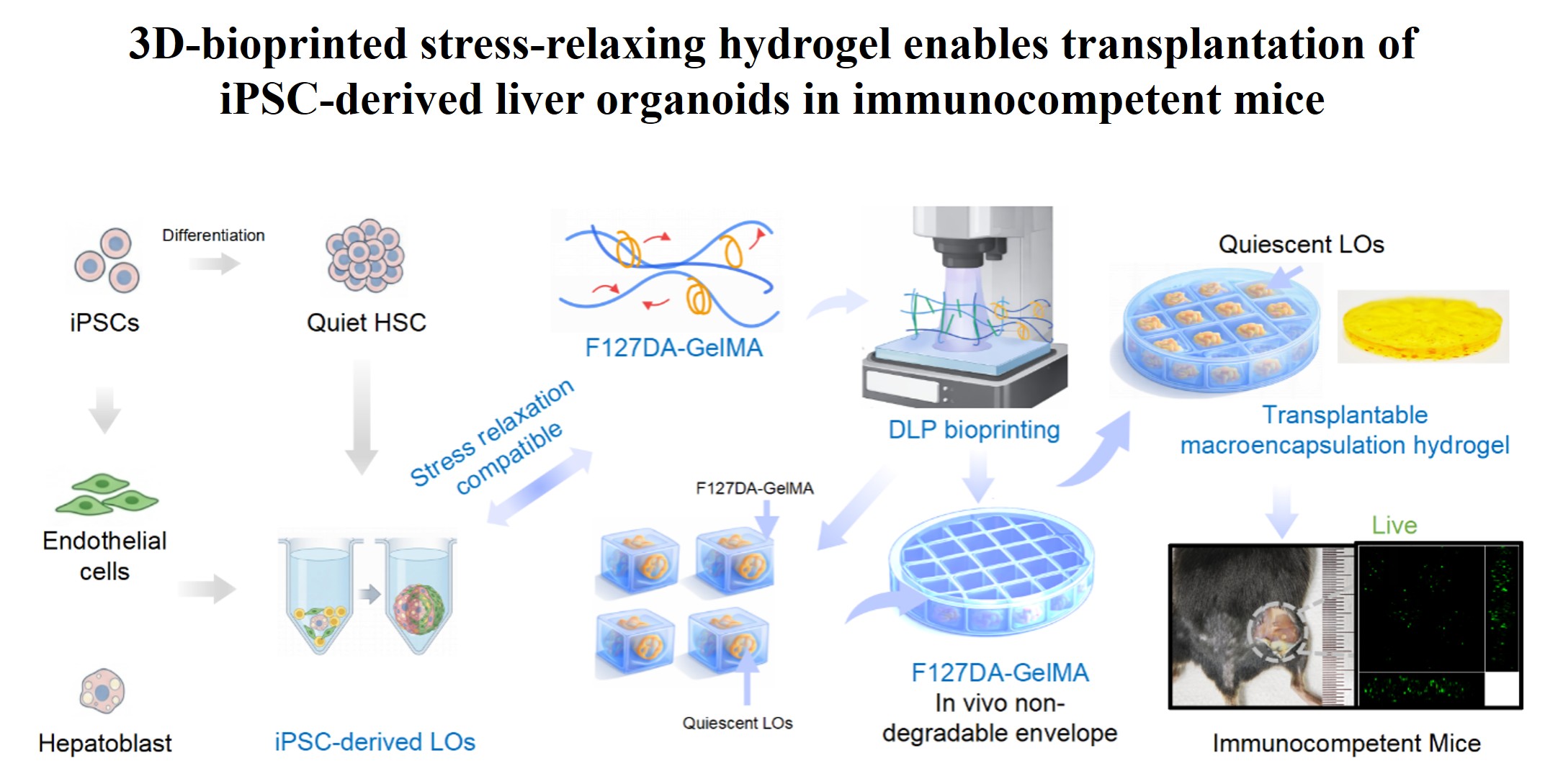
Digital light processing (DLP) bioprinting enables the fabrication of stem cell-derived liver organoids into biomimetic architectures. However, preserving quiescent hepatic stellate cells (HSCs) within human liver organoids during DLP printing remains challenging, as the mechanical requirements for print fidelity often conflict with the compliant microenvironment necessary for maintaining HSC quiescence. To address this limitation, we delineated the printable window of induced pluripotent stem cell (iPSC)-derived HSCs that balances printability with resistance to activation. Notably, day 10 HSCs retained a quiescent phenotype, contributing to the assembly of multicellular organoids without fibrotic activation. We subsequently evaluated the stress-relaxation properties of poly(ethylene glycol) diacrylate (PEGDA)–gelatin methacryloyl (GelMA) and F127DA–GelMA hydrogels, demonstrating that fast-relaxing inner hydrogels preserved the compact cellular morphology of liver organoids, suppressed activation-associated gene expression, and protected HSCs from fibrotic conversion. This highlights that stress relaxation, rather than stiffness alone, is critical for cellular adaptation. Then, we developed a DLP-bioprinted macroencapsulation platform integrating stage-selected iPSC-derived HSCs, stress relaxation-tuned hydrogels, and a protective outer shell. The DLP-printed outer shell conferred structural integrity to the macroencapsulated construct, enabling successful implantation in immunocompetent mice with high graft viability and minimal alpha-smooth muscle actin (α-SMA) expression in iPSC-derived liver organoids containing HSCs. In summary, this study establishes a coordinated strategy harmonizing HSC selection, matrix mechanics, and bioprinting design to balance biological and mechanical demands, yielding structurally stable, physiologically relevant liver organoids while preventing fibrotic activation during biofabrication.
- Takebe T, Sekine K, Enomura M, et al. Vascularized and functional human liver from an iPSC-derived organ bud transplant. Nature. 2013;499(7459):481-484. doi: 10.1038/nature12271
- Tang XY, Wu S, Wang D, et al. Human organoids in basic research and clinical applications. Signal Transduct Target Ther. 2022;7(1):168. doi: 10.1038/s41392-022-01024-9
- Harrison SP, Baumgarten SF, Verma R, Lunov O, Dejneka A, Sullivan GJ. Liver Organoids: Recent Developments, Limitations and Potential. Front Med. 2021;8:574047. doi: 10.3389/fmed.2021.574047
- Grebenyuk S, Abdel Fattah AR, Kumar M, et al. Large-scale perfused tissues via synthetic 3D soft microfluidics. Nat Commun. 2023;14(1):193. doi: 10.1038/s41467-022-35619-1
- Kamm DR, McCommis KS. Hepatic stellate cells in physiology and pathology. J Physiol. 2022;600(8):1825-1837. doi: 10.1113/JP281061
- Trivedi P, Wang S, Friedman SL. The Power of Plasticity- Metabolic Regulation of Hepatic Stellate Cells. Cell Metab. 2021;33(2):242-257. doi: 10.1016/j.cmet.2020.10.026
- Coll M, Perea L, Boon R, et al. Generation of Hepatic Stellate Cells from Human Pluripotent Stem Cells Enables In Vitro Modeling of Liver Fibrosis. Cell Stem Cell. 2018;23(1):101- 113.e7. doi: 10.1016/j.stem.2018.05.027
- Koui Y, Himeno M, Mori Y, et al. Development of human iPSC-derived quiescent hepatic stellate cell-like cells for drug discovery and in vitro disease modeling. Stem Cell Rep. 2021;16(12):3050-3063. doi: 10.1016/j.stemcr.2021.11.002
- Huang MS, Christakopoulos F, Roth JG, Heilshorn SC. Organoid bioprinting: from cells to functional tissues. Nat Rev Bioeng. 2024;3(2):126-142. doi: 10.1038/s44222-024-00268-0
- Zhao Z, Chen X, Dowbaj AM, et al. Organoids. Nat Rev Methods Primers. 2022;2:94. doi: 10.1038/s43586-022-00174-y
- Ding H, Dong M, Zheng Q, Wu ZL. Digital light processing 3D printing of hydrogels: a minireview. Mol Syst Des Eng. 2022;7(9):1017-1029. doi: 10.1039/d2me00066k
- Jeong YG, Yoo JJ, Lee SJ, Kim MS. 3D digital light process bioprinting: Cutting-edge platforms for resolution of organ fabrication. Mater Today Bio. 2024;29:101284. doi: 10.1016/j.mtbio.2024.101284
- Duong VT, Lin CC. Digital Light Processing 3D Bioprinting of Gelatin-Norbornene Hydrogel for Enhanced Vascularization. Macromol Biosci. 2023;23(12):e2300213. doi: 10.1002/mabi.202300213
- Zhu S, Liao X, Xu Y, et al. 3D bioprinting of high-performance hydrogel with in-situ birth of stem cell spheroids. Bioact Mater. 2025;43:392-405. doi: 10.1016/j.bioactmat.2024.09.033
- He N, Wang X, Shi L, et al. Photoinhibiting via simultaneous photoabsorption and free-radical reaction for high-fidelity light-based bioprinting. Nat Commun. 2023;14(1). doi: 10.1038/s41467-023-38838-2
- Zhu J. Bioactive modification of poly(ethylene glycol) hydrogels for tissue engineering. Biomaterials. 2010;31(17):4639-4656. doi: 10.1016/j.biomaterials.2010.02.044
- Zhao P, Wang B, Wang L, et al. Rapid printing of 3D porous scaffolds for breast reconstruction. Bio-des Manuf. 2023;6(6):691-703. doi: 10.1007/s42242-023-00253-3
- Caliari SR, Perepelyuk M, Soulas EM, Lee GY, Wells RG, Burdick JA. Gradually softening hydrogels for modeling hepatic stellate cell behavior during fibrosis regression. Integr Biol. 2016;8(6):720-728. doi: 10.1039/c6ib00027d
- Fowler M, Moreno Lozano A, Krause J, et al. Guiding vascular infiltration through architected GelMA/PEGDA hydrogels: an in vivo study of channel diameter, length, and complexity. Biomater Sci. 2025;13(11):2951-2960. doi: 10.1039/d5bm00193e
- Wang Y, Huang R, Lu Y, Liu M, Mo R. Immuno-protective vesicle-crosslinked hydrogel for allogenic transplantation. Nat Commun. 2024;15(1):5176. doi: 10.1038/s41467-024-49135-x