
3D-printed dual-crosslinked hydrogel scaffold loaded with ginger-derived exosomes for enhanced infected wound healing

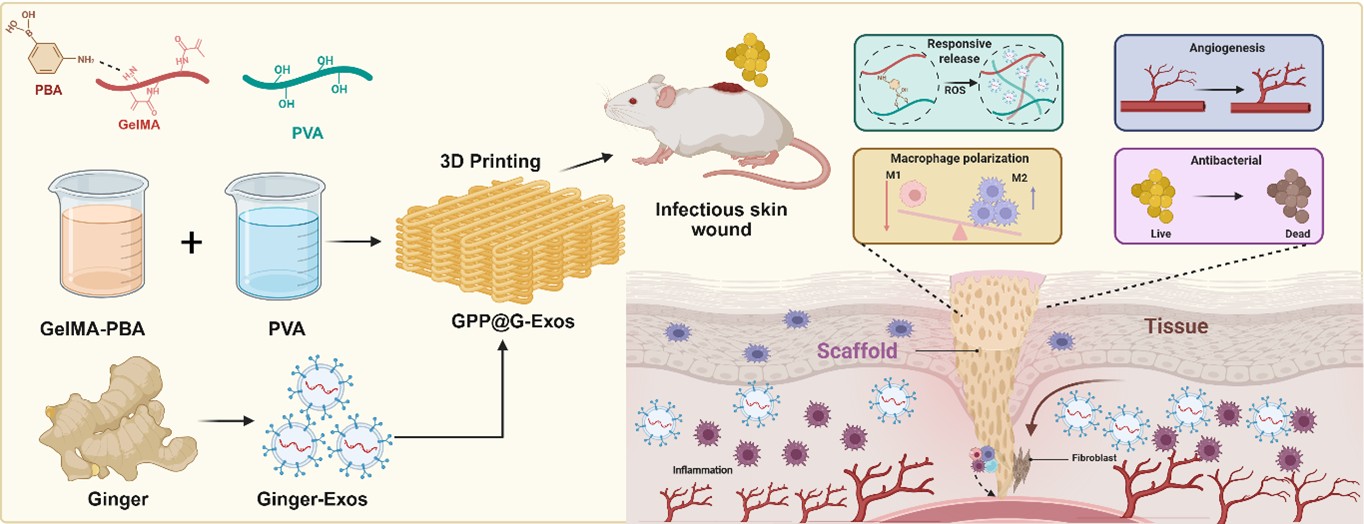
Infected wounds pose a significant clinical challenge, as persistent bacterial colonization exacerbates inflammation, disrupts the local immune microenvironment, and delays tissue repair. Here, we report the development of a 3D printing dual-crosslinked hydrogel scaffold loaded with ginger-derived exosome-like vesicles (GPP@G-ELNs) to promote healing of infected full-thickness wounds. The hydrogel was fabricated by combining GelMA-PBA and PVA to form a dual-network structure, followed by photo-crosslinking and 3D printing, and then loaded with G-ELNs. The bioactivity of the scaffold was evaluated in an infected rat wound model, focusing on wound closure, angiogenesis, antibacterial efficacy, and immunomodulatory effects. Treatment with GPP@G-ELNs hydrogel significantly accelerated wound healing, reduced inflammatory cell infiltration, promoted collagen deposition, and enhanced angiogenesis. Moreover, the hydrogel exhibited potent antibacterial activity, with ginger-derived exosomes playing a critical role in modulating macrophage polarization and controlling local immune responses. These findings demonstrate that the 3D printing GPP@G-ELNs hydrogel provides an integrated platform for infection control, immunoregulation, and tissue regeneration, offering promising potential for clinical application in the management of infected wounds.
- Tan X, Lin N, Yang S, et al. AuCu@CuO2 Aerogels with H2O2/O2 Self-Supplying and Quadruple Enzyme-Like Activity for MRSA-Infected Diabetic Wound Management. Adv Sci. 2025;12(27):e2502391. doi: 10.1002/advs.202502391
- Uberoi A, McCready-Vangi A, Grice EA. The wound microbiota: microbial mechanisms of impaired wound healing and infection. Nat Rev Microbiol. 2024;22(8):507- 521. doi: 10.1038/s41579-024-01035-z
- Wang X, Dong J, Kang J, et al. Self-Adaptive Release of Stem Cell-Derived Exosomes from a Multifunctional Hydrogel for Accelerating MRSA-Infected Diabetic Wound Repair. J Am Chem Soc. 2025;147(19):16362-16378. doi: 10.1021/jacs.5c02184
- Chen G, Wu H, Zhao X, et al. Drug-Loaded Janus Dressings Precipitated from PEG–PTMC Thermosensitive Hydrogel for Oral Ulcer Treatment. Chem Mater. 2025;37(5):1865- 1880. doi: 10.1021/acs.chemmater.4c03077
- Lai CM, Chen WJ, Qin Y, Xu D, Lai YK, He SH. Innovative hydrogel design: tailoring immunomodulation for optimal chronic wound recovery. Adv Sci. 2025;12(2):2412360. doi: 10.1002/ADVS.202412360
- Fang Y, Han Y, Yang L, et al. Conductive hydrogels: intelligent dressings for monitoring and healing chronic wounds. Regen Biomater. 2025;12:rbae127. doi: 10.1093/rb/rbae127
- Gan S, Zheng Z, Li X, et al. Scab-Inspired Thermoresponsive Hydrogel Dressing for Accelerated Healing of Infected Wounds. ACS Appl Mater Interfaces. 2026. doi: 10.1021/acsami.5c21571
- Xiang T, Guo Q, Jia L, et al. Multifunctional hydrogels for the healing of diabetic wounds. Adv Healthc Mater. 2024;13(1):2301885. doi: 10.1002/adhm.202301885
- Lin X, Zhang X, Wang Y, Chen W, Zhu Z, Wang S. Hydrogels and hydrogel-based drug delivery systems for promoting refractory wound healing: Applications and prospects. Int J Biol Macromol. 2025;285:138098. doi: 10.1016/j.ijbiomac.2024.138098
- Lu Z, Tan K, Xiang S, et al. Peptide loaded self-healing hydrogel promotes diabetic skin wound healing through macrophage orchestration and inflammation inhibition. Mater Today Bio. 2025;32:101690. doi: 10.1016/j.mtbio.2025.101690
- Tan Y, Xu C, Liu Y, Bai Y, Li X, Wang X. Sprayable and self-healing chitosan-based hydrogels for promoting healing of infected wound via anti-bacteria, anti-inflammation and angiogenesis. Carbohydr Polym. 2024;337:122147. doi: 10.1016/j.carbpol.2024.122147
- Gao S, Chen T, Deng C, Liu G, Wei Z. An endoplasmic reticulum stress-responsive nanocomposite hydrogel for diabetic wound healing through a fibroblast-immune cell dual regulation hub. J Nanobiotechnol. 2025;23(1):689. doi: 10.1186/s12951-025-03732-0
- Zhang F, Zhang H, Wang S, et al. A dynamically phase-adaptive regulating hydrogel promotes ultrafast anti-fibrotic wound healing. Nat Comm. 2025;16(1):3738. doi: 10.1038/s41467-025-58987-w
- Xu R, Ooi HS, Bian L, Ouyang L, Sun W. Dynamic hydrogels for biofabrication: A review. Biomaterials. 2025:320. doi: 10.1016/j.biomaterials.2025.123266
- Zhou X, Yu X, You T, et al. 3D printing‐based hydrogel dressings for wound healing. Adv Sci. 2024;11(47):2404580. doi: 10.1002/advs.202404580
- Cao W, Peng S, Yao Y, et al. A nanofibrous membrane loaded with doxycycline and printed with conductive hydrogel strips promotes diabetic wound healing in vivo. Acta Biomater. 2022;152:60-73. doi: 10.1016/j.actbio.2022.08.048
- Zhu J, Zeng Q, Liu Y, et al. Smart nanosilver strikes twice: precision bacteria killing meets autophagy‐boosted healing for infected wounds. Adv Funct Mater. 2025;35(48):2507797. doi: 10.1002/adfm.202507797
- Gong L, Chang L, Chen S, et al. Multifunctional injectable hydrogel with self-supplied H(2)S release and bacterial inhibition for the wound healing with enhanced macrophages polarization via interfering with PI3K/Akt pathway. Biomaterials. 2025;318:123144. doi: 10.1016/j.biomaterials.2025.123144
- Wang S, Zhang Y, Zeng Y, et al. Plant-derived vesicle-like nanoparticles for immunomodulation: Mechanisms and applications. Bioact Mater. 2026;55:171-204. doi: 10.1016/J.BioActmat.2025.09.024
- Han R, Zhou D, Ji N, et al. Folic acid-modified ginger-derived extracellular vesicles for targeted treatment of rheumatoid arthritis by remodeling immune microenvironment via the PI3K-AKT pathway. J Nanobiotechnol. 2025;23(1):41. doi: 10.1186/S12951-025-03096-5
- Mu N, Li J, Zeng L, et al. Plant-Derived Exosome-Like Nanovesicles: Current Progress and Prospects. Int J Nanomed. 2023;18:4987-5009. doi: 10.2147/IJN.S420748
- Li L, Wang F, Zhu D, Hu S, Cheng K, Li Z. Engineering exosomes and exosome-like nanovesicles for improving tissue targeting and retention. Fundam Res. 2025;5(2):851- 867.
- Li D, Que N, Tang H, et al. Advances in Hydrogel‐Based Electronic Skins: From Material Design to Multifunctional Applications. Adv Funct Mater. 2025:e27525. doi: 10.1002/adfm.202527525
- Terriac L, Helesbeux J-J, Maugars Y, Guicheux J, Tibbitt MW, Delplace V. Boronate ester hydrogels for biomedical applications: challenges and opportunities. Chem Mater. 2024;36(14):6674-6695. doi: 10.1021/acs.chemmater.4c00507
- Jiang L, Dong J, Jiang M, et al. 3D-printed multifunctional bilayer scaffold with sustained release of apoptotic extracellular vesicles and antibacterial coacervates for enhanced wound healing. Biomaterials. 2025;318:123196. doi: 10.1016/j.biomaterials.2025.123196
- Wang Y, Gao C, Cheng S, et al. 3D Bioprinting of Double‐ Layer Conductive Skin for Wound Healing. Adv Healthc Mater. 2025;14(9):2404388. doi: 10.1002/adhm.202404388
- Fan Y-L, Liu H-J, Wang Z-L, et al. A one-nano MOF-two-functions strategy toward self-healing, anti-inflammatory, and antibacterial hydrogels for infected wound repair. Chem Eng J. 2024;497:155037. doi: 10.1016/j.cej.2024.155037
- Xu H, Zhao X, Wang J, et al. A glucose-activated cascade oxygen release hydrogel wound dressing for microenvironment regulation of MRSA-infected diabetic wounds. Nano Today. 2026;67:102962. doi: 10.1016/j.nantod.2025.102962