
Black phosphorus scaffolds for efficient bone defect repair via anti-inflammatory, osteogenic, and photothermal therapeutic effects

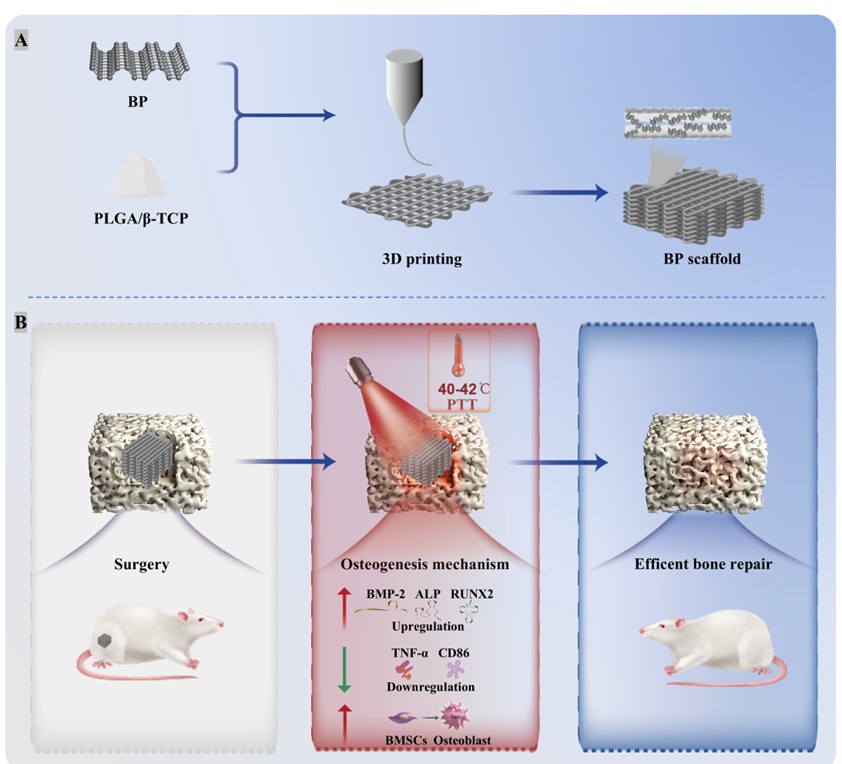
Bone defects pose a high risk of non-union and permanent disability, making effective bone regeneration a critical focus in the development of bone repair materials. Current research primarily emphasizes enhancing the single osteogenic function of bone repair materials, while neglecting the impact of the complex microenvironment in bone defect areas. This has resulted in the failure of many developed bone repair materials to achieve effective in vivo bone regeneration. In this study, a multifunctional near-infrared light-responsive black phosphorus (BP) bone repair scaffold was fabricated via low-temperature deposition 3D printing. In vitro characterization demonstrated that the scaffold possesses a cancellous bone-like structure, moderate compressive strength, and cytocompatibility, with the ability to promote osteogenesis under inflammatory conditions. In vivo studies further confirmed its favorable photothermal responsiveness, enabling photothermal therapy (PTT) to accelerate bone regeneration while reducing inflammation in the defect area. These findings indicate that the multifunctional BP scaffold achieves superior bone repair outcomes through synergistic effects of anti-inflammation, promotion of osteogenic differentiation, and PTT, thereby improving the success rate of defect repair. Moreover, the simple fabrication process and satisfactory therapeutic efficacy of this multifunctional BP scaffold highlight its high potential for clinical translation.
- Wang J, Wu Y, Li G, et al. Engineering large-scale self-mineralizing bone organoids with bone matrix-inspired hydroxyapatite hybrid bioinks. Adv Mater. 2024;36(30):e2309875. doi: 10.1002/adma.202309875
- Chen H, Xi H, Guo M, et al. PLGA/β-TCP/ICT composite scaffold incorporating MXene (Ti3C2Tx) promotes osteogenesis through near-infrared-mediated mild photothermal therapy. Mater Des. 2024;244:113083. doi: 10.1016/j.matdes.2024.113083
- Chen H, Tan X, Fu J, et al. γ-Fe2O3/polydopamine/ TiO2 nano-porous array composite coating (FPTCC) to modulate antibacterial, osteogenesis, and osseointegration through photothermal-magnetic response. Mater Des. 2024;248:113516. doi: 10.1016/j.matdes.2024.113516
- Hu X, Chen J, Yang S, et al. 3D printed multifunctional biomimetic bone scaffold combined with TP-Mg nanoparticles for the infectious bone defects repair. Small. 2024;20(40):e2403681. doi: 10.1002/smll.202403681
- Xie C, Ye J, Liang R, et al. Advanced strategies of biomimetic tissue-engineered grafts for bone regeneration. Adv Healthc Mater. 2021;10(14):e2100408. doi: 10.1002/adhm.202100408
- Huang Y, Wan X, Su Q, et al. Ultrasound-activated piezo-hot carriers trigger tandem catalysis coordinating cuproptosis-like bacterial death against implant infections. Nat Commun. 2024;15(1):1643. doi: 10.1038/s41467-024-45619-y
- Robin M, Mouloungui E, Castillo Dali G, et al. Mineralized collagen plywood contributes to bone autograft performance. Nature. 2024;636(8041):100-107. doi: 10.1038/s41586-024-08208-z
- Shen X, Zhang Z, Cheng C, et al. Bone regeneration and antibacterial properties of calcium-phosphorus coatings induced by gentamicin-loaded polydopamine on magnesium alloys. Biomed Technol. 2024;5:87-101. doi: 10.1515/bmt-2023-0104
- Liu X, Zhou J, Chen M, et al. 3D-printed biomimetic bone scaffold loaded with lyophilized concentrated growth factors promotes bone defect repair by regulation the VEGFR2/PI3K/AKT signaling pathway. Int J Biol Macromol. 2024;282(Pt 2):136938. doi: 10.1016/j.ijbiomac.2024.136938
- Liang W, Zhou C, Liu X, Pan B, Qian Y, Yang W. Current status of nano-embedded growth factors and stem cells delivery to bone for targeted repair and regeneration. J Orthop Transl. 2025;50:257-273. doi: 10.1016/j.jot.2024.12.003
- Zhao R, Han F, Yu Q, et al. A multifunctional scaffold that promotes the scaffold-tissue interface integration and rescues the ROS microenvironment for repair of annulus fibrosus defects. Bioact Mater. 2024;41:257-270. doi: 10.1016/j.bioactmat.2024.06.025
- Sun X, Gao Y, Li Z, He J, Wu Y. Magnetic responsive hydroxyapatite scaffold modulated macrophage polarization through PPAR/JAK-STAT signaling and enhanced fatty acid metabolism. Biomaterials. 2023;295: 122051. doi: 10.1016/j.biomaterials.2023.122051
- Xue P, Tan X, Xi H, et al. Low-temperature deposition 3D printing biotin-doped PLGA/β-TCP scaffold for repair of bone defects in osteonecrosis of femoral head. IJB. 2023;10(1):1152. doi: 10.36922/ijb.1152
- Xue P, Chen H, Xi H, et al. Magnesium dopped calcium-fluoride/icaritin composite multi-layer coating functionalized 3D printed β-TCP scaffold induces sustained bone regeneration in a rabbit model. Mater Des. 2022;223:111156. doi: 10.1016/j.matdes.2022.111156
- Sun H, Xu J, Wang Y, et al. Bone microenvironment regulative hydrogels with ROS scavenging and prolonged oxygen-generating for enhancing bone repair. Bioact Mater. 2023;24:477-496. doi: 10.1016/j.bioactmat.2022.12.021
- Yang X, Yang X, Luo P, et al. Novel one-pot strategy for fabrication of a pH-responsive bone-targeted drug self-frame delivery system for treatment of osteoporosis. Mater Today Bio. 2023;20:100688. doi: 10.1016/j.mtbio.2023.100688
- Xue P, Xi H, Chen H, He S, Liu X, Du B. Predictive value of clinical features and CT radiomics in the efficacy of hip preservation surgery with fibula allograft. J Orthop Surg Res. 2023;18(1):940. doi: 10.1186/s13018-023-04431-y
- Chen H, Xue P, Xi H, et al. A deep-learning model for predicting the efficacy of non-vascularized fibular grafting using digital radiography. Acad Radiol. 2024;31(4):1501-1507. doi: 10.1016/j.acra.2023.10.023
- Chen H, Xue P, Xi H, et al. Predicting efficacy and guiding procedure choice in non-vascularized bone grafting: a CT radiomics and clinical predictor approach. BMC Musculoskelet Disord. 2023;24(1):959. doi: 10.1186/s12891-023-07095-1
- Couce ML, Saenz de Pipaon M. Bone mineralization and calcium phosphorus metabolism. Nutrients. 2021;13(11):3692. doi: 10.3390/nu13113692
- Hou J, Yin S, Jiao R, et al. The combination of hydrogels and rutin-loaded black phosphorus nanosheets treats rheumatoid arthritis. Mater Today Bio. 2024;29:101264. doi: 10.1016/j.mtbio.2024.101264
- Huang S, Xu S, Hu Y, et al. Preparation of NIR-responsive, ROS-generating and antibacterial black phosphorus quantum dots for promoting the MRSA-infected wound healing in diabetic rats. Acta Biomater. 2022;137:199-217. doi: 10.1016/j.actbio.2021.10.008
- Wang W, Zhang G, Wang Y, et al. An injectable and thermosensitive hydrogel with nano-aided NIR-II phototherapeutic and chemical effects for periodontal antibacteria and bone regeneration. J Nanobiotechnology. 2023;21(1):367. doi: 10.1186/s12951-023-02124-6
- Wang M, Lu X, Yin X, et al. Synchrotron radiation-based Fourier-transform infrared spectromicroscopy for characterization of the protein/peptide distribution in single microspheres. Acta Pharm Sin B. 2015;5(3):270-276. doi: 10.1016/j.apsb.2015.03.008
- Zairani NAS, Jaafar M, Ahmad N, Abdul Razak K. Fabrication and characterization of porous β-tricalcium phosphate scaffolds coated with alginate. Ceram Int. 2016;42(4):5141-5147. doi: 10.1016/j.ceramint.2015.12.034
- Kang KR, Piao ZG, Kim JS, et al. Synthesis and characterization of β-tricalcium phosphate derived from Haliotis sp. shells. Implant Dent. 2017;26(3):378-387. doi: 10.1097/ID.0000000000000559
- Ma S, Wei Y, Sun R, et al. Calcium phosphate bone cements incorporated with black phosphorus nanosheets enhanced osteogenesis. ACS Biomater Sci Eng. 2023;9(1):292-302. doi: 10.1021/acsbiomaterials.2c00742
- Xue P, Chang Z, Chen H, et al. Macrophage membrane (MMs) camouflaged near-infrared (NIR) responsive bone defect area targeting nanocarrier delivery system (BTNDS) for rapid repair: promoting osteogenesis via phototherapy and modulating immunity. J Nanobiotechnology. 2024;22(1):87. doi: 10.1186/s12951-024-02351-5
- Shen G, Ren H, Shang Q, et al. Foxf1 knockdown promotes BMSC osteogenesis in part by activating the Wnt/β-catenin signalling pathway and prevents ovariectomy-induced bone loss. EBioMedicine. 2020;52:102626. doi: 10.1016/j.ebiom.2020.102626
- Kennedy A, Waters E, Rowshanravan B, et al. Differences in CD80 and CD86 transendocytosis reveal CD86 as a key target for CTLA-4 immune regulation. Nat Immunol. 2022;23(9):1365-1378. doi: 10.1038/s41590-022-01289-w
- He R, Wang Z, Cui M, et al. HIF1A alleviates compression-induced apoptosis of nucleus pulposus derived stem cells via upregulating autophagy. Autophagy. 2021;17(11): 3338-3360. doi: 10.1080/15548627.2021.1872227
- Hu L, Yu Y, Shen Y, et al. Ythdf2 promotes pulmonary hypertension by suppressing Hmox1-dependent anti-inflammatory and antioxidant function in alveolar macrophages. Redox Biol. 2023;61:102638. doi: 10.1016/j.redox.2023.102638
- Ng JQ, Jafarov TH, Little CB, et al. Loss of Grem1-lineage chondrogenic progenitor cells causes osteoarthritis. Nat Commun. 2023;14(1):6909. doi: 10.1038/s41467-023-42199-1
- Agas D, Gabai V, Sufianov AA, Shneider A, Sabbieti MG. P62/SQSTM1 enhances osteogenesis and attenuates inflammatory signals in bone marrow microenvironment. Gen Comp Endocrinol. 2022;320:114009. doi: 10.1016/j.ygcen.2022.114009
- Tang D, Kang R. SQSTM1 is a therapeutic target for infection and sterile inflammation. Cytokine. 2023;169: 156317. doi: 10.1016/j.cytokine.2023.156317
- Lingli Z, Xing H, Liqiu W, et al. Palmitoylation restricts SQSTM1/p62-mediated autophagic degradation of NOD2 to modulate inflammation. Cell Death Differ. 2022;29(8):1541-1551. doi: 10.1038/s41418-022-00942-z
- Li Y, Lu D, Xu F, et al. EGR1 promotes craniofacial bone regeneration via activation of ALPL⁺PDGFD⁺ periosteal stem cells. Adv Sci (Weinh). 2025;12(30):e10243. doi: 10.1002/advs.202410243
- Zhang H, Cai D, Bai X. Macrophages regulate the progression of osteoarthritis. Osteoarthritis Cartilage. 2020;28(5):555-561. doi: 10.1016/j.joca.2020.01.007
- Wang J, Zhang Y, Cao J, et al. The role of autophagy in bone metabolism and clinical significance. Autophagy. 2023;19(9):2409-2427. doi: 10.1080/15548627.2023.2186112
- Katz JN, Arant KR, Loeser RF. Diagnosis and treatment of hip and knee osteoarthritis: a review. JAMA. 2021;325(6):568-578. doi: 10.1001/jama.2020.22171
- Xie C, Liang R, Ye J, et al. High-efficient engineering of osteo-callus organoids for rapid bone regeneration within one month. Biomaterials. 2022;288:121741. doi: 10.1016/j.biomaterials.2022.121741