
Precision hydrogel environments for advanced microbial culture and patterning

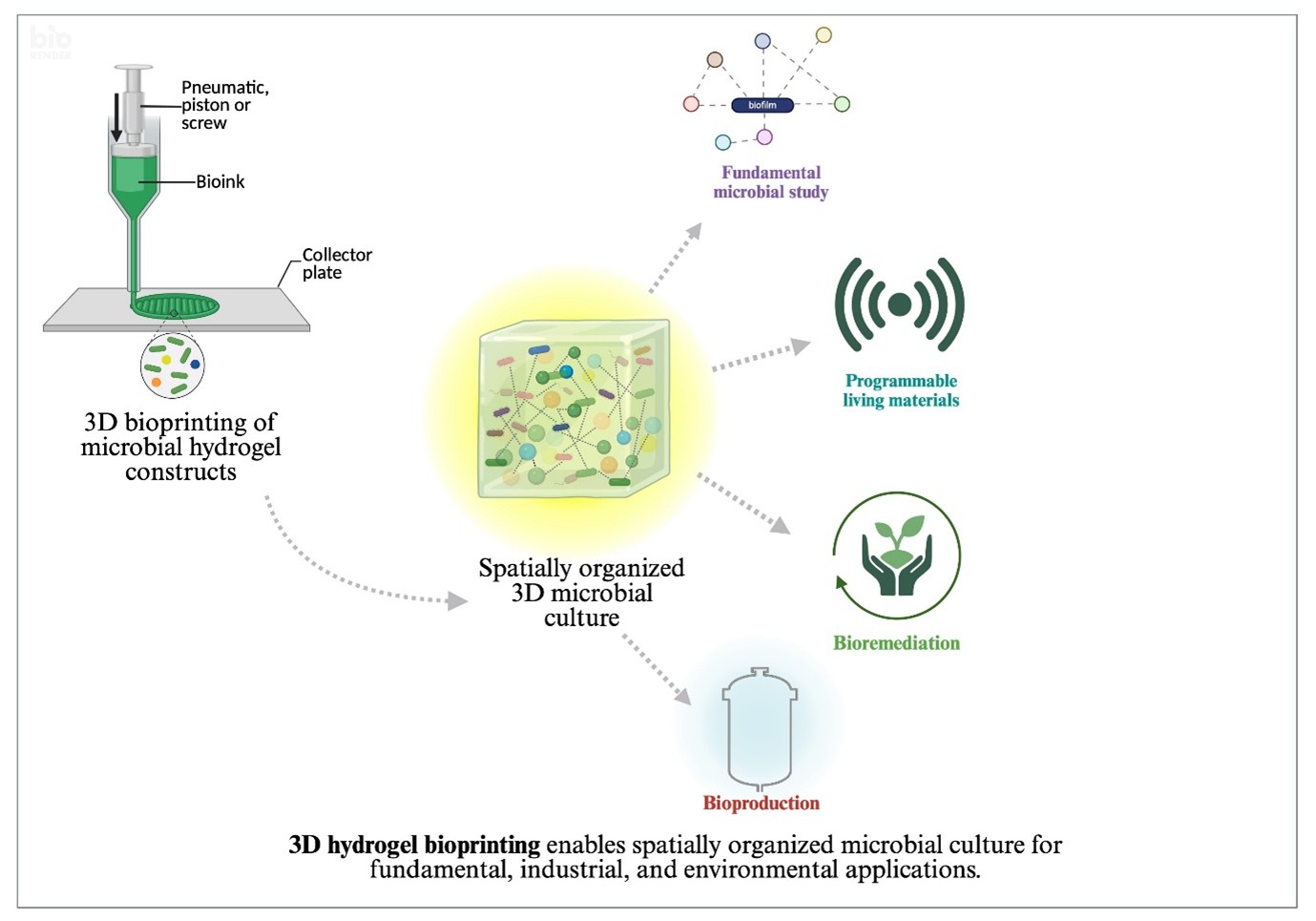
Hydrogel materials and scaffolds have emerged as transformative tools in biological research by offering precise control over cell viability, metabolism, and productivity. Their compatibility with three-dimensional (3D) bioprinting and patterning technologies enables the precise and reproducible organization of living components, facilitating novel experimental paradigms across diverse disciplines. Although most 3D hydrogel research has emphasized mammalian cell applications, particularly in tissue engineering, there is a growing body of research applying these technologies to study, manipulate, and harness a variety of microorganisms, such as bacteria. This review explores the latest advances in microbial hydrogel encapsulation, focusing on material selection and patterning methods designed to preserve microbial viability and function. We compare the distinct requirements and challenges of culturing microorganisms in hydrogels versus mammalian systems and highlight recent breakthroughs in bacterial bioprinting that are advancing microbiological research, paving the way for current and emerging applications in various areas, including oral health. By synthesizing current knowledge and identifying promising future directions, this review underscores the potential of microbial hydrogel culture as a versatile platform for investigating microbial communities, probing bacterial– material interactions, and engineering living materials with applications in human health and environmental systems.
- Pascalie J, Potier M, Kowaliw T, et al. Developmental design of synthetic bacterial architectures by morphogenetic engineering. ACS Synth Biol. 2016;5(8):842-861. doi:10.1021/acssynbio.5b00246
- Brenner K, You L, Arnold FH. Engineering microbial consortia: a new frontier in synthetic biology. Trends Biotechnol. 2008;26(9):483-489. doi:10.1016/j.tibtech.2008.05.004
- Gajic I, Kabic J, Kekic D, et al. Antimicrobial susceptibility testing: a comprehensive review of currently used methods. Antibiotics. 2022;11(4):427. doi:10.3390/antibiotics11040427
- Prindle A, Selimkhanov J, Li H, Razinkov I, Tsimring LS, Hasty J. Rapid and tunable post-translational coupling of genetic circuits. Nature. 2014;508(7496):387-391. doi:10.1038/nature13238
- Sulaeva I, Henniges U, Rosenau T, Potthast A. Bacterial cellulose as a material for wound treatment: properties and modifications. A review. Biotechnol Adv. 2015;33(8):1547-1571. doi:10.1016/j.biotechadv.2015.07.009
- McCarty NS, Ledesma-Amaro R. Synthetic biology tools to engineer microbial communities for biotechnology. Trends Biotechnol. 2019;37(2):181-197. doi:10.1016/j.tibtech.2018.11.002
- Sreepadmanabh M, Ganesh M, Sanjenbam P, Kurzthaler C, Agashe D, Bhattacharjee T. Cell shape affects bacterial colony growth under physical confinement. Nat Commun. 2024;15(1):9561. doi:10.1038/s41467-024-53989-6
- Wells M, Schneider R, Bhattarai B, et al. Perspective: the viscoelastic properties of biofilm infections and mechanical interactions with phagocytic immune cells. Front Cell Infect Microbiol. 2023;13. doi:10.3389/fcimb.2023.1102199
- Storm C, Pastore JJ, MacKintosh FC, Lubensky TC, Janmey PA. Nonlinear elasticity in biological gels. Nature. 2005;435(7039):191-194. doi:10.1038/nature03521
- Lazarus E, Meyer AS, Ikuma K, Rivero IV. Three dimensional printed biofilms: fabrication, design and future biomedical and environmental applications. Microb Biotechnol. 2024;17(1):e14360. doi:10.1111/1751-7915.14360
- Denton O, Wan Y, Beattie L, et al. Understanding the role of biofilms in acute recurrent tonsillitis through 3D bioprinting of a novel gelatin-PEGDA hydrogel. Bioengineering. 2024;11(3):202. doi:10.3390/bioengineering11030202
- Ning E, Turnbull G, Clarke J, et al. 3D bioprinting of mature bacterial biofilms for antimicrobial resistance drug testing. Biofabrication. 2019;11(4):045018. doi:10.1088/1758-5090/ab37a0
- Stewart PS, Costerton JW. Antibiotic resistance of bacteria in biofilms. Lancet Lond Engl. 2001;358(9276): 135-138. doi:10.1016/s0140-6736(01)05321-1
- Paré G, Kitsiou S. Chapter 9 methods for literature reviews. In: Handbook of eHealth Evaluation: An Evidence-Based Approach [Internet]. Victoria (BC): University of Victoria; 2017. https://www.ncbi.nlm.nih.gov/books/NBK481583/. Accessed August 22, 2025.
- Mobaraki M, Ghaffari M, Yazdanpanah A, Luo Y, Mills DK. Bioinks and bioprinting: a focused review. Bioprinting. 2020;18:e00080. doi:10.1016/j.bprint.2020.e00080
- Farasati Far B, Safaei M, Nahavandi R, et al. Hydrogel encapsulation techniques and its clinical applications in drug delivery and regenerative medicine: a systematic review. ACS Omega. 2024;9(27):29139-29158. doi:10.1021/acsomega.3c10102
- Theus AS, Ning L, Hwang B, et al. Bioprintability: physiomechanical and biological requirements of materials for 3D bioprinting processes. Polymers. 2020; 12(10):2262. doi:10.3390/polym12102262
- Zhang Y, Zhou D, Chen J, et al. Biomaterials based on marine resources for 3D bioprinting applications. Mar Drugs. 2019;17(10):555. doi:10.3390/md17100555
- Hwang CM, Sant S, Masaeli M, et al. Fabrication of three-dimensional porous cell-laden hydrogel for tissue engineering. Biofabrication. 2010;2(3):035003. doi:10.1088/1758-5082/2/3/035003
- Ng WL, Vyas C, Huang B, Yeong WY, Bartolo P. Advanced bioprinting strategies for fabrication of biomimetic tissues and organs. Int J Extreme Manuf. 2025;7(6):062006. doi:10.1088/2631-7990/adeee0
- Mancha Sánchez E, Gómez-Blanco JC, López Nieto E, et al. Hydrogels for bioprinting: a systematic review of hydrogels synthesis, bioprinting parameters, and bioprinted structures behavior. Front Bioeng Biotechnol. 2020;8. doi:10.3389/fbioe.2020.00776
- Hospodiuk M, Dey M, Sosnoski D, Ozbolat IT. The bioink: a comprehensive review on bioprintable materials. Biotechnol Adv. 2017;35(2):217-239. doi:10.1016/j.biotechadv.2016.12.006
- Hölzl K, Lin S, Tytgat L, Van Vlierberghe S, Gu L, Ovsianikov A. Bioink properties before, during and after 3D bioprinting. Biofabrication. 2016;8(3):032002. doi:10.1088/1758-5090/8/3/032002
- Khoeini R, Nosrati H, Akbarzadeh A, et al. Natural and synthetic bioinks for 3D bioprinting. Adv NanoBiomed Res. 2021;1(8):2000097. doi:10.1002/anbr.202000097
- González LM, Mukhitov N, Voigt CA. Resilient living materials built by printing bacterial spores. Nat Chem Biol. 2020;16(2):126-133. doi:10.1038/s41589-019-0412-5
- Qian F, Zhu C, Knipe JM, et al. Direct writing of tunable living inks for bioprocess intensification. Nano Lett. 2019;19(9):5829-5835. doi:10.1021/acs.nanolett.9b00066
- Herzog J, Franke L, Lai Y, Gomez Rossi P, Sachtleben J, Weuster-Botz D. 3D bioprinting of microorganisms: principles and applications. Bioprocess Biosyst Eng. 2024;47(4):443-461. doi:10.1007/s00449-023-02965-3
- Aghlara-Fotovat S, Musteata E, Doerfert MD, et al. Hydrogel-encapsulation to enhance bacterial diagnosis of colon inflammation. Biomaterials. 2023;301:122246. doi:10.1016/j.biomaterials.2023.122246
- Barreiros dos Santos M, Azevedo S, Agusil JP, et al. Label-free ITO-based immunosensor for the detection of very low concentrations of pathogenic bacteria. Bioelectrochemistry. 2015;101:146-152. doi:10.1016/j.bioelechem.2014.09.002
- Balasubramanian S, Aubin-Tam ME, Meyer AS. 3D printing for the fabrication of biofilm-based functional living materials. ACS Synth Biol. 2019;8(7):1564-1567. doi:10.1021/acssynbio.9b00192
- Schmieden DT, Basalo Vázquez SJ, Sangüesa H, van der Does M, Idema T, Meyer AS. Printing of patterned, engineered E. coli biofilms with a low-cost 3D Printer. ACS Synth Biol. 2018;7(5):1328-1337. doi:10.1021/acssynbio.7b00424
- Sakai S, Hirose K, Taguchi K, Ogushi Y, Kawakami K. An injectable, in situ enzymatically gellable, gelatin derivative for drug delivery and tissue engineering. Biomaterials. 2009;30(20):3371-3377. doi:10.1016/j.biomaterials.2009.03.030
- Yeh M kung, Liang Y ming, Cheng K ming, Dai NT, Liu C che, Young J jong. A novel cell support membrane for skin tissue engineering: gelatin film cross-linked with 2-chloro-1-methylpyridinium iodide. Polymer. 2011;52(4): 996-1003. doi:10.1016/j.polymer.2010.10.060
- Ozbolat IT, Hospodiuk M. Current advances and future perspectives in extrusion-based bioprinting. Biomaterials. 2016;76:321-343. doi:10.1016/j.biomaterials.2015.10.076
- Utoiu E, Manoiu VS, Oprita EI, Craciunescu O. Bacterial cellulose: a sustainable source for hydrogels and 3D-printed scaffolds for tissue engineering. Gels. 2024;10(6):387. doi:10.3390/gels10060387
- Purcell EK, Singh A, Kipke DR. Alginate composition effects on a neural stem cell–seeded scaffold. Tissue Eng Part C Methods. 2009;15(4):541-550. doi:10.1089/ten.tec.2008.0302
- Augst AD, Kong HJ, Mooney DJ. Alginate hydrogels as biomaterials. Macromol Biosci. 2006;6(8):623-633. doi:10.1002/mabi.200600069
- Hellio D, Djabourov M. Physically and chemically crosslinked gelatin gels. Macromol Symp. 2006;241(1): 23-27. doi:10.1002/masy.200650904
- Parenteau-Bareil R, Gauvin R, Berthod F. Collagen-based biomaterials for tissue engineering applications. Materials. 2010;3(3):1863-1887. doi:10.3390/ma3031863
- Yin N, Santos TMA, Auer GK, Crooks JA, Oliver PM, Weibel DB. Bacterial cellulose as a substrate for microbial cell culture. Appl Environ Microbiol. 2014;80(6): 1926-1932. doi:10.1128/AEM.03452-13
- Pu X, Wu Y, Liu J, Wu B. 3D bioprinting of microbial-based living materials for advanced energy and environmental applications. Chem Bio Eng. 2024;1(7):568-592. doi:10.1021/cbe.4c00024
- Benwood C, Chrenek J, Kirsch RL, et al. Natural biomaterials and their use as bioinks for printing tissues. Bioengineering. 2021;8(2):27. doi:10.3390/bioengineering8020027
- Zhang H, Xia H, Zhao Y. Poly(vinyl alcohol) hydrogel can autonomously self-heal. ACS Macro Lett. 2012;1(11):1233-1236. doi:10.1021/mz300451r
- Rovetta R, Pallavicini A, Ginestra PS. Bioprinting process optimization: case study on PVA (polyvinyl alcohol) and graphene oxide biocompatible hydrogels. Procedia CIRP. 2022;110:145-149. doi:10.1016/j.procir.2022.06.027
- Lin CC, Anseth KS. PEG hydrogels for the controlled release of biomolecules in regenerative medicine. Pharm Res. 2009;26(3):631-643. doi:10.1007/s11095-008-9801-2
- Kadilak AL, Rehaag JC, Harrington CA, Shor LM. A 3D-printed microbial cell culture platform with in situ PEGDA hydrogel barriers for differential substrate delivery. Biomicrofluidics. 2017;11(5):054109. doi:10.1063/1.5003477
- Gong CY, Shi S, Dong PW, et al. In vitro drug release behavior from a novel thermosensitive composite hydrogel based on Pluronic f127 and poly(ethylene glycol)-poly(ε- caprolactone)-poly(ethylene glycol) copolymer. BMC Biotechnol. 2009;9:8. doi:10.1186/1472-6750-9-8
- Vashi AV, Keramidaris E, Abberton KM, et al. Adipose differentiation of bone marrow-derived mesenchymal stem cells using Pluronic F-127 hydrogel in vitro. Biomaterials. 2008;29(5):573-579. doi:10.1016/j.biomaterials.2007.10.017
- Lee SH, Lee Y, Lee SW, et al. Enzyme-mediated cross-linking of Pluronic copolymer micelles for injectable and in situ forming hydrogels. Acta Biomater. 2011;7(4):1468-1476. doi:10.1016/j.actbio.2010.11.029
- Vandenhaute M, Schelfhout J, Van Vlierberghe S, Mendes E, Dubruel P. Cross-linkable, thermo-responsive Pluronic® building blocks for biomedical applications: synthesis and physico-chemical evaluation. Eur Polym J. 2014;53: 126-138. doi:10.1016/j.eurpolymj.2014.01.016
- Gungor-Ozkerim PS, Inci I, Zhang YS, Khademhosseini A, Dokmeci MR. Bioinks for 3D bioprinting: an overview. Biomater Sci. 2018;6(5):915-946. doi:10.1039/C7BM00765E
- Qamar SA, Riasat A, Jahangeer M, et al. Prospects of microbial polysaccharides-based hybrid constructs for biomimicking applications. J Basic Microbiol. 2022;62(11):1319-1336. doi:10.1002/jobm.202100596
- Zarrintaj P, Manouchehri S, Ahmadi Z, et al. Agarose-based biomaterials for tissue engineering. Carbohydr Polym. 2018;187:66-84. doi:10.1016/j.carbpol.2018.01.060
- Tomić SL, Babić Radić MM, Vuković JS, Filipović VV, Nikodinovic-Runic J, Vukomanović M. Alginate-based hydrogels and scaffolds for biomedical applications. Mar Drugs. 2023;21(3):177. doi:10.3390/md21030177
- Osidak EO, Kozhukhov VI, Osidak MS, Domogatsky SP. Collagen as bioink for bioprinting: a comprehensive review. Int J Bioprinting. 2020;6(3):270. doi:10.18063/ijb.v6i3.270
- Sharifi S, Sharifi H, Akbari A, Chodosh J. Systematic optimization of visible light-induced crosslinking conditions of gelatin methacryloyl (GelMA). Sci Rep. 2021;11(1): 23276. doi:10.1038/s41598-021-02830-x
- Lazaridou M, Bikiaris DN, Lamprou DA. 3D bioprinted chitosan-based hydrogel scaffolds in tissue engineering and localised drug delivery. Pharmaceutics. 2022;14(9):1978. doi:10.3390/pharmaceutics14091978
- Sanz-Horta R, Matesanz A, Gallardo A, et al. Technological advances in fibrin for tissue engineering. J Tissue Eng. 2023;14:20417314231190288. doi:10.1177/20417314231190288
- Trucco D, Sharma A, Manferdini C, et al. Modeling and fabrication of silk fibroin–gelatin-based constructs using extrusion-based three-dimensional bioprinting. ACS Biomater Sci Eng. 2021;7(7):3306-3320. doi:10.1021/acsbiomaterials.1c00410
- Pescosolido L, Schuurman W, Malda J, et al. Hyaluronic acid and dextran-based semi-IPN hydrogels as biomaterials for bioprinting. Biomacromolecules. 2011;12(5):1831-1838. doi:10.1021/bm200178w
- Ashammakhi N, Ahadian S, Xu C, et al. Bioinks and bioprinting technologies to make heterogeneous and biomimetic tissue constructs. Mater Today Bio. 2019;1:100008. doi:10.1016/j.mtbio.2019.100008
- Kandemir N, Vollmer W, Jakubovics NS, Chen J. Mechanical interactions between bacteria and hydrogels. Sci Rep. 2018;8(1):10893. doi:10.1038/s41598-018-29269-x
- Burczak K, Fujisato T, Hatada M, Ikada Y. Protein permeation through poly(vinyl alcohol) hydrogel membranes. Biomaterials. 1994;15(3):231-238. doi:10.1016/0142-9612(94)90072-8
- Cai MH, Chen XY, Fu LQ, et al. Design and development of hybrid hydrogels for biomedical applications: recent trends in anticancer drug delivery and tissue engineering. Front Bioeng Biotechnol. 2021;9. doi:10.3389/fbioe.2021.630943
- Lee KY, Mooney DJ. Alginate: Properties and biomedical applications. Prog Polym Sci. 2012;37(1):106-126. doi:10.1016/j.progpolymsci.2011.06.003
- Haq MA, Su Y, Wang D. Mechanical properties of PNIPAM based hydrogels: a review. Mater Sci Eng C. 2017;70: 842-855. doi:10.1016/j.msec.2016.09.081
- Chueh B han, Zheng Y, Torisawa Y Suke, et al. Patterning alginate hydrogels using light-directed release of caged calcium in a microfluidic device. Biomed Microdevices. 2010;12(1):145-151. doi:10.1007/s10544-009-9369-6
- Fisch P, Broguiere N, Finkielsztein S, Linder T, Zenobi- Wong M. Bioprinting of cartilaginous auricular constructs utilizing an enzymatically crosslinkable bioink. Adv Funct Mater. 2021;31(16):2008261. doi:10.1002/adfm.202008261
- Gupta A, Avci P, Dai T, Huang YY, Hamblin MR. Ultraviolet radiation in wound care: sterilization and stimulation. Adv Wound Care. 2013;2(8):422-437. doi:10.1089/wound.2012.0366
- Hu J, Hou Y, Park H, et al. Visible light crosslinkable chitosan hydrogels for tissue engineering. Acta Biomater. 2012;8(5):1730-1738. doi:10.1016/j.actbio.2012.01.029
- Pereira RF, Bártolo PJ. 3D bioprinting of photocrosslinkable hydrogel constructs. J Appl Polym Sci. 2015;132(48). doi:10.1002/app.42458
- Elkhoury K, Zuazola J, Vijayavenkataraman S. Bioprinting the future using light: a review on photocrosslinking reactions, photoreactive groups, and photoinitiators. SLAS Technol. 2023;28(3):142-151. doi:10.1016/j.slast.2023.02.003
- Nair DP, Podgórski M, Chatani S, et al. The thiol-Michael addition click reaction: a powerful and widely used tool in materials chemistry. Chem Mater. 2014;26(1):724-744. doi:10.1021/cm402180t
- Baldwin AD, Kiick KL. Tunable degradation of maleimide-thiol adducts in reducing environments. Bioconjug Chem. 2011;22(10):1946-1953. doi:10.1021/bc200148v
- Yang X, Lu Z, Wu H, Li W, Zheng L, Zhao J. Collagen-alginate as bioink for three-dimensional (3D) cell printing based cartilage tissue engineering. Mater Sci Eng C. 2018;83:195-201. doi:10.1016/j.msec.2017.09.002
- Gao T, Gillispie GJ, Copus JS, et al. Optimization of gelatin– alginate composite bioink printability using rheological parameters: a systematic approach. Biofabrication. 2018;10(3):034106. doi:10.1088/1758-5090/aacdc7
- Sun JY, Zhao X, Illeperuma WRK, et al. Highly stretchable and tough hydrogels. Nature. 2012;489(7414):133-136. doi:10.1038/nature11409
- Hernandez JL, Woodrow KA. Medical applications of porous biomaterials: features of porosity and tissue-specific implications for biocompatibility. Adv Healthc Mater. 2022;11(9):e2102087. doi:10.1002/adhm.202102087
- Dvir T, Timko BP, Kohane DS, Langer R. Nanotechnological strategies for engineering complex tissues. Nat Nanotechnol. 2011;6(1):13-22. doi:10.1038/nnano.2010.246
- De France KJ, Xu F, Hoare T. Structured macroporous hydrogels: progress, challenges, and opportunities. Adv Healthc Mater. 2018;7(1). doi:10.1002/adhm.201700927
- Loh QL, Choong C. Three-dimensional scaffolds for tissue engineering applications: role of porosity and pore size. Tissue Eng Part B Rev. 2013;19(6):485-502. doi:10.1089/ten.teb.2012.0437
- Kim J, Yaszemski MJ, Lu L. Three-dimensional porous biodegradable polymeric scaffolds fabricated with biodegradable hydrogel porogens. Tissue Eng Part C Methods. 2009;15(4):583-594. doi:10.1089/ten.tec.2008.0642
- Dehghani F, Annabi N. Engineering porous scaffolds using gas-based techniques. Curr Opin Biotechnol. 2011;22(5):661-666. doi:10.1016/j.copbio.2011.04.005
- Aldemir Dikici B, Claeyssens F. Basic principles of emulsion templating and its use as an emerging manufacturing method of tissue engineering scaffolds. Front Bioeng Biotechnol. 2020;8. doi:10.3389/fbioe.2020.00875
- Annabi N, Nichol JW, Zhong X, et al. Controlling the porosity and microarchitecture of hydrogels for tissue engineering. Tissue Eng Part B Rev. 2010;16(4): 371-383. doi:10.1089/ten.teb.2009.0639
- Lau HK, Paul A, Sidhu I, et al. Microstructured elastomer-PEG hydrogels via kinetic capture of aqueous liquid–liquid phase separation. Adv Sci. 2018;5(6): 1701010. doi:10.1002/advs.201701010
- Foudazi R, Zowada R, Manas-Zloczower I, Feke DL. Porous hydrogels: present challenges and future opportunities. Langmuir. 2023;39(6):2092-2111. doi:10.1021/acs.langmuir.2c02253
- Dong PT, Shi W, He X, Borisy GG. Adhesive interactions within microbial consortia can be differentiated at the single-cell level through expansion microscopy. Proc Natl Acad Sci USA. 2024;121(48):e2411617121. doi:10.1073/pnas.2411617121
- Lim Y, Shiver AL, Khariton M, et al. Mechanically resolved imaging of bacteria using expansion microscopy. PLOS Biol. 2019;17(10):e3000268. doi:10.1371/journal.pbio.3000268
- Johnston TG, Yuan SF, Wagner JM, et al. Compartmentalized microbes and co-cultures in hydrogels for on-demand bioproduction and preservation. Nat Commun. 2020;11(1):563. doi:10.1038/s41467-020-14371-4
- Jin GZ, Kim HW. Effects of type I collagen concentration in hydrogel on the growth and phenotypic expression of rat chondrocytes. Tissue Eng Regen Med. 2017;14(4): 383-391. doi:10.1007/s13770-017-0060-3
- Yeh J, Ling Y, Karp JM, et al. Micromolding of shape-controlled, harvestable cell-laden hydrogels. Biomaterials. 2006;27(31):5391-5398. doi:10.1016/j.biomaterials.2006.06.005
- Occhetta P, Sadr N, Piraino F, Redaelli A, Moretti M, Rasponi M. Fabrication of 3D cell-laden hydrogel microstructures through photo-mold patterning. Biofabrication. 2013;5(3):035002. doi:10.1088/1758-5082/5/3/035002
- Landers R, Hübner U, Schmelzeisen R, Mülhaupt R. Rapid prototyping of scaffolds derived from thermoreversible hydrogels and tailored for applications in tissue engineering. Biomaterials. 2002;23(23):4437-4447. doi:10.1016/S0142-9612(02)00139-4
- Zhang YS, Haghiashtiani G, Hübscher T, et al. 3D extrusion bioprinting. Nat Rev Methods Primer. 2021;1(1):1-20. doi:10.1038/s43586-021-00073-8
- Hinton TJ, Jallerat Q, Palchesko RN, et al. Three-dimensional printing of complex biological structures by freeform reversible embedding of suspended hydrogels. Sci Adv. 2015;1(9):e1500758. doi:10.1126/sciadv.1500758
- Bhattacharjee T, Zehnder SM, Rowe KG, et al. Writing in the granular gel medium. Sci Adv. 2015;1(8):e1500655. doi:10.1126/sciadv.1500655
- Bertassoni LE, Cecconi M, Manoharan V, et al. Hydrogel bioprinted microchannel networks for vascularization of tissue engineering constructs. Lab Chip. 2014;14(13):2202-2211. doi:10.1039/C4LC00030G
- Homan KA, Kolesky DB, Skylar-Scott MA, et al. Bioprinting of 3D convoluted renal proximal tubules on perfusable chips. Sci Rep. 2016;6(1):34845. doi:10.1038/srep34845
- Liu T, Liu Q, Anaya I, et al. Investigating lymphangiogenesis in a sacrificially bioprinted volumetric model of breast tumor tissue. Methods. 2021;190:72-79. doi:10.1016/j.ymeth.2020.04.003
- Miller JS, Stevens KR, Yang MT, et al. Rapid casting of patterned vascular networks for perfusable engineered three-dimensional tissues. Nat Mater. 2012;11(9):768-774. doi:10.1038/nmat3357
- Wu W, DeConinck A, Lewis JA. Omnidirectional printing of 3D microvascular networks. Adv Mater. 2011;23(24):H178-H183. doi:10.1002/adma.201004625
- Liu W, Zhong Z, Hu N, et al. Coaxial extrusion bioprinting of 3D microfibrous constructs with cell-favorable gelatin methacryloyl microenvironments. Biofabrication. 2018;10(2):024102. doi:10.1088/1758-5090/aa9d44
- Ouyang L, Highley CB, Sun W, Burdick JA. A generalizable strategy for the 3D bioprinting of hydrogels from nonviscous photo‐crosslinkable Inks. Adv Mater. 2017;29(8): 1604983. doi:10.1002/adma.201604983
- Galarraga JH, Kwon MY, Burdick JA. 3D bioprinting via an in situ crosslinking technique towards engineering cartilage tissue. Sci Rep. 2019;9(1):19987. doi:10.1038/s41598-019-56117-3
- Barui S. 3D inkjet printing of biomaterials: principles and applications. Med Devices Sens. 2021;4(1):e10143. doi:10.1002/mds3.10143
- Li X, Liu B, Pei B, et al. Inkjet bioprinting of biomaterials. Chem Rev. 2020;120(19):10793-10833. doi:10.1021/acs.chemrev.0c00008
- Nieto D, Marchal Corrales JA, Jorge de Mora A, Moroni L. Fundamentals of light-cell–polymer interactions in photo-cross-linking based bioprinting. APL Bioeng. 2020;4(4):041502. doi:10.1063/5.0022693
- Manapat JZ, Chen Q, Ye P, Advincula RC. 3D printing of polymer nanocomposites via stereolithography. Macromol Mater Eng. 2017;302(9):1600553. doi:10.1002/mame.201600553
- Stampfl J, Baudis S, Heller C, et al. Photopolymers with tunable mechanical properties processed by laser-based high-resolution stereolithography. J Micromech Microeng. 2008;18(12):125014. doi:10.1088/0960-1317/18/12/125014
- Peng X, Kuang X, Roach DJ, et al. Integrating digital light processing with direct ink writing for hybrid 3D printing of functional structures and devices. Addit Manuf. 2021;40:101911. doi:10.1016/j.addma.2021.101911
- Connell JL, Kim J, Shear JB, Bard AJ, Whiteley M. Real-time monitoring of quorum sensing in 3D-printed bacterial aggregates using scanning electrochemical microscopy. Proc Natl Acad Sci USA. 2014;111(51):18255-18260. doi:10.1073/pnas.1421211111
- Müller J, Jäkel AC, Richter J, Eder M, Falgenhauer E, Simmel FC. Bacterial growth, communication, and guided chemotaxis in 3D-bioprinted hydrogel environments. ACS Appl Mater Interfaces. 2022;14(14):15871-15880. doi:10.1021/acsami.1c20836
- Ceballos-González CF, Bolívar-Monsalve EJ, Quevedo- Moreno DA, et al. High-throughput and continuous chaotic bioprinting of spatially controlled bacterial microcosms. ACS Biomater Sci Eng. 2021;7(6):2408-2419. doi:10.1021/acsbiomaterials.0c01646
- Yusupov VI, Gorlenko MV, Cheptsov VS, et al. Laser engineering of microbial systems. Laser Phys Lett. 2018;15(6):065604. doi:10.1088/1612-202X/aab5ef
- Reinhardt O, Ihmann S, Ahlhelm M, Gelinsky M. 3D bioprinting of mineralizing cyanobacteria as novel approach for the fabrication of living building materials. Front Bioeng Biotechnol. 2023;11. doi:10.3389/fbioe.2023.1145177
- Binelli MR, Kan A, Rozas LEA, Pisaturo G, Prakash N, Studart AR. Complex living materials made by light‐based printing of genetically programmed bacteria. Adv Mater. 2023;35(6):2207483. doi:10.1002/adma.202207483
- Mohammadi Z, Rabbani M. Bacterial bioprinting on a flexible substrate for fabrication of a colorimetric temperature indicator by using a commercial inkjet printer. J Med Signals Sens. 2018;8(3):170-174. doi:10.4103/jmss.JMSS_41_17
- Dubbin K, Dong Z, Park DM, et al. Projection microstereolithographic microbial bioprinting for engineered biofilms. Nano Lett. 2021;21(3):1352-1359. doi:10.1021/acs.nanolett.0c04100
- Balasubramanian S, Yu K, Cardenas DV, Aubin-Tam ME, Meyer AS. Emergent biological endurance depends on extracellular matrix composition of three-dimensionally printed Escherichia coli biofilms. ACS Synth Biol. 2021;10(11):2997-3008. doi:10.1021/acssynbio.1c00290
- Jiang M, Zheng J, Tang Y, et al. Retrievable hydrogel networks with confined microalgae for efficient antibiotic degradation and enhanced stress tolerance. Nat Commun. 2025;16(1). doi:10.1038/s41467-025-58415-z
- He F, Ou Y, Liu J, et al. 3D Printed biocatalytic living materials with dual‐network reinforced bioinks. Small. 2022;18(6). doi:10.1002/smll.202104820
- Wang D, Li X yan, Li A. Natural bioink of interpenetrating network hydrogels mimicking extracellular polymeric substances for microbial immobilization in water pollution control. Environ Res. 2024;262:119856. doi:10.1016/j.envres.2024.119856
- Datta D, Weiss EL, Wangpraseurt D, et al. Phenotypically complex living materials containing engineered cyanobacteria. Nat Commun. 2023;14(1). doi:10.1038/s41467-023-40265-2
- Lehner BAE, Schmieden DT, Meyer AS. A straightforward approach for 3D bacterial printing. ACS Synth Biol. 2017;6(7):1124-1130. doi:10.1021/acssynbio.6b00395
- Ming Z, Han L, Bao M, et al. Living bacterial hydrogels for accelerated infected wound healing. Adv Sci. 2021;8(24):2102545. doi:10.1002/advs.202102545
- Huang J, Liu S, Zhang C, et al. Programmable and printable Bacillus subtilis biofilms as engineered living materials. Nat Chem Biol. 2019;15(1):34-41. doi:10.1038/s41589-018-0169-2
- Schaffner M, Rühs PA, Coulter F, Kilcher S, Studart AR. 3D printing of bacteria into functional complex materials. Sci Adv. 2017;3(12):eaao6804. doi:10.1126/sciadv.aao6804
- Molinari S, Tesoriero RF, Li D, et al. A de novo matrix for macroscopic living materials from bacteria. Nat Commun. 2022;13(1):5544. doi:10.1038/s41467-022-33191-2
- Chen AY, Deng Z, Billings AN, et al. Synthesis and patterning of tunable multiscale materials with engineered cells. Nat Mater. 2014;13(5):515-523. doi:10.1038/nmat3912
- Freyman MC, Kou T, Wang S, Li Y. 3D printing of living bacteria electrode. Nano Res. 2020;13(5):1318-1323. doi:10.1007/s12274-019-2534-1
- Pham JV, Yilma MA, Feliz A, et al. A review of the microbial production of bioactive natural products and biologics. Front Microbiol. 2019;10. doi:10.3389/fmicb.2019.01404
- Sun M, Gao AX, Liu X, Bai Z, Wang P, Ledesma-Amaro R. Microbial conversion of ethanol to high-value products: progress and challenges. Biotechnol Biofuels Bioprod. 2024;17(1):115. doi:10.1186/s13068-024-02546-w
- da Silva TL, Gouveia L, Reis A. Integrated microbial processes for biofuels and high value-added products: the way to improve the cost effectiveness of biofuel production. Appl Microbiol Biotechnol. 2014;98(3):1043-1053. doi:10.1007/s00253-013-5389-5
- Nikita S, Mishra S, Gupta K, Runkana V, Gomes J, Rathore AS. Advances in bioreactor control for production of biotherapeutic products. Biotechnol Bioeng. 2023;120(5):1189-1214. doi:10.1002/bit.28346
- Smith MJ, Francis MB. Improving metabolite production in microbial co-cultures using a spatially constrained hydrogel. Biotechnol Bioeng. 2017;114(6):1195-1200. doi:10.1002/bit.26235
- Duraj-Thatte AM, Manjula-Basavanna A, Rutledge J, et al. Programmable microbial ink for 3D printing of living materials produced from genetically engineered protein nanofibers. Nat Commun. 2021;12(1):6600. doi:10.1038/s41467-021-26791-x
- Cui Z, Feng Y, Liu F, Jiang L, Yue J. 3D bioprinting of living materials for structure-dependent production of hyaluronic acid. ACS Macro Lett. 2022;11(4):452-459. doi:10.1021/acsmacrolett.2c00037
- Sharma S, Pathania S, Bhagta S, et al. Microbial remediation of polluted environment by using recombinant E. coli: a review. Biotechnol Environ. 2024;1(1). doi:10.1186/s44314-024-00008-z
- Zhang Y, Hsu HH, Wheeler JJ, Tang S, Jiang X. Emerging investigator series: emerging biotechnologies in wastewater treatment: from biomolecular engineering to multiscale integration. Environ Sci Water Res Technol. 2020;6(8):1967-1985. doi:10.1039/D0EW00393J
- Justus KB, Hellebrekers T, Lewis DD, et al. A biosensing soft robot: autonomous parsing of chemical signals through integrated organic and inorganic interfaces. Sci Robot. 2019;4(31):eaax0765. doi:10.1126/scirobotics.aax0765
- Gilbert C, Tang TC, Ott W, et al. Living materials with programmable functionalities grown from engineered microbial co-cultures. Nat Mater. 2021;20(5):691-700. doi:10.1038/s41563-020-00857-5
- Barnhart MM, Chapman MR. Curli biogenesis and function. Annu Rev Microbiol. 2006;60:131-147. doi:10.1146/annurev.micro.60.080805.142106
- Liu X, Yuk H, Lin S, et al. 3D printing of living responsive materials and devices. Adv Mater. 2018;30(4):1704821. doi:10.1002/adma.201704821
- Majerle A, Schmieden DT, Jerala R, Meyer AS. Synthetic biology for multiscale designed biomimetic assemblies: from designed self-assembling biopolymers to bacterial bioprinting. Biochemistry. 2019;58(16):2095-2104. doi:10.1021/acs.biochem.8b00922
- Zheng DW, Qiao JY, Ma JC, et al. A microbial community cultured in gradient hydrogel for investigating gut microbiome-drug interaction and guiding therapeutic decisions. Adv Mater. 2023;35(22):2300977. doi:10.1002/adma.202300977
- Aliyazdi S, Frisch S, Hidalgo A, et al. 3D bioprinting of E. coli MG1655 biofilms on human lung epithelial cells for building complex in vitro infection models. Biofabrication. 2023;15(3):035019. doi:10.1088/1758-5090/acd95e
- Darch SE, Simoska O, Fitzpatrick M, et al. Spatial determinants of quorum signaling in a pseudomonas aeruginosa infection model. Proc Natl Acad Sci USA. 2018;115(18):4779-4784. doi:10.1073/pnas.1719317115
- Connell JL, Ritschdorff ET, Whiteley M, Shear JB. 3D printing of microscopic bacterial communities. Proc Natl Acad Sci USA. 2013;110(46):18380-18385. doi:10.1073/pnas.1309729110
- Connell JL, Wessel AK, Parsek MR, Ellington AD, Whiteley M, Shear JB. Probing prokaryotic social behaviors with bacterial “Lobster Traps.” mBio. 2010;1(4):e00202-10. doi:10.1128/mBio.00202-10
- Aftab M, Ikram S, Ullah M, et al. Recent trends and future directions in 3D printing of biocompatible polymers. J Manuf Mater Process. 2025;9(4). doi:10.3390/jmmp9040129
- Ma X, Xu M, Cui X, Yin J, Wu Q. Hybrid 3D bioprinting of sustainable biomaterials for advanced multiscale tissue engineering. Small Weinh Bergstr Ger. Published online March 27, 2025:e2408947. doi:10.1002/smll.202408947
- Zhang TC, Bishop PL. Density, porosity, and pore structure of biofilms. Water Res. 1994;28(11):2267-2277. doi:10.1016/0043-1354(94)90042-6