

Machine learning-enabled prediction and inverse screening of elastic modulus in Euclidean-tiling structures

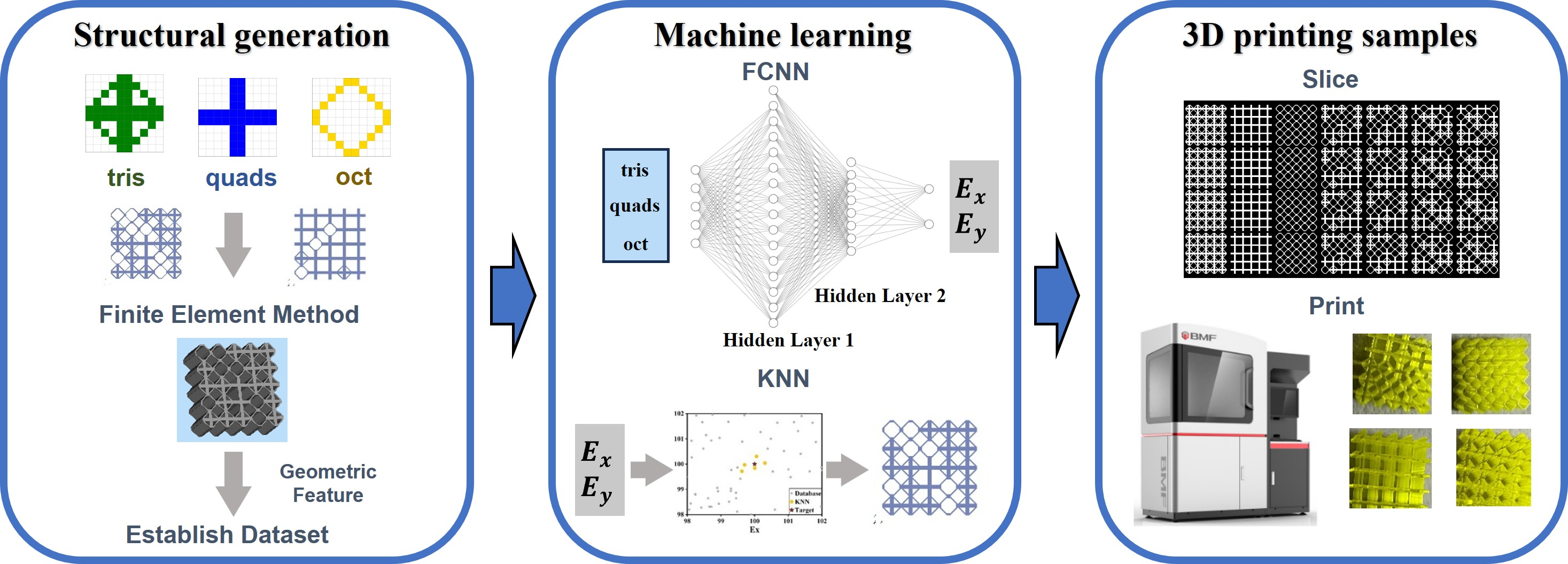
Traditional bone-implant lattices are commonly based on periodic unit cells, which simplify design and fabrication but limit geometric diversity and the fine, directional tuning of effective stiffness. Herein, a data-driven framework for multicell tessellations inspired by Euclidean-tiling (ET) is proposed to balance geometric freedom with controllable in-plane elastic modulus. Using three tiling-compatible unit cells (tris, quad, and oct), 10,000 randomly assembled 5 × 5 tiling structures were generated to construct a finite element database of structure-property relationships targeting the in-plane equivalent modulus (Ex and Ey). A fully connected neural network (FCNN) was trained with two input feature representations, namely a unit cell arrangement encoding (UCAE) and a unit cell frequency statistic (UCFS). As the FCNN input, the UCAE consistently outperformed the UCFS, achieving R2 values of approximately 0.99 for both Ex and Ey, with a mean absolute error of about 1.4 MPa. Based on the FE database, a k-nearest neighbors strategy was applied to retrieve the five structures most closely matching the target modulus. The selected designs were subsequently fabricated by high-precision 3D printing. The elastic modulus values obtained from machine learning prediction, finite element analysis, and experimental testing showed close agreement. Overall, this framework enables rapid prediction and inverse screening of elastic modulus in ET-based structures with high degrees of freedom.
- Huiskes R, Weinans H, Rietbergen BY. The Relationship Between Stress Shielding and Bone Resorption Around Total Hip Stems and the Effects of Flexible Materials. Clin Orthop Relat Res. 1992;274. doi: 10.1097/00003086-199201000-00014
- Zadpoor AA. Mechanical performance of additively manufactured meta-biomaterials. Acta Biomater.2019;85:41-59. doi: 10.1016/j.actbio.2018.12.038
- Evans FG. Mechanical Properties of Bone. Thomas; 1973. Available from https://www.google.co.jp/books/edition/_/EqATngEACAAJ?hl=zh-CN&sa=X&ved=2ahUKEwj8x6uru62TAxWLoa8BHSF4KOkQre8FegQICRAC [Last accessed on 2026 Mar 25].
- Currey JD. Bones: Structure and Mechanics. Princeton University Press. 2002. Accessed January 11, 2026. Available from https://www.jstor.org/stable/j.ctt4cg9wv [Last accessed on 2026 Mar 25].
- Rho JY, Kuhn-Spearing L, Zioupos P. Mechanical properties and the hierarchical structure of bone. Med Eng Phys.1998;20(2):92-102. doi: 10.1016/S1350-4533(98)00007-1
- Ashman RB, Jae YR. Elastic modulus of trabecular bone material. J Biomech. 1988;21(3):177-181. doi: 10.1016/0021-9290(88)90167-4
- Rho JY, Ashman RB, Turner CH. Young’s modulus of trabecular and cortical bone material: Ultrasonic and micro-tensile measurements. J Biomech. 1993;26(2):111-119. doi: 10.1016/0021-9290(93)90042-D
- Zysset PK, Edward Guo X, Edward Hoffler C, et al. Elastic modulus and hardness of cortical and trabecular bone lamellae measured by nanoindentation in the human femur. J Biomech. 1999;32(10):1005-1012. doi: 10.1016/S0021-9290(99)00111-6
- Arabnejad S, Johnston B, Tanzer M, et al. Fully porous3D printed titanium femoral stem to reduce stress shielding following total hip arthroplasty. J Orthop Res.2017;35(8):1774-1783. doi: 10.1002/jor.23445
- Ibrahim P, Jameekornkul P, Panesar A, et al. The utility of additively manufactured β-Ti latticed hip implants in reducing femoral stress shielding: A finite element study. J Mech Behav Biomed Mater. 2025;168:106999. doi: 10.1016/j.jmbbm.2025.106999
- Qin Y, Jing Z, Zou D, et al. A metamaterial scaffold beyond modulus limits: enhanced osteogenesis and angiogenesis of critical bone defects. Nat Commun. 2025;16(1):2180. doi: 10.1038/s41467-025-57609-9
- Safavi S, Gray HA, Lee PVS. Design and optimisation of patient-specific porous femoral stems. J Orthop Surg.2025;20(1):1002. doi: 10.1186/s13018-025-06389-5
- Kadkhodapour J, Montazerian H, Darabi ACh, et al. Failure mechanisms of additively manufactured porous biomaterials: Effects of porosity and type of unit cell. J Mech Behav Biomed Mater. 2015;50:180-191. doi: 10.1016/j.jmbbm.2015.06.012
- Garcia-Gareta E, Coathup MJ, Blunn GW. Osteoinduction of bone grafting materials for bone repair and regeneration. Bone. 2015;81:112-121. doi: 10.1016/j.bone.2015.07.007
- Bose S, Vahabzadeh S, Bandyopadhyay A. Bonetissue engineering using 3D printing. Mater Today.2013;16(12):496-504.doi: 10.1016/j.mattod.2013.11.017
- Benedetti M, du Plessis A, Ritchie RO, et al. Architected cellular materials: A review on their mechanical properties towards fatigue-tolerant design and fabrication. Mater Sci Eng R Rep. 2021;144:100606. doi: 10.1016/j.mser.2021.100606
- Maevskaia E, Guerrero J, Ghayor C, et al. Triply periodic minimal surface-based scaffolds for bone tissue engineering: A mechanical, in vitro and in vivo Study. Tissue Eng Part A.2023;29(19-20):507-517. doi: 10.1089/ten.tea.2023.0033
- Ghazlan A, Ngo T, Le VT, et al. A bio-mimetic cellular structure for mitigating the effects of impulsive loadings-Anumerical study. J Sandw Struct Mater. 2021;23(6):1929-1955. doi: 10.1177/1099636220908581
- Jia Y, Liu K, Zhang XS. Modulate stress distribution with bio-inspired irregular architected materials towards optimal tissue support. Nat Commun. 2024;15(1):4072. doi: 10.1038/s41467-024-47831-2
- Jia Y, Liu K, Zhang XS. Topology optimization of irregular multiscale structures with tunable responses using a virtual growth rule. Comput Methods Appl Mech Eng.2024;425:116864. doi: 10.1016/j.cma.2024.116864
- Grunbaum B, Shephard GC. Tilings by Regular Polygons. Math Mag. 1977;50(5):227-247. doi: 10.1080/0025570X.1977.11976655
- De Las Penas MLAN, Tomenes MD, Abila AKM. Creating planar k-isogonal tilings: 29th Asian Technology Conference in Mathematics, ATCM 2024. Proc Asian Technol Conf Math. 2024:52-66. Available from https://research.ateneo.edu/en/publications/creating-planar-k-isogonal-tilings/ [Last accessed on 2026 Mar 25].
- Max N. Constructing and visualizing uniform tilings. Computers. 2023;12(10):208. doi: 10.3390/computers12100208
- Roberts AP, Garboczi EJ. Elastic moduli of model random three-dimensional closed-cell cellular solids. Acta Mater.2001;49(2):189-197. doi: 10.1016/S1359-6454(00)00314-1
- Li K, Gao XL, Subhash G. Effects of cell shape and cell wall thickness variations on the elastic properties of two-dimensional cellular solids. Int J Solids Struct.2005;42(5):1777-1795. doi: 10.1016/j.ijsolstr.2004.08.005
- Li K, Gao XL, Wang J. Dynamic crushing behavior of honeycomb structures with irregular cell shapes and non-uniform cell wall thickness. Int J Solids Struct.2007;44(14):5003-5026. doi: 10.1016/j.ijsolstr.2006.12.017
- Grunbaum B, Shephard GC. Tilings and Patterns. Courier Dover Publications. 1987. Available from https://archive.org/details/isbn_0716711931/page/n1/mode/ [Last accessed on 2026 Mar 25].
- Mahato V, Chatterjee S, Nyabadza A, et al. Layer porosity in powder-bed fusion prediction using regression machine learning models and time-series features. Int J AI Mater Des.2024;1(3):33-49. doi: 10.36922/ijamd.4812
- Lew AJ, Jin K, Buehler MJ. Designing architected materials for mechanical compression via simulation, deep learning, and experimentation. Npj Comput Mater. 2023;9(1):80. doi: 10.1038/s41524-023-01036-1
- Ha CS, Yao D, Xu Z, et al. Rapid inverse design of metamaterials based on prescribed mechanical behavior through machine learning. Nat Commun. 2023;14(1):5765. doi: 10.1038/s41467-023-40854-1
- Zheng L, Karapiperis K, Kumar S, et al. Unifying the design space and optimizing linear and nonlinear truss metamaterials by generative modeling. Nat Commun.2023;14(1):7563. doi: 10.1038/s41467-023-42068-x
- Yang Z, Yu CH, Buehler MJ. Deep learning model to predict complex stress and strain fields in hierarchical composites. Sci Adv. 2021;7(15):eabd7416. doi: 10.1126/sciadv.abd7416
- Jo J, Park M, Kang S, et al. Data-driven prediction of strain fields in auxetic structures and non-contact validation with mechano luminescence for structural health monitoring. IntJ AI Mater Des. 2024;1(2):48-60. doi: 10.36922/ijamd.3539
- Luan S, Chen E, John J, et al. A data-driven framework for structure-property correlation in ordered and disordered cellular metamaterials. Sci Adv. 2023;9(41):eadi1453. doi: 10.1126/sciadv.adi1453
- Shaikeea AJD. Exploration of truss metamaterials with graph-based generative modeling. Nat Commun. 2023;14(1):7565.doi: 10.1038/s41467-023-43217-y
- Meyer PP, Bonatti C, Tancogne-Dejean T, et al. Graph-based metamaterials: Deep learning of structure-property relations. Mater Des. 2022;223:111175. doi: 10.1016/j.matdes.2022.111175
- Jiawei Wang, Yanqin Liu, Limei Yan, et al. Fractional sub-equation neural networks (fSENNs) method for exact solutions of space-time fractional partial differential equations. Chaos 2025;35(4):043110. doi: 10.1063/5.0259937
- Xie XR, Zhang RF. Neural network-based symbolic calculation approach for solving the Korteweg-de Vries equation. Chaos Solitons Fractals. 2025;194:116232. doi: 10.1016/j.chaos.2025.116232
- Liu K, Sun R, Daraio C. Growth rules for irregular architected materials with programmable properties. Science. 2022;377(6609):975-981. doi: 10.1126/science.abn1459
- Gibson LJ, Ashby MF. Cellular Solids: Structure and Properties. 2nd ed. Cambridge University Press. 1997. doi: 10.1017/CBO9781139878326
- Bastek JH, Kochmann DM. Inverse design of nonlinear mechanical metamaterials via video denoising diffusion models. Nat Mach Intell. 2023;5(12):1466-1475. doi: 10.1038/s42256-023-00762-x
- Lumpe TS, Stankovic T. Exploring the property space of periodic cellular structures based on crystal networks. Proc Natl Acad Sci USA. 2021;118(7):e2003504118. doi: 10.1073/pnas.2003504118
- Lamas I, Feijoo I, Gomez S, et al. Influence of nodal spheres on the mechanical behaviour of auxetic materials manufactured with PA12. Materials. 2025;18(24):5688. doi: 10.3390/ma18245688
- Gibson LJ. Biomechanics of cellular solids. J. Biomech.2005;38(3):377-399. doi: 10.1016/j.jbiomech.2004.09.027
- Meza LR, Zelhofer AJ, Clarke N, et al. Resilient 3Dhierarchical architected metamaterials. Proc Natl Acad Sci.2015;112(37):11502-11507. doi: 10.1073/pnas.1509120112
- Kolken HMA, de Jonge CP, van der Sloten T, et al. Additively manufactured space-filling meta-implants. Acta Biomater.2021;125:345-357. doi: 10.1016/j.actbio.2021.02.020
- Zhao D, Yu K, Sun T, et al. Material-structure-function integrated additive manufacturing of degradable metallic bone implants for load-bearing applications. Adv Funct Mater. 2023;33(16):2213128. doi: 10.1002/adfm.202213128