
Two leading experts examine how AI is reshaping design practice and how human expertise is transferred to intelligent manufacturing systems
The International Journal of AI for Materials and Design (IJAMD) convened the November edition of its Distinguished Speaker Series on 10 November 2026, bringing together researchers for an afternoon programme on artificial intelligence in design and manufacturing. The session, held online, was chaired by IJAMD Editor-in-Chief Prof. Wai Yee Yeong of Nanyang Technological University.
The programme featured two keynote lectures. Prof. Pai Zheng of The Hong Kong Polytechnic University presented Towards Embodied Intelligent Manufacturing Systems: An Ego-centric Skill Learning Approach, and Prof. Danni Chang of Shanghai Jiao Tong University presented User Insights and Design Innovation in Human-AI Collaboration. Both talks were followed by an extended discussion with an international audience.
Prof. Zheng opened with a question that has become central to industrial AI: why, after decades of automation, do skilled workers remain indispensable on the factory floor? His answer focused on what he termed contact-rich processes (assembly, drilling, welding, disassembly), where physical feel, not visual recognition, determines success. Such work, he argued, is precisely where general-purpose foundation models still fall short.
His research group addresses this gap by capturing human expertise at the point of performance. Using instrumented data gloves and multimodal sensing, the team records not only hand trajectories but also force and tactile signals, building datasets that preserve the implicit knowledge skilled operators carry in their hands. These recordings are then used to train robots through few-shot imitation learning, reducing the number of human demonstrations required. Prof. Zheng also described a deliberately vertical strategy for industrial AI. Rather than pursuing a single general-purpose model, his group develops domain-specific foundation models in which each robot acquires a specialised skill set: an approach he compared to the way skilled workers spend decades mastering a narrow range of processes. Demonstrations included dual-arm robotic welding cells, precision peg-in-hole insertion, and the disassembly of ageing electric vehicle batteries, where heterogeneous robots cooperate under human supervision.
A recurring theme was the distinction between what is technologically impressive and what industry will actually accept. Laboratory learning policies may reach 80-90 per cent accuracy, Prof. Zheng noted, but production lines demand far higher reliability. This gap, he suggested, makes natural-language interaction and rapid deployment, rather than fully autonomous learning, the more immediate route to industrial adoption.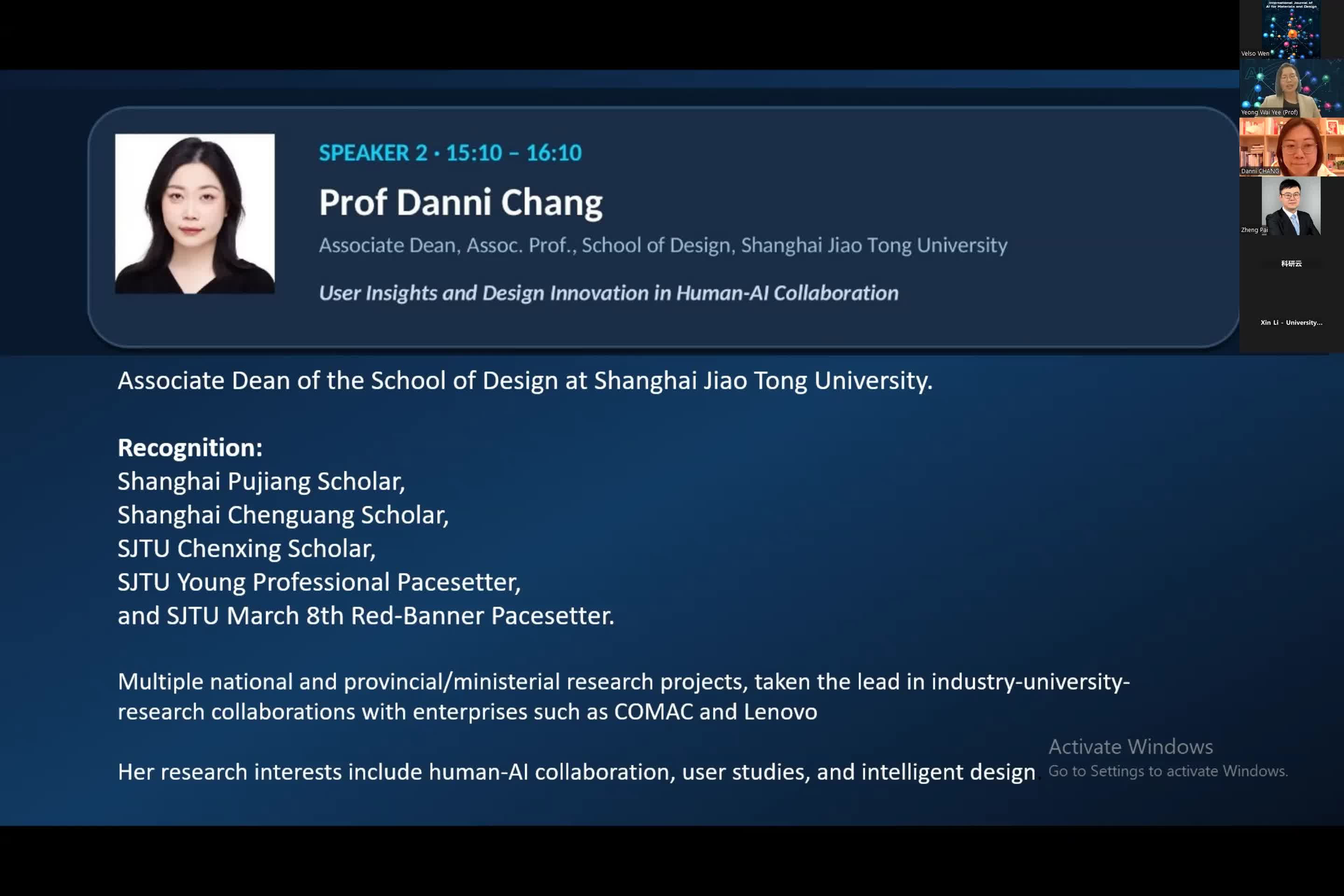
Prof. Chang approached the same technological shift from the design side, asking how designers can understand the people they design for when generative systems can produce solutions at scale.
She traced design's evolution through three stages: from craft-based practice, through human-centred design thinking, to computational and now AI-era design, and argued that authority has shifted at each stage: from the maker's hand to the user's need to data. What has not changed, she emphasised, is that successful design sits at the intersection of business, technology and human value, and that the third of these is the slowest to automate. Her group's work therefore concentrates on methods for identifying user insight and user intention. Prof. Chang presented studies using eye-tracking to measure perceived product attributes, physiological sensing to capture responses users cannot articulate, and large-scale mining of user-generated content to map feedback onto designable product features. She also described controlled experiments on trust in AI systems, showing that voice interaction increases both perceived machine consciousness and the politeness of users' own language: evidence, she argued, that interface modality is a social design decision rather than a stylistic one. Other projects extended the argument to multi-agent systems, where sharing information between agents improves coherence but raises privacy concerns, and to AI-assisted creativity for children, where the design decision that matters most is where the AI stops: the system completes individual elements but deliberately leaves narrative structure to the child, because structure is the skill being taught.
Prof. Chang closed with a question rather than a conclusion. As AI takes over more of the design process, she argued, the discipline's task is to decide where human judgement should remain: particularly in aesthetic and qualitative decisions that define design quality. Simple design work, she suggested, may increasingly be automated; high-quality design cannot be.
--
The Distinguished Speaker Series continues in 2027, with sessions planned on AI for materials and metals, semiconductors and industrial AI, robotics and embodied AI, and organoids and biomedical systems. Details will be announced on the journal's website.