
Investigations on association of CD44 and its isoforms in altitude-associated lung pathologies in BALB/c mice

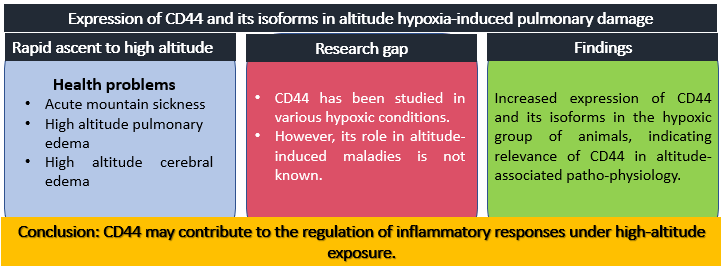
Rapid ascent to mountainous terrain often leads to medical emergencies, including acute mountain sickness, high-altitude pulmonary edema, and high-altitude cerebral edema. Among these, respiratory disorders are the most prevalent at high altitude. However, despite extensive research, the mechanism underlying altitude-associated pulmonary pathophysiology remains elusive, with limited treatment options. Cluster of differentiation 44 (CD44) is a widely expressed transmembrane glycoprotein, present across diverse types of tissues. Several studies have demonstrated marked upregulation of CD44 expression in the lungs in activation-induced inflammatory conditions. However, the contribution of CD44 and its isoforms to the pathogenesis of altitude-associated lung maladies has yet to be elucidated. This study investigated the involvement of CD44 and its variant isoforms in altitude-associated lung pathologies using BALB/c mice. Animals were exposed to hypobaric hypoxia conditions, corresponding to a simulated altitude of ~25,000 feet for 24 h in a hypobaric hypoxia chamber. Results showed a significant increase in CD44 expression from 3.83 ± 1.4% to 19 ± 3.6%, and its variant isoforms such as CD44v5, CD44v7, and CD44v8 were found to be increased by 3-fold, 4-fold, and 2-fold, respectively (p < 0.0001), along with severe pulmonary pathological damage and inflammation in the lung parenchyma of animals exposed to simulated altitude conditions. These observations suggest that CD44 and its isoforms may have some possible links with the development of lung pathologies at high altitude.
Baba, M., Oishi, R., & Saeki, K. (1988). Enhancement of blood-brain barrier permeability to sodium fluorescein by stimulation of mu opioid receptors in mice. Naunyn-Schmiedeberg’s Archives of Pharmacology, 337(4), 423–428. https://doi.org/10.1007/BF00169534
Bailey, D. M., & Davies, B. (2001). Acute mountain sickness; prophylactic benefits of antioxidant vitamin supplementation at high altitude. High Altitude Medicine & Biology, 2(1), 21–29. https://doi.org/10.1089/152702901750067882
Bakonyi, T., & Radak, Z. (2004). High altitude and free radicals. Journal of sports science & medicine, 3(2), 64–69. https://pmc.ncbi.nlm.nih.gov/articles/PMC3899533/
Balhara, M., Tirpude, R. J., Patir, H., & Reddy, M. P. K. (2024). Investigations on the physiological and inflammatory responses in BALB/c mice exposed to acute hypoxia [Conference abstract]. Pulmonary Circulation, 14(4), A016. https://doi.org/10.1002/pul2.70023
Barletta, K. E., Cagnina, R. E., Wallace, K. L., Ramos, S. I., Mehrad, B., & Linden, J. (2012). Leukocyte compartments in the mouse lung: distinguishing between marginated, interstitial, and alveolar cells in response to injury. Journal of Immunological Methods, 375(1-2), 100–110. https://doi.org/10.1016/j.jim.2011.09.013
Bärtsch, P., Mairbäurl, H., Maggiorini, M., & Swenson, E. R. (2005). Physiological aspects of high-altitude pulmonary edema. Journal of Applied Physiology, 98(3), 1101–1110. https://doi.org/10.1152/japplphysiol.01167.2004
Baumgartner, R. W., Eichenberger, U., & Bärtsch, P. (2002). Postural ataxia at high altitude is not related to mild to moderate acute mountain sickness. European Journal of Applied Physiology, 86(4), 322–326. https://doi.org/10.1007/s00421-001-0534-8
Berdiaki, A., Neagu, M., Spyridaki, I., Kuskov, A., Perez, S., & Nikitovic, D. (2023). Hyaluronan and Reactive Oxygen Species Signaling-Novel Cues from the Matrix?. Antioxidants (Basel), 12(4), 824. https://doi.org/10.3390/antiox12040824
Bertaux-Skeirik, N., Wunderlich, M., Teal, E., et al. (2017). CD44 variant isoform 9 emerges in response to injury and contributes to the regeneration of the gastric epithelium. The Journal of Pathology, 242(4), 463–475. https://doi.org/10.1002/path.4918
Beytut, E., Sözmen, M., & Ergínsoy, S. (2009). Immunohistochemical detection of pulmonary surfactant proteins and retroviral antigens in the lungs of sheep with pulmonary adenomatosis. Journal of Comparative Pathology, 140(1), 43–53. https://doi.org/10.1016/j.jcpa.2008.10.003
Bhattacharya, S., Shrimali, N. M., Mohammad, G., Koul, P. A., Prchal, J. T., & Guchhait, P. (2021). Gain-of-function Tibetan PHD2D4E;C127S variant suppresses monocyte function: A lesson in inflammatory response to inspired hypoxia. eBioMedicine, 68, 103418. https://doi.org/10.1016/j.ebiom.2021.103418
Bickler, P. E., Feiner, J. R., Lipnick, M. S., Batchelder, P., MacLeod, D. B., & Severinghaus, J. W. (2017). Effects of Acute, Profound Hypoxia on Healthy Humans: Implications for Safety of Tests Evaluating Pulse Oximetry or Tissue Oximetry Performance. Anesthesia & Analgesia, 124(1), 146–153. https://doi.org/10.1213/ANE.0000000000001421
Castillo-Rodríguez, R. A., Trejo-Solís, C., Cabrera-Cano, A., Gómez-Manzo, S., & Dávila-Borja, V. M. (2022). Hypoxia as a Modulator of Inflammation and Immune Response in Cancer. Cancers (Basel), 14(9), 2291. https://doi.org/10.3390/cancers14092291
Cathcart, R., Schwiers, E., & Ames, B. N. (1983). Detection of picomole levels of hydroperoxides using a fluorescent dichlorofluorescein assay. Analytical Biochemistry, 134(1), 111–116. https://doi.org/10.1016/0003-2697(83)90270-1
Chandel, N. S., McClintock, D. S., Feliciano, C. E., et al. (2000). Reactive oxygen species generated at mitochondrial complex III stabilize hypoxia-inducible factor-1alpha during hypoxia: a mechanism of O2 sensing. Journal of Biological Chemistry, 275(33), 25130–25138. https://doi.org/10.1074/jbc.M001914200
Chen, C., Zhao, S., Karnad, A., & Freeman, J. W. (2018). The biology and role of CD44 in cancer progression: therapeutic implications. Journal of Hematology & Oncology, 11(1), 64. https://doi.org/10.1186/s13045-018-0605-5
Chen, J., Zhou, J., Lu, J., Xiong, H., Shi, X., & Gong, L. (2014). Significance of CD44 expression in head and neck cancer: a systemic review and meta-analysis. BMC Cancer, 14(1), 15. https://doi.org/10.1186/1471-2407-14-15
Cosgun, B. E., Erdemli, M. E., Gul, M., et al. (2019). Crocin (active constituent of saffron) improves CCl₄-induced liver damage by modulating oxidative stress in rats. Turkish Journal of Biochemistry, 44(3), 370–378. https://doi.org/10.1515/tjb-2017-0173
DeGrendele, H. C., Kosfiszer, M., Estess, P., & Siegelman, M. H. (1997). CD44 activation and associated primary adhesion is inducible via T cell receptor stimulation. The Journal of Immunology, 159(6), 2549–2553. https://doi.org/10.4049/jimmunol.159.6.2549
Eltzschig, H. K., & Carmeliet, P. (2011). Hypoxia and inflammation. The New England Journal of Medicine, 364(7), 656–665. https://doi.org/10.1056/NEJMra0910283
Grisar, J., Munk, M., Steiner, C. W., Amoyo-Minar, L., Tohidast-Akrad, M., Zenz, P., Steiner, G., & Smolen, J. S. (2012). Expression patterns of CD44 and CD44 splice variants in patients with rheumatoid arthritis. Clinical and experimental rheumatology, 30(1), 64–72. https://www.clinexprheumatol.org/abstract.asp?a=4711
Guo, Y. J., Liu, G., Wang, X., Jin, D., Wu, M., Ma, J., & Sy, M. S. (1994). Potential use of soluble CD44 in serum as indicator of tumor burden and metastasis in patients with gastric or colon cancer. Cancer Research, 54(2), 422–426. https://pubmed.ncbi.nlm.nih.gov/7506122/
Hackett, P. H., & Roach, R. C. (2001). High-altitude illness. The New England Journal of Medicine, 345(2), 107–114. https://doi.org/10.1056/NEJM200107123450206
Hartmann, G., Tschöp, M., Fischer, R., et al. (2000). High altitude increases circulating interleukin-6, interleukin-1 receptor antagonist and C-reactive protein. Cytokine, 12(3), 246–252. https://doi.org/10.1006/cyto.1999.0533
Hasan, Z., Palani, K., Rahman, M., & Thorlacius, H. (2011). Targeting CD44 expressed on neutrophils inhibits lung damage in abdominal sepsis. Shock, 35(6), 567–572. https://doi.org/10.1097/SHK.0b013e3182144935
Haynes, B. F., Hale, L. P., Patton, K. L., Martin, M. E., & McCallum, R. M. (1991). Measurement of an adhesion molecule as an indicator of inflammatory disease activity. Up-regulation of the receptor for hyaluronate (CD44) in rheumatoid arthritis. Arthritis & Rheumatism, 34(11), 1434–1443. https://doi.org/10.1002/art.1780341115
Himadri, P., Kumari, S. S., Chitharanjan, M., & Dhananjay, S. (2010). Role of oxidative stress and inflammation in hypoxia-induced cerebral edema: a molecular approach. International Journal of Molecular Sciences, 11(3), 231–244. https://doi.org/10.1089/ham.2009.1057
Hoarau, A., Polette, M., & Coraux, C. (2022). Lung Hyaluronasome: Involvement of Low Molecular Weight Ha (Lmw-Ha) in Innate Immunity. Biomolecules, 12(5), 658. https://doi.org/10.3390/biom12050658
Hollingsworth, J. W., Li, Z., Brass, D. M., Garantziotis, S., Timberlake, S. H., Kim, A., Hossain, I., Savani, R. C., & Schwartz, D. A. (2007). CD44 Regulates Macrophage Recruitment to the Lung in Lipopolysaccharide-Induced Airway Disease. American Journal of Respiratory Cell and Molecular Biology, 37(2), 248–253. https://doi.org/10.1165/rcmb.2006-0363oc
Hu, L., Nomura, S., Sato, Y., Takagi, K., Ishii, T., Honma, Y., Watanabe, K., Mizukami, Y., & Muto, J. (2022). Anti-inflammatory effects of differential molecular weight Hyaluronic acids on UVB-induced calprotectin-mediated keratinocyte inflammation. Journal of Dermatological Science, 107(1), 24–31. https://doi.org/10.1016/j.jdermsci.2022.06.001
Huh, J. W., Kim, H. R., Kim, Y. J., Lee, J. H., Park, Y. S., Cho, S. H., & Joo, J. K. (2009). Expression of standard CD44 in human colorectal carcinoma: Association with prognosis. Pathology International, 59(4), 241–246. https://doi.org/10.1111/j.1440-1827.2009.02357.x
Johnson, P., & Ruffell, B. (2009). CD44 and its role in inflammation and inflammatory diseases. Inflammation & Allergy - Drug Targets, 8(3), 208–220. https://doi.org/10.2174/187152809788680994
Jordan, A. R., Racine, R. R., Hennig, M. J., & Lokeshwar, V. B. (2015). The Role of CD44 in Disease Pathophysiology and Targeted Treatment. Frontiers in Immunology, 6, 182. https://doi.org/10.3389/fimmu.2015.00182
Katoh, S. (2022). Critical Involvement of CD44 in T Helper Type 2 Cell-Mediated Eosinophilic Airway Inflammation in a Mouse Model of Acute Asthma. Frontiers in Immunology, 12, 811600. https://doi.org/10.3389/fimmu.2021.811600
Kopp, R., Fichter, M., Schalhorn, G., Danescu, J., & Classen, S. (2009). Frequent expression of the high molecular, 673-bp CD44v3, v8-10 variant in colorectal adenomas and carcinomas. International Journal of Molecular Medicine, 24(5), 677–683. https://doi.org/10.3892/ijmm_00000279
Krettek, A., Sukhova, G. K., Schönbeck, U., & Libby, P. (2004). Enhanced expression of CD44 variants in human atheroma and abdominal aortic aneurysm: possible role for a feedback loop in endothelial cells. The American Journal of Pathology, 165(5), 1571–1581. https://doi.org/10.1016/S0002-9440(10)63414-1
Krishnamachary, B., Penet, M.-F., Nimmagadda, S., Mironchik, Y., Raman, V., Solaiyappan, M., Semenza, G. L., Pomper, M. G., & Bhujwalla, Z. M. (2012). Hypoxia Regulates CD44 and Its Variant Isoforms through HIF-1α in Triple Negative Breast Cancer. PLoS ONE, 7(8), e44078. https://doi.org/10.1371/journal.pone.0044078
Krolikoski, M., Monslow, J., & Puré, E. (2019). The CD44-HA axis and inflammation in atherosclerosis: A temporal perspective. Matrix Biology, 78–79, 201–218. https://doi.org/10.1016/j.matbio.2018.05.007
Kubo, K., Hanaoka, M., Hayano, T., Miyahara, T., Hachiya, T., Hayasaka, M., Koizumi, T., Fujimoto, K., Kobayashi, T., & Honda, T. (1998). Inflammatory cytokines in BAL fluid and pulmonary hemodynamics in high-altitude pulmonary edema. Respiration Physiology, 111(3), 301–310. https://doi.org/10.1016/s0034-5687(98)00006-1
Landini, G., Martinelli, G., & Piccinini, F. (2021). Colour deconvolution: Stain unmixing in histological imaging. Bioinformatics, 37(10), 1485–1487. https://doi.org/10.1093/bioinformatics/btaa847
Ley K, Laudanna C, Cybulsky MI, Nourshargh S. (2007). Getting to the site of inflammation: the leukocyte adhesion cascade updated. Nature Reviews Immunology, 7(9), 678–689. https://doi.org/10.1038/nri2156
Li, Z., Potts, E. N., Piantadosi, C. A., Foster, W. M., & Hollingsworth, J. W. (2010). Hyaluronan fragments contribute to the ozone-primed immune response to lipopolysaccharide. The Journal of Immunology, 185(11), 6891–6898. https://doi.org/10.4049/jimmunol.1000283
Liang, J., Jiang, D., Griffith, J., Yu, S., Fan, J., Zhao, X., Bucala, R., & Noble, P. W. (2007). CD44 Is a Negative Regulator of Acute Pulmonary Inflammation and Lipopolysaccharide-TLR Signaling in Mouse Macrophages. The Journal of Immunology, 178(4), 2469–2475. https://doi.org/10.4049/jimmunol.178.4.2469
Lin, J., & Ding, D. (2017). The prognostic role of the cancer stem cell marker CD44 in ovarian cancer: a meta-analysis. Cancer Cell International, 17(1), 8. https://doi.org/10.1186/s12935-016-0376-4
Lowry, O. H., Rosebrough, N. J., Farr, A. L., & Randall, R. J. (1951). Protein measurement with the Folin phenol reagent. Journal of Biological Chemistry, 193(1), 265–275. https://doi.org/10.1016/S0021-9258(19)52451-6.
Luan, Y. Y., & Yao, Y. M. (2018). The Clinical Significance and Potential Role of C-Reactive Protein in Chronic Inflammatory and Neurodegenerative Diseases. Frontiers in Immunology, 9, 1302. https://doi.org/10.3389/fimmu.2018.01302
Luo, Z., Tian, M., Yang, G., Tan, Q., Chen, Y., Li, G., Zhang, Q., Li, Y., Wan, P., & Wu, J. (2022). Hypoxia signaling in human health and diseases: implications and prospects for therapeutics. Signal Transduction and Targeted Therapy, 7(1). https://doi.org/10.1038/s41392-022-01080-1
Mairer, K., Wille, M., Bucher, T., & Burtscher, M. (2009). Prevalence of acute mountain sickness in the Eastern Alps. High Altitude Medicine & Biology, 10(3), 239–245. https://doi.org/10.1089/ham.2008.1091
Marin, J. J. G., Asensio, M., Álvarez-Fernández, L., Hortelano-Hernandez, N., Delgado-Calvo, K., Marijuan, R. P., Perez-Silva, L., Benizri, L. O., Gallai, D., Lozano, E., Macias, R. I. R., Briz, O., & Reviejo, M. (2026). Impact of CD44 alternative splicing on the response to anticancer drugs. Biochemical Pharmacology, 251, 118111. https://doi.org/10.1016/j.bcp.2026.118111
Masson, D., Denis, M. G., Denis, M., Blanchard, D., Loirat, M. J., Cassagnau, E., & Lustenberger, P. (1999). Soluble CD44: quantification and molecular repartition in plasma of patients with colorectal cancer. British Journal of Cancer, 80(12), 1995–2000. https://doi.org/10.1038/sj.bjc.6690633
McKallip, R. J., Do, Y., Fisher, M. T., Robertson, J. L., Nagarkatti, P. S., & Nagarkatti, M. (2002). Role of CD44 in activation-induced cell death: CD44-deficient mice exhibit enhanced T cell response to conventional and superantigens. International Immunology, 14(9), 1015–1026. https://doi.org/10.1093/intimm/dxf068
McKallip, R. J., Fisher, M., Gunthert, U., Szakal, A. K., Nagarkatti, P. S., & Nagarkatti, M. (2005). Role of CD44 and its v7 isoform in staphylococcal enterotoxin B-induced toxic shock: CD44 deficiency on hepatic mononuclear cells leads to reduced activation-induced apoptosis that results in increased liver damage. Infection and Immunity, 73(1), 50–61. https://doi.org/10.1128/IAI.73.1.50-61.2005
Menon, V., Thomas, R., Ghale, A. R., Reinhard, C., & Pruszak, J. (2014). Flow cytometry protocols for surface and intracellular antigen analyses of neural cell types. Journal of Visualized Experiments, (94), 52241. https://doi.org/10.3791/52241
Mishra, S., Kumar, G., Chhabra, A., Sethy, N. K., Jain, N., Meena, R. N., Tulsawani, R., Prasad, D. N., Kumar, B., & Sharma, M. (2020). Cysteine becomes conditionally essential during hypobaric hypoxia and regulates adaptive neuro-physiological responses through CBS/H2S pathway. Biochimica et Biophysica Acta (BBA) - Molecular Basis of Disease, 1866(7), 165769. https://doi.org/10.1016/j.bbadis.2020.165769
Movafagh, S., Crook, S., & Vo, K. (2015). Regulation of hypoxia-inducible factor-1a by reactive oxygen species: new developments in an old debate. Journal of Cellular Biochemistry, 116(5), 696–703. https://doi.org/10.1002/jcb.25074
Myrkhiyeva, Z., Nurlankyzy, M., Berikkhanova, K., Baimagambet, Z., Bissen, A., Bikhanov, N., Tan, C. K. L., Tosi, D., Ashikbayeva, Z., & Bekmurzayeva, A. (2025). Digging into the Solubility Factor in Cancer Diagnosis: A Case of Soluble CD44 Protein. Biosensors, 15(12), 796. https://doi.org/10.3390/bios15120796
Naor, D., Sionov, R. V., & Ish-Shalom, D. (1997). CD44: structure, function, and association with the malignant process. Advances in Cancer Research, 71, 241–319. https://doi.org/10.1016/s0065-230x(08)60101-3
Nimje, M. A., Patir, H., Tirpude, R., & Kumar, B. (2022). Elucidating the combined effect of intermittent hypoxia training and acetazolamide on hypoxia induced hematological and physiological changes. Current Research in Physiology, 5, 327–337. https://doi.org/10.1016/j.crphys.2022.07.004
Oh, H. J., Kim, S. T., Kim, H. J., Lee, K. T., & Yim, H. (2026). Multifaceted roles of CD44 in cancer progression and targeted therapeutic strategies. Experimental & Molecular Medicine, 58(8), 2451–2469. https://doi.org/10.1038/s12276-026-01797-x
Ohkawa, H., Ohishi, N., & Yagi, K. (1979). Assay for lipid peroxides in animal tissues by thiobarbituric acid reaction. Analytical Biochemistry, 95(2), 351–358. https://doi.org/10.1016/0003-2697(79)90738-3
Paralikar S. J. (2012). High altitude pulmonary edema-clinical features, pathophysiology, prevention and treatment. Indian Journal of Occupational and Environmental Medicine, 16(2), 59–62. https://doi.org/10.4103/0019-5278.107066
Rahman, I., Kode, A., & Biswas, S. K. (2006). Assay for quantitative determination of glutathione and glutathione disulfide levels using enzymatic recycling method. Nature Protocols, 1(6), 3159–3165. https://doi.org/10.1038/nprot.2006.378
Ruifrok, A. C., & Johnston, D. A. (2001). Quantification of histochemical staining by color deconvolution. Analytical and Quantitative Cytology and Histology, 23(4), 291–299. https://scispace.com/papers/quantification-of-histochemical-staining-by-color-4vk4xfd6ux
Schoene, R. B., Swenson, E. R., Pizzo, C. J., Hackett, P. H., Roach, R. C., Mills, W. J., Jr, Henderson, W. R., Jr, & Martin, T. R. (1988). The lung at high altitude: bronchoalveolar lavage in acute mountain sickness and pulmonary edema. Journal of Applied Physiology, 64(6), 2605–2613. https://doi.org/10.1152/jappl.1988.64.6.2605
Seiter, S., Schmidt, D.-S., & Zöller, M. (2000). The CD44 variant isoforms CD44v6 and CD44v7 are expressed by distinct leukocyte subpopulations and exert non-overlapping functional activities. International Immunology, 12(1), 37–49. https://doi.org/10.1093/intimm/12.1.37
Sheriff, A., Kayser, S., Brunner, P., & Vogt, B. (2021). C-Reactive Protein Triggers Cell Death in Ischemic Cells. Frontiers in Immunology, 12, 630430. https://doi.org/10.3389/fimmu.2021.630430
Siegel, J., Rent, R., & Gewurz, H. (1974). Interactions of C-reactive protein with the complement system. I. Protamine-induced consumption of complement in acute phase sera. The Journal of Experimental Medicine, 140(3), 631–647. https://doi.org/10.1084/jem.140.3.631
Singleton, P. A., Mirzapoiazova, T., Guo, Y., Sammani, S., Mambetsariev, N., Lennon, F. E., Moreno-Vinasco, L., & Garcia, J. G. N. (2010). High-molecular-weight hyaluronan is a novel inhibitor of pulmonary vascular leakiness. American Journal of Physiology-Lung Cellular and Molecular Physiology, 299(5), L639–L651. https://doi.org/10.1152/ajplung.00405.2009
Stamenkovic, I., Amiot, M., Pesando, J. M., & Seed, B. (1989). A lymphocyte molecule implicated in lymph node homing is a member of the cartilage link protein family. Cell, 56(6), 1057–1062. https://doi.org/10.1016/0092-8674(89)90638-7
Strober W. (2015). Trypan Blue Exclusion Test of Cell Viability. Current Protocols in Immunology, 111(1), A3.B.1–A3.B.3. https://doi.org/10.1002/0471142735.ima03bs111
Sun, J., Law, G. P., Bridges, C. C., & McKallip, R. J. (2012). CD44 as a novel target for treatment of staphylococcal enterotoxin B-induced acute inflammatory lung injury. Clinical Immunology, 144(1), 41–52. https://doi.org/10.1016/j.clim.2012.05.001
Suzuki, H., Kitamura, K., Goto, N., Ishikawa, K., Ouchida, T., Tanaka, T., Kaneko, M. K., & Kato, Y. (2023). A Novel Anti-CD44 Variant 3 Monoclonal Antibody C44Mab-6 Was Established for Multiple Applications. International Journal of Molecular Sciences, 24(9), 8411. https://doi.org/10.3390/ijms24098411
Swenson, E. R., & Bärtsch, P. (2012). High-altitude pulmonary edema. Comprehensive Physiology, 2(4), 2753–2773. https://doi.org/10.1002/cphy.c100029
van der Windt, G. J.W., Hoogendijk, A. J., de Vos, A. F., Kerver, M. E., Florquin, S., & van der Poll, T. (2011). The role of CD44 in the acute and resolution phase of the host response during pneumococcal pneumonia. Laboratory Investigation, 91(4), 588–597. https://doi.org/10.1038/labinvest.2010.206
Xu, H., Niu, M., Yuan, X., Wu, K., & Liu, A. (2020). CD44 as a tumor biomarker and therapeutic target. Experimental Hematology & Oncology, 9(1), 36. https://doi.org/10.1186/s40164-020-00192-0
Yanova, M., Stepanova, E., Maltseva, D., & Tonevitsky, A. (2025). CD44 variant exons induce chemoresistance by modulating cell death pathways. Frontiers in Cell and Developmental Biology, 13, 1508577. https://doi.org/10.3389/fcell.2025.1508577
Yu, Q., & Toole, B. P. (1997). Common pattern of CD44 isoforms is expressed in morphogenetically active epithelia. Developmental Dynamics, 208(1), 1–10. https://doi.org/10.1002/(SICI)1097-0177(199701)208:1<1::AID-AJA1>3.0.CO;2-M
Zhang, S., Wang, N., Ma, H., & Jing, L. (2025). A stable rat model of high altitude pulmonary edema established by hypobaric hypoxia combined diurnal temperature fluctuation and exercise. Biochemical and Biophysical Research Communications, 744, 151193. https://doi.org/10.1016/j.bbrc.2024.151193
Ziranu, P., Pretta, A., Aimola, V., Cau, F., Mariani, S., D’Agata, A. P., Codipietro, C., Rizzo, D., Dell’Utri, V., Sanna, G., Moledda, G., Cadoni, A., Lai, E., Puzzoni, M., Pusceddu, V., Castagnola, M., Scartozzi, M., & Faa, G. (2024). CD44: A New Prognostic Marker in Colorectal Cancer? Cancers, 16(8), 1569. https://doi.org/10.3390/cancers16081569