
Coumarins and Notch signaling: Critical appraisal of mechanistic evidence and therapeutic implications

Introduction: The Notch signaling pathway regulates cell fate determination, tissue homeostasis, stem cell maintenance, and vascular development, while its dysregulation contributes to cancer and other pathological conditions. Natural and synthetic coumarins have emerged as potential modulators of this pathway, although their molecular mechanisms and therapeutic relevance remain incompletely understood.
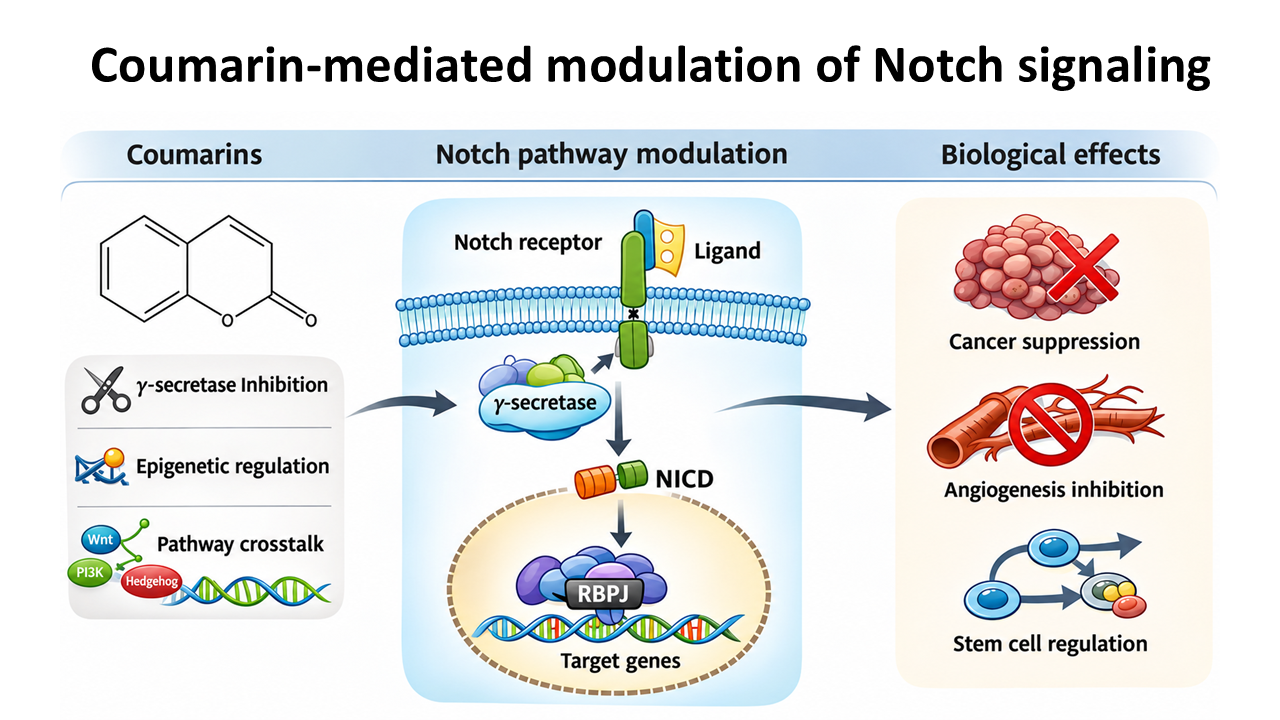
Objective: This review critically examines the experimental evidence linking coumarin derivatives to Notch signaling, emphasizing receptor–ligand interactions, γ-secretase-dependent processing, transcriptional and epigenetic regulation, and crosstalk with Wnt, Hedgehog, phosphoinositide 3-kinase/protein kinase B, and vascular endothelial growth factor pathways.
Results: Available findings suggest that coumarins may either enhance or suppress Notch-associated signaling depending on their chemical structures, concentrations, and biological contexts. However, much of the supporting evidence derives from changes in pathway-associated markers or interconnected signaling networks rather than direct demonstration of molecular target engagement. These limitations complicate mechanistic interpretation and the attribution of anticancer, vascular, and developmental effects specifically to Notch modulation. Although coumarin scaffolds offer opportunities for medicinal chemistry optimization, their therapeutic development remains constrained by insufficient target validation, uncertain selectivity, limited pharmacokinetic characterization, and unresolved safety considerations.
Conclusion: Future investigations should prioritize direct target-engagement studies, pathway-specific functional validation, structure–activity relationships, and rigorous preclinical assessment. Distinguishing established mechanisms from indirect associations and therapeutic hypotheses will be essential for determining whether coumarin derivatives can be developed into selective and clinically relevant Notch modulators.
- Zhou B, Lin W, Long Y, et al. Notch signaling pathway: architecture, disease, and therapeutics. Signal Transduct Target Ther. 2022;7(1):95. doi: 10.1038/s41392-022-00934-y
- Yong Y, Zhang R, Liu Z, et al. Gamma-secretase complex-dependent intramembrane proteolysis of CD147 regulates the Notch1 signaling pathway in hepatocellular carcinoma. J Pathol. 2019;249(2):255-267. doi: 10.1002/path.5316
- Meng Y, Bo Z, Feng X, Yang X, Handford PA. The Notch signaling pathway: mechanistic insights in health and disease. Engineering. 2024;34:212-232. doi: 10.1016/j.eng.2023.11.011
- Nie RZ, Wang H, Wang SS, et al. Interaction between Notch signaling pathway and bioactive compounds and its intervention on cancer. Front Nutr. 2025;12:1647661. doi: 10.3389/fnut.2025.1647661
- Mustafa YF. Hybrid coumarins in oncology: design strategies and multi-target mechanisms against tumor resistance. Indian J Clin Biochem. Published online 2025. doi: 10.1007/s12291-025-01382-5
- Kubrak TP, Makuch-Kocka A, Aebisher D. Coumarins in anticancer therapy: mechanisms of action, potential applications and research perspectives. Pharmaceutics. 2025;17(5):595. doi: 10.3390/pharmaceutics17050595
- Zhao Y, Jing L, Han L, Guo C, Yang Q. Coumarins in the tumor-immune application: from molecular mechanisms to therapeutic innovations. Front Immunol. 2025;16:1681892. doi: 10.3389/fimmu.2025.1681892
- Stefanachi A, Leonetti F, Pisani L, Catto M, Carotti A. Coumarin: a natural, privileged and versatile scaffold for bioactive compounds. Molecules. 2018;23(2):250. doi: 10.3390/molecules23020250
- Guan J, Wei X, Qu S, Lv T, Fu Q, Yuan Y. Osthole prevents cerebral ischemia-reperfusion injury via the Notch signaling pathway. Biochem Cell Biol. 2017;95(4):459-467. doi: 10.1139/bcb-2016-0233
- Li Y, Wang G, Li Y. Therapeutic potential of natural coumarins in autoimmune diseases with underlying mechanisms. Front Immunol. 2024;15:1432846. doi: 10.3389/fimmu.2024.1432846
- Flores-Morales V, Villasana-Ruíz AP, Garza-Veloz I, González-Delgado S, Martinez-Fierro ML. Therapeutic effects of coumarins with different substitution patterns. Molecules. 2023;28(5):2413. doi: 10.3390/molecules28052413
- Giuli MV, Mancusi A, Giuliani E, Screpanti I, Checquolo S. Notch signaling in female cancers: a multifaceted node to overcome drug resistance. Cancer Drug Resist. 2021;4(4):805-836. doi: 10.20517/cdr.2021.53
- Zeki NM, Mustafa YF. Coumarin hybrids for targeted therapies: a promising approach for potential drug candidates. Phytochem Lett. 2024;60:117-133. doi: 10.1016/j.phytol.2024.01.010
- Potts C, Yang C, Liaw L. NOTCH signaling networks in perivascular adipose tissue. Arterioscler Thromb Vasc Biol. 2025;45(6):845-856. doi: 10.1161/ATVBAHA.124.321690
- Sisto M, Lisi S. Significance of Notch signaling in salivary gland development and diseases. J Clin Med. 2025;14(10):3325. doi: 10.3390/jcm14103325
- Pancewicz J. A brief overview of clinical significance of novel Notch2 regulators. Mol Cell Oncol. 2020;7(5):1776084. doi: 10.1080/23723556.2020.1776084
- Yang KF, Zhang JY, Feng M, et al. Secretase promotes AD progression: simultaneously cleave Notch and APP. Front Aging Neurosci. 2024;16:1445470. doi: 10.3389/fnagi.2024.1445470
- Gonzalez R, Reinberg D. The Notch pathway: a guardian of cell fate during neurogenesis. Curr Opin Cell Biol. 2025;95:102543. doi: 10.1016/j.ceb.2025.102543
- Younes AH, Mustafa YF. Novel coumarins from green sweet bell pepper seeds: their isolation, characterization, oxidative stress-mitigating, anticancer, anti-inflammatory, and antidiabetic properties. J Mol Struct. 2024;1312:138629. doi: 10.1016/j.molstruc.2024.138629
- Lüscher B, Bussmann P, Müller J. Role of histone H3 lysine 4 methylation in chromatin biology. Molecules. 2025;30(20):4075. doi: 10.3390/molecules30204075
- O'Brien KA, Murray AJ, Simonson TS. Notch signaling and cross-talk in hypoxia: a candidate pathway for high-altitude adaptation. Life (Basel). 2022;12(3):437. doi: 10.3390/life12030437
- Yan Y, Kong L, Xia Y, et al. Osthole promotes endogenous neural stem cell proliferation and improved neurological function through Notch signaling pathway in mice acute mechanical brain injury. Brain Behav Immun. 2018;67:118-129. doi: 10.1016/j.bbi.2017.08.011
- Li Y, Sun Z, Xu H, Zhang Q, Zeng C. Osthole inhibits proliferation of kainic acid-activated BV-2 cells by modulating the Notch signaling pathway. Mol Med Rep. 2020;22(5):3759-3766. doi: 10.3892/mmr.2020.11455
- Sen P, Ghosh SS. The intricate Notch signaling dynamics in therapeutic realms of cancer. ACS Pharmacol Transl Sci. 2023;6(5):651-670. doi: 10.1021/acsptsci.2c00239
- Schaefer K, Lui I, Byrnes JR, et al. Direct identification of proteolytic cleavages on living cells using a glycan-tethered peptide ligase. ACS Cent Sci. 2022;8(10):1447-1456. doi: 10.1021/acscentsci.2c00899
- Rullo M, La Spada G, Stefanachi A, Macchia E, Pisani L, Leonetti F. Playing around the coumarin core in the discovery of multimodal compounds directed at Alzheimer's-related targets: a recent literature overview. Molecules. 2025;30(4):891. doi: 10.3390/molecules30040891
- Abdulaziz NT, Al-bazzaz FY, Mustafa YF. Natural products for attenuating Alzheimer's disease: a narrative review. Eurasian Chem Commun. 2023;5(4):358-370. doi: 10.22034/ecc.2023.377844.1579
- Asim A, Jastrzębski MK, Kaczor AA. Dual inhibitors of acetylcholinesterase and monoamine oxidase-B for the treatment of Alzheimer's disease. Molecules. 2025;30(14):2975. doi: 10.3390/molecules30142975
- Song C, Zhang J, Xu C, Gao M, Li N, Geng Q. The critical role of γ-secretase and its inhibitors in cancer and cancer therapeutics. Int J Biol Sci. 2023;19(16):5089-5103. doi: 10.7150/ijbs.87334
- Ogos M, Stary D, Bajda M. Recent advances in the search for effective anti-Alzheimer's drugs. Int J Mol Sci. 2024;26(1):157. doi: 10.3390/ijms26010157
- An J, Chen B, Tian D, Guo Y, Yan Y, Yang H. Regulation of neurogenesis and neuronal differentiation by natural compounds. Curr Stem Cell Res Ther. 2022;17(8):756-771. doi: 10.2174/1574888X16666210907141447
- Parmigiani E, Taylor V, Giachino C. Oncogenic and tumor-suppressive functions of NOTCH signaling in glioma. Cells. 2020;9(10):2304. doi: 10.3390/cells9102304
- Abedin Y, Gabrilovich S, Alpert E, et al. Gamma secretase inhibitors as potential therapeutic targets for Notch signaling in uterine leiomyosarcoma. Int J Mol Sci. 2022;23(11):5980. doi: 10.3390/ijms23115980
- Tayarani-Najaran Z, Tayarani-Najaran N, Eghbali S. A review of auraptene as an anticancer agent. Front Pharmacol. 2021;12:698352. doi: 10.3389/fphar.2021.698352
- de Araújo RSA, Carmo J de O dos S, de Omena Silva SL, et al. Coumarin derivatives exert anti-lung cancer activity by inhibition of epithelial-mesenchymal transition and migration in A549 cells. Pharmaceuticals (Basel). 2022;15(1):104. doi: 10.3390/ph15010104
- Chen HY, Bohlen JF, Maher BJ. Molecular and cellular function of transcription factor 4 in Pitt-Hopkins syndrome. Dev Neurosci. 2021;43(3-4):159-167. doi: 10.1159/000516666
- Zhao H, Ming T, Tang S, et al. Wnt signaling in colorectal cancer: pathogenic role and therapeutic target. Mol Cancer. 2022;21(1):144. doi: 10.1186/s12943-022-01616-7
- Liu HP, Gao ZH, Cui SX, et al. Inhibition of intestinal adenoma formation in APCMin/+ mice by Riccardin D, a natural product derived from liverwort plant Dumortiera hirsuta. PLoS One. 2012;7(3):e33243. doi: 10.1371/journal.pone.0033243
- Marconi GD, Porcheri C, Trubiani O, Mitsiadis TA. Three-dimensional culture systems for dissecting Notch signalling in health and disease. Int J Mol Sci. 2021;22(22):12473. doi: 10.3390/ijms222212473
- Akil A, Gutiérrez-García AK, Guenter R, et al. Notch signaling in vascular endothelial cells, angiogenesis, and tumor progression: an update and prospective. Front Cell Dev Biol. 2021;9:642352. doi: 10.3389/fcell.2021.642352
- Gozlan O, Sprinzak D. Notch signaling in development and homeostasis. Development. 2023;150(4):dev201138. doi: 10.1242/dev.201138
- Parambath S, Selvraj NR, Venugopal P, Aradhya R. Notch signaling: an emerging paradigm in the pathogenesis of reproductive disorders and diverse pathological conditions. Int J Mol Sci. 2024;25(10):5423. doi: 10.3390/ijms25105423
- Ramshekar A, Hartnett ME. Vascular endothelial growth factor signaling in models of oxygen-induced retinopathy: insights into mechanisms of pathology in retinopathy of prematurity. Front Pediatr. 2021;9:796143. doi: 10.3389/fped.2021.796143
- Miele L, Espinoza I, Pochampally R, Watabe K, Xing F. Notch signaling: targeting cancer stem cells and epithelial-to-mesenchymal transition. Onco Targets Ther. 2013;6:1249-1259. doi: 10.2147/OTT.S36162
- Majnooni MB, Fakhri S, Smeriglio A, et al. Antiangiogenic effects of coumarins against cancer: from chemistry to medicine. Molecules. 2019;24(23):4278. doi: 10.3390/molecules24234278
- Ugarte F, Ryser M, Thieme S, et al. Notch signaling enhances osteogenic differentiation while inhibiting adipogenesis in primary human bone marrow stromal cells. Exp Hematol. 2009;37(7):867-875.e1. doi: 10.1016/j.exphem.2009.03.007
- Karakaya C, van Turnhout MC, Visser VL, et al. Notch signaling regulates strain-mediated phenotypic switching of vascular smooth muscle cells. Front Cell Dev Biol. 2022;10:910503. doi: 10.3389/fcell.2022.910503
- Li J, Lv X, Zhang X, et al. Notch signaling regulates limb regeneration through Hes1 and HeyL in the Chinese mitten crab. Insect Biochem Mol Biol. 2024;175:104209. doi: 10.1016/j.ibmb.2024.104209
- Sergio I, Varricchio C, Squillante F, Cantale Aeo NM, Campese AF, Felli MP. Notch inhibitors and BH3 mimetics in T-cell acute lymphoblastic leukemia. Int J Mol Sci. 2024;25(23):12839. doi: 10.3390/ijms252312839
- Xing W, Yang J, Zheng Y, et al. The role of the Notch signaling pathway in the differentiation of human umbilical cord-derived mesenchymal stem cells. Front Biosci (Landmark Ed). 2024;29(2):74. doi: 10.31083/j.fbl2902074
- Wang S, Gu S, Chen J, Yuan Z, Liang P, Cui H. Mechanism of Notch signaling pathway in malignant progression of glioblastoma and targeted therapy. Biomolecules. 2024;14(4):480. doi: 10.3390/biom14040480
- Li X, Yan X, Wang Y, Kaur B, Han H, Yu J. The Notch signaling pathway: a potential target for cancer immunotherapy. J Hematol Oncol. 2023;16(1):45. doi: 10.1186/s13045-023-01439-z
- Zhang Z, Wu W, Shao Z. NOTCH signaling in osteosarcoma. Curr Issues Mol Biol. 2023;45(3):2266-2283. doi: 10.3390/cimb45030146
- Ding J, Yeong C. Advances in DLL3-targeted therapies for small cell lung cancer: challenges, opportunities, and future directions. Front Oncol. 2024;14:1504139. doi: 10.3389/fonc.2024.1504139
- Kim JW, Ko JH, Sage J. DLL3 regulates Notch signaling in small cell lung cancer. iScience. 2022;25(12):105603. doi: 10.1016/j.isci.2022.105603
- Mack JJ, Iruela-Arispe ML. NOTCH regulation of the endothelial cell phenotype. Curr Opin Hematol. 2018;25(3):212-218. doi: 10.1097/MOH.0000000000000425
- Ali A, Yun S. Multifaceted role of Notch signaling in vascular health and diseases. Biomedicines. 2025;13(4):837. doi: 10.3390/biomedicines13040837
- Misiorek JO, Przybyszewska-Podstawka A, Kałafut J, et al. Context matters: NOTCH signatures and pathway in cancer progression and metastasis. Cells. 2021;10(1):94. doi: 10.3390/cells10010094
- Liu Z, Fan F, Wang A, Zheng S, Lu Y. Dll4-Notch signaling in regulation of tumor angiogenesis. J Cancer Res Clin Oncol. 2014;140(4):525-536. doi: 10.1007/s00432-013-1534-x
- He L, Lui KO, Zhou B. The formation of coronary vessels in cardiac development and disease. Cold Spring Harb Perspect Biol. 2020;12(5):a037168. doi: 10.1101/cshperspect.a037168
- Tarazón E, Pérez-Carrillo L, Giménez-Escamilla I, et al. DNMT3B system dysregulation contributes to the hypomethylated state in ischaemic human hearts. Biomedicines. 2022;10(4):866. doi: 10.3390/biomedicines10040866
- Pourrajab F, Zare-Khormizi MR. Epigenetic isoforms (DNMT3A/3B and HDAC3/7) potential predictors of endothelial dysfunction and subclinical atherosclerosis. Mol Biol Rep. 2025;52(1):722. doi: 10.1007/s11033-025-10816-5
- Ying J, Xu T, Wang C, et al. Dnmt3b ablation impairs fracture repair through upregulation of Notch pathway. JCI Insight. 2020;5(3):e131816. doi: 10.1172/jci.insight.131816
- You WK, Schuetz TJ, Lee SH. Targeting the DLL/Notch signaling pathway in cancer: challenges and advances in clinical development. Mol Cancer Ther. 2023;22(1):3-11. doi: 10.1158/1535-7163.MCT-22-0243
- Anusewicz D, Orzechowska M, Bednarek AK. Notch signaling pathway in cancer—review with bioinformatic analysis. Cancers (Basel). 2021;13(4):768. doi: 10.3390/cancers13040768
- Gomez AH, Joshi S, Yang Y, Tune JD, Zhao MT, Yang H. Bioengineering systems for modulating Notch signaling in cardiovascular development, disease, and regeneration. J Cardiovasc Dev Dis. 2021;8(10):125. doi: 10.3390/jcdd8100125
- Szymański P, Markowicz M, Mikiciuk-Olasik E. Adaptation of high-throughput screening in drug discovery—toxicological screening tests. Int J Mol Sci. 2011;13(1):427-452. doi: 10.3390/ijms13010427
- Farooqi AA, Butt G, El-Zahaby SA, et al. Luteolin mediated targeting of protein network and microRNAs in different cancers: focus on JAK-STAT, NOTCH, mTOR and TRAIL-mediated signaling pathways. Pharmacol Res. 2020;160:105188. doi: 10.1016/j.phrs.2020.105188
- Czerwonka A, Kałafut J, Nees M. Modulation of Notch signaling by small-molecular compounds and its potential in anticancer studies. Cancers (Basel). 2023;15(18):4563. doi: 10.3390/cancers15184563
- Orioli R, Belluti F, Gobbi S, Rampa A, Bisi A. Naturally inspired coumarin derivatives in Alzheimer's disease drug discovery: latest advances and current challenges. Molecules. 2024;29(15):3514. doi: 10.3390/molecules29153514
- Siebel C, Lendahl U. Notch signaling in development, tissue homeostasis, and disease. Physiol Rev. 2017;97(4):1235-1294. doi: 10.1152/physrev.00005.2017
- Fatima R, Prasher P, Sharma M, et al. Natural products targeting Notch signaling in cancer: mechanistic insights and food-based chemoprevention potential. Food Front. 2026;7(1):e70151. doi: 10.1002/fft2.70151
- Abdulaziz NT, Mustafa YF. Antibacterial and antitumor potentials of some novel coumarins. Int J Drug Deliv Technol. 2022;12(1):239-247.
- Pandey P, Ramniwas S, Seifeldin SA, et al. Notch signaling mediated repressive effects of resveratrol in inducing caspase-dependent apoptosis in MCF-7 breast cancer cells. Cell Mol Biol (Noisy-le-grand). 2024;70(8):96-103. doi: 10.14715/cmb/2024.70.8.12
- Ebrahimi S, Soukhtanloo M, Mostafavi-Pour Z. Anti-tumor effects of auraptene through induction of apoptosis and oxidative stress in a mouse model of colorectal cancer. Tissue Cell. 2023;81:102004. doi: 10.1016/j.tice.2022.102004
- Kostenko V, Akimov O, Gutnik O, et al. Modulation of redox-sensitive transcription factors with polyphenols as pathogenetically grounded approach in therapy of systemic inflammatory response. Heliyon. 2023;9(5):e15551. doi: 10.1016/j.heliyon.2023.e15551
- Ma J, Zhang M, Mulati S, Nabi X, Zhang W. Esculetin inhibits the PI3K/Akt/mTOR pathway and enhances anti-colorectal cancer activity via binding to ENO1. Front Pharmacol. 2025;16:1627114. doi: 10.3389/fphar.2025.1627114
- Gao XY, Li XY, Zhang CY, Bai CY. Scopoletin: a review of its pharmacology, pharmacokinetics, and toxicity. Front Pharmacol. 2024;15:1268464. doi: 10.3389/fphar.2024.1268464
- Lee M, Yang C, Park S, Song G, Lim W. Fraxetin induces cell death in colon cancer cells via mitochondria dysfunction and enhances therapeutic effects in 5-fluorouracil resistant cells. J Cell Biochem. 2022;123(2):469-480. doi: 10.1002/jcb.30187
- Lehal R, Zaric J, Vigolo M, et al. Pharmacological disruption of the Notch transcription factor complex. Proc Natl Acad Sci U S A. 2020;117(28):16292-16301. doi: 10.1073/pnas.1922606117
- Ouyang W, Xu Z, Guan S, et al. Advancement opportunities and endeavor of innovative targeted therapies for small cell lung cancer. Int J Biol Sci. 2025;21(3):1322-1341. doi: 10.7150/ijbs.105973
- Takebe N, Miele L, Harris PJ, et al. Targeting Notch, Hedgehog, and Wnt pathways in cancer stem cells: clinical update. Nat Rev Clin Oncol. 2015;12(8):445-464. doi: 10.1038/nrclinonc.2015.61
- Omar M, Nuzzo PV, Ravera F, et al. Notch-based gene signature for predicting the response to neoadjuvant chemotherapy in triple-negative breast cancer. J Transl Med. 2023;21(1):811. doi: 10.1186/s12967-023-04713-3
- Iwamoto T, Ogi K, Nakagaki T, et al. Notch1 mutation represents a potential therapeutic target to enhance immune recognition in oral squamous cell carcinoma. Cancer Rep (Hoboken). 2025;8(10):e70345. doi: 10.1002/cnr2.70345
- Gummadi R, Nori LP, Pindiprolu SKSS, Dasari N, Ahmad Z, Muhasina KM. Nanomaterials for delivery of drugs and genes to disrupt notch signaling pathway in breast cancer. Naunyn Schmiedebergs Arch Pharmacol. 2025;398(11):14683-14707. doi: 10.1007/s00210-025-04082-2
- Zhdanovskaya N, Lazzari S, Caprioglio D, et al. Identification of a novel curcumin derivative influencing Notch pathway and DNA damage as a potential therapeutic agent in T-ALL. Cancers (Basel). 2022;14(23):5772. doi: 10.3390/cancers14235772
- Dai Y, Sun J, Zhang X, et al. Supramolecular assembly boosting the phototherapy performances of BODIPYs. Coord Chem Rev. 2024;517:216054. doi: 10.1016/j.ccr.2024.216054
- Wu S, Yan M, Liang M, Yang W, Chen J, Zhou J. Supramolecular host-guest nanosystems for overcoming cancer drug resistance. Cancer Drug Resist. 2023;6(4):805-827. doi: 10.20517/cdr.2023.77
- Ding Y, Tong Z, Jin L, et al. An NIR discrete metallacycle constructed from perylene bisimide and tetraphenylethylene fluorophores for imaging-guided cancer radio-chemotherapy. Adv Mater. 2022;34(7):2106388. doi: 10.1002/adma.202106388
- Zhang WJ, Zhou J. Supramolecular materials in life sciences: recent advances and future directions. Biomed Eng Commun. 2025;4(2):7. doi: 10.53388/BMEC2025007
- Wu S, Yan MM, Zhou J. Supramolecular polymeric materials based on macrocyclic hosts for cancer therapy. Biomed Eng Commun. 2023;2(3):15. doi: 10.53388/BMEC2023015
- Yan M, Wu S, Wang Y, et al. Recent progress of supramolecular chemotherapy based on host-guest interactions. Adv Mater. 2024;36(21):2304249. doi: 10.1002/adma.202304249
- Mori M, Miyamoto T, Yakushiji H, et al. Effects of N-[N-(3,5-difluorophenacetyl-L-alanyl)]-S-phenylglycine t-butyl ester (DAPT) on cell proliferation and apoptosis in Ishikawa endometrial cancer cells. Hum Cell. 2012;25(1):9-15. doi: 10.1007/s13577-011-0038-8
- Mutalik C, Nivedita, Sneka C, et al. Zebrafish insights into nanomaterial toxicity: a focused exploration on metallic, metal oxide, semiconductor, and mixed-metal nanoparticles. Int J Mol Sci. 2024;25(3):1926. doi: 10.3390/ijms25031926
- Hans CP, Sharma N, Dev R, Blain JM, Tonniges J, Agarwal G. DAPT, a potent Notch inhibitor regresses actively growing abdominal aortic aneurysm via divergent pathways. Clin Sci (Lond). 2020;134(12):1555-1572. doi: 10.1042/CS20200456
- Hasan SS, Fischer A. Notch signaling in the vasculature: angiogenesis and angiocrine functions. Cold Spring Harb Perspect Med. 2023;13(2):a041166. doi: 10.1101/cshperspect.a041166
- Baek KI, Chang SS, Chang CC, et al. Vascular injury in the zebrafish tail modulates blood flow and peak wall shear stress to restore embryonic circular network. Front Cardiovasc Med. 2022;9:841101. doi: 10.3389/fcvm.2022.841101
- Pham TL, Nguyen VP, Nguyen TTA, Min BS, Kim JA. Phytochemical constituents of Hydrangea macrophylla var. acuminata leaves and their inhibitory activity against PTP1B and α-glucosidase. J Enzyme Inhib Med Chem. 2025;40(1):2584940. doi: 10.1080/14756366.2025.2584940
- Veilleux C, Roy MÈ, Zgheib A, Desjarlais M, Annabi B. Evidence for a JAK2/STAT3 proinflammatory and vasculogenic mimicry interrelated molecular signature in adipocyte-derived mesenchymal stromal/stem cells. Cell Commun Signal. 2025;23(1):291. doi: 10.1186/s12964-025-02298-6
- Martinez Lyons A, Boulter L. NOTCH signalling—a core regulator of bile duct disease? Dis Model Mech. 2023;16(9):dmm050231. doi: 10.1242/dmm.050231
- Lv Y, Pang X, Cao Z, et al. Evolution and function of the Notch signaling pathway: an invertebrate perspective. Int J Mol Sci. 2024;25(6):3322. doi: 10.3390/ijms25063322
- Chen C, Du Y, Nie R, Wang S, Wang H, Li P. Notch signaling in cancers: mechanism and potential therapy. Front Cell Dev Biol. 2025;13:1542967. doi: 10.3389/fcell.2025.1542967
- Kachanova O, Lobov A, Malashicheva A. The role of the Notch signaling pathway in recovery of cardiac function after myocardial infarction. Int J Mol Sci. 2022;23(20):12509. doi: 10.3390/ijms232012509
- Osipo C, Zlobin A, Olsauskas-Kuprys R. Gamma secretase inhibitors of Notch signaling. Onco Targets Ther. 2013;6:943-955. doi: 10.2147/OTT.S33766
- Wang L, Gao J, Xu K, Li J, Liang C. Development and validation of two cell-based reporter-gene assays for determining the bioactivity of recombinant human thyroid-stimulating hormone pharmaceutical products. Molecules. 2025;30(5):1037. doi: 10.3390/molecules30051037
- Sparaneo A, Torrisi F, D'Angeli F, et al. Decoding the NRF2-NOTCH crosstalk in lung cancer—an update. Antioxidants (Basel). 2025;14(6):657. doi: 10.3390/antiox14060657
- Dietrich B, Kunihs V, Lackner AI, et al. NOTCH3 signalling controls human trophoblast stem cell expansion and differentiation. Development. 2023;150(22):dev202152. doi: 10.1242/dev.202152
- Shi J, Xiao P, Liu X, et al. Notch3 modulates cardiac fibroblast proliferation, apoptosis, and fibroblast to myofibroblast transition via negative regulation of the RhoA/ROCK/Hif1α axis. Front Physiol. 2020;11:669. doi: 10.3389/fphys.2020.00669
- Lachowicz-Radulska J, Widelski J, Nowaczyński F, et al. Zebrafish as a suitable model for utilizing the bioactivity of coumarins and coumarin-based compounds. Int J Mol Sci. 2025;26(4):1444. doi: 10.3390/ijms26041444
- Gomez-Lamarca MJ, Falo-Sanjuan J, Stojnic R, et al. Activation of the Notch signaling pathway in vivo elicits changes in CSL nuclear dynamics. Dev Cell. 2018;44(5):611-623.e7. doi: 10.1016/j.devcel.2018.01.020
- Kadokura H, Harada N, Yamaki S, et al. Development of luciferase-based highly sensitive reporters that detect ER-associated protein biogenesis abnormalities. iScience. 2024;27(11):111189. doi: 10.1016/j.isci.2024.111189
- Narayanan R, Mendieta-Serrano MA, Saunders TE. The role of cellular active stresses in shaping the zebrafish body axis. Curr Opin Cell Biol. 2021;73:69-77. doi: 10.1016/j.ceb.2021.06.002
- Makwana K, Tilley L, Chakravarty P, et al. Modelling co-development between the somites and neural tube in human trunk-like structures. Nat Cell Biol. 2025;27(12):2049-2062. doi: 10.1038/s41556-025-01813-8
- Iluta S, Nistor M, Buruiana S, Dima D. Notch and Hedgehog signaling unveiled: crosstalk, roles, and breakthroughs in cancer stem cell research. Life (Basel). 2025;15(2):228. doi: 10.3390/life15020228
- Mao Y, Jiang L. Effects of Notch signalling pathway on the relationship between vascular endothelial dysfunction and endothelial stromal transformation in atherosclerosis. Artif Cells Nanomed Biotechnol. 2018;46(4):764-772. doi: 10.1080/21691401.2017.1337030
- Helker CS, Eberlein J, Wilhelm K, et al. Apelin signaling drives vascular endothelial cells toward a pro-angiogenic state. eLife. 2020;9:e55589. doi: 10.7554/eLife.55589
- Kumar V, Vashishta M, Kong L, et al. The role of Notch, Hedgehog, and Wnt signaling pathways in the resistance of tumors to anticancer therapies. Front Cell Dev Biol. 2021;9:650772. doi: 10.3389/fcell.2021.650772
- Garg SS, Gupta J, Sahu D, Liu CJ. Pharmacological and therapeutic applications of esculetin. Int J Mol Sci. 2022;23(20):12643. doi: 10.3390/ijms232012643
- Mustafa YF. When the gut speaks: the hidden toll of irritable bowel syndrome on body and mind. Gastroenterol Endosc. 2025;3(3):135-151. doi: 10.1016/j.gande.2025.05.002
- de Vicente JC, Lequerica-Fernández P, Rivas HT, et al. Immunohistochemical evaluation of NOTCH1 signaling pathway in oral squamous cell carcinoma: clinical and prognostic significance. Int J Mol Sci. 2025;26(18):9167. doi: 10.3390/ijms26189167
- Demir Y, Ceylan H, Yeşilkent EN, et al. Esculetin attenuates doxorubicin-induced cardiac toxicity: evidence from gene expression, enzyme activity, and molecular docking analyses. Comput Biol Chem. 2026;120:108654. doi: 10.1016/j.compbiolchem.2025.108654
- Zinellu A, Mangoni AA. Systematic review and meta-analysis of the effect of statins on circulating E-selectin, L-selectin, and P-selectin. Biomedicines. 2021;9(11):1707. doi: 10.3390/biomedicines9111707
- Zhang RZ, Zeng XH, Lin ZF, et al. Downregulation of Hes1 expression in experimental biliary atresia and its effects on bile duct structure. World J Gastroenterol. 2018;24(29):3260-3272. doi: 10.3748/wjg.v24.i29.3260