

Targeted therapy resistance in EGFR-mutant non-small cell lung cancer: Roles of MET, Trop-2-directed antibody–drug conjugates, and molecular monitoring

Introduction: Epidermal growth factor receptor (EGFR) tyrosine kinase inhibitors (TKIs) have substantially improved outcomes in patients with EGFR-mutant non-small cell lung cancer (NSCLC), but acquired resistance remains a major barrier to durable disease control.
Objective: This narrative review summarizes the major mechanisms of EGFR-TKI resistance and evaluates the roles of mesenchymal–epithelial transition factor (MET)-targeted therapy, trophoblast cell-surface antigen 2 (Trop-2)-directed antibody–drug conjugates (ADCs), and molecular monitoring in post-resistance management.
Methods: Relevant randomized controlled trials, translational studies, and consensus guidelines on targeted therapy resistance in NSCLC were identified from PubMed and Web of Science, with emphasis on recent high-quality evidence and seminal studies.
Results: EGFR-TKI resistance arises through on-target EGFR alterations, bypass pathway activation, histologic transformation, and non-genetic adaptation. MET amplification is a clinically relevant bypass mechanism, particularly after third-generation EGFR-TKI exposure, and may support combined EGFR/MET inhibition when confirmed using assay-specific criteria. Trop-2-directed ADCs provide a non-genotype-dependent treatment option for patients with heterogeneous or non-actionable resistance, although Trop-2 expression is not yet a validated universal predictive biomarker. Plasma circulating tumor DNA can facilitate rapid detection of emerging resistance, but negative or discordant plasma findings should be interpreted together with tissue biopsy, disease distribution, and the possibility of histologic transformation. Minimal residual disease assessment remains investigational for treatment-guided decision-making.
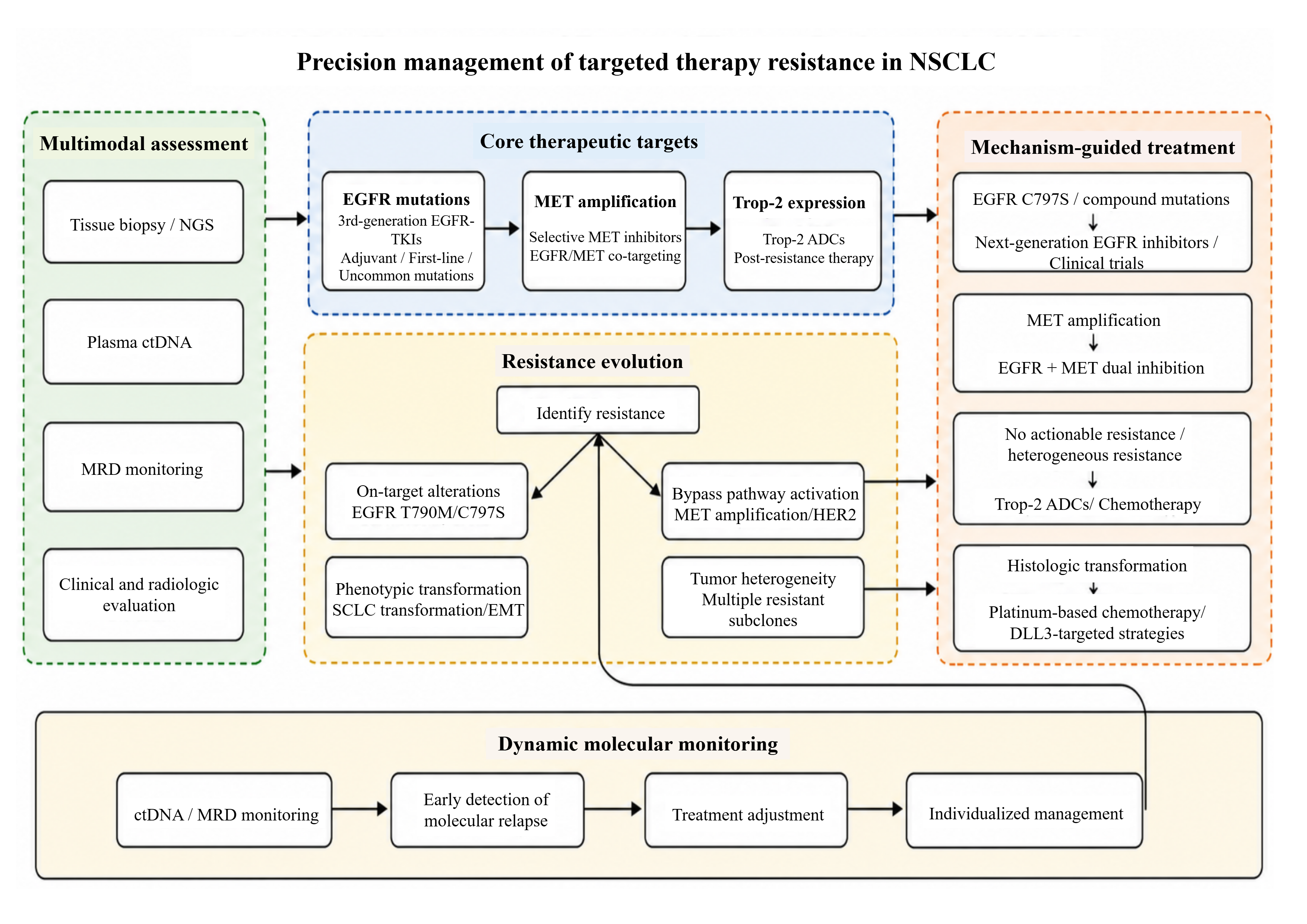
Conclusion: Post-EGFR-TKI management should follow a mechanism-guided framework integrating progression pattern, tissue and plasma reassessment, biomarker-specific interpretation, matched therapy, and longitudinal molecular monitoring. Prospective studies are needed to standardize testing thresholds and optimize treatment sequencing.
- Bray F, Laversanne M, Sung H, et al. Global cancer statistics 2022: GLOBOCAN estimates of incidence and mortality worldwide for 36 cancers in 185 countries. CA Cancer J Clin. 2024;74(3):229-263. doi: 10.3322/caac.21834
- Fox AH, Nishino M, Osarogiagbon RU, et al. Acquiring tissue for advanced lung cancer diagnosis and comprehensive biomarker testing: A National Lung Cancer Roundtable best-practice guide. CA Cancer J Clin. 2023;73(4):358-375. doi: 10.3322/caac.21774
- Sonkin D, Thomas A, Teicher BA. Cancer treatments: Past, present, and future. Cancer Genet. 2024;286-287:18-24. doi: 10.1016/j.cancergen.2024.06.002
- Rolfo C, Mack P, Scagliotti GV, et al. Liquid Biopsy for Advanced NSCLC: A Consensus Statement From the International Association for the Study of Lung Cancer. J Thorac Oncol. 2021;16(10):1647-1662. doi: 10.1016/j.jtho.2021.06.017
- Zhou F, Guo H, Xia Y, et al. The changing treatment landscape of EGFR-mutant non-small-cell lung cancer. Nat Rev Clin Oncol. 2025;22(2):95-116. doi: 10.1038/s41571-024-00971-2
- Wu YL, Guarneri V, Voon PJ, et al. Tepotinib plus osimertinib in patients with EGFR-mutated non-small-cell lung cancer with MET amplification following progression on first-line osimertinib (INSIGHT 2): a multicentre, open-label, phase 2 trial. Lancet Oncol. 2024;25(8):989-1002. doi: 10.1016/s1470-2045(24)00270-5
- Kuo P, Elboudwarej E, Zavodovskaya M, et al. Trop-2 expression in non-small cell lung cancer. PLoS One. 2025;20(4):e0321555. doi: 10.1371/journal.pone.0321555
- Planchard D, Jänne PA, Cheng Y, et al. Osimertinib with or without Chemotherapy in EGFR-Mutated Advanced NSCLC. N Engl J Med. 2023;389(21):1935-1948. doi: 10.1056/NEJMoa2306434
- Hendriks LE, Kerr KM, Menis J, et al. Non-oncogene-addicted metastatic non-small-cell lung cancer: ESMO Clinical Practice Guideline for diagnosis, treatment and follow-up. Ann Oncol. 2023;34(4):358-376. doi: 10.1016/j.annonc.2022.12.013
- Tian Z, Cen L, Wei F, et al. EGFR mutations in non-small cell lung cancer: Classification, characteristics and resistance to third-generation EGFR-tyrosine kinase inhibitors (Review). Oncol Lett. 2025;30(2):375. doi: 10.3892/ol.2025.15121
- Tsuboi M, Herbst RS, John T, et al. Overall Survival with Osimertinib in Resected EGFR-Mutated NSCLC. N Engl J Med. 2023;389(2):137-147. doi: 10.1056/NEJMoa2304594
- Okuma Y, Kubota K, Shimokawa M, et al. First-Line Osimertinib for Previously Untreated Patients With NSCLC and Uncommon EGFR Mutations: The UNICORN Phase 2 Nonrandomized Clinical Trial. JAMA Oncol. 2024;10(1):43-51. doi: 10.1001/jamaoncol.2023.5013
- Sands J, Ahn MJ, Lisberg A, et al. Datopotamab Deruxtecan in Advanced or Metastatic Non-Small Cell Lung Cancer With Actionable Genomic Alterations: Results From the Phase II TROPION-Lung05 Study. J Clin Oncol. 2025;43(10):1254-1265. doi: 10.1200/jco-24-01349
- Pellini B, Chaudhuri AA. Circulating Tumor DNA Minimal Residual Disease Detection of Non-Small-Cell Lung Cancer Treated With Curative Intent. J Clin Oncol. 2022;40(6):567-575. doi: 10.1200/jco.21.01929
- Tran HT, Heeke S, Sujit S, et al. Circulating tumor DNA and radiological tumor volume identify patients at risk for relapse with resected, early-stage non-small-cell lung cancer. Ann Oncol. 2024;35(2):183-189. doi: 10.1016/j.annonc.2023.11.008
- Zalaquett Z, Catherine Rita Hachem M, Kassis Y, et al. Acquired resistance mechanisms to osimertinib: The constant battle. Cancer Treat Rev. 2023;116:102557. doi: 10.1016/j.ctrv.2023.102557
- Liu HR. Liquid biopsy – driven cancer genetics in the ultrasensitive and hyper-data-integration eras. Cancer Adv. 2026;9:e26001-e26032. doi: 10.53388/2026926005
- Soria JC, Ohe Y, Vansteenkiste J, et al. Osimertinib in Untreated EGFR-Mutated Advanced Non-Small-Cell Lung Cancer. N Engl J Med. 2018;378(2):113-125. doi: 10.1056/NEJMoa1713137
- Engelman JA, Zejnullahu K, Mitsudomi T, et al. MET amplification leads to gefitinib resistance in lung cancer by activating ERBB3 signaling. Science. 2007;316(5827):1039-1043. doi: 10.1126/science.1141478
- Batra U, Biswas B, Prabhash K, Krishna MV. Differential clinicopathological features, treatments and outcomes in patients with Exon 19 deletion and Exon 21 L858R EGFR mutation-positive adenocarcinoma non-small-cell lung cancer. BMJ Open Respir Res. 2023;10(1):e001492. doi: 10.1136/bmjresp-2022-001492
- Ramalingam SS, Vansteenkiste J, Planchard D, et al. Overall Survival with Osimertinib in Untreated, EGFR-Mutated Advanced NSCLC. N Engl J Med. 2020;382(1):41-50. doi: 10.1056/NEJMoa1913662
- Robichaux JP, Le X, Vijayan RSK, et al. Structure-based classification predicts drug response in EGFR-mutant NSCLC. Nature. 2021;597(7878):732-737. doi: 10.1038/s41586-021-03898-1
- Zhang L, Zhang X, Wu L, et al. Aumolertinib as adjuvant therapy in resected EGFR-mutated non-small-cell lung cancer (ARTS): a double-blind, multicentre, randomised, controlled, phase 3 trial. Lancet Oncol. 2026;27(2):159-168. doi: 10.1016/s1470-2045(25)00643-6
- Herbst RS, John T, Grohé C, et al. Molecular residual disease analysis of adjuvant osimertinib in resected EGFR-mutated stage IB-IIIA non-small-cell lung cancer. Nat Med. 2025;31(6):1958-1968. doi: 10.1038/s41591-025-03577-y
- Abbosh C, Birkbak NJ, Wilson GA, et al. Phylogenetic ctDNA analysis depicts early-stage lung cancer evolution. Nature. 2017;545(7655):446-451. doi: 10.1038/nature22364
- Cui Q, Zhang JT, Yin H, et al. Comparison of circulating tumor DNA assays for molecular residual disease detection in non-small cell lung cancer. J Thorac Oncol. 2026:104090. doi: 10.1016/j.jtho.2026.104090
- Shi C, Zhang C, Fu Z, et al. Antitumor activity of aumolertinib, a third-generation EGFR tyrosine kinase inhibitor, in non-small-cell lung cancer harboring uncommon EGFR mutations. Acta Pharm Sin B. 2023;13(6):2613-2627. doi: 10.1016/j.apsb.2023.03.007
- Shi Y, Wu L, Ji Y, et al. Efficacy and safety of limertinib versus gefitinib as first-line treatment for locally advanced or metastatic non-small-cell lung cancer with EGFR-sensitising mutation: a randomised, double-blind, double-dummy, phase 3 trial. Lancet Respir Med. 2025;13(8):677-686. doi: 10.1016/s2213-2600(25)00121-3
- Shi Y, Li B, Wu L, et al. Efficacy and Safety of Limertinib (ASK120067) in Patients With Locally Advanced or Metastatic EGFR Thr790Met-Mutated NSCLC: A Multicenter, Single-Arm, Phase 2b Study. J Thorac Oncol. 2022;17(10):1205-1215. doi: 10.1016/j.jtho.2022.05.011
- Qin K, Hong L, Zhang J, Le X. MET Amplification as a Resistance Driver to TKI Therapies in Lung Cancer: Clinical Challenges and Opportunities. Cancers (Basel). 2023;15(3):612. doi: 10.3390/cancers15030612
- Peng LX, Jie GL, Li AN, et al. MET amplification identified by next-generation sequencing and its clinical relevance for MET inhibitors. Exp Hematol Oncol. 2021;10(1):52. doi: 10.1186/s40164-021-00245-y
- Caparica R, Yen CT, Coudry R, et al. Responses to Crizotinib Can Occur in High-Level MET-Amplified Non-Small Cell Lung Cancer Independent of MET Exon 14 Alterations. J Thorac Oncol. 2017;12(1):141-144. doi: 10.1016/j.jtho.2016.09.116
- Wu YL, Yao Y, Yang JJ, et al. Vebreltinib in MET amplification-driven advanced non-small-cell lung cancer (KUNPENG): A single-arm, multi-cohort, multicentre, phase 2 study. Lancet Oncol. 2026;27(1):36-44. doi: 10.1016/s1470-2045(25)00594-7
- Rolfo C, O'Brate A, Menzel C, et al. Liquid and Tissue Biopsies for Identifying MET Exon 14 Skipping NSCLC: Analyses from the Phase II VISION Study of Tepotinib. Clin Cancer Res. 2025;31(13):2675-2684. doi: 10.1158/1078-0432.Ccr-24-4097
- Hartmaier RJ, Markovets AA, Ahn MJ, et al. Osimertinib + Savolitinib to Overcome Acquired MET-Mediated Resistance in Epidermal Growth Factor Receptor-Mutated, MET-Amplified Non-Small Cell Lung Cancer: TATTON. Cancer Discov. 2023;13(1):98-113. doi: 10.1158/2159-8290.Cd-22-0586
- Sun X, Jia L, Wang T, et al. Trop2 binding IGF2R induces gefitinib resistance in NSCLC by remodeling the tumor microenvironment. J Cancer. 2021;12(17):5310-5319. doi: 10.7150/jca.57711
- Fang W, Wu L, Meng X, et al. Sacituzumab Tirumotecan in EGFR-TKI-Resistant, EGFR-Mutated Advanced NSCLC. N Engl J Med. 2026;394(1):13-26. doi: 10.1056/NEJMoa2512071
- Killock D. Sacituzumab tirumotecan improves OS in EGFR TKI-resistant NSCLC. Nat Rev Clin Oncol. 2025;22(12):899. doi: 10.1038/s41571-025-01090-2
- Ahn MJ, Tanaka K, Paz-Ares L, et al. Datopotamab Deruxtecan Versus Docetaxel for Previously Treated Advanced or Metastatic Non-Small Cell Lung Cancer: The Randomized, Open-Label Phase III TROPION-Lung01 Study. J Clin Oncol. 2025;43(3):260-272. doi: 10.1200/jco-24-01544
- Johnson M, Garassino MC, Mok T, Mitsudomi T. Treatment strategies and outcomes for patients with EGFR-mutant non-small cell lung cancer resistant to EGFR tyrosine kinase inhibitors: Focus on novel therapies. Lung Cancer. 2022;170:41-51. doi: 10.1016/j.lungcan.2022.05.011
- Vokes NI, Chambers E, Nguyen T, et al. Concurrent TP53 Mutations Facilitate Resistance Evolution in EGFR-Mutant Lung Adenocarcinoma. J Thorac Oncol. 2022;17(6):779-792. doi: 10.1016/j.jtho.2022.02.011
- Coleman N, Hong L, Zhang J, Heymach J, Hong D, Le X. Beyond epidermal growth factor receptor: MET amplification as a general resistance driver to targeted therapy in oncogene-driven non-small-cell lung cancer. ESMO Open. 2021;6(6):100319. doi: 10.1016/j.esmoop.2021.100319
- Shiba-Ishii A, Takemura N, Kawai H, Matsubara D. Histologic transformation of non-small-cell lung cancer in response to tyrosine kinase inhibitors: Current knowledge of genetic changes and molecular mechanisms. Cancer Sci. 2024;115(7):2138-2146. doi: 10.1111/cas.16192
- Chhouri H, Alexandre D, Grumolato L. Mechanisms of Acquired Resistance and Tolerance to EGFR Targeted Therapy in Non-Small Cell Lung Cancer. Cancers (Basel). 2023;15(2):504. doi: 10.3390/cancers15020504
- Chmielecki J, Gray JE, Cheng Y, et al. Candidate mechanisms of acquired resistance to first-line osimertinib in EGFR-mutated advanced non-small cell lung cancer. Nat Commun. 2023;14(1):1070. doi: 10.1038/s41467-023-35961-y
- Lu C, Wei XW, Wang Z, et al. Allelic Context of EGFR C797X-Mutant Lung Cancer Defines Four Subtypes With Heterogeneous Genomic Landscape and Distinct Clinical Outcomes. J Thorac Oncol. 2024;19(4):601-612. doi: 10.1016/j.jtho.2023.11.016
- Wang R, Chen Y, Li L, Zhang L, Zhang S. Osimertinib acquired resistance among patients with EGFR-mutated NSCLC: from molecular mechanisms to clinical therapeutic strategies. Cancer Drug Resist. 2025;8:61. doi: 10.20517/cdr.2025.140
- Tamiya A, Osuga M, Harada D, et al. Mechanisms of resistance and correlation between pre-treatment co-alterations and p-prognosis to osimertinib in chemo-naïve advanced non-small cell lung cancer. Lung Cancer. 2024;195:107917. doi: 10.1016/j.lungcan.2024.107917
- Chmielecki J, Mok T, Wu YL, et al. Analysis of acquired resistance mechanisms to osimertinib in patients with EGFR-mutated advanced non-small cell lung cancer from the AURA3 trial. Nat Commun. 2023;14(1):1071. doi: 10.1038/s41467-023-35962-x
- Catania C, Liu SV, Garassino M, et al. Correlation between treatments and outcomes of patients with EGFR-mutated non-small-cell lung cancer that transitioned into small-cell lung cancer: an international retrospective study. ESMO Open. 2025;10(7):105326. doi: 10.1016/j.esmoop.2025.105326
- Saalfeld FC, Möller J, Christopoulos P, et al. Small cell transformation in EGFR-mutated non-small cell lung cancer: DLL3 expression and efficacy of immune checkpoint inhibitors or tyrosine kinase inhibitors combined with chemotherapy. Eur J Cancer. 2024;213:115065. doi: 10.1016/j.ejca.2024.115065
- Chen Y, He M, Dai Z, et al. Clinical and molecular profiling of EGFR-mutant lung adenocarcinomas transformation to small cell lung cancer during TKI treatment. Front Oncol. 2023;13:1308313. doi: 10.3389/fonc.2023.1308313
- Dela Cruz MCP, Medina PMB. Epithelial-mesenchymal transition (EMT) and its role in acquired epidermal growth factor receptor-tyrosine kinase inhibitor (EGFR-TKI) chemoresistance in non-small cell lung cancer (NSCLC). Cancer Pathog Ther. 2025;3(3):215-225. doi: 10.1016/j.cpt.2024.07.001
- Lailler C, Didelot A, Garinet S, et al. PrP(C) controls epithelial-to-mesenchymal transition in EGFR-mutated NSCLC: implications for TKI resistance and patient follow-up. Oncogene. 2024;43(37):2781-2794. doi: 10.1038/s41388-024-03130-0
- Lim SM, Fujino T, Kim C, et al. BBT-176, a Novel Fourth-Generation Tyrosine Kinase Inhibitor for Osimertinib-Resistant EGFR Mutations in Non-Small Cell Lung Cancer. Clin Cancer Res. 2023;29(16):3004-3016. doi: 10.1158/1078-0432.Ccr-22-3901
- Su C, Sun SY. Fourth-generation epidermal growth factor receptor-tyrosine kinases inhibitors: hope and challenges. Transl Cancer Res. 2024;13(8):3929-3934. doi: 10.21037/tcr-24-406
- Xu J, Zhu A, Xu Y, et al. Real-world analysis of subsequent-line strategies for EGFR C797S mutant non-small cell lung cancer patients acquired resistance to third-generation EGFR tyrosine kinase inhibitors. BMC Cancer. 2025;25(1):1879. doi: 10.1186/s12885-025-15335-x
- Hu D, Hu Y, Lei S, Wu D, Wang Y. MET tyrosine kinase inhibitors in combination with EGFR tyrosine kinase inhibitors in NSCLC patients with EGFR mutations and acquired MEt alterations: a systematic review and meta-analysis. BMC Cancer. 2025;25(1):732. doi: 10.1186/s12885-025-14145-5
- Zhou X, Zeng L, Huang Z, et al. Strategies Beyond 3rd EGFR-TKI Acquired Resistance: Opportunities and Challenges. Cancer Med. 2025;14(9):e70921. doi: 10.1002/cam4.70921
- Ahn MJ, Cho BC, Felip E, et al. Tarlatamab for Patients with Previously Treated Small-Cell Lung Cancer. N Engl J Med. 2023;389(22):2063-2075. doi: 10.1056/NEJMoa2307980
- Cooper AJ, Herzberg B, Parma M, et al. Multi-Institution Analysis of Tarlatamab for the Treatment of EGFR-Mutant Transformed Small Cell Lung Cancer. JCO Precis Oncol. 2025;9:e2500538. doi: 10.1200/po-25-00538
- Papadimitrakopoulou VA, Mok TS, Han JY, et al. Osimertinib versus platinum-pemetrexed for patients with EGFR T790M advanced NSCLC and progression on a prior EGFR-tyrosine kinase inhibitor: AURA3 overall survival analysis. Ann Oncol. 2020;31(11):1536-1544. doi: 10.1016/j.annonc.2020.08.2100
- Zhang D, Zhao J, Yang Y, et al. Fourth-generation EGFR-TKI to overcome C797S mutation: past, present, and future. J Enzyme Inhib Med Chem. 2025;40(1):2481392. doi: 10.1080/14756366.2025.2481392
- Corvaja C, Passaro A, Attili I, et al. Advancements in fourth-generation EGFR TKIs in EGFR-mutant NSCLC: Bridging biological insights and therapeutic development. Cancer Treat Rev. 2024;130:102824. doi: 10.1016/j.ctrv.2024.102824
- Yamaoka T, Ohmori T, Ohba M, et al. Acquired Resistance Mechanisms to Combination Met-TKI/EGFR-TKI Exposure in Met-Amplified EGFR-TKI-Resistant Lung Adenocarcinoma Harboring an Activating EGFR Mutation. Mol Cancer Ther. 2016;15(12):3040-3054. doi: 10.1158/1535-7163.Mct-16-0313
- Takezawa K, Pirazzoli V, Arcila ME, et al. HER2 amplification: a potential mechanism of acquired resistance to EGFR inhibition in EGFR-mutant lung cancers that lack the second-site EGFRT790M mutation. Cancer Discov. 2012;2(10):922-933. doi: 10.1158/2159-8290.Cd-12-0108
- Rock A, Mambetsariev I, Pareek S, et al. Small Cell Transformation of EGFR-Mutant NSCLC Treated with Tyrosine Kinase Inhibition. Curr Oncol. 2025;32(10):554. doi: 10.3390/curroncol32100554
- Zhu X, Chen L, Liu L, Niu X. EMT-Mediated Acquired EGFR-TKI Resistance in NSCLC: Mechanisms and Strategies. Front Oncol. 2019;9:1044. doi: 10.3389/fonc.2019.01044
- Gray JE, Markovets A, Reungwetwattana T, et al. Longitudinal Analyses of Circulating Tumor DNA for the Detection of EGFR Mutation-Positive Advanced NSCLC Progression During Treatment: Data From FLAURA and AURA3. J Thorac Oncol. 2024;19(11):1525-1538. doi: 10.1016/j.jtho.2024.07.008
- Leonetti A, Verzè M, Minari R, et al. Resistance to osimertinib in advanced EGFR-mutated NSCLC: a prospective study of molecular genotyping on tissue and liquid biopsies. Br J Cancer. 2024;130(1):135-142. doi: 10.1038/s41416-023-02475-9
- Gale D, Heider K, Ruiz-Valdepenas A, et al. Residual ctDNA after treatment predicts early relapse in patients with early-stage non-small cell lung cancer. Ann Oncol. 2022;33(5):500-510. doi: 10.1016/j.annonc.2022.02.007
- Jeon H, Wang S, Song J, Gill H, Cheng H. Update 2025: Management of Non-Small-Cell Lung Cancer. Lung. 2025;203(1):53. doi: 10.1007/s00408-025-00801-x
- Ernst SM, Aldea M, von der Thüsen JH, et al. Utilizing ctDNA to discover mechanisms of resistance to targeted therapies in patients with metastatic NSCLC: towards more informative trials. Nat Rev Clin Oncol. 2025;22(5):371-378. doi: 10.1038/s41571-025-01011-3
- Yamaguchi T, Masago K, Sasaki E, Kuroda H, Matsushita H, Horio Y. EML4-ALK Variant 3a/b as a mechanism of osimertinib resistance in a patient with EGFR L858R positive NSCLC. Cancer Genet. 2024;280-281:13-16. doi: 10.1016/j.cancergen.2023.12.001
- de Langen AJ, Johnson ML, Mazieres J, et al. Sotorasib versus docetaxel for previously treated non-small-cell lung cancer with KRAS(G12C) mutation: a randomised, open-label, phase 3 trial. Lancet. 2023;401(10378):733-746. doi: 10.1016/s0140-6736(23)00221-0
- Jänne PA, Riely GJ, Gadgeel SM, et al. Adagrasib in Non-Small-Cell Lung Cancer Harboring a KRAS(G12C) Mutation. N Engl J Med. 2022;387(2):120-131. doi: 10.1056/NEJMoa2204619
- de Marinis F, Kim TM, Bonanno L, et al. Savolitinib plus osimertinib in epidermal growth factor receptor (EGFR)-mutated advanced non-small cell lung cancer with MET overexpression and/or amplification following disease progression on osimertinib: primary results from the phase II SAVANNAH study. Ann Oncol. 2025;36(8):920-933. doi: 10.1016/j.annonc.2025.04.003
- Nogami N, Barlesi F, Socinski MA, et al. IMpower150 Final Exploratory Analyses for Atezolizumab Plus Bevacizumab and Chemotherapy in Key NSCLC Patient Subgroups With EGFR Mutations or Metastases in the Liver or Brain. J Thorac Oncol. 2022;17(2):309-323. doi: 10.1016/j.jtho.2021.09.014
- Trontzas IP, He M, Wurtz A, et al. Quantitative Protein Expression of Antibody-Drug Conjugate Targets in EGFR Mutated and Wild-type Non-Small Cell Lung Cancer. Clin Cancer Res. 2025;31(13):2767-2776. doi: 10.1158/1078-0432.Ccr-24-3347
- Sakata Y, Saito G, Sakata S, et al. Osimertinib as first-line treatment for elderly patients with advanced EGFR mutation-positive non-small cell lung cancer in a real-world setting (OSI-FACT-EP). Lung Cancer. 2023;186:107426. doi: 10.1016/j.lungcan.2023.107426
- Nguyen TNH, Van QL, Thi Bich PN, et al. Therapeutic Outcomes of Osimertinib in EGFR-Mutant Non-Small Cell Lung Cancer With Brain Metastases: Results From a Retrospective Study at Vietnam National Cancer Hospital. Cancer Control. 2025;32:10732748251348429. doi: 10.1177/10732748251348429
- Areses Manrique MC, León-Mateos L, Silva-Díaz S, et al. Real-world clinical experience with osimertinib in advanced EGFR-mutated non-small cell lung cancer. Clin Transl Oncol. 2025;28(2):494-503. doi: 10.1007/s12094-025-04015-8