
Comparative serum proteomic profiling of cardiovascular death versus coronary atherosclerosis

Introduction: The proteomic differences distinguishing active vascular inflammation (severe atherosclerosis) from terminal systemic collapse (cardiovascular death [CVD]) remain undefined.
Objective: We aimed to identify protein profiles associated with key functional differences between severe atherosclerosis and CVD.
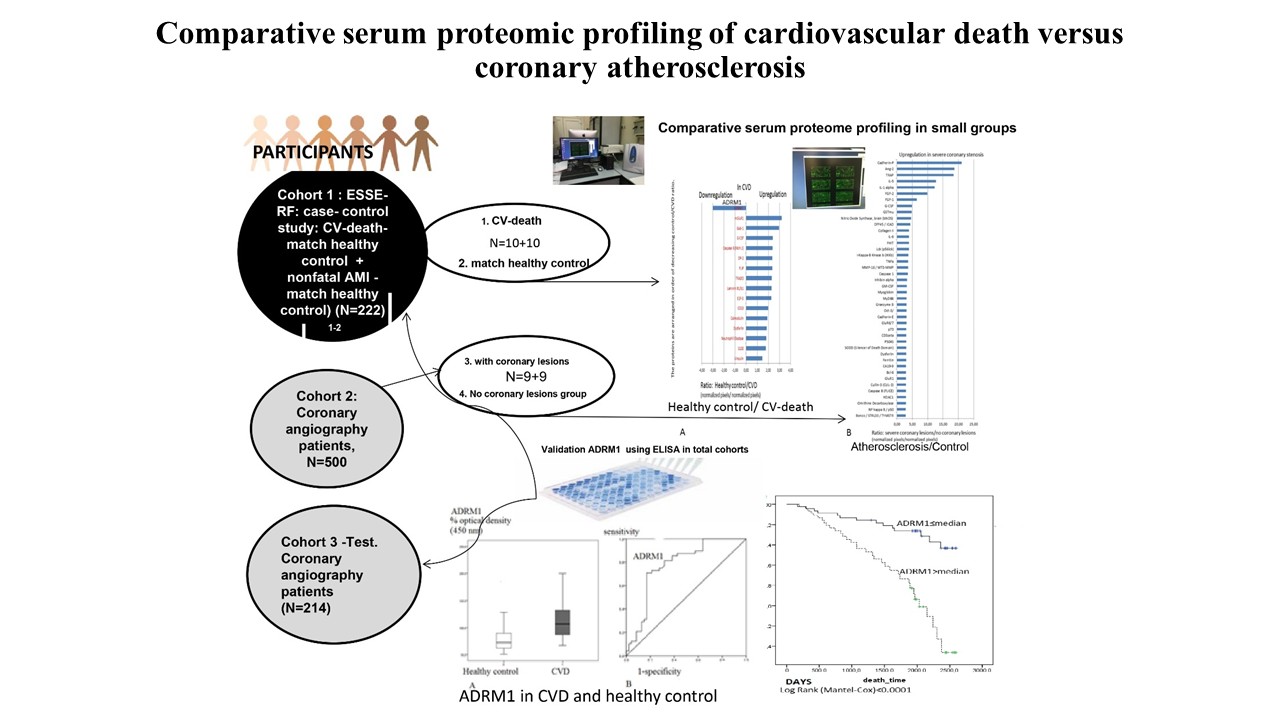
Methods: Serum proteomic profiles were evaluated in four groups from two cohorts. In the general population, Cohort 1, CVD patients (Group 1, n = 10) were compared with healthy controls (Group 2, n = 10). In Cohort 2 (coronary heart disease patients), those with severe coronary stenosis (Group 3, n = 9) were compared with those without stenosis (Group 4, n = 9). Protein expression was analyzed using antibody microarrays targeting 656 proteins across 13 signaling pathways. Findings were validated by in-house enzyme-linked immunosorbent assay for adhesion-regulating molecule 1 (ADRM1) in independent Cohort 3 and total Cohort 1.
Results: Severe atherosclerosis (Group 3 versus Group 4) showed increased levels of inflammation-promoting cytokines (interleukin [IL]-6, IL-1α, tumor necrosis factor-alpha), T-cell mediators (CD53, lymphocyte-specific protein tyrosine kinase, granzyme B), apoptotic regulators, and matrix remodeling proteins (collagen II), indicating active inflammation. In contrast, CVD samples (Group 1 versus Group 2) exhibited lower levels of protective proteins, including vinculin, laminin B1, dysferlin, and calcium signaling mediators. Higher ADRM1 levels were observed in CVD samples, confirmed in Cohort 1 but not in atherosclerosis or nonfatal acute myocardial infarction in Cohort 3. The association between high ADRM1 and CVD was confirmed by Kaplan–Meier survival analysis.
Conclusion: High ADRM1 may be considered an independent predictor of CVD during 6.5-year follow-up. Proteomic profiling suggests that CVD, but not an extension of atherosclerotic burden, may be associated with excessive proteasomal degradation via ADRM1.
- World Health Organization. Cardiovascular diseases segment. Accessed February 2, 2026. https://www.who.int/news-room/fact-sheets/detail/cardiovascular-diseases-(cvds)
- Climente-González H, Oh M, Chajewska U, et al. Interpretable machine learning leverages proteomics to improve cardiovascular disease risk prediction and biomarker identification. Commun Med (Lond). 2025;5(1):170. doi: 10.1038/s43856-025-00872-0
- Stewart RAH, Robledo KP, Tonkin AM, et al. Plasma Protein Biomarkers and Long-Term Cardiovascular Mortality Risk in Patients With Chronic Coronary Heart Disease. J Am Heart Assoc. 2024;13(21):e034367. doi: 10.1161/JAHA.123.034367
- Elhadad MA, Del C Gómez-Alonso M, Chen CW, et al. Plasma proteome association with coronary heart disease and carotid intima media thickness: results from the KORA F4 study. Cardiovasc Diabetol. 2024;23(1):181. doi: 10.1186/s12933-024-02274-3
- Duong T, Austin TR, Brody JA, et al. Circulating Blood Plasma Profiling Reveals Proteomic Signature and a Causal Role for SVEP1 in Sudden Cardiac Death. Circ Genom Precis Med. 2024;17(5):e004494. doi: 10.1161/CIRCGEN.123.004494
- Drapkina OM, Shalnova SA, Imaeva AE, et al. Epidemiology of Cardiovascular Diseases in Regions of Russian Federation. Third survey (ESSE-RF-3). Rationale and study design. Cardiovasc Ther Prev. 2022;21(5):3246. [In Russian] doi: 10.15829/1728-8800-2022-3246
- Scientific Organizing Committee of the ESSE-RF. Epidemiology of cardiovascular diseases in different regions of Russia (ESSE-RF). The rationale for and design of the study. Russ J Prev Med. 2013;16(6):25-34.
- Gumanova NG, Bogdanova NL, Metelskaya VA, et al. Serum biomarkers, including nitric oxide metabolites (NOx), for prognosis of cardiovascular death and acute myocardial infarction in an ESSE-RF case-control cohort with 6.5-year follow up. Sci Rep. 2022;12(1):18177. doi: 10.1038/s41598-022-22367-x
- Task Force Members, Montalescot G, Sechtem U, et al. 2013 ESC guidelines on the management of stable coronary artery disease: the Task Force on the management of stable coronary artery disease of the European Society of Cardiology. Eur Heart J. 2013;34(38):2949-3003. doi: 10.1093/eurheartj/eht296
- Gensini GG. A more meaningful scoring system for determining the severity of coronary heart disease. Am J Cardiol. 1983;51(3):606. doi: 10.1016/S0002-9149(83)80105-2
- Gumanova NG, Vasilyev DK, Bogdanova NL, Havrichenko YI, Drapkina OM. P-, E-, and H-cadherins differ in their relationships with coronary stenosis, cardiovascular outcomes, and unplanned recurrent revascularization. J Mol Cell Cardiol Plus. 2024;9:100091. doi: 10.1016/j.jmccpl.2024.100091
- Gumanova NG, Vasilyev DK, Bogdanova NL, Drapkina OM. Serum Level of Cadherin-P (CDH3) Is a Novel Predictor of Cardiovascular Events Related to Atherosclerosis in a 3-Year Follow-Up Study. J Clin Med. 2024;13(21):6293. doi: 10.3390/jcm13216293
- Gumanova NG, Bogdanova NL, Metelskaya VA. Proteomic biomarker evaluation using antibody microarrays: association between analytical methods such as microarray and ELISA. Lab Med. 2024;55(3):325-333. doi: 10.1093/labmed/lmad083
- Gumanova NG. New strategies for studying circulating protein biomarkers using antibody microarrays in clinical studies. Russ J Prev Med. 2024;27(2):119-126. [In Russian] doi: 10.17116/profmed202427021119
- Gumanova NG, Vasilyev DK, Bogdanova NL, Havrichenko YI, Kots AY, Metelskaya VA. Application of an antibody microarray for serum protein profiling of coronary artery stenosis. Biochem Biophys Res Commun. 2022;631:55-63. doi: 10.1016/j.bbrc.2022.09.053
- Li J, Wang W, Lin Z, et al. Vinculin: A new target for the diagnosis and treatment of disease. Prog Biophys Mol Biol. 2025;195:157-166. doi: 10.1016/j.pbiomolbio.2025.01.004
- Yurchenco PD. Basement membranes: cell scaffoldings and signaling platforms. Cold Spring Harb Perspect Biol. 2011;3(2):a004911. doi: 10.1101/cshperspect.a004911
- Bansal D, Campbell KP. Dysferlin and the plasma membrane repair in muscular dystrophy. Trends Cell Biol. 2004;14(4):206-213. doi: 10.1016/j.tcb.2004.03.001
- Chin D, Means AR. Calmodulin: a prototypical calcium sensor. Trends Cell Biol. 2000;10(8):322-328. doi: 10.1016/s0962-8924(00)01800-6
- Wang S, Ni Y, Feng J, Zhang W, Zhou M, Zhao C. S100A8/A9 as a central hub in inflammaging: Cross-system mechanisms. Ageing Res Rev. 2026;118:103108. doi: 10.1016/j.arr.2026.103108
- Korkmaz B, Horwitz MS, Jenne DE, Gauthier F. Neutrophil elastase, proteinase 3, and cathepsin G as therapeutic targets in human diseases. Pharmacol Rev. 2010;62(4):726-759. doi: 10.1124/pr.110.002733
- Acharya M, Borland G, Edkins AL, et al. CD23/FcεRII: molecular multi-tasking. Clin Exp Immunol. 2010;162(1):12-23. doi: 10.1111/j.1365-2249.2010.04210.x
- Roberts AW. G-CSF: a key regulator of neutrophil production, but that's not all! Growth Factors. 2005;23(1):33-41. doi: 10.1080/08977190500055836
- Hsu H, Xiong J, Goeddel DV. The TNF receptor 1-associated protein TRADD signals cell death and NF-kappa B activation. 1995;81(4):495-504. doi: 10.1016/0092-8674(95)90070-5
- Thome M, Tschopp J. Regulation of lymphocyte proliferation and death by FLIP. Nat Rev Immunol. 2001;1(1):50-58. doi: 10.1038/35095508
- Jiang Y, Woronicz JD, Liu W, Goeddel DV. Prevention of constitutive TNF receptor 1 signaling by silencer of death domains. 1999;283(5401):543-546. doi: 10.1126/science.283.5401.543
- Kagawa S, Gu J, Honda T, et al. Deficiency of caspase-3 in MCF7 cells blocks Bax-mediated nuclear fragmentation but not cell death. Clin Cancer Res. 2001;7(5):1474-1480.
- Mannell H, Krotz F. SHP-2 regulates growth factor dependent vascular signalling and function. Mini Rev Med Chem. 2014;14(6):471-483. doi: 10.2174/1389557514999140506094738
- Leone G, DeGregori J, Yan Z, et al. E2F3 activity is regulated during the cell cycle and is required for the induction of S phase. Genes Dev. 1998;12(14):2120-2130. doi: 10.1101/gad.12.14.2120
- Vincent A, Sportouch C, Covinhes A, et al. Cardiac mGluR1 metabotropic receptors in cardioprotection. Cardiovasc Res. 2017;113(6):644-655. doi: 10.1093/cvr/cvx024
- Hollmann M, Heinemann S. Cloned glutamate receptors. Annu Rev Neurosci. 1994;17(1):31-108. doi: 10.1146/annurev.ne.17.030194.000335
- Husnjak K, Elsasser S, Zhang N, et al. Proteasome subunit Rpn13 is a novel ubiquitin receptor. 2008;453(7194):481-488. doi: 10.1038/nature06926
- Aigner T, Neureiter D, Câmpean V, Soder S, Amann K. Expression of cartilage-specific markers in calcified and non-calcified atherosclerotic lesions. 2008;196(1):37-41. doi: 10.1016/j.atherosclerosis.2007.01.020
- Kleemann R, Zadelaar S, Kooistra T. Cytokines and atherosclerosis: a comprehensive review of studies in mice. Cardiovasc Res. 2008;79(3):360-376. doi: 10.1093/cvr/cvn120
- Moyer CF, Sajuthi D, Tulli H, Williams JK. Synthesis of IL-1 alpha and IL-1 beta by arterial cells in atherosclerosis. Am J Pathol. 1991;138(4):951-960.
- Chowdhury D, Lieberman J. Death by a thousand cuts: granzyme pathways of programmed cell death. Annu Rev Immunol. 2008;26(1):389-420. doi: 10.1146/annurev.immunol.26.021607.090404
- Takeda K, Akira S. TLR signaling pathways. Semin Immunol. 2004;16(1):3-9. doi: 10.1016/j.smim.2003.10.003
- Pintucci G, Yu PJ, Sharony R, et al. Induction of stromelysin-1 (MMP-3) by fibroblast growth factor-2 (FGF-2) in FGF-2-/- microvascular endothelial cells requires prolonged activation of extracellular signal-regulated kinases-1 and -2 (ERK-1/2). J Cell Biochem. 2003;90(5):1015-1025. doi: 10.1002/jcb.10721
- Pàmies A, Llop D, Ibarretxe D, et al. Angiopoietin-2, vascular endothelial growth factor family, and heparin binding endothelial growth factor are associated with subclinical atherosclerosis in rheumatoid arthritis. Comput Struct Biotechnol J. 2024;23:1680-1688. doi: 10.1016/j.csbj.2024.04.042
- Welt C, Sidis Y, Keutmann H, Schneyer A. Activins, inhibins, and follistatins: from endocrinology to signaling. A paradigm for the new millennium. Exp Biol Med (Maywood). 2002;227(9):724-752. doi: 10.1177/153537020222700905
- Martinon F, Burns K, Tschopp J. The inflammasome: a molecular platform triggering activation of inflammatory caspases and processing of proIL-beta. Mol Cell. 2002;10(2):417-426. doi: 10.1016/S1097-2765(02)00599-3
- Melino G, De Laurenzi V, Vousden KH. p73: Friend or foe in tumorigenesis. Nat Rev Cancer. 2002;2(8):605-615. doi: 10.1038/nrc861
- Dent AL, Vasanwala FH, Toney LM. Regulation of gene expression by the proto-oncogene BCL-6. Crit Rev Oncol Hematol. 2002;41(1):1-9. doi: 10.1016/s1040-8428(01)00164-0
- Safa AR. Roles of c-FLIP in Apoptosis, Necroptosis, and Autophagy. J Carcinog Mutagen. 2013;6:003. doi: 10.4172/2157-2518.S6-003
- Sabol SL, Li R, Lee TY, Abdul-Khalek R. Inhibition of apoptosis-associated DNA fragmentation activity in nonapoptotic cells: the role of DNA fragmentation factor-45 (DFF45/ICAD). Biochem Biophys Res Commun. 1998;253(1):151-158. doi: 10.1006/bbrc.1998.9770
- Boldin MP, Goncharov TM, Goltsev YV, Wallach D. Involvement of MACH, a novel MORT1/FADD-interacting protease, in Fas/APO-1- and TNF receptor-induced cell death. 1996;85(6):803-815. doi: 10.1016/S0092-8674(00)81265-9
- Pryshchep S, Goronzy JJ, Parashar S, Weyand CM. Insufficient deactivation of the protein tyrosine kinase lck amplifies T-cell responsiveness in acute coronary syndrome. Circ Res. 2010;106(4):769-778. doi: 10.1161/CIRCRESAHA.109.206052
- Karin M, Delhase M. The I kappa B kinase (IKK) and NF-kappa B: key elements of proinflammatory signalling. Semin Immunol. 2000;12(1):85-98. doi: 10.1006/smim.2000.0210
- Kumar G, Chaihongsa N, Brozoski DT, et al. Vascular smooth muscle RbFox2 regulates the cytoskeleton and arterial stiffness by a RhoBTB1/Cullin-3 mechanism. JCI Insight. 2026;11(11):e202638. doi: 10.1172/jci.insight.202638
- Schöler HR, Ruppert S, Suzuki N, Chowdhury K, Gruss P. New type of POU domain in germ line-specific protein Oct-4. 1990;344(6265):435-439. doi: 10.1038/344435a0
- Tan H, Cao J, Zhang J, Zuo Z. Critical role of inflammatory cytokines in impairing biochemical processes for learning and memory after surgery in rats. J Neuroinflammation. 2014;11(1):93. doi: 10.1186/1742-2094-11-93
- Chen T, Li Y, Sun Y, et al. HDAC1 Regulates Acquired Resistance to EGFR Inhibitors through the TFCP2-NDRG1 Signaling Axis in Pancreatic Cancer. Int J Biol Sci. 2026;22(8):4346-4366. doi: 10.7150/ijbs.131003
- Pichiorri F, Okumura H, Nakamura T, et al. Correlation of fragile histidine triad (Fhit) protein structural features with effector interactions and biological functions. J Biol Chem. 2009;284(2):1040-1049. doi: 10.1074/jbc.M806638200
- Khadorych MA, Gumanova NG, Vasilyev DK. Glutathione-S-transferase in the context of antioxidant protection against cardiovascular diseases. Russ J Prev Med. 2025;28(12):124-129. [In Russian] doi: 10.17116/profmed202528121124
- Jiang Z, Woda BA, Wu CL, Yang XJ. Discovery and Clinical Application of a Novel Prostate Cancer Marker. Am J Clin Pathol. 2004;122(2):275-289. doi: 10.1309/EJUYUQPEX1MG68MK
- Cesari F. Catching ubiquitin. Nat Rev Mol Cell Biol. 2008;9(7):498-499. doi: 10.1038/nrm2431
- Schreiner P, Chen X, Husnjak K, et al. Ubiquitin docking at the proteasome through a novel pleckstrin-homology domain interaction. 2008;453(7194):548-552. doi: 10.1038/nature06924
- Zhang Z, Guo Q, Zhao Z, et al. IGF2BP1-Mediates m6A Modification of KLF4 and Upregulates ADRM1 to Affect EndMT in Diabetic Atherosclerosis. Acta Cardiol Sin. 2025;41(5):598-611. doi: 10.6515/ACS.202509_41(5).20250104A
- Chybowska AD, Vernardis S, McCartney DL, et al. Untargeted proteomic profiling identifies candidate biomarkers for early detection of cardiovascular disease and mortality. Preprint posted online November 21, 2025. doi: 10.1101/2025.11.20.25340673
- Chen K, Pan Y, Wang Y, et al. Plasma proteins and onset of atherosclerosis: integrating human plasma proteogenomics, transcriptomics and in vivo evidence. J Transl Med. 2025;23(1):1303. doi: 10.1186/s12967-025-07269-6
- Dubin RF, Rhee EP. Proteomics and Metabolomics in Kidney Disease, including Insights into Etiology, Treatment, and Prevention. Clin J Am Soc Nephrol. 2020;15(3):404-411. doi: 10.2215/CJN.07420619