
Distinct metabolic subtypes of gastric cancer: Immune profiles, therapeutic response prediction, and a 60-gene classifier

Introduction: Metabolic reprogramming influences cancer progression and the immune microenvironment. In gastric cancer (GC), metabolic states may impact immune responses and treatment outcomes, but specific metabolic subtypes remain poorly characterized.
Objective: This study investigated metabolic subtypes and their immune features in GC and developed a gene classifier for clinical use.
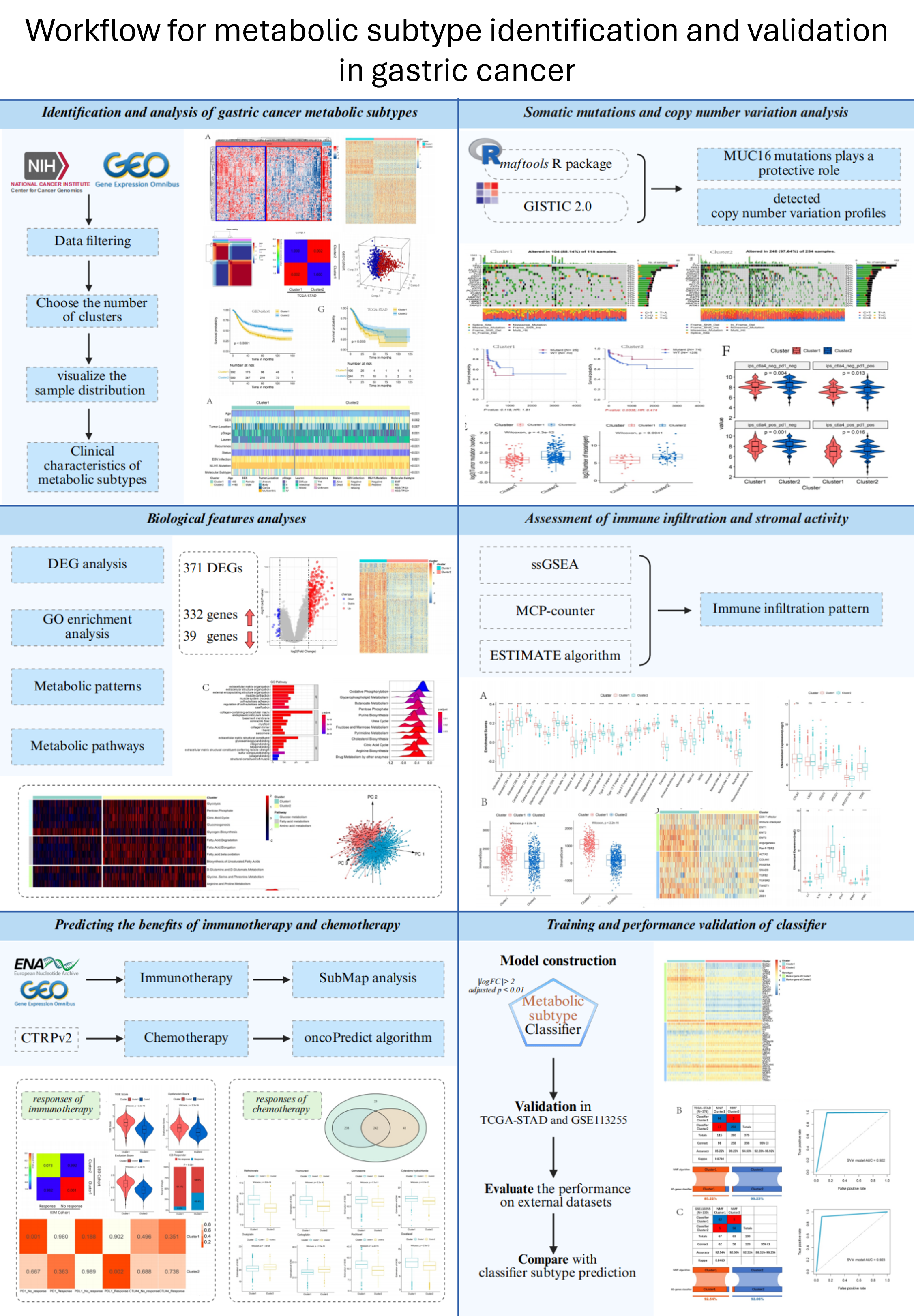
Methods: Transcriptomic profiling via RNA sequencing, together with clinical data from 981 GC patients, was analyzed and independently validated using two external datasets (TCGA-STAD cohort and GSE113255). Non-negative matrix factorization identified two metabolic subtypes (clusters 1 and 2) based on metabolic gene expression. We compared clinical features, genomic alterations, immune profiles, and drug responses between subtypes and developed a 60-gene classifier using a support vector machine model.
Results: Cluster 1 was associated with poor prognosis, a low mutation burden, immune exclusion, high stromal activity, and dense immune infiltration; this subtype demonstrated increased sensitivity to platinum-based therapies. In contrast, cluster 2 was characterized by better clinical outcomes, an immune-inflamed phenotype, elevated programmed death-ligand 1 and cytokine expression, and a greater potential for responding to immunotherapy.
Conclusion: Our metabolic classification delineates distinct GC subtypes that hold significant implications for prognosis and therapy. The 60-gene classifier offers a practical tool for the clinical identification of these subtypes, which could enhance the precision of immunotherapy and chemotherapy strategies tailored to GC patients.
- Sung H, Ferlay J, Siegel RL, et al. Global cancer statistics 2020: GLOBOCAN estimates of incidence and mortality worldwide for 36 cancers in 185 countries. CA Cancer J Clin. 2021;71(3):209-249. doi: 10.3322/caac.21660
- Smyth EC, Nilsson M, Grabsch HI, van Grieken NC, Lordick F. Gastric cancer. Lancet. 2020;396(10251):635-648. doi: 10.1016/S0140-6736(20)31288-5
- Laurén P. The two histological main types of gastric carcinoma: diffuse and so-called intestinal-type carcinoma. An attempt at a histo-clinical classification. Acta Pathol Microbiol Scand. 1965;64(1):31-49. doi: 10.1111/apm.1965.64.1.31
- Cancer Genome Atlas Research Network. Comprehensive molecular characterization of gastric adenocarcinoma. Nature. 2014;513(7517):202-209. doi: 10.1038/nature13480
- Cristescu R, Lee J, Nebozhyn M, et al. Molecular analysis of gastric cancer identifies subtypes associated with distinct clinical outcomes. Nat Med. 2015;21(5):449-456. doi: 10.1038/nm.3850
- Ward PS, Thompson CB. Metabolic reprogramming: a cancer hallmark even Warburg did not anticipate. Cancer Cell. 2012;21(3):297-308. doi: 10.1016/j.ccr.2012.02.014
- Bin YL, Hu HS, Tian F, et al. Metabolic reprogramming in gastric cancer: Trojan horse effect. Front Oncol. 2022;11. doi: 10.3389/fonc.2021.745209
- Liu Y, Zhang Z, Wang J, et al. Metabolic reprogramming results in abnormal glycolysis in gastric cancer: a review. OTT. 2019;12:1195-1205. doi: 10.2147/OTT.S189687
- Li Z, Zhang H. Reprogramming of glucose, fatty acid and amino acid metabolism for cancer progression. Cell Mol Life Sci. 2016;73(2):377-392. doi: 10.1007/s00018-015-2070-4
- Li N, Meng D, Xu Y, et al. Pyruvate kinase M2 knockdown suppresses migration, invasion, and epithelial-mesenchymal transition of gastric carcinoma via hypoxia-inducible factor alpha/B-cell lymphoma 6 pathway. BioMed Res Int. 2020;2020(1). doi: 10.1155/2020/7467104
- Cui MY, Yi X, Zhu DX, Wu J. The role of lipid metabolism in gastric cancer. Front Oncol. 2022;12. doi: 10.3389/fonc.2022.916661
- Ye B, Yu S, Wang J, Ren Y. CircB3GNTL1 and miR- 598 regulation effects on proliferation, apoptosis, and glutaminolysis in gastric cancer cells. Cell Mol Biol. 2020;66(7):18-23. doi: 10.14715/cmb/2020.66.7.4
- Zhao L, Liu Y, Zhang S, et al. Impacts and mechanisms of metabolic reprogramming of tumor microenvironment for immunotherapy in gastric cancer. Cell Death Dis. 2022;13(4). doi: 10.1038/s41419-022-04821-w
- Oya Y, Hayakawa Y, Koike K. Tumor microenvironment in gastric cancers. Cancer Sci. 2020;111(8):2696-2707. doi: 10.1111/cas.14521
- Dai Y, Li F, Jiao Y, et al. Mortalin/glucose-regulated protein 75 promotes the cisplatin-resistance of gastric cancer via regulating anti-oxidation/apoptosis and metabolic reprogramming. Cell Death Discov. 2021;7(1). doi: 10.1038/s41420-021-00517-w
- Darvin P, Toor SM, Sasidharan Nair V, Elkord E. Immune checkpoint inhibitors: recent progress and potential biomarkers. Exp Mol Med. 2018;50(12):1-11. doi: 10.1038/s12276-018-0191-1
- Yang W, Bai Y, Xiong Y, et al. Potentiating the antitumour response of CD8+ T cells by modulating cholesterol metabolism. Nature. 2016;531(7596):651-655. doi: 10.1038/nature17412
- Peng X, Chen Z, Farshidfar F, et al. Molecular characterization and clinical relevance of metabolic expression subtypes in human cancers. Cell Rep. 2018;23(1):255-269.e4. doi: 10.1016/j.celrep.2018.03.077
- Possemato R, Marks KM, Shaul YD, Pacold ME, Kim D, Birsoy K, et al. Functional genomics reveals serine synthesis is essential in PHGDH-amplified breast cancer. Nature. 2011;476(7360):346-350. doi: 10.1038/nature10350
- Brunet JP, Tamayo P, Golub TR, Mesirov JP. Metagenes and molecular pattern discovery using matrix factorization. Proc Natl Acad Sci USA. 2004;101(12):4164-4169. doi: 10.1073/pnas.0308531101
- Rosario SR, Long MD, Affronti HC, Rowsam AM, Eng KH, Smiraglia DJ. Pan-cancer analysis of transcriptional metabolic dysregulation using The Cancer Genome Atlas. Nat Commun. 2018;9(1). doi: 10.1038/s41467-018-07232-8
- Jia Q, Wu W, Wang Y, et al. Local mutational diversity drives intratumoral immune heterogeneity in non-small cell lung cancer. Nat Commun. 2018;9(1). doi: 10.1038/s41467-018-07767-w
- Sanchez-Vega F, Mina M, Armenia J, et al. Oncogenic signaling pathways in The Cancer Genome Atlas. Cell. 2018;173(2):321-337.e10. doi: 10.1016/j.cell.2018.03.035
- Gallo D, Young JTF, Fourtounis J, et al. CCNE1 amplification is synthetic lethal with PKMYT1 kinase inhibition. Nature. 2022;604(7907):749-756. doi: 10.1038/s41586-022-04638-9.
- Fu J, Li K, Zhang W, Wan C, Zhang J, Jiang P, et al. Large-scale public data reuse to model immunotherapy response and resistance. Genome Med. 2020;12(1). doi: 10.1186/s13073-020-0721-z
- Sinkala M, Mulder N, Martin DP. Metabolic gene alterations impact the clinical aggressiveness and drug responses of 32 human cancers. Commun Biol. 2019;2(1). doi: 10.1038/s42003-019-0666-1
- Biffi G, Tuveson DA. Diversity and biology of cancer-associated fibroblasts. Physiol Rev. 2021;101(1):147-176. doi: 10.1152/physrev.00048.2019
- Mantovani A, Marchesi F, Malesci A, Laghi L, Allavena P. Tumour-associated macrophages as treatment targets in oncology. Nat Rev Clin Oncol. 2017;14(7):399-416. doi: 10.1038/nrclinonc.2016.217
- Li C, Jiang P, Wei S, Xu X, Wang J. Regulatory T cells in tumor microenvironment: new mechanisms, potential therapeutic strategies and future prospects. Mol Cancer. 2020;19(1). doi: 10.1186/s12943-020-01234-1
- Grout JA, Sirven P, Leader AM, et al. Spatial positioning and matrix programs of cancer-associated fibroblasts promote T cell exclusion in human lung tumors. Cancer Discov. 2022;12(11):2606-2625. doi: 10.1158/2159-8290.CD-21-1714
- Mariathasan S, Turley SJ, Nickles D, et al. TGF-β attenuates tumour response to PD-L1 blockade by contributing to exclusion of T cells. Nature. 2018;554(7693):544-548. doi: 10.1038/nature25501
- Chen DS, Mellman I. Elements of cancer immunity and the cancer-immune set point. Nature. 2017;541(7637):321-330. doi: 10.1038/nature21349
- DeBerardinis RJ, Chandel NS. We need to talk about the Warburg effect. Nat Metab. 2020;2(2):127-129. doi: 10.1038/s42255-020-0172-2
- Ghergurovich JM, Lang JD, Levin MK, Briones N, Facista SJ, Mueller C, et al. Local production of lactate, ribose phosphate, and amino acids within human triple-negative breast cancer. Med. 2021;2(6):736-754.e6. doi: 10.1016/j.medj.2021.03.009
- Nieman KM, Kenny HA, Penicka CV, Ladanyi A, Buell- Gutbrod R, Zillhardt MR, et al. Adipocytes promote ovarian cancer metastasis and provide energy for rapid tumor growth. Nat Med. 2011;17(11):1498-1503. doi: 10.1038/nm.2492
- Henke E, Nandigama R, Ergun S. Extracellular matrix in the tumor microenvironment and its impact on cancer therapy. Front Mol Biosci. 2020;6. doi: 10.3389/fmolb.2019.00160
- Vander Heiden MG, DeBerardinis RJ. Understanding the intersections between metabolism and cancer biology. Cell. 2017;168(4):657-669. doi: 10.1016/j.cell.2016.12.039
- Bader JE, Voss K, Rathmell JC. Targeting metabolism to improve the tumor microenvironment for cancer immunotherapy. Mol Cell. 2020;78(6):1019-1033. doi: 10.1016/j.molcel.2020.05.034
- Li X, Wenes M, Romero P, Huang SCC, Fendt SM, Ho PC. Navigating metabolic pathways to enhance antitumour immunity and immunotherapy. Nat Rev Clin Oncol. 2019;16(7):425-441. doi: 10.1038/s41571-019-0203-7
- Goodman AM, Kato S, Bazhenova L, et al. Tumor mutational burden as an independent predictor of response to immunotherapy in diverse cancers. Mol Cancer Ther. 2017;16(11):2598-2608. doi: 10.1158/1535-7163.MCT-17-0386
- Jardim DL, Goodman A, de Melo Gagliato D, Kurzrock R. The challenges of tumor mutational burden as an immunotherapy biomarker. Cancer Cell. 2021;39(2):154- 173. doi: 10.1016/j.ccell.2020.10.001
- Dejure FR, Eilers M. MYC and tumor metabolism: chicken and egg. EMBO J. 2017;36(23):3409-3420. doi: 10.15252/embj.201796438
- Han H, Jain AD, Truica MI, Izquierdo-Ferrer J, Anker JF, Lysy B, et al. Small-molecule MYC inhibitors suppress tumor growth and enhance immunotherapy. Cancer Cell. 2019;36(5):483-497.e15. doi: 10.1016/j.ccell.2019.10.001
- Pan Y, Fei Q, Xiong P, et al. Synergistic inhibition of pancreatic cancer with anti-PD-L1 and c-Myc inhibitor JQ1. OncoImmunology. 2019;8(5):e1581529. doi: 10.1080/2162402X.2019.1581529
- Li X, Pasche B, Zhang W, Chen K. Association of MUC16 mutation with tumor mutation load and outcomes in patients with gastric cancer. JAMA Oncol. 2018;4(12):1691. doi: 10.1001/jamaoncol.2018.2805
- Aithal A, Rauth S, Kshirsagar P, et al. MUC16 as a novel target for cancer therapy. Expert Opin Ther Targets. 2018;22(8):675-686. doi: 10.1080/14728222.2018.1498845