
Relationship between ischemic stroke and calcific aortic valve stenosis evaluated using Mendelian randomization and transcriptomic analysis

Introduction: Aortic valve stenosis (AVS) is clinically associated with an increased risk of stroke and ischemic cerebrovascular events. However, previous studies on the relationship between aortic valve calcification and stroke have yielded inconsistent findings, and the causal link between ischemic stroke (IHS) and calcified AVS (CAVS) remains unclear due to confounding factors.
Objective: This study aimed to investigate the relationship between IHS and CAVS.
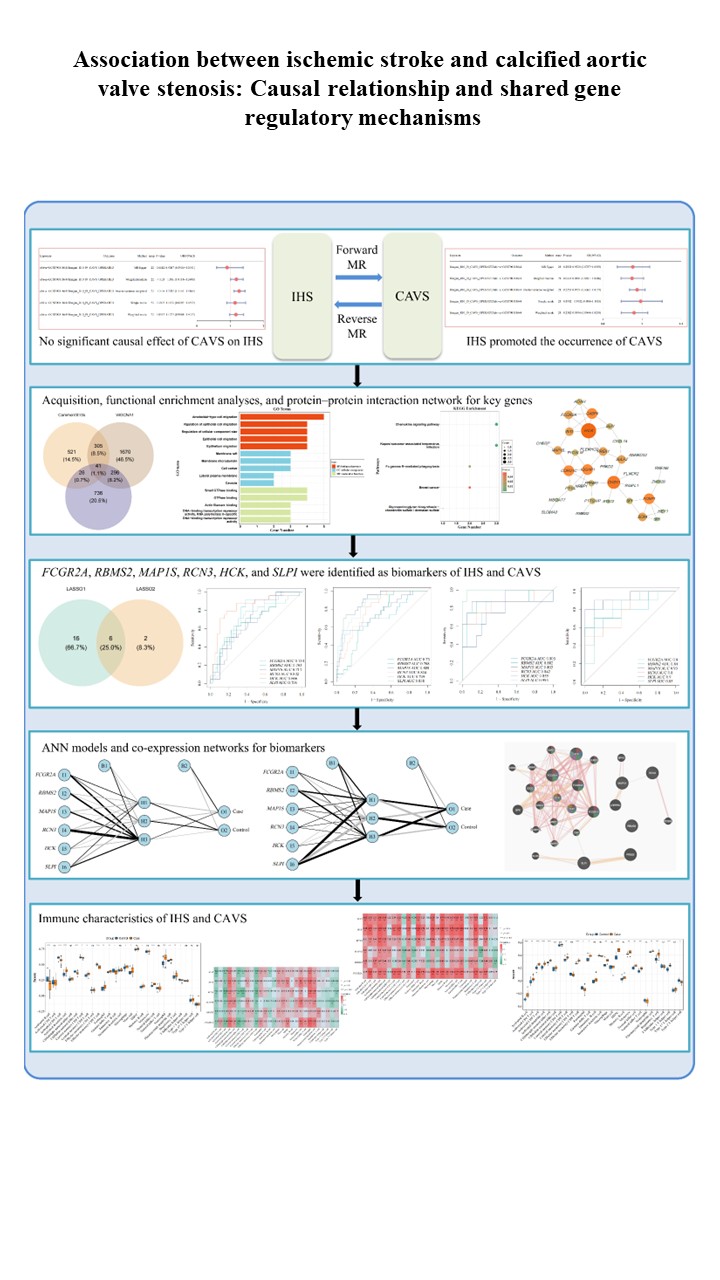
Methods: In the first part of the study, we explored the bidirectional causal relationship between IHS and CAVS using Mendelian randomization (MR). In the second part, we identified shared diagnostic biomarkers for the two diseases through differential gene expression analysis, weighted gene co-expression network analysis, and least absolute shrinkage and selection operator regression. Based on these biomarkers, an artificial neural network (ANN) diagnostic model was established to aid the diagnosis of both diseases.
Results: MR analysis suggested that genetically predicted IHS was associated with an increased risk of CAVS (p=0.0003, odds ratio [OR] = 1.2701, 95% confidence interval [CI]: 1.1153–1.4465), whereas CAVS did not exert a significant causal effect on IHS (p=0.2254, OR = 0.9751, 95% CI: 0.9361–1.0158). FCGR2A, RBMS2, MAP1S, RCN3, HCK, and SLPI were identified as shared diagnostic biomarkers for IHS and CAVS. Based on these six genes, an ANN diagnostic model was developed and demonstrated reliable diagnostic performance for both diseases.
Conclusion: Genetically predicted IHS appears to be associated with an increased risk of CAVS, while CAVS does not demonstrate a significant causal effect on IHS. FCGR2A, RBMS2, MAP1S, RCN3, HCK, and SLPI serve as shared diagnostic biomarkers for IHS and CAVS. The ANN-based diagnostic model incorporating these biomarkers showed strong predictive capability for both diseases.
- Eveborn GW, Schirmer H, Heggelund G, Lunde P, Rasmussen K. The evolving epidemiology of valvular aortic stenosis. The Tromsø study. Heart. 2013;99(6):396-400. doi: 10.1136/heartjnl-2012-302265
- Pan W, Zhou D, Cheng L, Shu X, Ge J. Candidates for transcatheter aortic valve implantation may be fewer in China. Int J Cardiol. 2013;168(5):e133-e134. doi: 10.1016/j.ijcard.2013.08.028
- Lin R, Zhu Y, Chen W, Wang Z, Wang Y, Du J. Identification of circulating inflammatory proteins associated with calcific aortic valve stenosis by multiplex analysis. Cardiovasc Toxicol. 2024;24(5):499-512. doi: 10.1007/s12012-024-09854-5
- Peeters FE, Meex SJ, Dweck MR, et al. Calcific aortic valve stenosis: Hard disease in the heart: A biomolecular approach towards diagnosis and treatment. Eur Heart J. 2018;39(28):2618-2624. doi: 10.1093/eurheartj/ehx653
- Carabello BA, Paulus WJ. Aortic stenosis. Lancet. 2009;373(9667):956-966. doi: 10.1016/s0140-6736(09)60211-7
- Yadgir S, Johnson CO, Aboyans V, et al. Global, regional, and national burden of calcific aortic valve and degenerative mitral valve diseases, 1990-2017. Circulation. 2020, 141(21):1670-1680. doi: 10.1161/circulationaha.119.043391
- Otto CM, Prendergast B. Aortic-valve stenosis--from patients at risk to severe valve obstruction. N Engl J Med. 2014;371(8):744-756. doi: 10.1056/nejmra1313875
- Baumgartner H, Falk V, Bax JJ, et al. 2017 ESC/EACTS guidelines for the management of valvular heart disease. Kardiol Pol. 2018;76(1):1-62. doi: 10.5603/kp.2018.0013
- Haakenstad A, Yearwood JA, Fullman N, et al. Assessing performance of the healthcare access and quality index, overall and by select age groups, for 204 countries and territories, 1990-2019: A systematic analysis from the global burden of disease study 2019. Lancet Glob Health. 2022;10(12):e1715-e1743. doi: 10.1016/s2214-109x(22)00429-6
- Donkor ES. Stroke in the 21st century: A snapshot of the burden, epidemiology, and quality of life. Stroke Res Treat. 2018;2018:3238165. doi: 10.1155/2018/3238165
- Herpich F, Rincon F. Management of acute ischemic stroke. Crit Care Med. 2020;48(11):1654-1663. doi: 10.1097/ccm.0000000000004597
- Powers WJ. Acute ischemic stroke. N Engl J Med. 2020;383(3):252-260. doi: 10.1056/nejmcp1917030
- Li Y, Lu J, Wang J, et al. Inflammatory cytokines and risk of ischemic stroke: A mendelian randomization study. Front Pharmacol. 2021;12:779899. doi: 10.3389/fphar.2021.779899
- Kapadia SR, Makkar R, Leon M, et al. Cerebral embolic protection during transcatheter aortic-valve replacement. N Engl J Med. 2022;387(14):1253-1263. doi: 10.1056/nejmoa2204961
- Blankenberg S, Seiffert M, Vonthein R, et al. Transcatheter or surgical treatment of aortic-valve stenosis. N Engl J Med. 2024;390(17):1572-1583. doi: 10.1056/nejmoa2400685
- Daneault B, Kirtane AJ, Kodali SK, et al. Stroke associated with surgical and transcatheter treatment of aortic stenosis: A comprehensive review. J Am Coll Cardiol. 2011;58(21):2143-2150. doi: 10.1016/j.jacc.2011.08.024
- Andreasen C, Gislason GH, Køber L, et al. Incidence of ischemic stroke in individuals with and without aortic valve stenosis: A Danish retrospective cohort study. Stroke. 2020;51(5):1364-1371. doi: 10.1161/strokeaha.119.028389
- Wilson JH, Cranley JJ. Recurrent calcium emboli in a patient with aortic stenosis. Chest. 1989;96(6):1433-1434. doi: 10.1378/chest.96.6.1433
- Ito A, Iwata S, Tamura S, et al. Prevalence and risk factors of silent brain infarction in patients with aortic stenosis. Cerebrovasc Dis Extra. 2020;10(3):116-123. doi: 10.1159/000510438
- Gupta A, Giambrone AE, Gialdini G, et al. Silent brain infarction and risk of future stroke: A systematic review and meta-analysis. Stroke. 2016;47(3):719-725. doi: 10.1161/strokeaha.115.011889
- Boon A, Lodder J, Cheriex E, Kessels F. Risk of stroke in a cohort of 815 patients with calcification of the aortic valve with or without stenosis. Stroke. 1996;27(5):847-851. doi: 10.1161/01.str.27.5.847
- Bos D, Bozorgpourniazi A, Mutlu U, et al. Aortic valve calcification and risk of stroke: The rotterdam study. Stroke. 2016;47(11):2859-2861. doi: 10.1161/strokeaha.116.015200
- Sekula P, Del Greco MF, Pattaro C, Köttgen A. Mendelian randomization as an approach to assess causality using observational data. J Am Soc Nephrol. 2016;27(11):3253-3265. doi: 10.1681/asn.2016010098
- Swanson SA, Tiemeier H, Ikram MA, Hernán MA. Nature as a trialist?: Deconstructing the analogy between mendelian randomization and randomized trials. Epidemiology. 2017;28(5):653-659. doi: 10.1097/ede.0000000000000699
- Fernández-Ruiz I. Artificial intelligence to improve the diagnosis of cardiovascular diseases. Nat Rev Cardiol. 2019;16(3):133. doi: 10.1038/s41569-019-0158-5
- Bertsimas D, Mingardi L, Stellato B. Machine learning for real-time heart disease prediction. IEEE J Biomed Health Inform. 2021;25(9):3627-3637. doi: 10.1109/jbhi.2021.3066347
- Kurki MI, Karjalainen J, Palta P, et al. FinnGen provides genetic insights from a well-phenotyped isolated population. Nature. 2023;613(7944):508-518. doi: 10.1038/s41586-022-05473-8
- Lawlor DA, Harbord RM, Sterne JA, Timpson N, Davey Smith G. Mendelian randomization: Using genes as instruments for making causal inferences in epidemiology. Stat Med. 2008;27(8):1133-1163. doi: 10.1002/sim.3034
- Swerdlow DI, Kuchenbaecker KB, Shah S, et al. Selecting instruments for Mendelian randomization in the wake of genome-wide association studies. Int J Epidemiol. 2016;45(5):1600-1616. doi: 10.1093/ije/dyw088
- Ouyang F, Yuan P, Ju Y, Chen W, Peng Z, Xu H. Alzheimer’s disease as a causal risk factor for diabetic retinopathy: A Mendelian randomization study. Front Endocrinol (Lausanne). 2024;15:1340608. doi: 10.3389/fendo.2024.1340608
- Wu H, Wang H, Liu D, Liu Z, Zhang W. Mendelian randomization analyses of associations between breast cancer and bone mineral density. Sci Rep. 2023;13(1):1721. doi: 10.1038/s41598-023-28899-0
- Olwi DI, Kaisinger LR, Kentistou KA, et al. Likely causal effects of insulin resistance and IGF-1 bioaction on childhood and adult adiposity: A Mendelian randomization study. Int J Obes (Lond). 2024;48(11):1650-1655. doi: 10.1038/s41366-024-01605-4
- Hemani G, Tilling K, Davey Smith G. Orienting the causal relationship between imprecisely measured traits using GWAS summary data. PLoS Genet. 2017;13(11):e1007081. doi: 10.1371/journal.pgen.1007081
- Hemani G, Zheng J, Elsworth B, et al. The MR-Base platform supports systematic causal inference across the human phenome. Elife. 2018;7:e34408. doi: 10.7554/eLife.34408
- Burgess S, Davey Smith G, Davies NM, et al. Guidelines for performing Mendelian randomization investigations: Update for summer 2023. Wellcome Open Res. 2023;4:186. doi: 10.12688/wellcomeopenres.15555.3
- Greco MF, Minelli C, Sheehan NA, Thompson JR. Detecting pleiotropy in Mendelian randomisation studies with summary data and a continuous outcome. Stat Med. 2015;34(21):2926-2940. doi: 10.1002/sim.6522
- Bowden J, Davey Smith G, Burgess S. Mendelian randomization with invalid instruments: Effect estimation and bias detection through Egger regression. Int J Epidemiol. 2015;44(2):512-525. doi: 10.1093/ije/dyv080
- Verbanck M, Chen CY, Neale B, Do R. Detection of widespread horizontal pleiotropy in causal relationships inferred from Mendelian randomization between complex traits and diseases. Nat Genet. 2018;50(5):693-698. doi: 10.1038/s41588-018-0099-7
- Ritchie ME, Phipson B, Wu D, et al. Limma powers differential expression analyses for RNA-sequencing and microarray studies. Nucleic Acids Res. 2015;43(7):e47. doi: 10.1093/nar/gkv007
- Langfelder P, Horvath S. WGCNA: An R package for weighted correlation network analysis. BMC Bioinformatics. 2008;9:559. doi: 10.1186/1471-2105-9-559
- Yu G, Wang LG, Han Y, He QY. Clusterprofiler: An R package for comparing biological themes among gene clusters. OMICS. 2012;16(5):284-287. doi: 10.1089/omi.2011.0118
- Szklarczyk D, Gable AL, Lyon D, et al. STRING v11: Protein-protein association networks with increased coverage, supporting functional discovery in genome-wide experimental datasets. Nucleic Acids Res. 2019;47(D1):D607-D613. doi: 10.1093/nar/gky1131
- Shannon P, Markiel A, Ozier O, et al. Cytoscape: A software environment for integrated models of biomolecular interaction networks. Genome Res. 2003;13(11):2498-2504. doi: 10.1101/gr.1239303
- Frost HR, Amos CI. Gene set selection via LASSO penalized regression (SLPR). Nucleic Acids Res. 2017;45(12):e114. doi: 10.1093/nar/gkx291
- Friedman J, Hastie T, Tibshirani R. Regularization paths for generalized linear models via coordinate descent. J Stat Softw. 2010;33(1):1-22. doi: 10.18637/jss.v033.i01
- Rosenblatt F. The perceptron: A probabilistic model for information storage and organization in the brain. Psychol Rev. 1958;65(6):386-408. doi: 10.1037/h0042519
- Warde-Farley D, Donaldson SL, Comes O, et al. The GeneMANIA prediction server: Biological network integration for gene prioritization and predicting gene function. Nucleic Acids Res. 2010;38:W214-W220. doi: 10.1093/nar/gkq537
- Barbie DA, Tamayo P, Boehm JS, et al. Systematic RNA interference reveals that oncogenic KRAS-driven cancers require TBK1. Nature. 2009;462(7269):108-112. doi: 10.1038/nature08460
- Knox C, Wilson M, Klinger CM, et al. DrugBank 6.0: The DrugBank knowledgebase for 2024. Nucleic Acids Res. 2024;52(D1):D1265-D1275. doi: 10.1093/nar/gkad976
- Zhang D, Dai X, Wang C, et al. Aortic valve calcification and risk of stroke: A systematic review and meta-analysis. J Clin Neurosci. 2018;55:32-37. doi: 10.1016/j.jocn.2018.07.016
- Cosmi JE, Kort S, Tunick PA, et al. The risk of the development of aortic stenosis in patients with “benign” aortic valve thickening. Arch Intern Med. 2002;162(20):2345-2347. doi: 10.1001/archinte.162.20.2345
- Makkar RR, Yoon SH, Leon MB, et al. Association between transcatheter aortic valve replacement for bicuspid vs tricuspid aortic stenosis and mortality or stroke. JAMA. 2019;321(22):2193-2202. doi: 10.1001/jama.2019.7108
- Zhu H, Hu S, Li Y, et al. Interleukins and ischemic stroke. Front Immunol. 2022;13:828447. doi: 10.3389/fimmu.2022.828447
- Tirandi A, Sgura C, Carbone F, Montecucco F, Liberale L. Inflammatory biomarkers of ischemic stroke. Intern Emerg Med. 2023;18(3):723-732. doi: 10.1007/s11739-023-03201-2
- Yu Chen H, Dina C, Small AM, et al. Dyslipidemia, inflammation, calcification, and adiposity in aortic stenosis: A genome-wide study. Eur Heart J. 2023;44(21):1927-1939. doi: 10.1093/eurheartj/ehad142
- Driscoll K, Cruz AD, Butcher JT. Inflammatory and biomechanical drivers of endothelial-interstitial interactions in calcific aortic valve disease. Circ Res. 2021;128(9):1344-1370. doi: 10.1161/circresaha.121.318011
- Galante A, Pietroiusti A, Vellini M, et al. C-reactive protein is increased in patients with degenerative aortic valvular stenosis. J Am Coll Cardiol. 2001;38(4):1078-1082. doi: 10.1016/s0735-1097(01)01484-x
- Small A, Kiss D, Giri J, et al. Biomarkers of calcific aortic valve disease. Arterioscler Thromb Vasc Biol. 2017;37(4):623-632. doi: 10.1161/atvbaha.116.308615
- Coté N, Mahmut A, Bosse Y, et al. Inflammation is associated with the remodeling of calcific aortic valve disease. Inflammation. 2013;36(3):573-581. doi: 10.1007/s10753-012-9579-6
- Yang Z, Zhang J, Zhu Y, et al. IL-17A induces valvular endothelial inflammation and aggravates calcific aortic valve disease. Biochem Biophys Res Commun. 2023;672:145-153. doi: 10.1016/j.bbrc.2023.04.079
- Kaden JJ, Dempfle CE, Grobholz R, et al. Interleukin-1 beta promotes matrix metalloproteinase expression and cell proliferation in calcific aortic valve stenosis. Atherosclerosis. 2003;170(2):205-211. doi: 10.1016/s0021-9150(03)00284-3
- Conte M, Petraglia L, Campana P, et al. The role of inflammation and metabolic risk factors in the pathogenesis of calcific aortic valve stenosis. Aging Clin Exp Res. 2021;33:1765-1770. doi: 10.1007/s40520-020-01681-2
- Lee SH, Choi JH. Involvement of immune cell network in aortic valve stenosis: Communication between valvular interstitial cells and immune cells. Immune Netw. 2016;16(1):26-32. doi: 10.4110/in.2016.16.1.26
- Kaden JJ, Kiliç R, Sarikoç A, et al. Tumor necrosis factor alpha promotes an osteoblast-like phenotype in human aortic valve myofibroblasts: A potential regulatory mechanism of valvular calcification. Int J Mol Med. 2005;16(5):869-872. doi: 10.3892/ijmm.16.5.869
- Parameswaran N, Patial S. Tumor necrosis factor-α signaling in macrophages. Crit Rev Eukaryot Gene Expr. 2010;20(2):87-103. doi: 10.1615/critreveukargeneexpr.v20.i2.10
- Mathieu P, Bouchareb R, Boulanger MC. Innate and adaptive immunity in calcific aortic valve disease. J Immunol Res. 2015;2015:851945. doi: 10.1155/2015/851945
- Aikawa E, Aikawa M, Libby P, et al. Arterial and aortic valve calcification abolished by elastolytic cathepsin S deficiency in chronic renal disease. Circulation. 2009;119(13):1785-1794. doi: 10.1161/circulationaha.108.827972
- Goody PR, Hosen MR, Christmann D, et al. Aortic valve stenosis: From basic mechanisms to novel therapeutic targets. Arterioscler Thromb Vasc Biol. 2020;40(4):885-900. doi: 10.1161/atvbaha.119.313067
- Márquez Pete N, Maldonado Montoro MDM, Pérez Ramírez C, et al. Influence of the FCGR2A rs1801274 and FCGR3A rs396991 polymorphisms on response to abatacept in patients with rheumatoid arthritis. J Pers Med. 2021;11(6):573. doi: 10.3390/jpm11060573
- Dai Y, Chen W, Huang J, Cui T. FCGR2A could function as a prognostic marker and correlate with immune infiltration in head and neck squamous cell carcinoma. Biomed Res Int. 2021;2021:8874578. doi: 10.1155/2021/8874578
- Van Der Meer IM, Witteman JC, Hofman A, Kluft C, De Maat MP. Genetic variation in fcgamma receptor IIa protects against advanced peripheral atherosclerosis. The rotterdam study. Thromb Haemost. 2004;92(6):1273-1276. doi: 10.1160/th04-05-0268
- Kim YS, Yoo JH, Lee BC. Susceptibility for ischemic stroke in Korean population is associated with polymorphisms of the Fc gamma receptor IIA. Blood Coagul Fibrinolysis. 2009;20(5):353-357. doi: 10.1097/mbc.0b013e32832a86fe
- Lee BC, Lee H, Park HK, Yang JS, Chung JH. Susceptibility for ischemic stroke in four constitution medicine is associated with polymorphisms of FCGR2A and IL1RN genes. Neurol Res. 2010;32(Suppl 1):43-47. doi: 10.1179/016164109x12537002793922
- Antequera-González B, Martínez-Micaelo N, Sureda- Barbosa C, et al. Specific multiomic profiling in aortic stenosis in bicuspid aortic valve disease. Biomedicines. 2024;12(2):380. doi: 10.3390/biomedicines12020380
- Gao Z, Fan S. The clinical and cellular impact of RBMS2 on the progression and prognosis of kidney renal clear cell carcinoma. Genet Res (Camb). 2023;2023:5512781. doi: 10.1155/2023/5512781
- Liu L, McKeehan WL, Wang F, Xie R. MAP1S enhances autophagy to suppress tumorigenesis. Autophagy. 2012;8(2):278-280. doi: 10.4161/auto.8.2.18939
- He Y, Alejo S, Johnson JD, Jayamohan S, Sareddy GR. Reticulocalbin 3 is a novel mediator of glioblastoma progression. Cancers (Basel). 2023;15(7):2008. doi: 10.3390/cancers15072008
- Poh AR, O’Donoghue RJ, Ernst M. Hematopoietic cell kinase (HCK) as a therapeutic target in immune and cancer cells. Oncotarget. 2015;6(18):15752-15771. doi: 10.18632/oncotarget.4199
- Qiao E, Huang Z, Wang W. Exploring potential genes and pathways related to calcific aortic valve disease. Gene. 2022;808:145987. doi: 10.1016/j.gene.2021.145987
- Bouchard D, Morisset D, Bourbonnais Y, Tremblay GM. Proteins with whey-acidic-protein motifs and cancer. Lancet Oncol. 2006;7(2):167-174. doi: 10.1016/s1470-2045(06)70579-4
- Majchrzak-Gorecka M, Majewski P, Grygier B, Murzyn K, Cichy J. Secretory leukocyte protease inhibitor (SLPI), a multifunctional protein in the host defense response. Cytokine Growth Factor Rev. 2016;28:79-93. doi: 10.1016/j.cytogfr.2015.12.001
- Zhu E, Shu X, Xu Z, et al. Screening of immune-related secretory proteins linking chronic kidney disease with calcific aortic valve disease based on comprehensive bioinformatics analysis and machine learning. J Transl Med. 2023;21(1):359. doi: 10.1186/s12967-023-04171-x