

Defense mechanisms, big five traits, and resilience in cancer: An exploratory, hypothesis-generating pilot study

Introduction: Psychological adaptation to cancer is thought to reflect the joint influence of dispositional traits and defensive functioning on resilience and trauma-related symptoms.
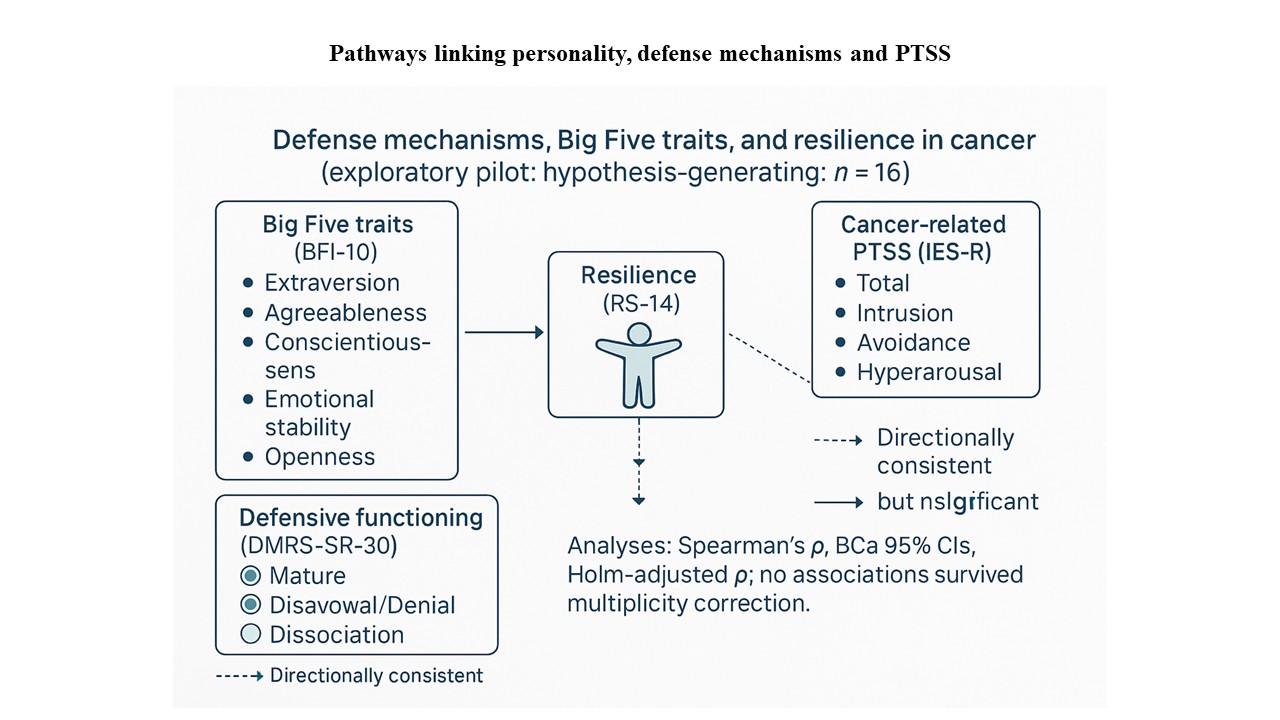
Objective: This pilot study explores associations among Big Five traits, defense mechanisms, psychological resilience, and post-traumatic stress symptoms (PTSS) in adult oncology patients.
Methods: Sixteen consecutively recruited patients with histologically confirmed cancer completed validated self-report measures: 10-item big five inventory (personality), defense mechanisms rating scales–self-report (30-item, assessing overall defensive functioning and defense levels/mechanisms), 14-item resilience scale (resilience), and impact of event scale–revised (PTSS). Primary analyses estimated Spearman’s ρ with bias-corrected and accelerated 95% confidence intervals; family-wise error was controlled using Holm adjustment (two-tailed α = 0.05).
Results: After controlling for multiple comparisons, no associations remained statistically significant, and confidence intervals were wide.
Conclusion: Findings are hypothesis-generating and consistent with a psychodynamically informed, multidimensional model in which defensive style and personality dispositions shape resilience and PTSS. Definitive inferences require larger, prospectively characterized cohorts, psychometrically stronger trait measures, and multivariate modeling (e.g., structural equation modeling), with pre-registered analytic plans and longitudinal follow-up to test mechanism-focused interventions that target defense restructuring and resilience enhancement.
- Sung H, Ferlay J, Siegel RL, et al. Global Cancer Statistics 2020: GLOBOCAN estimates of incidence and mortality worldwide for 36 cancers in 185 countries. CA Cancer J Clin. 2021;71(3):209-249. doi: 10.3322/caac.21660
- Chida Y, Hamer M, Wardle J, Steptoe A. Do stress-related psychosocial factors contribute to cancer incidence and survival? A systematic quantitative review of prospective cohort studies. Nat Clin Pract Oncol. 2008;5(8):466-475. doi: 10.1038/ncponc1134
- Cordova MJ, Riba MB, Spiegel D. Post-traumatic stress disorder and cancer. Lancet Psychiatry. 2017; 4(4):330-338. doi: 10.1016/S2215-0366(17)30014-7
- Abbey G, Thompson SBN, Hickish T, Heathcote D. A meta-analysis of prevalence rates and moderating factors for cancer-related post-traumatic stress disorder. Psychooncology. 2015;24(4):371-381. doi: 10.1002/pon.3654
- Tauber NM, O’Toole MS, Dinkel A, et al. Effect of psychological intervention on fear of cancer recurrence: A systematic review and meta-analysis. J Clin Oncol. 2019;37(31):2899-2915. doi: 10.1200/JCO.19.00572
- Butow PN, Turner J, Gilchrist J, et al. Randomized trial of ConquerFear: A theoretically based psychosocial intervention for fear of cancer recurrence. J Clin Oncol. 2017;35(36):4066-4077. doi: 10.1200/JCO.2017.73.1257
- Di Giuseppe M, Perry JC, Conversano C, et al. The DMRS-Q: Theoretical background and scoring (observer-rated Q-sort). Front Psychol. 2021;12:718440. doi: 10.3389/fpsyg.2021.718440
- Di Giuseppe M, Ciacchini R, Micheloni T, Bertolucci I, Marchi L, Conversano C. Defense mechanisms in cancer patients: A systematic review. J Psychosom Res. 2018;115: 76-86. doi: 10.1016/j.jpsychores.2018.10.016
- Weihs KL, Enright TM, Simmens SJ, Reiss D. Negative affectivity, restriction of emotions, and site of metastases predict mortality in recurrent breast cancer. J Psychosom Res. 2000;49(1):59-68. doi: 10.1016/S0022-3999(00)00143-4
- Falagas ME, Zarkadoulia EA, Ioannidou EN, Peppas G, Christodoulou C, Rafailidis PI. The effect of psychosocial factors on breast cancer outcome: A systematic review. Breast Cancer Res. 2007;9(4):R44. doi: 10.1186/bcr1744
- Bogg T, Roberts BW. Conscientiousness and health-related behaviors: A meta-analysis of the leading behavioral contributors to mortality. Psychol Bull. 2004;130(6): 887-919. doi: 10.1037/0033-2909.130.6.887
- Strickhouser JE, Zell E, Krizan Z. Does personality predict health and well-being? A metasynthesis. Health Psychol. 2017;36(8):797-810. doi: 10.1037/hea0000475
- Paika V, Almyroudi A, Tomenson B, et al. Personality variables are associated with colorectal cancer patients’ quality of life independent of psychological distress and disease severity. Psychooncology. 2010;19(3):273-282. doi: 10.1002/pon.1563
- Bonanno GA. Loss, trauma, and human resilience: Have we underestimated the human capacity to thrive after extremely aversive events? Am Psychol. 2004;59(1):20-28. doi: 10.1037/0003-066X.59.1.20
- Seiler A, Jenewein J. Resilience in cancer patients. Front Psychiatry. 2019;10:208. doi: 10.3389/fpsyt.2019.00208
- Wang Q, Li X, Li Y, Shao J, Li Y. Effects of resilience-promoting interventions on cancer patients: A systematic review and meta-analysis. Front Psychol. 2023;14:952693. doi: 10.3389/fpsyg.2023.952693
- Lin C, Wang P, Deng J, Lyu S, Miao Y. The effect of attention and interpretation therapy on improving psychological resilience, cancer-related fatigue, and negative emotions after colon cancer surgery. Ann Palliat Med. 2020;9(5): 2637-2647. doi: 10.21037/apm-20-439
- Tedeschi RG, Calhoun LG. The posttraumatic growth inventory: Measuring the positive legacy of trauma. J Trauma Stress. 1996;9(3):455-471. doi: 10.1002/jts.2490090305
- von Elm E, Altman DG, Egger M, et al. The Strengthening the Reporting of Observational Studies in Epidemiology (STROBE) statement: Guidelines for reporting observational studies. PLoS Med. 2007;4(10):e296. doi: 10.1371/journal.pmed.0040296
- Rammstedt B, John OP. Measuring personality in one minute or less: A 10-item short version of the Big Five Inventory in English and German. J Res Pers. 2007;41(1):203-212. doi: 10.1016/j.jrp.2006.03.001
- Guido G, Peluso AM, Capestro M, Miglietta M. An Italian version of the 10-Item Big Five Inventory: An application to hedonic and utilitarian shopping values. Pers Individ Dif. 2015;76:135-140. doi: 10.1016/j.paid.2014.11.053
- Creamer M, Bell R, Failla S. Psychometric properties of the impact of event scale-revised. Behav Res Ther. 2003;41(12):1489-1506. doi: 10.1016/j.brat.2003.07.010
- Craparo G, Faraci P, Rotondo G, Gori A. The Impact of Event Scale-Revised: Psychometric properties of the Italian version in a sample of flood victims. Neuropsychiatr Dis Treat. 2013;9:1427-1433. doi: 10.2147/NDT.S51793
- Di Giuseppe M, Perry JC, Prout TA, Petraglia J, Conversano C. The assessment of defense mechanisms with the DMRS-SR-30: A validation study. Front Psychiatry. 2020;11:870. doi: 10.3389/fpsyt.2020.00870
- Callegari C, Bertù L, Lucano M, Ielmini M, Braggio E, Vender S. Reliability and validity of the Italian version of the 14-item Resilience Scale. Psychol Res Behav Manag. 2016;9:277-284. doi: 10.2147/PRBM.S115657
- Julious SA. Sample size of 12 per group rule of thumb for a pilot study. Pharm Stat. 2005;4(4):287-291. doi: 10.1002/pst.185
- Whitehead AL, Julious SA, Cooper CL, Campbell MJ. Estimating the sample size for a pilot randomised trial to minimise the overall trial sample size. Trials. 2016;17:581. doi: 10.1186/s13063-016-1738-8
- Holm S. A simple sequentially rejective multiple test procedure. Scand J Stat. 1979;6(2):65-70. doi: 10.2307/4615733
- World Medical Association. World Medical Association Declaration of Helsinki: Ethical principles for medical research involving human subjects. JAMA. 2013;310(20):2191-2194. doi: 10.1001/jama.2013.281053
- Efron B. Better bootstrap confidence intervals. Ann Stat. 1987;15(2):135-148. doi: 10.1214/aos/1176350263
- Schönbrodt FD, Perugini M. At what sample size do correlations stabilize? J Res Pers. 2013;47(5):609-612. doi: 10.1016/j.jrp.2013.05.009
- Bonett DG, Wright TA. Sample size requirements for estimating Pearson, Kendall and Spearman correlations. Psychol Methods. 2000;5(2):241-259. doi: 10.1037/1082-989X.5.2.241
- Button KS, Ioannidis JPA, Mokrysz C, et al. Power failure: Why small sample size undermines the reliability of neuroscience. Nat Rev Neurosci. 2013;14(5):365-376. doi: 10.1038/nrn3475
- Kalisch R, Müller MB, Tüscher O. A conceptual framework for the neurobiological study of resilience. Behav Brain Sci. 2015; 38:e92. doi: 10.1017/S0140525X1400082
- Faller H, Schuler M, Richard M, Heckl U, Weis J, Küffner R. Effects of psycho-oncologic interventions on emotional distress and quality of life in adult patients with cancer: Systematic review and meta-analysis. J Clin Oncol. 2013;31(6):782-793. doi: 10.1200/JCO.2011.40.8922
- Lucas AR, Morland C, Williamson J, Jones M, Humphris G. Validation of the Lee-Jones theoretical model of fear of cancer recurrence. Psychooncology. 2023;32(8):1562-1575. doi: 10.1002/pon.6076
- Soto CJ, John OP. Short and extra-short forms of the Big Five Inventory-2 (BFI-2-S, BFI-2-XS). J Res Personal. 2017;68: 69-81. doi: 10.1016/j.jrp.2017.02.004
- Sleep CE, Lynam DR, Miller JD. A comparison of the validity of very brief measures of the Big Five/Five-Factor Model of personality. Assessment. 2021;28(3):739-758. doi: 10.1177/1073191120939160
- Russo SJ, Murrough JW, Han MH, Charney DS, Nestler EJ. Neurobiology of resilience. Nature Neuroscience. 2012; 15(11):1475-1484. doi: 10.1038/nn.3234
- Cramer P. Defense mechanisms in psychology today: Further processes for adaptation. Am Psychol. 2000;55(6):637-646. doi: 10.1037/0003-066X.55.6.637
- Vaillant GE. Adaptive mental mechanisms: Their role in a positive psychology. Am Psychol. 2000;55(1):89-98. doi: 10.1037/0003-066X.55.1.89
- Luthar SS, Cicchetti D, Becker B. The construct of resilience: A critical evaluation and guidelines for future work. Child Dev. 2000;71(3):543-562. doi: 10.1111/1467-8624.00164
- Swartzman S, Booth JN, Munro A, Sani F. Posttraumatic stress symptoms in cancer patients: A meta-analysis. Psychooncology. 2017;26(4):573-585. doi: 10.1002/pon.4281
- Credé M, Harms PD, Niehorster S, Gaye-Valentine A. An evaluation of the consequences of using short measures of the Big Five personality traits. J Personal Soc Psychol. 2012;102(4):874-888. doi: 10.1037/a0027403
- Stanton AL, Rowland JH, Ganz PA. Life after cancer: The evolving psychosocial oncology. Annu Rev Psychol. 2015;66:139-165. doi: 10.1146/annurev-psych-010814-015310