

Cross-lingual data science methods to enhance cognitive embodied intelligence in English and Uzbek robotic communication

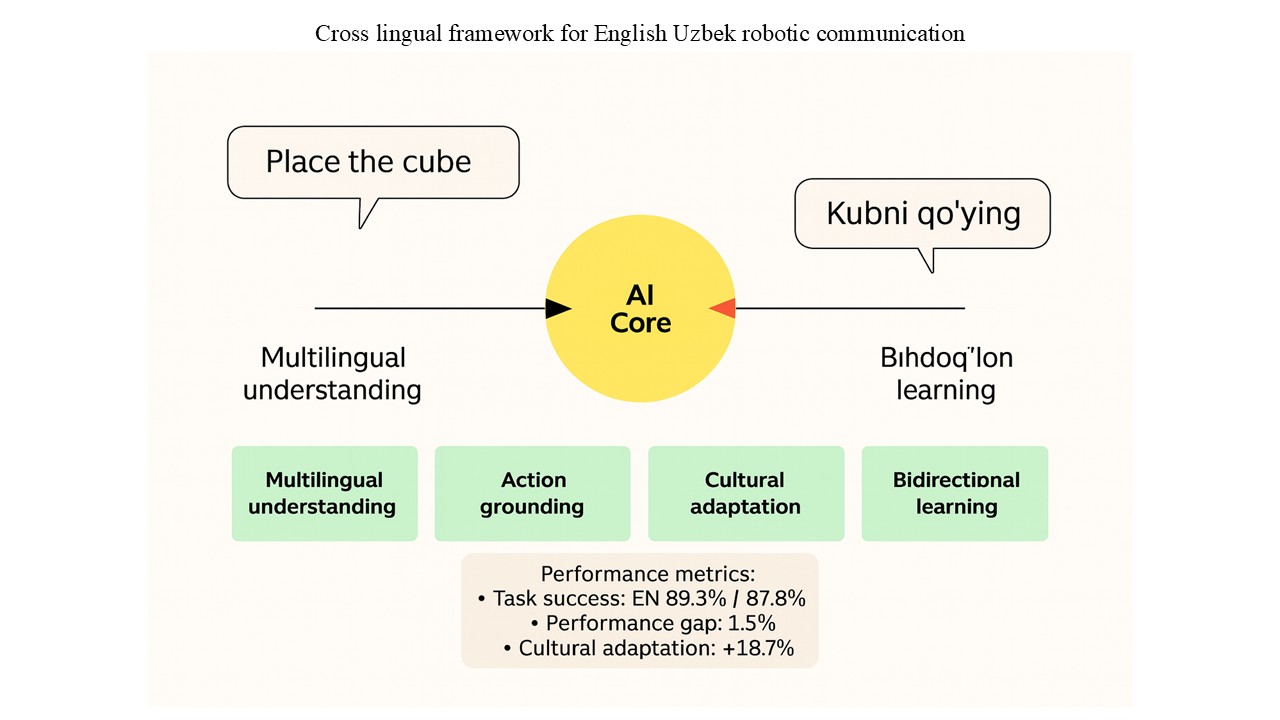
Natural language processing in robotic systems has become central to the development of intelligent autonomous agents capable of seamless human–robot interaction. However, the predominant focus on high-resource languages, particularly English, limits the global applicability and inclusivity of robotic communication systems. This research proposes a novel framework that leverages cross-lingual data science methodologies to enable robust robotic communication capabilities across English and Uzbek linguistic domains, incorporating specialized components for multilingual understanding, action grounding, cultural adaptation, and bidirectional learning. Experimental validation demonstrates that the proposed approach achieves task success rates of 89.3% for English commands and 87.8% for Uzbek commands, representing a significant advancement over existing methodologies. The performance gap between languages was minimized to just 1.5%, compared to disparities exceeding 5.6% in baseline systems. The integrated cognitive architecture demonstrated superior capability in translating linguistic commands into executable actions, with the action grounding module achieving a 91.2% success rate in command-to-action conversion. Cultural adaptation mechanisms contributed to an 18.7% improvement in communication naturalness ratings from Uzbek-speaking participants, while the morphology-aware representations enabled a 23.4% improvement in command-understanding accuracy for complex Uzbek structures. Ablation studies reveal that cultural adaptation contributes most significantly to user satisfaction metrics, while action grounding has a substantial impact on technical performance measures. The findings demonstrate that carefully designed cross-lingual frameworks can effectively bridge linguistic divides while maintaining the precision required for robotic task execution in real-world environments. This work contributes to the theoretical understanding and practical implementation of inclusive cognitive embodied intelligence systems, enabling more accessible and effective human–robot interaction across linguistic boundaries. The proposed methods can be extended to other low-resource language scenarios, supporting more equitable global deployment of robotic technologies.
- Hong W, Kumar NA, Patrick S, et al. Empirical validation of an auxetic structured foot with the powered transfemoral prosthesis. IEEE Robot Autom Lett. 2022;7(4):11228-11235. doi: 10.1109/lra.2022.3194673
- Seok S, Choi S, Kim K, Choi J, Sung JE, Lim Y. Robot-assisted language assessment: development and evaluation of feasibility and usability. Intellig Serv Robot. 2024;17(2): 303-313. doi: 10.1007/s11370-023-00505-2
- Antonucci A, Bevilacqua P, Leonardi S, Paolopoli L, Fontanelli D. Humans as path-finders for mobile robots using teach-by-showing navigation. Auton Robot. 2023;47(8):1255-1273. doi: 10.1007/s10514-023-10125-5
- Guo Y, Yang XJ, Shi C. TIP: A trust inference and propagation model in multi-human multi-robot teams. Autonom Robot. 2024;48(7):20. doi: 10.1007/s10514-024-10175-3
- Sun Y, Ji F. An embodied intelligence system for coal mine safety assessment based on multi-level large language models. Sensors (Basel). 2025;25(2):488. doi: 10.3390/s25020488
- Shamsuddin R, Tabrizi HB, Gottimukkula PR. Towards responsible AI: An implementable blueprint for integrating explainability and social-cognitive frameworks in AI systems. AI Perspect Adv. 2025;7(1):1. doi: 10.1186/s42467-024-00016-5
- Fan J, Yin Y, Wang T, Dong W, Zheng P, Wang L. Vision-language model-based human-robot collaboration for smart manufacturing: A state-of-the-art survey. Front Eng Manag. 2025;12(1):177-200. doi: 10.1007/s42524-025-4136-9
- Tajeuna EG, Bouguessa M, Wang S. Mining customers’ changeable electricity consumption for effective load forecasting. ACM Trans Intellig Syst Technol. 2021;12(4): 1-26. doi: 10.1145/3466684
- Liu H, Duan T. Cross-modal collaboration and robust feature classifier for open-vocabulary 3D object detection. Sensors (Basel). 2025;25(2):553. doi: 10.3390/s25020553
- Pszona M, Janicka M, Wojdyga G, Wawer A. Towards universal methods for fake news detection. Nat Language Eng. 2022;29(4):1004-1042. doi: 10.1017/s1351324922000456
- Sulistyo DA, Wibawa AP, Prasetya DD, Ahda FA. An enhanced pivot-based neural machine translation for low-resource languages. Int J Adv Intellig Inform. 2025; 11(2):258. doi: 10.26555/ijain.v11i2.2115
- Gai K, She Y, Zhu L, Choo KKR, Wan Z. A blockchain-based access control scheme for zero trust cross-organizational data sharing. ACM Trans Int Technol. 2022;23(3):1-25. doi: 10.1145/3511899
- Mwakapina JW. The role of artificial intelligence in the future of language teaching and learning practices in higher education. Pan Afr J Educ Soc Sci. 2024;5(2):106-122. doi: 10.56893/pajes2024v05i02.08
- Bonet-Jover A, Sepúlveda-Torres R, Saquete E, Martínez- Barco P, Nieto-Pérez M. RUN-AS: A novel approach to annotate news reliability for disinformation detection. Lang Resour Evaluation. 2023;58(2):609-639. doi: 10.1007/s10579-023-09678-9
- Longpre S, Lu Y, Daiber J. MKQA: A linguistically diverse benchmark for multilingual open domain question answering. Trans Assoc Comput Linguist. 2021;9:1389-1406. doi: 10.1162/tacl_a_00433
- Gutierrez-Vasques X, Bentz C, Samardžić T. Languages through the looking glass of BPE compression. Comput Linguist. 2023;49(4):943-1001. doi: 10.1162/coli_a_00489
- Zhao X, Fu T, Tao C, Yan R. There is no Standard Answer: Knowledge-Grounded Dialogue Generation with Adversarial Activated Multi-Reference Learning. United States: Cornell University; 2022. p. 1878-1891. doi: 10.18653/v1/2022.emnlp-main.123
- Barradas I, Tschiesner R, Peer A. Dynamic emotion intensity estimation from physiological signals facilitating interpretation via appraisal theory. PLoS One. 2025;20(1):e0315929. doi: 10.1371/journal.pone.0315929
- Mughal SF, Aamir S, Samad A, Zehra U, Syed AA. MaI: A transformer based domain specific chatbot for menstrual health. ACM J Respons Comput. 2025;2(1):1-32. doi: 10.1145/3711711
- Egorova A, Kruzhkov M, Nuriev V, Zatsman I. Interval evaluation of temporal (in)stability for neural machine translation. Discov Artif Intellig. 2025;5(1):5. doi: 10.1007/s44163-025-00222-y
- Looi CK, Jia F. Personalization capabilities of current technology chatbots in a learning environment: An analysis of student-tutor bot interactions. Educ Inform Technol. 2025;30:14165-14195. doi: 10.1007/s10639-025-13369-z
- Zabolotna K, Nøhr L, Iwata M, Spikol D, Malmberg J, Järvenoja H. How does collaborative task design shape collaborative knowledge construction and group-level regulation of learning? A study of secondary school students’ interactions in two varied tasks. Int J Comput Support Collab Learn. 2025;20(2):171-199. doi: 10.1007/s11412-024-09442-3
- Alexander C. What is 4E cognitive science? Phenomenol Cogn Sci. 2025. doi: 10.1007/s11097-025-10055-w
- Deng Y, Liao L, Lei W, Yang G, Lam W, Chua TS. Proactive conversational AI: A comprehensive survey of advancements and opportunities. ACM Trans Inform Syst. 2025;43(3): 1-45. doi: 10.1145/3715097
- Liu Y, Gu J, Goyal N, et al. Multilingual denoising pre-training for neural machine translation. Trans Assoc Comput Linguist. 2020;8:726-742. doi: 10.1162/tacl_a_00343
- Oskooei AR, Aktaş MS, Keleş M. Seeing the sound: Multilingual lip sync for real-time face-to-face translation. Computers. 2024;14(1):7. doi: 10.3390/computers14010007
- Vesentini F, Muradore R, Fiorini P. A survey on Velocity obstacle paradigm. Robot Autonom Syst. 2024;174:104645. doi: 10.1016/j.robot.2024.104645
- Bampis L, Gasteratos A. Sequence-based visual place recognition: A scale-space approach for boundary detection. Autonom Robot. 2021;45(4):505-518. doi: 10.1007/s10514-021-09984-7
- Kouris P, Alexandridis G, Stafylopatis A. Abstractive text summarization: Enhancing sequence-to-sequence models using word sense disambiguation and semantic content generalization. Comput Linguist. 2021;47(4):813-859. doi: 10.1162/coli_a_00417
- Adelani DI, Abbott JZ, Neubig G, et al. MasakHaNER: Named entity recognition for African languages. Trans Assoc Comput Linguist. 2021;9:1116-1131. doi: 10.1162/tacl_a_00416
- Sundari MS, Agal S, Raju AM, Patil A. Cross-Lingual Summarization for Overseas Applications using Multilingual Pre-Trained Models and Knowledge Distillation. United States: IEEE; 2025. p. 1-6. doi: 10.1109/icsses64899.2025.11009852
- Chen X, Hu X, Huang Y, et al. Deep learning-based software engineering: Progress, challenges, and opportunities. Sci China Inform Sci. 2024;68(1):111102. doi: 10.1007/s11432-023-4127-5
- Lin WY, Liu S, Dai BT, Li H. Distance based image classification: A solution to generative classification’s conundrum? Int J Comput Vision. 2022;131(1):177-198. doi: 10.1007/s11263-022-01675-9
- Qin Y, Wang Z, Qian Q, Wang Y, Luo J. Discriminative manifold domain adaptation for cross-domain fault diagnosis of rotating machineries. Knowl Based Syst. 2023;285:111332. doi: 10.1016/j.knosys.2023.111332
- Katzef M, Cullen AC, Alpcan T, Leckie C. Generative adversarial networks for anomaly detection on decentralised data. Ann Rev Control. 2021;53:329-337. doi: 10.1016/j.arcontrol.2021.10.002
- Weick KE, Sutcliffe KM, Obstfeld D. Organizing and the process of sensemaking. Organiz Sci. 2005;16(4):409-421. doi: 10.1287/orsc.1050.0133
- Garcia-Arteaga J, Zambrano-Zambrano J, Parraga-Alava J, Rodas-Silva J. An effective approach for identifying keywords as high-quality filters to get emergency-implicated Twitter Spanish data. Computer Speech Lang. 2023;84:101579. doi: 10.1016/j.csl.2023.101579
- Özbilen U, Dönmez A, Güven AZ, et al. Turkish Education Studies. Berlin: ResearchGate; 2025. doi: 10.37609/akya.3468