
Quartile deviation as a novel indicator of response evaluation regularity in liver cancer patients

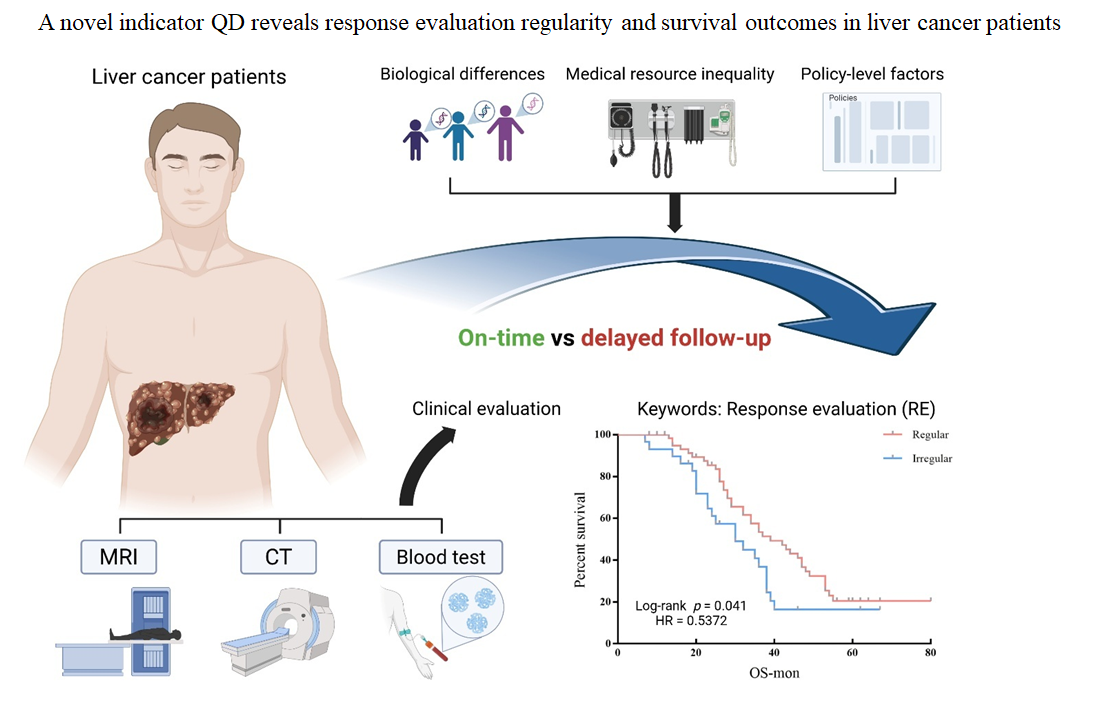
Regular response evaluation (RE) is essential for whole-process cancer management, yet no standardized quantitative indicator exists to assess its regularity in clinical practice. This study proposed the quartile deviation (QD) of RE intervals as a novel indicator of RE regularity and examined its association with clinical characteristics and survival outcomes in patients with liver tumor lesions. Clinical data from patients treated at Shanghai General Hospital between January 1, 2015, and December 31, 2021, were retrospectively analyzed. A total of 102 eligible patients with at least four upper abdominal computed tomography or magnetic resonance imaging examinations were included, yielding 587 valid RE records; 60.8% completed seven or more REs during treatment. QD values of RE intervals were calculated to assess voluntary RE regularity. Using the mean QD value (6.77) as the cut-off, patients were classified into a regular RE group (QD ≤ 6.77, n = 67) and an irregular RE group (QD > 6.77, n = 35). Patients with regular RE were younger (61.6 ± 1.218 years), had significantly shorter RE intervals (10.57 ± 0.4566 weeks), and achieved a longer median overall survival (39 versus 30 months) than those with irregular RE. Median progression-free survival did not differ significantly between groups. Patients with metastatic colorectal cancer exhibited lower QD values than those with hepatocellular carcinoma, indicating better RE regularity. In conclusion, QD is a practical indicator of RE regularity. More regular RE is associated with improved survival outcomes, supporting standardized cancer management.
- Sung H, Ferlay J, Siegel RL, et al. Global Cancer Statistics 2020: GLOBOCAN Estimates of Incidence and Mortality Worldwide for 36 Cancers in 185 Countries. CA A Cancer J Clin. 2021;71(3):209-249. doi: 10.3322/caac.21660
- Arnold M, Abnet CC, Neale RE, Vignat J, Giovannucci EL, McGlynn KA, et al. Global Burden of 5 Major Types of Gastrointestinal Cancer. Gastroenterology. 2020;159(1):335-349.e15. doi: 10.1053/j.gastro.2020.02.068
- Siegel RL, Miller KD, Fuchs HE, Jemal A. Cancer statistics, 2022. CA A Cancer J Clin. 2022;72(1):7-33. doi: 10.3322/caac.21708
- Su GL, Altayar O, O’Shea R, et al. AGA Clinical Practice Guideline on Systemic Therapy for Hepatocellular Carcinoma. Gastroenterology. 2022;162(3):920-934. doi: 10.1053/j.gastro.2021.12.276
- Therasse P, Arbuck SG, Eisenhauer EA, et al. New Guidelines to Evaluate the Response to Treatment in Solid Tumors. JNCI: J Nat Cancer Inst. 2000;92(3):205-216. doi: 10.1093/jnci/92.3.205
- Eisenhauer EA, Therasse P, Bogaerts J, et al. New response evaluation criteria in solid tumours: Revised RECIST guideline (version 1.1). Eur J Cancer. 2009;45(2):228-247. doi: 10.1016/j.ejca.2008.10.026
- Amorim J, França M, Perez-Girbes A, Torregrosa A, Martí-Bonmatí L. Critical review of HCC imaging in the multidisciplinary setting: treatment allocation and evaluation of response. Abdom Radiol. 2020;45(10):3119-3128. doi: 10.1007/s00261-020-02470-1
- Dimitroulis D, Damaskos C, Valsami S, et al. From diagnosis to treatment of hepatocellular carcinoma: An epidemic problem for both developed and developing world. WJG. 2017;23(29):5282. doi: 10.3748/wjg.v23.i29.5282
- Stroehl YW, Letzen BS, van Breugel JMM, Geschwind JF, Chapiro J. Intra-arterial therapies for liver cancer: assessing tumor response. Expert Rev Anticancer Ther. 2016;17(2):119-127. doi: 10.1080/14737140.2017.1273775
- Rashidian N, Alseidi A, Kirks RC. Cancers Metastatic to the Liver. Surg Clin North Am. 2020;100(3):551-563. doi: 10.1016/j.suc.2020.02.005
- Baghdadi A, Mirpour S, Ghadimi M, et al. Imaging of Colorectal Liver Metastasis. J Gastrointest Surg. 2022;26(1):245-257. doi: 10.1007/s11605-021-05164-1
- Giesen N, Sprute R, Rüthrich M, et al. 2021 update of the AGIHO guideline on evidence-based management of COVID-19 in patients with cancer regarding diagnostics, viral shedding, vaccination and therapy. Eur J Cancer. 2021;147:154-160. doi: 10.1016/j.ejca.2021.01.033.
- McGrath S, Zhao X, Steele R, et al. Estimating the sample mean and standard deviation from commonly reported quantiles in meta-analysis. Stat Methods Med Res. 2020;29(9):2520-2537. doi: 10.1177/0962280219889080.
- Ludmir EB, Mainwaring W, Lin TA, et al. Factors Associated With Age Disparities Among Cancer Clinical Trial Participants. JAMA Oncol. 2019;5(12):1769. doi: 10.1001/jamaoncol.2019.2055
- Gajra A, Loh KP, Hurria A, et al. Comprehensive Geriatric Assessment-Guided Therapy Does Improve Outcomes of Older Patients With Advanced Lung Cancer. JCO. 2016;34(33):4047-4048. doi: 10.1200/jco.2016.67.5926
- Park HM, Park SJ, Han SS, Kim SH. Surgery for elderly patients with resectable pancreatic cancer, a comparison with non-surgical treatments: a retrospective study outcomes of resectable pancreatic cancer. BMC Cancer. 2019;19(1). doi: 10.1186/s12885-019-6255-3
- Mohile SG, Dale W, Somerfield MR, et al. Practical Assessment and Management of Vulnerabilities in Older Patients Receiving Chemotherapy: ASCO Guideline for Geriatric Oncology. JCO. 2018;36(22):2326-2347. doi: 10.1200/jco.2018.78.8687
- Hamaker ME, te Molder M, Thielen N, van Munster BC, Schiphorst AH, van Huis LH. The effect of a geriatric evaluation on treatment decisions and outcome for older cancer patients – A systematic review. J Geriatr Oncol. 2018;9(5):430-440. doi: 10.1016/j.jgo.2018.03.014.
- Zhao Y, Zhu R, Bai J, et al. The Application of Whole-Process Case Management in Patients with Triple-Negative Breast Cancer. J Oncol. 2022;2022:1-6. doi: 10.1155/2022/1794288
- Cuglievan B, Berkman A, Dibaj S, et al. Impact of Lagtime, Health Insurance Type, and Income Status at Diagnosis on the Long-Term Survival of Adolescent and Young Adult Cancer Patients. J Adolesc Young Adult Oncol. 2021;10(2):164-174. doi: 10.1089/jayao.2020.0041
- Martin S, Ulrich C, Munsell M, Taylor S, Lange G, Bleyer A. Delays in Cancer Diagnosis in Underinsured Young Adults and Older Adolescents. Oncologist. 2007;12(7):816-824. doi: 10.1634/theoncologist.12-7-816
- Ullah A, Razzaq A, Zhou C, et al. Biological Significance of EphB4 Expression in Cancer. CPPS. 2024;25(3):244-255. doi: 10.2174/0113892037269589231017055642
- Moustafa HAM, Sohaib AU, Saleem I, Ullah A. Targeting of YKL-40 as a Protumor in Personalized Medicine: A New Dimension in Disease Understanding. CGT. 2026;26(1):17-26. doi: 10.2174/0115665232332419250213081510