

Applications of single-cell and spatial transcriptomics in osteoarthritis

Osteoarthritis (OA) is no longer regarded simply as a disease of cartilage wear but as a disorder affecting the entire joint. Disease progression involves a variety of cell types and local tissue environments, and traditional bulk transcriptomic analysis cannot fully capture these changes. This article summarizes recent work using single-cell RNA sequencing (scRNA-seq) and spatial transcriptomics (ST) to study OA pathogenesis. Through scRNA-seq, researchers found disease-related and potentially protective cell groups in joint cartilage, synovial membrane, meniscus, and subchondral bone. The technology can also track changes in cell states and analyze communication among different cell types as the disease progresses. ST retains organizational structure information, so gene expression patterns can correspond to specific tissue areas and local immune microenvironments. Together, these methods have gradually shifted OA research from analyzing a single pathway to focusing on interactions among different tissues and cell groups in lesioned joints. This review also discusses current technical limitations and future directions, especially further improvements in spatiotemporal atlas construction and multi-omics integration. These advances may help to discover new biomarkers and promote the development of more accurate OA treatment strategies.
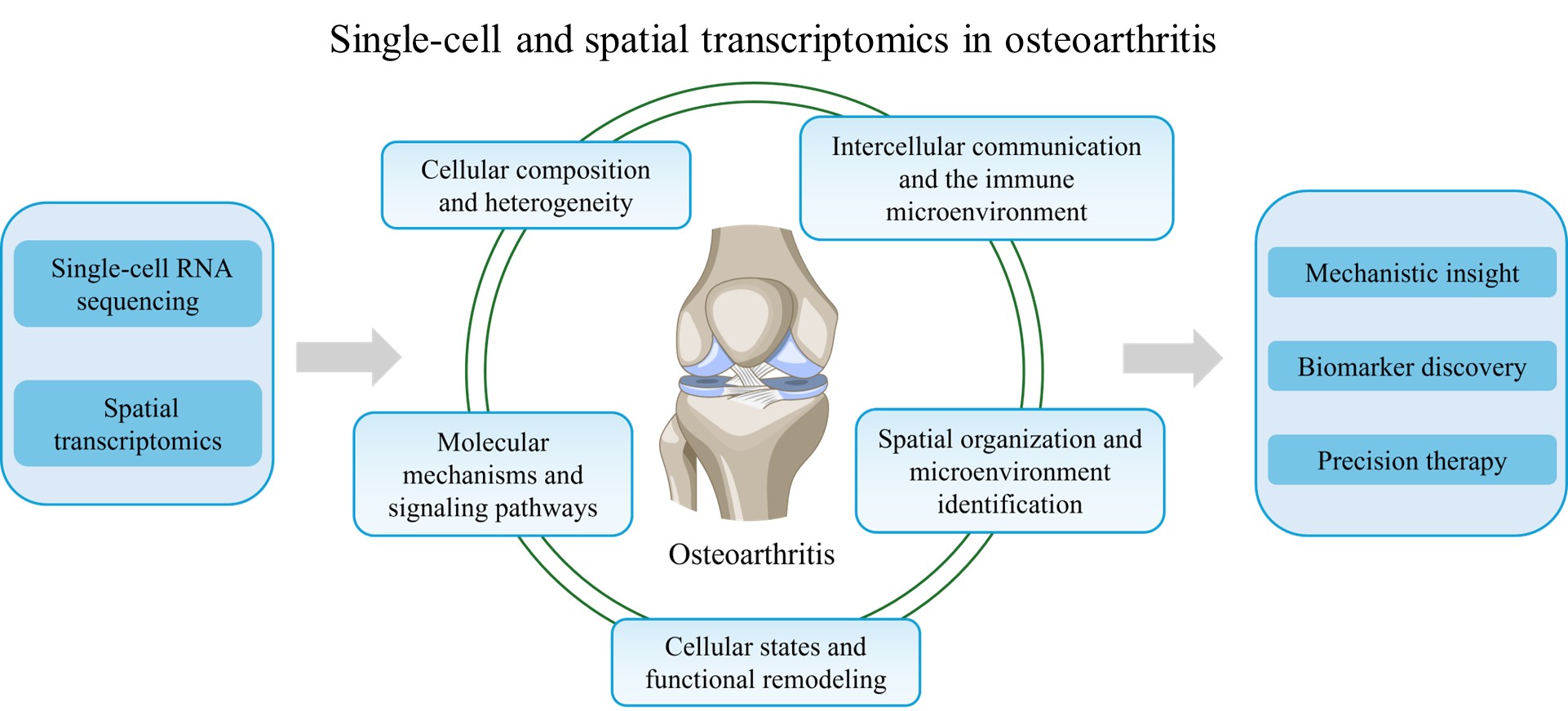
- Steinmetz JD, Culbreth GT, Haile LM, et al. Global, regional, and national burden of osteoarthritis, 1990–2020 and projections to 2050: a systematic analysis for the Global Burden of Disease Study 2021. Lancet Rheumatol. 2023;5(9):e508-e522. doi: 10.1016/s2665-9913(23)00163-7
- Allen KD, Thoma LM, Golightly YM. Epidemiology of osteoarthritis. Osteoarthr Cartil. 2022;30(2):184-195. doi: 10.1016/j.joca.2021.04.020
- Loeser RF, Goldring SR, Scanzello CR, Goldring MB. Osteoarthritis: a disease of the joint as an organ. Arthritis Rheum. 2012;64(6):1697-1707. doi: 10.1002/art.34453
- Yao Q, Wu X, Tao C, et al. Osteoarthritis: pathogenic signaling pathways and therapeutic targets. Signal Transduct Target Ther. 2023;8(1):56. doi: 10.1038/s41392-023-01330-w
- Hunter DJ. Pharmacologic therapy for osteoarthritis—the era of disease modification. Nat Rev Rheumatol. 2011;7(1):13-22. doi: 10.1038/nrrheum.2010.178
- Tuerlings M, van Hoolwerff M, Houtman E, et al. RNA sequencing reveals interacting key determinants of osteoarthritis acting in subchondral bone and articular cartilage: identification of IL11 and CHADL as attractive treatment targets. Arthritis Rheumatol. 2021;73(5):789-799.doi: 10.1002/art.41600
- Ji Q, Zheng Y, Zhang G, et al. Single-cell RNA-seq analysis reveals the progression of human osteoarthritis. Ann Rheum Dis. 2019;78(1):100-110. doi: 10.1136/annrheumdis-2017-212863
- Huang ZY, Luo ZY, Cai YR, et al. Single cell transcriptomics in human osteoarthritis synovium and in silico deconvoluted bulk RNA sequencing. Osteoarthr Cartil. 2022;30(3):475-480. doi: 10.1016/j.joca.2021.12.007
- Longo SK, Guo MG, Ji AL, Khavari PA. Integrating single-cell and spatial transcriptomics to elucidate intercellular tissue dynamics. Nat Rev Genet. 2021;22(10):627-644. doi: 10.1038/s41576-021-00370-8
- Ståhl PL, Salmén F, Vickovic S, et al. Visualization and analysis of gene expression in tissue sections by spatial transcriptomics. Science. 2016;353(6294):78-82. doi: 10.1126/science.aaf2403
- Vickovic S, Eraslan G, Salmén F, et al. High-definition spatial transcriptomics for in situ tissue profiling. Nat Methods. 2019;16(10):987-990. doi: 10.1038/s41592-019-0548-y
- Lou P, Lu X, Li M, et al. Single-cell sequencing reveals a senescent immune landscape in bone marrow lesions inducing articular cartilage damage in osteoarthritis. Bone Res. 2025;13(1):94. doi: 10.1038/s41413-025-00467-4
- Wang C, Zeng Z, Wang T, et al. Unraveling the spatial and signaling dynamics and splicing kinetics of immune infiltration in osteoarthritis synovium. Front Immunol. 2025;16:1521038. doi: 10.3389/fimmu.2025.1521038
- Wang H, Cheng P, Wang J, et al. Advances in spatial transcriptomics and its application in the musculoskeletal system. Bone Res. 2025;13(1):54. doi: 10.1038/s41413-025-00429-w
- Li X, Fang L, Zhou R, et al. Current cutting-edge omics techniques on musculoskeletal tissues and diseases. Bone Res. 2025;13(1):59. doi: 10.1038/s41413-025-00442-z
- Rai MF, Collins KH, Lang A, et al. Three decades of advancements in osteoarthritis research: insights from transcriptomic, proteomic, and metabolomic studies. Osteoarthr Cartil. 2024;32(4):385-397. doi: 10.1016/j.joca.2023.11.019
- Fan X, Sun AR, Young RSE, et al. Spatial analysis of the osteoarthritis microenvironment: techniques, insights, and applications. Bone Res. 2024;12(1):7. doi: 10.1038/s41413-023-00304-6
- Xie P, Sun AR, Gao F, Li L, Crawford R, Prasadam I. Resolving microenvironment complexity and cellular heterogeneity in osteoarthritis via spatial transcriptomics. Osteoarthr Cartil. 2026;34(3):332-342. doi: 10.1016/j.joca.2025.07.007
- Tang F, Barbacioru C, Wang Y, et al. mRNA-Seq whole-transcriptome analysis of a single cell. Nat Methods. 2009;6(5):377-382. doi: 10.1038/nmeth.1315
- Ramsköld D, Luo S, Wang YC, et al. Full-length mRNA-Seq from single-cell levels of RNA and individual circulating tumor cells. Nat Biotechnol. 2012;30(8):777-782. doi: 10.1038/nbt.2282
- Hashimshony T, Wagner F, Sher N, Yanai I. CEL-Seq: single-cell RNA-Seq by multiplexed linear amplification. Cell Rep. 2012;2(3):666-673. doi: 10.1016/j.celrep.2012.08.003
- Picelli S, Björklund ÅK, Faridani OR, Sagasser S, Winberg G, Sandberg R. Smart-seq2 for sensitive full-length transcriptome profiling in single cells. Nat Methods. 2013;10(11):1096-1098. doi: 10.1038/nmeth.2639
- Macosko EZ, Basu A, Satija R, et al. Highly parallel genome-wide expression profiling of individual cells using nanoliter droplets. Cell. 2015;161(5):1202-1214. doi: 10.1016/j.cell.2015.05.002
- Klein AM, Mazutis L, Akartuna I, et al. Droplet barcoding for single-cell transcriptomics applied to embryonic stem cells. Cell. 2015;161(5):1187-1201. doi: 10.1016/j.cell.2015.04.044
- Zheng GXY, Terry JM, Belgrader P, et al. Massively parallel digital transcriptional profiling of single cells. Nat Commun. 2017;8(1):14049. doi: 10.1038/ncomms14049
- Stoeckius M, Hafemeister C, Stephenson W, et al. Simultaneous epitope and transcriptome measurement in single cells. Nat Methods. 2017;14(9):865-868. doi: 10.1038/nmeth.4380
- Liu Y, Da W, Xu MJ, et al. Single-cell transcriptomics reveals novel chondrocyte and osteoblast subtypes and their role in knee osteoarthritis pathogenesis. Signal Transduct Target Ther. 2025;10(1):40. doi: 10.1038/s41392-025-02136-8
- To K, Fei L, Pett JP, et al. A multi-omic atlas of human embryonic skeletal development. Nature. 2024;635(8039):657-667. doi: 10.1038/s41586-024-08189-z
- Fernandes LM, Khan NM, Trochez CM, et al. Single-cell RNA-seq identifies unique transcriptional landscapes of human nucleus pulposus and annulus fibrosus cells. Sci Rep. 2020;10(1):15263. doi: 10.1038/s41598-020-72261-7
- Moore L, Pan Z, Brotto M. RNAseq of osteoarthritic synovial tissues: systematic literary review. Front Aging. 2022;3:836791. doi: 10.3389/fragi.2022.836791
- Vandereyken K, Sifrim A, Thienpont B, Voet T. Methods and applications for single-cell and spatial multi-omics. Nat Rev Genet. 2023;24(8):494-515. doi: 10.1038/s41576-023-00580-2
- Delos Santos K, Rockel JS, Kapoor M. Spatial transcriptomics: challenges and future directions in musculoskeletal diseases. Curr Opin Rheumatol. 2026;38(2):143-153. doi: 10.1097/BOR.0000000000001140
- Lubeck E, Coskun AF, Zhiyentayev T, Ahmad M, Cai L. Single-cell in situ RNA profiling by sequential hybridization. Nat Methods. 2014;11(4):360-361. doi: 10.1038/nmeth.2892
- Chen KH, Boettiger AN, Moffitt JR, Wang S, Zhuang X. RNA imaging. Spatially resolved, highly multiplexed RNA profiling in single cells. Science. 2015;348(6233):aaa6090. doi: 10.1126/science.aaa6090
- Wang X, Allen WE, Wright MA, et al. Three-dimensional intact-tissue sequencing of single-cell transcriptional states. Science. 2018;361(6400):eaat5691. doi: 10.1126/science.aat5691
- Rodriques SG, Stickels RR, Goeva A, et al. Slide-seq: a scalable technology for measuring genome-wide expression at high spatial resolution. Science. 2019;363(6434):1463-1467. doi: 10.1126/science.aaw1219
- Eng CL, Lawson M, Zhu Q, et al. Transcriptome-scale super-resolved imaging in tissues by RNA seqFISH. Nature. 2019;568(7751):235-239. doi: 10.1038/s41586-019-1049-y
- Stickels RR, Murray E, Kumar P, et al. Highly sensitive spatial transcriptomics at near-cellular resolution with Slide-seqV2. Nat Biotechnol. 2021;39(3):313-319. doi: 10.1038/s41587-020-0739-1
- Chen A, Liao S, Cheng M, et al. Spatiotemporal transcriptomic atlas of mouse organogenesis using DNA nanoball-patterned arrays. Cell. 2022;185(10):1777-1792.e21. doi: 10.1016/j.cell.2022.04.003
- Ren P, Zhang R, Wang Y, et al. Systematic benchmarking of high-throughput subcellular spatial transcriptomics platforms across human tumors. Nat Commun. 2025;16(1):9232. doi: 10.1038/s41467-025-64292-3
- Biancalani T, Scalia G, Buffoni L, et al. Deep learning and alignment of spatially resolved single-cell transcriptomes with Tangram. Nat Methods. 2021;18(11):1352-1362. doi: 10.1038/s41592-021-01264-7
- Kleshchevnikov V, Shmatko A, Dann E, et al. Cell2location maps fine-grained cell types in spatial transcriptomics. Nat Biotechnol. 2022;40(5):661-671. doi: 10.1038/s41587-021-01139-4
- Fan Y, Bian X, Meng X, et al. Unveiling inflammatory and prehypertrophic cell populations as key contributors to knee cartilage degeneration in osteoarthritis using multi-omics data integration. Ann Rheum Dis. 2024;83(7):926-944. doi: 10.1136/ard-2023-224420
- Huang C, Zeng B, Zhou B, et al. Single-cell transcriptomic analysis of chondrocytes in cartilage and pathogenesis of osteoarthritis. Genes Dis. 2025;12(2):101241. doi: 10.1016/j.gendis.2024.101241
- Hao T, Pei Z, Hu S, et al. Identification of osteoarthritis-associated chondrocyte subpopulations and key gene-regulating drugs based on multi-omics analysis. Sci Rep. 2025;15(1):12448. doi: 10.1038/s41598-025-90694-w
- Sun Z, Yan M, Wang J, et al. Single-cell RNA sequencing reveals different chondrocyte states in femoral cartilage between osteoarthritis and healthy individuals. Front Immunol. 2024;15:1407679. doi: 10.3389/fimmu.2024.1407679
- Sun H, Wen X, Li H, et al. Single-cell RNA-seq analysis identifies meniscus progenitors and reveals the progression of meniscus degeneration. Ann Rheum Dis. 2020;79(3):408-417. doi: 10.1136/annrheumdis-2019-215926
- Tang S, Yao L, Ruan J, et al. Single-cell atlas of human infrapatellar fat pad and synovium implicates APOE signaling in osteoarthritis pathology. Sci Transl Med. 2024;16(731):eadf4590. doi: 10.1126/scitranslmed.adf4590
- Li J, Gui T, Yao L, et al. Synovium and infrapatellar fat pad share common mesenchymal progenitors and undergo coordinated changes in osteoarthritis. J Bone Miner Res. 2024;39(2):161-176. doi: 10.1093/jbmr/zjad009
- Elingaard-Larsen LO, Whytock KL, Divoux A, et al. Single-nuclei resolution of intermuscular adipose tissue indicates an inflammation-associated cellular profile in individuals with knee osteoarthritis: findings from the SOMMA KOA ancillary study. Aging Cell. 2026;25(1):e70348. doi: 10.1111/acel.70348
- Liao S, Yang M, Li D, et al. Comprehensive bulk and single-cell transcriptome profiling give useful insights into the characteristics of osteoarthritis associated synovial macrophages. Front Immunol. 2023;13:1078414. doi: 10.3389/fimmu.2022.1078414
- Sebastian A, Hum NR, McCool JL, et al. Single-cell RNA-Seq reveals changes in immune landscape in post-traumatic osteoarthritis. Front Immunol. 2022;13:938075. doi: 10.3389/fimmu.2022.938075
- Wu Y, Liu J, Yu W, Wang X, Li J, Zeng W. Single-cell transcriptome and multi-omics integration reveal ferroptosis-driven immune microenvironment remodeling in knee osteoarthritis. Front Immunol. 2025;16:1608378. doi: 10.3389/fimmu.2025.1608378
- Hu Y, Chen W, Lan S, et al. Denosumab attenuates knee osteoarthritis progression by inhibiting synovial inflammation via the RANK/TRAF6/FSTL1 signalling. Nat Commun. 2025;16(1):11394. doi: 10.1038/s41467-025-66202-z
- Lin Z, Jariyasakulroj S, Shu Y, et al. Spatial transcriptomics of TMJ reveals a remodeling fibroblast-immune microenvironment driving arthritis pain. Adv Sci. 2026;13(18):e19816. doi: 10.1002/advs.202519816
- Nanus DE, Badoume A, Wijesinghe SN, et al. Synovial tissue from sites of joint pain in knee osteoarthritis patients exhibits a differential phenotype with distinct fibroblast subsets. eBioMedicine. 2021;72:103618. doi: 10.1016/j.ebiom.2021.103618
- Peng J, Chen J, Gao D, et al. Integrative bulk and single-cell transcriptomic profiling reveals oxidative stress-related genes and potential therapeutic targets in osteoarthritis. Mediators Inflamm. 2025;2025:1240226. doi: 10.1155/mi/1240226
- Wu K, Zhong Z, Chen L, et al. Integrative analysis of bulk and single-cell RNA sequencing data reveals increased arachidonic acid metabolism in osteoarthritic chondrocytes. Front Med. 2025;12:1552029. doi: 10.3389/fmed.2025.1552029
- Zhang Z, Cheng D, Dang J, Wang X, Fan H, Liu D. Decoding endoplasmic reticulum stress on chondrocyte driving osteoarthritis development through integrating single-cell and transcriptomic profiling. Int J Med Sci. 2025;22(15):3906-3923. doi: 10.7150/ijms.119573
- Liu B, Liang Y, Wang C, et al. Dimeric PKM2 in chondrocytes impairs mitochondrial homeostasis in osteoarthritis. Cell Death Dis. 2026;17(1):370. doi: 10.1038/s41419-026-08621-4
- Fang C, Zhu S, Zhong R, et al. CDKN1A regulation on chondrogenic differentiation of human chondrocytes in osteoarthritis through single-cell and bulk sequencing analysis. Heliyon. 2024;10(5):e27466. doi: 10.1016/j.heliyon.2024.e27466
- Liu S, Chen H, Yang X, Wen Y, Chen L. Identification and validation of up-regulated TNFAIP6 in osteoarthritis with type 2 diabetes mellitus. Sci Rep. 2024;14(1):31450. doi: 10.1038/s41598-024-82985-5
- Liu B, Wang C, Weng Z, Yang Y, Shi Y, Zhang C. The glycolytic enzyme PFKFB3 alleviates DNA damage and chondrocyte senescence in osteoarthritis. Cell Death Discov. 2026;12(1):70. doi: 10.1038/s41420-025-02903-0
- Jachim SK, Venkatasubramanian D, Senevirathne G, et al. Leveraging single cell multiomic analyses to identify gene regulatory networks that drive human articular cartilage cell fate. Osteoarthr Cartil. 2026;34(3):358-371. doi: 10.1016/j.joca.2025.12.025
- Wang N, Liu K, Li JL, et al. Identification of osteoarthritis-related genes and potential drugs based on single cell RNA-seq data. Mol Med. 2026;32(1):1. doi: 10.1186/s10020-025-01379-z
- Zhao Z, Wu X, Wang D, Luo W, Ma JX, Ma XL. Integrated multiomics analysis identifies CDO1 as a novel therapeutic target for osteoarthritis. Endocr Metab Immune Disord Drug Targets. 2025;25. doi: 10.2174/0118715303387442250918111006
- Zhang D, Liu X, Zhang W, et al. Identification and validation of palmitoylation metabolism related biomarkers in osteoarthritis using transcriptomic and single cell RNA sequencing analyses. Sci Rep. 2026;16(1):1678. doi: 10.1038/s41598-025-31218-4
- Zeng M, Wang X, Chen T, et al. Comprehensive analysis on subchondral bone marrow lesions of human osteoarthritis by integrating bulk and single-cell transcriptomes. BMC Musculoskelet Disord. 2023;24(1):677. doi: 10.1186/s12891-023-06676-4
- Shibusaka K, Negishi S, Terashima A, et al. Defining subcellular synovial responses in TMJ osteoarthritis onset via mechanical stress and articular disk derangement models. Int J Oral Sci. 2026;18(1):28. doi: 10.1038/s41368-025-00411-6
- Negishi S, Shibusaka K, Maemura M, et al. Lubricin maintains temporomandibular joint homeostasis by regulating synovial inflammation. Regen Ther. 2026;31:101051. doi: 10.1016/j.reth.2025.101051
- Vincent TL, McLean CJ, Full LE, Peston D, Saklatvala J. FGF-2 is bound to perlecan in the pericellular matrix of articular cartilage, where it acts as a chondrocyte mechanotransducer. Osteoarthr Cartil. 2007;15(7):752-763. doi: 10.1016/j.joca.2007.01.021
- Chia SL, Sawaji Y, Burleigh A, et al. Fibroblast growth factor 2 is an intrinsic chondroprotective agent that suppresses ADAMTS-5 and delays cartilage degradation in murine osteoarthritis. Arthritis Rheum. 2009;60(7):2019-2027. doi: 10.1002/art.24654
- Wei F, Zhou J, Wei X, et al. Activation of Indian Hedgehog promotes chondrocyte hypertrophy and upregulation of MMP-13 in human osteoarthritic cartilage. Osteoarthr Cartil. 2012;20(7):755-763. doi: 10.1016/j.joca.2012.03.010
- Philpott HT, Birmingham TB, Blackler G, et al. Association of synovial innate immune exhaustion with worse pain in knee osteoarthritis. Arthritis Rheumatol. 2025;77(6):664-676. doi: 10.1002/art.43089